.gif)


What Makes Zepto Price Monitoring Essential for Tracking Discounts, Stock and Pack Size Variations?
Introduction
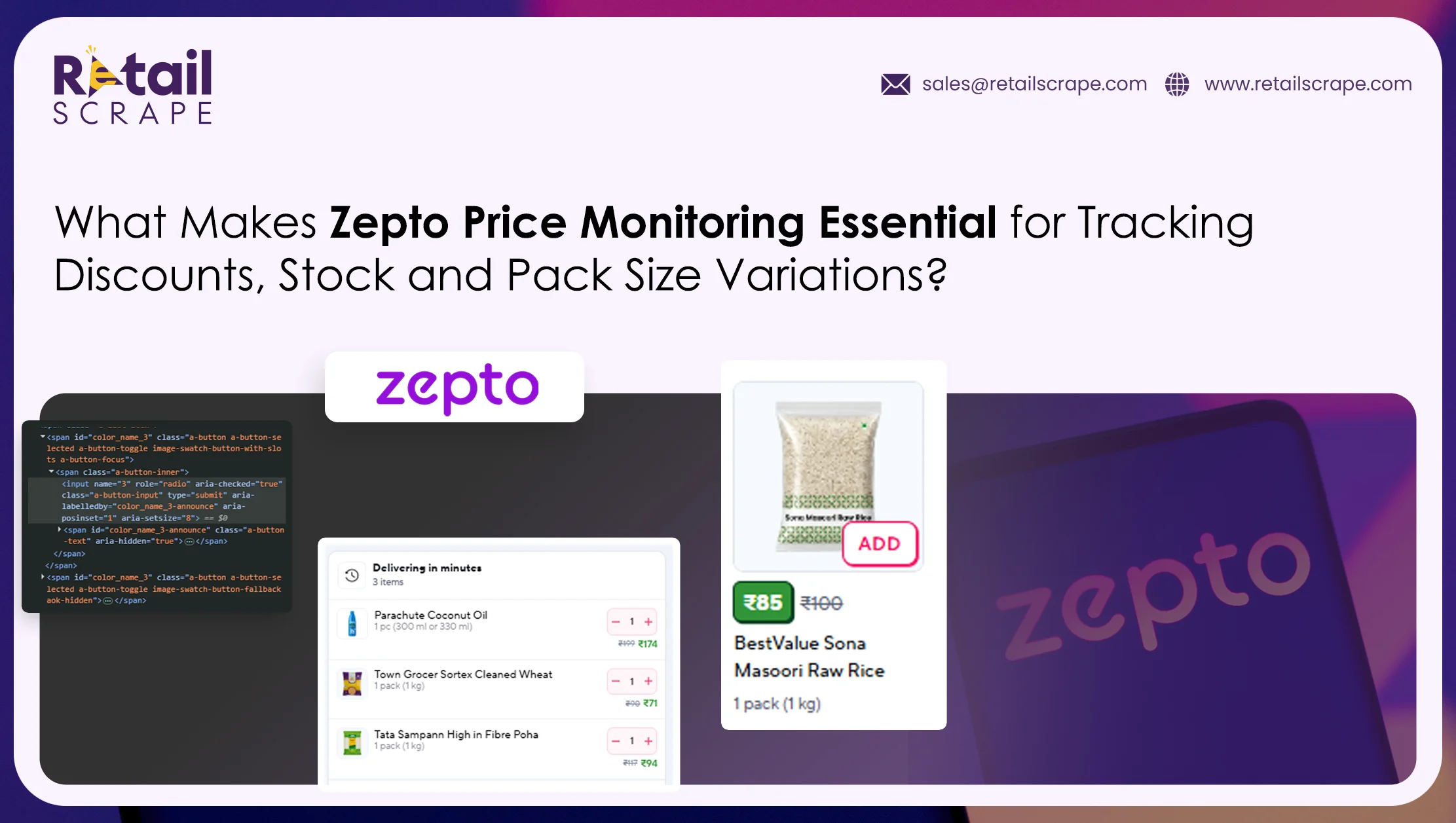
Quick commerce has reshaped Indian retail, with platforms like Zepto delivering essentials in under ten minutes. Because dark stores operate on hyper-local demand, product prices, promotional offers, and SKU availability shift multiple times a day. Relying on static pricing spreadsheets leaves FMCG brands blind to sudden shelf changes.
Implementing structured Zepto Price Monitoring gives commercial teams immediate visibility into how their products appear across different pin codes. By automating Zepto Product Price Tracking, brands can detect unauthorized discounting, protect retail margins, and ensure consistent pricing strategies across high-velocity urban neighborhoods without manual auditing delays.
Beyond base retail prices, quick commerce platforms frequently adjust pack configurations and flash deals to clear inventory or drive cart size. Combining Quick Commerce Price Comparison with automated shelf intelligence allows revenue teams to respond instantly to market shifts, safeguard brand equity, and capture higher conversion rates during peak ordering hours.
Capturing Flash Discounts and Hyper-Local Pricing Shifts Across Dark Stores
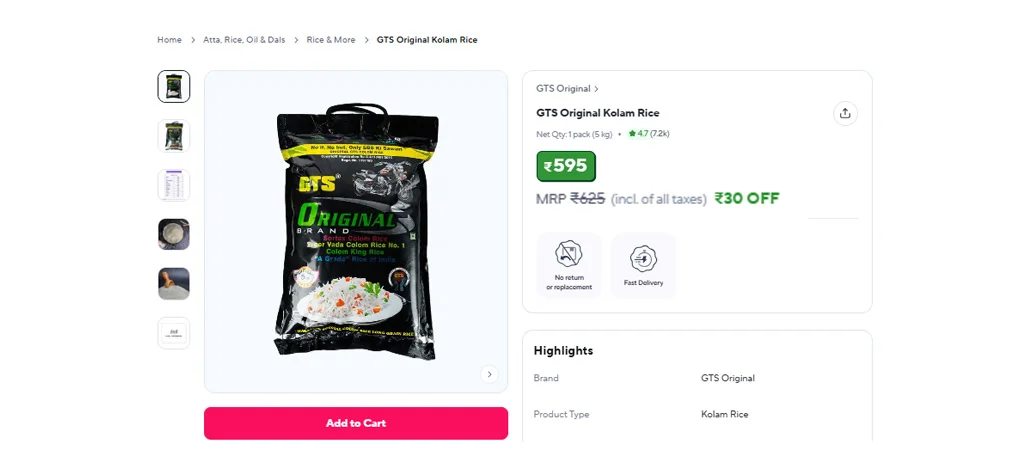
Quick commerce discounting rarely follows a predictable weekly calendar across Indian metropolitan hubs. Platforms deploy algorithmic markdowns, cart-value boosters, and city-specific coupons that alter final consumer prices within hours. Without continuous Zepto Discount Tracking embedded into daily revenue workflows, brand managers often discover severe margin erosion only after monthly distributor reconciliations are completed.
Deploying automated Zepto Product Data Scraping across high-velocity neighborhoods enables commercial teams to audit MRP versus selling price across dozens of pin codes simultaneously. Industry benchmarks show that fast-moving consumer goods experience an average of 3 to 5 price adjustments per week on quick commerce apps, with weekend promotional spikes reaching up to 28% off standard retail rates.
True pricing governance in ten-minute delivery requires constant visibility into hyper-local discounting mechanics. Teams that monitor live promotional shifts preserve healthy unit margins while maintaining strong brand positioning across competitive urban markets.
- Audit daily promotional depth across regional dark stores before campaign budgets deplete
- Identify unauthorized distributor price drops that create friction with general trade partners
- Measure conversion lift during short flash-sale windows across top-performing urban clusters
- Align trade marketing spend with real-time competitor markdown patterns during peak hours
| Promotional Metric | Traditional Retail | Quick Commerce App | Revenue Impact |
|---|---|---|---|
| Price Update Frequency | Weekly / Monthly | Multiple times daily | High margin volatility if unmonitored |
| Discount Depth Variance | 5% – 12% standard | 10% – 35% flash deals | Risk of channel conflict with general trade |
| Geo-Pricing Divergence | Regional / State level | Pin-code / Dark store level | Localized price undercutting across neighborhoods |
| Promo Visibility Window | 7 – 14 days | 4 – 12 hours | Missed share-of-shelf during peak demand |
Integrating Online Grocery Price Tracking into daily commercial operations ensures that every promotional campaign executes within agreed brand guardrails. When competitors drop prices on staple items like cooking oil or dairy, real-time alerts empower category managers to adjust trade spend immediately rather than losing the digital buy-box.
Preventing Revenue Loss Through Real-Time Stock Visibility Across Neighborhoods
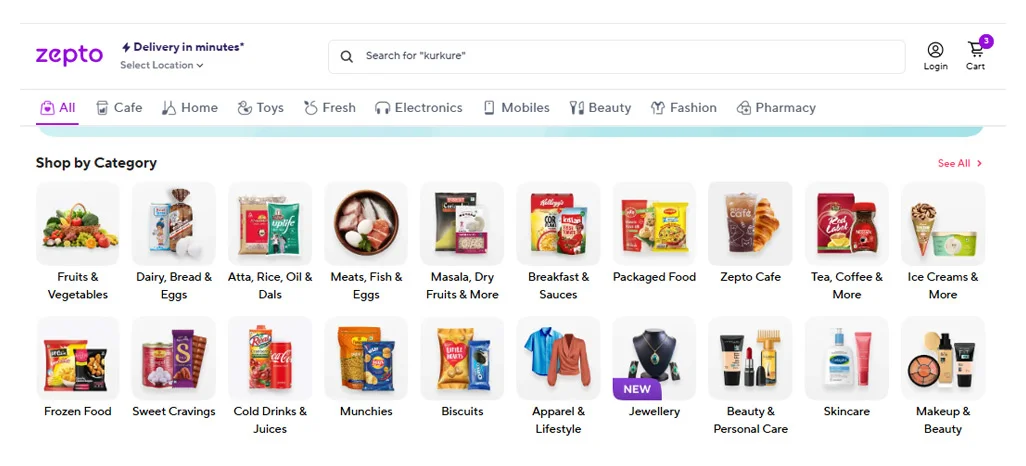
In ten-minute delivery ecosystems, out-of-stock events translate directly into permanent customer switching across urban households. Studies across Indian metro markets indicate that over 64% of quick commerce shoppers substitute a missing brand with an immediate competitor rather than abandoning their cart. Systematic Grocery Product Availability Tracking eliminates blind spots at the individual dark store level.
When brands pair inventory alerts with Grocery Price Monitoring across key metropolitan zones, they uncover critical correlations between competitor stockouts and dynamic price surges. Often, when a leading SKU goes unavailable in a high-demand cluster, rival brands capture sudden volume spikes while platform algorithms adjust search rankings. Monitoring availability across Tier-1 and Tier-2 pin codes helps supply chain teams prioritize replenishment before stock depletion hurts organic search placement.
Sustaining high on-shelf availability is the foundation of profitable quick commerce growth. Brands that connect real-time inventory signals with agile supply chain execution protect their market share and maximize repeat shopper retention.
- Pinpoint recurring evening stockouts across high-density residential pin codes before sales drop
- Track competitor inventory depletion to capitalize on sudden shifts in category demand
- Correlate dark store replenishment delays with drops in organic category search visibility
- Optimize regional warehouse allocation using granular neighborhood-level shelf availability data
| Dark Store Cluster | Average SKU Availability | Daily Out-of-Stock Duration | Estimated Sales Leakage |
|---|---|---|---|
| Mumbai (South & Suburbs) | 88.4% | 2.8 hours | 11.2% category revenue loss |
| Bengaluru (Tech Corridors) | 85.1% | 3.5 hours | 14.6% category revenue loss |
| Delhi NCR (Gurugram/Noida) | 89.7% | 2.4 hours | 9.8% category revenue loss |
| Hyderabad & Pune | 91.2% | 2.1 hours | 8.4% category revenue loss |
Using Grocery Competitor Price Tracking alongside dark store stock telemetry allows account managers to negotiate smarter replenishment schedules with platform buyers. Instead of reacting to delayed warehouse reports, brands can pinpoint exact fulfillment bottlenecks and maintain uninterrupted digital shelf presence.
Decoding Pack Size Variations and Unit Economics in Quick Commerce
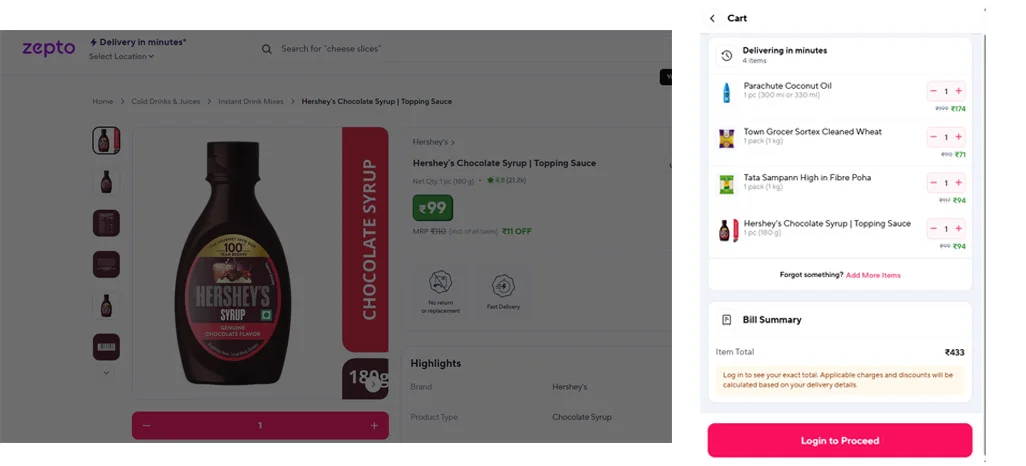
Quick commerce shoppers frequently switch between single-serve trial packs, standard household sizes, and multi-pack bundles depending on convenience and instant deals. Platforms also introduce exclusive combo packs that complicate direct price-per-gram evaluations. Comprehensive Zepto Product Data Extraction normalizes weights, volumes, and bundle counts so analysts can compare true unit economics accurately.
Accessing structured catalog feeds through a reliable Zepto API allows pricing teams to track shrinkflation tactics, value-pack launches, and cross-category bundling strategies. Data from quick commerce category audits reveals that multi-pack bundles drive nearly 32% higher average order values in snacks, beverages, and personal care segments compared to single-unit listings.
Evaluating pack size shifts ensures that brands do not misinterpret a competitor's multi-pack discount as a permanent price drop on standard SKUs. Granular visibility into gram-level pricing helps product teams design quick-commerce-exclusive pack sizes that maximize margins without triggering price wars in traditional retail channels.
- Standardize net weights and volumes across single units and promotional multipack bundles
- Detect competitor pack-size reductions that mask hidden price-per-gram increases
- Benchmark exclusive quick-commerce SKUs against standard retail packs to protect channel parity
- Evaluate shopper basket affinity for trial packs versus high-margin family value bundles
| Pack Configuration | Typical Weight / Count | Effective Unit Discount | Shopper Conversion Behavior |
|---|---|---|---|
| Single Trial Pack | 50g – 100g / 1 unit | 0% – 5% | High impulse add-on at checkout |
| Standard Retail SKU | 250g – 500g / 1 unit | 8% – 15% | Core benchmark for price comparison |
| Value Combo Bundle | 2x or 3x multipack | 18% – 25% | Strongest repeat purchase retention |
| Exclusive Quick-Pack | Custom dark-store SKU | 12% – 20% | Protects offline distributor price parity |
Mastering unit economics across diverse pack formats empowers revenue leaders to build resilient assortment strategies. Clear visibility into bundle pricing ensures every SKU contributes profitably to overall category growth.
How Retail Scrape Can Help You?
Scaling quick commerce intelligence across hundreds of pin codes requires resilient data pipelines built for rapid app updates. We empower consumer brands and retail analysts with automated Zepto Price Monitoring solutions that deliver clean, structured shelf data directly into your BI dashboards.
Our managed infrastructure eliminates manual tracking errors and handles complex anti-bot challenges seamlessly.
- Deliver pin-code level shelf snapshots across major Indian metro dark stores in real time
- Standardize product weights, pack counts, and unit prices for accurate cross-brand comparison
- Trigger automated alerts whenever competitor discounts breach predefined margin thresholds
- Track SKU availability windows to identify recurring out-of-stock patterns by neighborhood
- Monitor search rank positioning and sponsored banner placements across high-traffic categories
- Export clean, ready-to-analyze datasets in JSON, CSV, or direct database integrations
Whether you manage ten core SKUs or an entire FMCG catalog, our dedicated Zepto Scraper infrastructure adapts to your exact reporting frequency and geographic coverage needs. Through continuous Zepto Product Data Extraction, your commercial teams receive accurate, audit-ready shelf intelligence every single day.
Conclusion
Winning in ten-minute delivery requires moving beyond periodic spreadsheets toward real-time digital shelf visibility. By implementing continuous Zepto Price Monitoring, brands gain the clarity needed to protect margins, optimize promotional spend, and prevent costly stockouts across high-velocity neighborhoods. Pairing accurate pricing intelligence with Grocery Product Availability Tracking ensures your products remain competitively priced and consistently stocked whenever shoppers open the app.
Success in quick commerce belongs to teams that turn raw shelf fluctuations into immediate commercial action. Utilizing Quick Commerce Price Comparison allows revenue leaders to benchmark pack sizes, counter aggressive competitor markdowns, and scale profitably across every dark store cluster. Connect with Retail Scrape today to schedule a custom data demo and start tracking real-time shelf performance.