.gif)


Powering Top Sellers via Quick Commerce Availability Mapping by PIN Code to Fix Inventory Gaps
Introduction
Modern quick commerce operates on razor-thin delivery windows where product availability at the right location makes all the difference. Retail brands serving multiple urban zones struggle to maintain consistent stock visibility across their dark store networks. Our purpose-built solution delivered Quick Commerce Availability Mapping by PIN Code for a large-scale enterprise client, enabling them to close critical availability gaps that were silently eroding their top-seller performance across high-demand zones.
The scope of the challenge extended beyond simple stockouts. The client needed a way to Scrape Dark Store Product Availability across dozens of fulfillment nodes simultaneously, pulling structured data that reflected real-time ground conditions rather than delayed warehouse records. Without that granular feed, their inventory planning remained reactive rather than predictive, costing them both conversions and customer trust.
Retail Scrape stepped in with an intelligent data infrastructure tailored for the speed and complexity of quick commerce. By activating Multi-Location Grocery Availability Tracking as a core component of this engagement, we gave the client a live operational picture of what was in stock, where it was, and which PIN codes were underserved, turning raw availability signals into strategic stocking decisions.
The Client
The client is a fast-growing direct-to-consumer grocery brand operating across 14 major metropolitan areas in India. With over 200 active dark store nodes spread across Tier 1 and Tier 2 cities, they had built strong brand recognition and a loyal customer base, particularly for their fresh produce and packaged staple categories. The team initially relied on a PIN Code-Wise Product Availability dashboard built in-house, but the data refresh cycle was too slow for the pace at which their fulfillment landscape changed.
As the brand scaled rapidly, the cracks in their existing tracking infrastructure became harder to ignore. Their catalog expanded to over 3,800 active SKUs, and synchronizing availability data across so many store nodes proved to be an enormous operational burden. The organization lacked a reliable Location-Based Grocery Data API connection that could programmatically feed live availability status into their inventory management and order routing systems without manual intervention.
Category managers needed zone-specific availability signals to make procurement calls faster, logistics teams needed node-level stock status to reroute orders intelligently, and marketing teams needed real availability windows to build accurate campaign targeting. The convergence of these unmet needs across departments made it clear that a centralized, automated availability intelligence solution was no longer optional, it was foundational to sustaining market share.
Key Challenges Faced by the Client
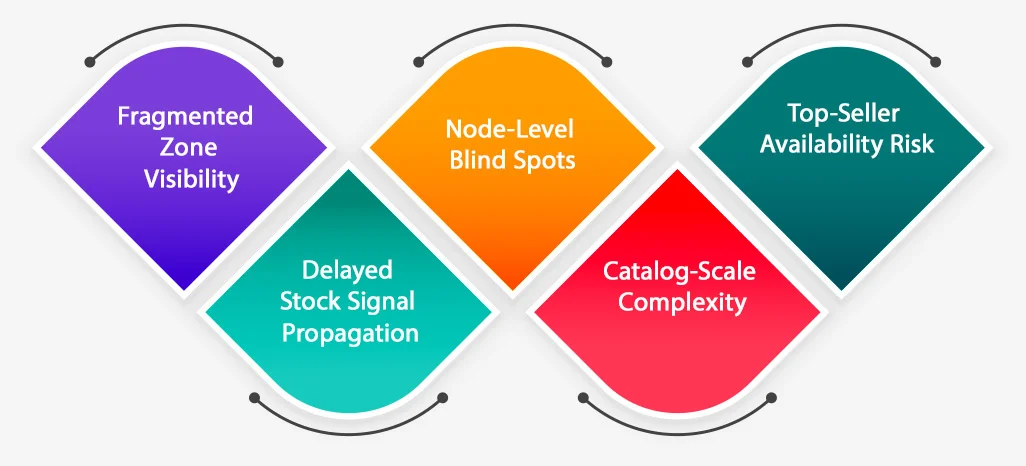
As the client’s dark store footprint grew, several structural bottlenecks emerged that compromised their ability to serve customers consistently and efficiently.
- Fragmented Zone Visibility
The absence of Grocery Availability Monitoring across interconnected PIN codes left category teams blind to hyper-local stock fluctuations, making it impossible to identify underperforming zones before customer complaints surfaced. The existing manual model of Grocery Real-Time Price Monitoring could not keep pace with the volume of change signals coming from active fulfillment nodes. - Delayed Stock Signal Propagation
Availability updates took anywhere from four to twelve hours to reflect in the client’s internal systems after a stockout occurred at a dark store. Quick Commerce PIN Code Tracking was entirely absent from their workflow, which meant that high-velocity SKUs went unreplenished until customer complaints or end-of-day reports flagged the issue. - Node-Level Blind Spots
Operational data was aggregated at the city level rather than the store or PIN level, which masked serious availability gaps within specific delivery zones. Without PIN Code-Level Inventory Tracking Services, the client had no way to distinguish between healthy zones and critically understocked ones. - Catalog-Scale Complexity
Tracking availability for thousands of SKUs across hundreds of nodes simultaneously exceeded what any manual or semi-automated process could reliably handle. The sheer volume of data points required automated, structured extraction, something the client’s legacy stack was not built to support at the needed frequency. - Top-Seller Availability Risk
The 50 highest-converting SKUs had no special monitoring layer protecting them from availability gaps. They were monitored with the same frequency and method as low-velocity items, which meant that the products driving the most revenue were as likely to go untracked during critical windows as any secondary catalog item.
Key Solutions for Addressing Client Challenges
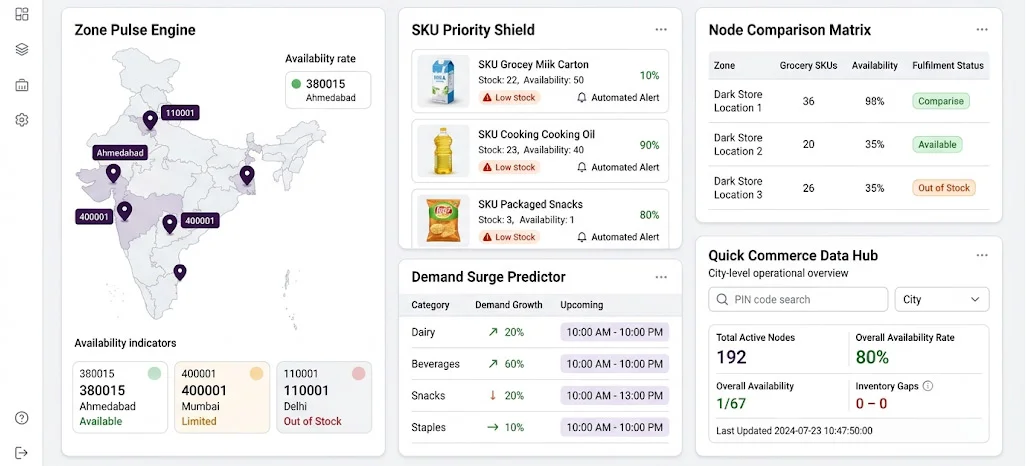
To address the breadth of these challenges, Retail Scrape designed and deployed a layered intelligence framework purpose-built for quick commerce scale and speed.
- Zone Pulse Engine
A real-time extraction engine built to map Quick Commerce Availability Mapping by PIN Code at a granular level, this module pulled structured availability data from live quick commerce platforms for every active dark store node. - SKU Priority Shield
This module created a dedicated monitoring layer for top-seller SKUs, flagging any availability drop below defined threshold levels and triggering automated alerts to procurement and logistics leads. - Node Comparison Matrix
A comparative analytics layer that mapped Hyperlocal Grocery Intelligence across all active dark store locations, enabling side-by-side performance analysis by zone, category, and time window. - Demand Surge Predictor
Using historical availability patterns, promotional schedules, and regional consumption trends, this component forecasted high-demand windows for key product categories by geography. It gave procurement teams advance visibility to stock up ahead of predicted spikes, shifting replenishment from reactive to anticipatory. - Quick Commerce Data Hub
It enabled operations managers to monitor city-level summaries and check PIN code availability through Quick Commerce Data Intelligence, helping them identify inventory gaps and respond more efficiently.
Key Insights Gained from Quick Commerce Availability Mapping by PIN Code
| Intelligence Area | Operational Finding |
|---|---|
| Top-Seller Stockout Mapping | Identified the 12 highest-frequency stockout SKUs within the top-50 catalog across peak delivery hours |
| Zone-Level Coverage Analysis | Revealed 38 PIN codes with chronic under-availability despite sufficient city-level stock allocation |
| Peak Demand Timing Patterns | Established precise high-demand windows by category and geography for proactive restocking alignment |
| Dark Store Performance Ranking | Benchmarked node-level availability performance across all 200+ locations to surface systemic gaps |
| Catalog Depth by PIN Code | Measured effective SKU availability depth per zone, exposing mismatches between listed and actual range |
Benefits of Quick Commerce Availability Mapping by PIN Code From Retail Scrape
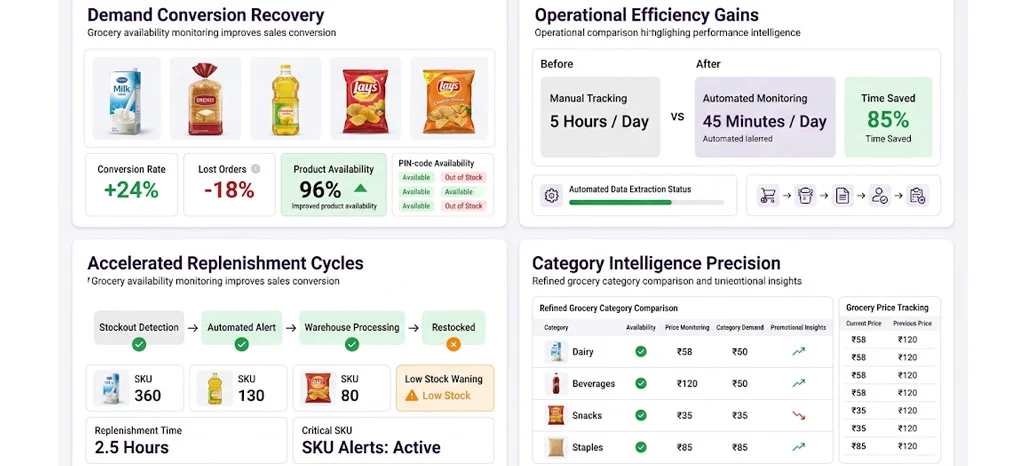
- Demand Conversion Recovery
By establishing Quick Commerce Product Availability monitoring at the PIN code level, the client captured orders that were previously lost to availability-related drop-offs. Top-seller conversion rates improved significantly as customers consistently found high-demand products in stock during their primary ordering windows. - Operational Efficiency Gains
The automation of availability data extraction through PIN Code-Level Inventory Tracking Services freed procurement and operations teams from hours of daily manual tracking. Resources previously consumed by data gathering were redeployed toward strategic planning, vendor negotiations, and new zone expansion initiatives. - Accelerated Replenishment Cycles
With real-time stockout signals feeding directly into logistics workflows, replenishment lead times shortened considerably. The structured alert system ensured that critical SKUs were flagged and restocked before sustained availability gaps could translate into measurable customer churn or negative review accumulation. - Category Intelligence Precision
The detailed availability data helped category managers improve assortment planning, promotional scheduling, and vendor evaluations, while Grocery Price Tracking provided better insights for making timely, data-driven decisions.
Client's Testimonial

The partnership with Retail Scrape brought a level of Quick Commerce Availability Mapping by PIN Code clarity we had not experienced before. For the first time, we had a real-time, PIN code-level view of our top-seller stock status across all active nodes. The impact on our fulfillment consistency was immediate, and the insights generated by their Multi-Location Grocery Availability Tracking capability gave our category teams an edge in restocking decisions we simply did not have before.
– VP of Operations, Leading Quick Commerce Grocery Brand
Conclusion
Sustainable growth in quick commerce depends on more than delivery speed, it depends on consistent product availability at the precise locations your customers are ordering from. Quick Commerce Availability Mapping by PIN Code gives retail and grocery brands the intelligence layer needed to protect top-seller performance, close zone-level inventory gaps, and build a replenishment model that keeps pace with real demand.
At Retail Scrape, we specialize in translating raw platform data into structured, actionable availability intelligence that operations teams can act on within minutes. Our solutions support Hyperlocal Grocery Intelligence at the dark store and PIN code level, equipping brands with the visibility they need to serve every delivery zone effectively.
Contact Retail Scrape today to discuss how we can build a customized PIN code-level availability intelligence solution for your quick commerce network. With proven expertise in Grocery Availability Monitoring across quick commerce ecosystems, we design and deploy availability tracking solutions that align with your fulfillment architecture and business objectives.