
Helping Grocers Deploy Hyperlocal Grocery Price Tracking Across Zip Codes to Automate Repricing
Introduction
Modern grocery retail has entered an era where pricing precision determines whether a store thrives or loses ground to competitors down the street. Regional price variations have grown increasingly complex, and grocers who fail to capture location-specific data risk losing loyal shoppers to rivals offering better deals just a few zip codes away. Hyperlocal Grocery Price Tracking Across Zip Codes has become the backbone of intelligent pricing strategies that large and mid-sized grocery chains now depend on to stay operationally relevant.
We work closely with grocery enterprises navigating this complexity, building automated data pipelines that capture competitor pricing at a granular, neighborhood level. With Grocery Price Monitoring for Dynamic Repricing, we enable clients to move away from blanket pricing approaches and shift toward targeted, data-backed decisions that reflect what shoppers in each specific zone are actually encountering at competing stores every single day.
This case study presents how we partnered with a major grocery enterprise to deploy a fully automated, zip code-level pricing intelligence system. By combining structured data extraction with advanced analytics, we helped the client transform how they respond to localized market shifts, faster, smarter, and with far greater accuracy than their previous methods allowed.
The Client
A prominent grocery chain operating more than 200 retail outlets across multiple metropolitan regions approached us with a pressing operational concern. Despite holding strong brand recognition and an extensive product assortment, the company was steadily losing basket share in key neighborhoods where competing stores had adopted more aggressive, location-tailored pricing. The leadership recognized that their pricing model had become too generalized to compete effectively at a store-by-store level. Integrating Hyperlocal Grocery Pricing intelligence into their daily operations was no longer optional, it had become a strategic necessity.
Their category management team had attempted to address this gap using internal surveys and occasional manual audits, but the volume of SKUs across store clusters made that approach unsustainable. Price changes in competing stores were going unnoticed for days, sometimes weeks, and by the time internal teams responded, the client had already absorbed the damage in foot traffic and revenue. The idea of Ai-Powered Grocery Price Optimization was discussed internally but lacked a structured implementation partner.
After evaluating several data services, the client selected us for our proven ability to operationalize competitor pricing data at scale. What distinguished our approach was not just the extraction capability but the ability to organize data by zip code, store cluster, and category, giving procurement and pricing teams a clear, actionable view of where they were competitively strong and where they were bleeding margin unnecessarily.
Key Challenges Faced by the Client
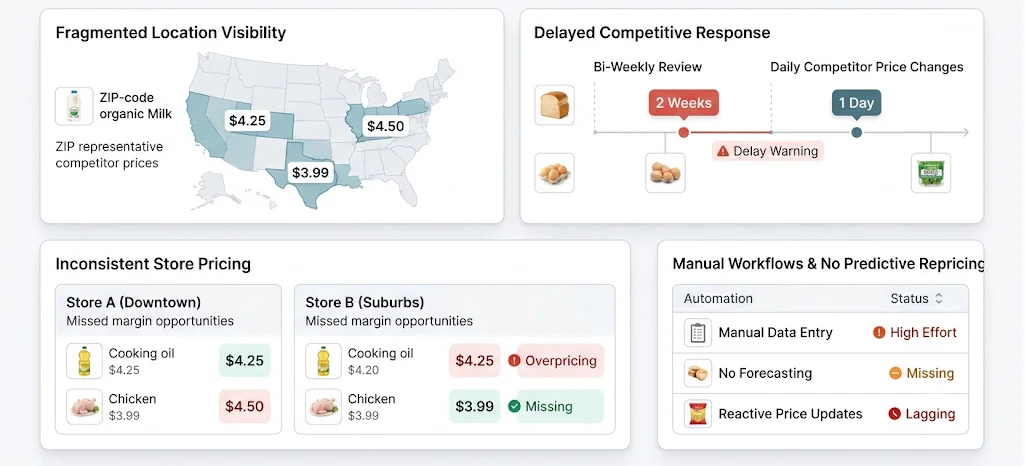
Before the solution rollout, the client encountered several deeply rooted challenges that slowed their pricing agility and reduced market responsiveness:
- Fragmented Location-Level Visibility
This created blind spots in neighborhoods where competitors had significantly different pricing postures, making Location-Based Grocery Price Intelligence a critical missing layer in their overall strategy. - Delayed Competitive Response Cycles
Internal pricing reviews happened on a bi-weekly basis, which proved entirely misaligned with how frequently competitor prices shifted on high-velocity SKUs. By the time the client's team updated shelf prices, competitors had already captured the value-conscious shopper segment in those zip codes. - Inconsistent Pricing Across the Store Network
Without zip-code-level pricing signals, the client applied uniform price bands across geographically diverse store clusters. This led to overpricing in price-sensitive neighborhoods and underpricing in areas where the client could have maintained better margins without affecting demand. - Manual Workflows With No Scalability
The existing approach relied heavily on field staff and manual data entry, which was neither scalable nor accurate. As the store network grew, the operational burden of maintaining even a basic level of pricing awareness across locations became unmanageable without structured automation. - Absence of Predictive Repricing Capability
The client lacked any forward-looking pricing mechanism. All adjustments were reactive, triggered only after competitive price movements had already impacted store performance. There was no infrastructure in place to anticipate pricing shifts based on historical competitor patterns or seasonal demand cycles.
Key Solutions for Addressing Client Challenges
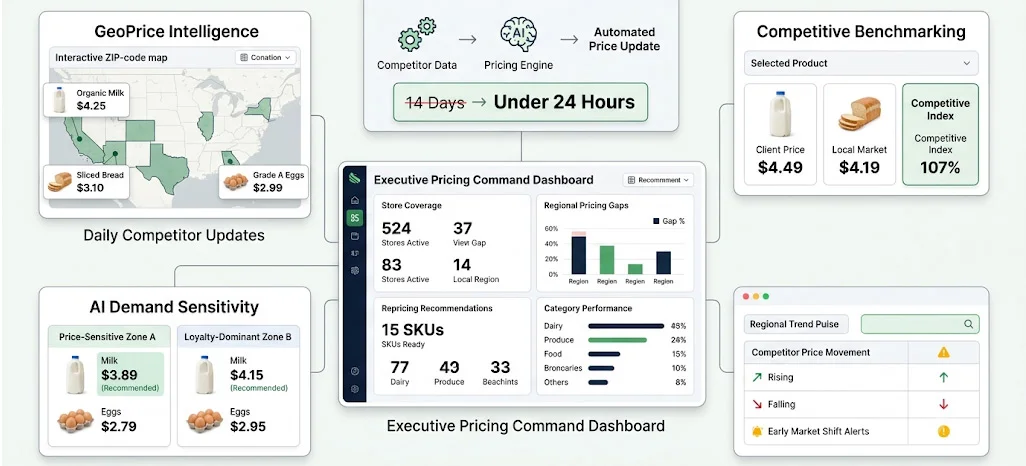
We deployed an end-to-end pricing intelligence architecture designed specifically for hyperlocal grocery environments. Each module addressed a distinct operational gap while integrating seamlessly into the client's existing data ecosystem.
- GeoPrice Intelligence Layer
We developed a zip-code-mapped extraction infrastructure that captures competitor pricing daily across all product categories. This Hyperlocal Grocery Price Monitoring layer feeds structured data directly into the client's pricing engine, enabling store-specific benchmarking without manual input. - Zip Code Competitive Benchmarking Engine
Using Zip Code-Wise Grocery Price Tracking, we built a benchmarking module that assigns each SKU a competitive index score based on how the client's price compares to the local market average. This score automatically triggers repricing recommendations when the threshold exceeds defined tolerance bands. - AI-Driven Demand Sensitivity Modeler
This module uses machine learning to assess price elasticity by product category and zip code. AI Dynamic Pricing for Grocery Retailers is applied here to distinguish between price-sensitive zones and loyalty-dominant zones, allowing the client to calibrate pricing strategy accordingly rather than treating all locations uniformly. - Regional Trend Pulse Monitor
A dedicated analytics layer continuously scans pricing trends across competitor store clusters and identifies directional shifts before they become widespread. This enables the client's category teams to make proactive assortment and pricing adjustments before competitive pressure peaks. - Automated Repricing Workflow Connector
We built a middleware integration layer that connects extracted competitor data directly to the client's price management system. This eliminated manual data entry entirely and reduced the repricing cycle from two weeks to under 24 hours across all store locations. - Executive Pricing Command Dashboard
A unified dashboard gives senior leadership a real-time view of pricing performance by zip code, category, and store cluster. Decision-makers can drill into specific regions, review competitive gaps, and approve repricing recommendations, all from a single interface without switching between systems.
Key Insights Gained from Hyperlocal Grocery Price Tracking Across Zip Codes
| Intelligence Area | Business Outcome Delivered |
|---|---|
| Zip Code Price Gap Mapping | Identified significant pricing disparities across 80+ micro-markets, enabling targeted price corrections |
| SKU-Level Competitive Indexing | Ranked 15,000+ SKUs by competitive price position, prioritizing repricing for high-impact categories |
| Seasonal Pricing Pattern Recognition | Mapped competitor price behavior across 12 months to forecast demand-driven price windows |
| Category Margin Recapture Analysis | Pinpointed overpriced segments in low-competition zones where margins could safely be expanded |
| Competitor Promotion Frequency Tracking | Measured how often rivals discounted specific categories, informing counter-promotion timing |
Benefits of Hyperlocal Grocery Price Tracking Across Zip Codes From Retail Scrape
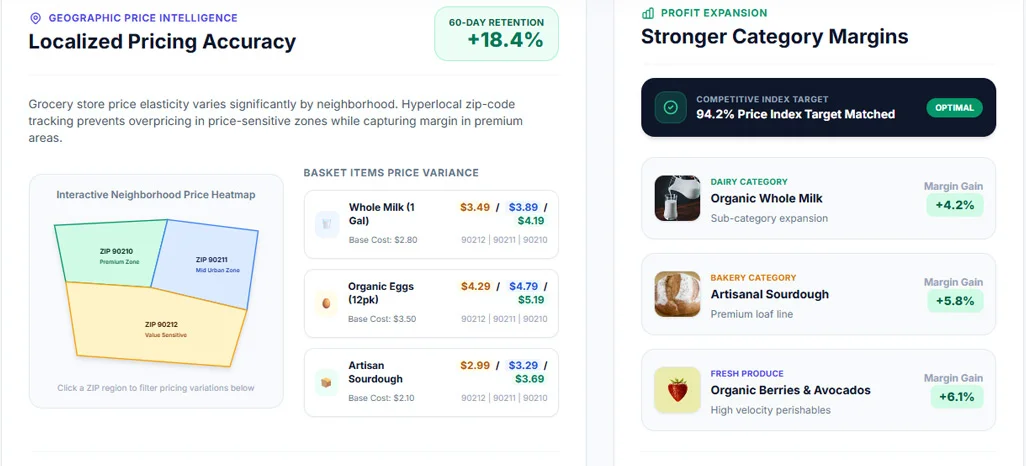
- Localized Pricing Accuracy
By deploying Hyperlocal Grocery Price Tracking Across Zip Codes, the client achieved granular pricing precision at a neighborhood level, which directly reduced price-driven customer attrition in the most competitive zip codes within the first 60 days of implementation. - Accelerated Repricing Speed
With Grocery Data Scraping powering daily competitor data refresh, the client's repricing cycle dropped from a bi-weekly cadence to a daily automated process, a change that proved particularly valuable during promotional windows and holiday demand surges when competitor prices shifted multiple times per week. - Stronger Category-Level Margins
Access to clean, structured competitor pricing data allowed category managers to recalibrate price bands in zones where the client held a competitive advantage. This led to measurable margin improvement without any reduction in shopper conversion rates. - Operational Efficiency Gains
Automation of data collection and repricing workflows freed pricing analysts from repetitive manual tasks, allowing the team to focus on strategic planning and category-level decision-making rather than data gathering.
Client's Testimonial

Retail Scrape completely changed how we think about store-level pricing. Before this engagement, we had no real visibility into what competitors were doing in specific neighborhoods. Now, with Hyperlocal Grocery Price Tracking Across Zip Codes driving our daily repricing cycles, we're making decisions that are grounded in actual local market data. The system gave us the ability to Analyze Regional Supermarket Price Differences in a way we simply couldn't do before, and the margin impact has been substantial.
– VP of Pricing Strategy, National Grocery Chain
Conclusion
In a retail environment where a two-cent price difference on a gallon of milk can redirect a shopper's weekly grocery run to a competitor, pricing intelligence at the zip code level is not a luxury, it is a fundamental operating requirement. Hyperlocal Grocery Price Tracking Across Zip Codes gives grocery enterprises the granular visibility they need to make pricing decisions that reflect what is actually happening on the ground, store by store and street by street.
The strategic value of being able to Hyperlocal Grocery Pricing decisions to specific neighborhood dynamics cannot be understated, retailers who act on location-specific data consistently outperform those relying on regional averages. We have built the infrastructure to make this level of intelligence accessible, automated, and actionable for grocery enterprises of every scale.
If your organization is ready to move beyond generalized pricing models and build a true Monitor Hyperlocal Grocery Prices by Location capability, our team is prepared to design a solution tailored to your store network, competitive landscape, and business objectives. Contact Retail Scrape today to schedule a detailed discovery session.