
Eliminating Availability Blind Spots Using Blinkit Product Availability Data Across 50+ Locations
Introduction
The quick commerce sector in India has fundamentally altered how FMCG brands think about last-mile distribution. Consumers now expect products to be available within minutes, and any stock gap at the hyperlocal level directly translates into lost sales and declining brand loyalty. Blinkit Product Availability Data has emerged as a critical intelligence layer for FMCG companies seeking to understand exactly where their products are present—and more importantly, where they are not.
Brands operating across metropolitan and Tier-2 markets face an inherently fragmented visibility challenge. A product might be consistently stocked in one part of a city while remaining perpetually out-of-stock in another dark store just kilometers away. FMCG Retail Data Intelligence bridges this gap by delivering structured, location-specific stock insights that purchasing and supply chain teams can act upon with confidence and precision.
We work with FMCG companies that need more than surface-level reporting. They need granular, store-by-store intelligence that connects directly to procurement workflows and distribution planning. This case study details how we helped a growing FMCG brand eliminate persistent availability blind spots across 50+ Blinkit locations by building a robust data pipeline that continuously monitors real-time stock signals at scale.
The Client
A mid-sized FMCG manufacturer with a strong portfolio of household and personal care products had been scaling its quick commerce presence aggressively over the past two years. With listings active on Blinkit across major urban clusters, the brand assumed its distribution network was performing adequately—until internal sales audits revealed alarming inconsistencies between expected revenue and actual order fulfillment rates. Blinkit Product Availability Data became the focal point of their diagnostic effort, as leadership realized they had no reliable mechanism to track real-time stock status at the store level.
The company's distribution partners submitted weekly inventory reports, but these figures rarely aligned with what was actually visible to consumers on the platform. The brand had no direct access to the Blinkit API and lacked the technical infrastructure to build independent monitoring capabilities in-house. As a result, stockouts would persist for days without anyone in the supply chain flagging them, eroding repeat purchase rates in neighborhoods where the brand had otherwise strong demand.
What made the problem particularly acute was the seasonal dimension. During festive quarters and health-awareness campaigns, demand surged in specific geographies, but the brand's replenishment cycles were calibrated to historical averages rather than real-time signals. Blinkit Stock Monitoring Across Multiple Locations was not part of their operational vocabulary—but after losing an estimated 18% of projected Q3 revenue to preventable stockouts, the leadership team decided it needed to become a core capability.
Key Challenges Faced by the Client
- Visibility Fragmentation Across Dark Stores
Relying entirely on distributor-submitted data created a blind spot that grew wider as the brand expanded to new cities. The absence of Blinkit Data Scraping meant the team had no independent verification mechanism, leaving critical inventory decisions vulnerable to reporting delays and inaccuracies across all active nodes. - Delayed Response to Stockout Events
By the time stockouts were flagged through internal channels, they had already persisted for 48 to 72 hours on average. Without continuous Blinkit Product Availability Tracking, the brand's supply chain team consistently operated in reactive mode, losing sales windows that could never be recovered once consumer demand shifted elsewhere. - Inability to Detect Location-Specific Demand Patterns
Aggregate sales data masked what was actually happening at the neighborhood level. Certain product SKUs were frequently out-of-stock in specific pin codes while overstocked in adjacent ones. The absence of Blinkit Stock Availability Data for FMCG Brands meant distribution resources were being misallocated consistently and systematically across the fulfillment network. - No Benchmark for Competitor Shelf Presence
The brand had no way to assess whether competing products in the same category were consistently available in locations where their own listings were missing. This made it nearly impossible to evaluate whether their availability gaps were broader market-level issues or problems specific to their own supply chain. - Manual Tracking Across Spreadsheets
Field teams were maintaining availability records manually through shared spreadsheets updated during periodic store visits. This approach was neither scalable nor accurate, and it completely failed to capture intraday stock changes that are particularly common on high-demand platforms.
Key Solutions for Addressing Client Challenges
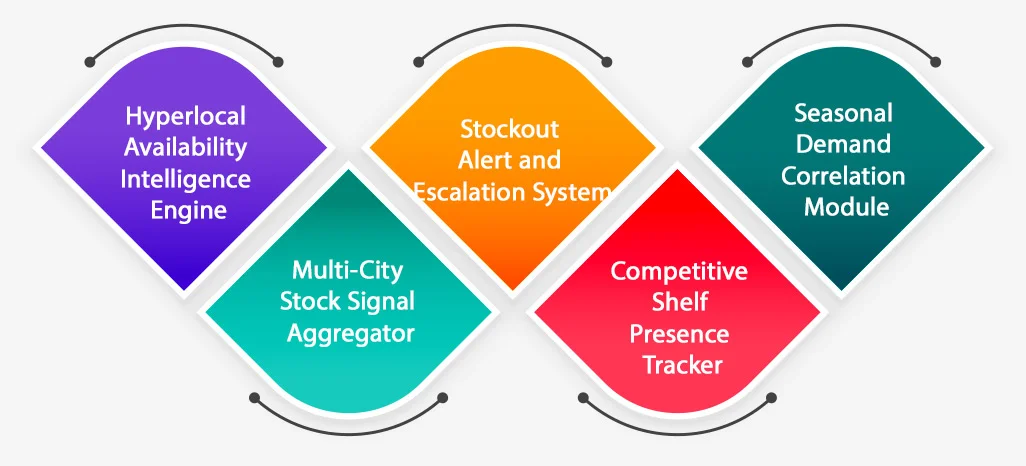
- Hyperlocal Availability Intelligence Engine
We deployed a location-aware scraping infrastructure designed specifically for Blinkit Store-Level Availability Monitoring, covering over 50 dark store nodes across 8 cities. The system captures product-level stock status at configurable intervals, giving the client a continuous, timestamped record of availability for every SKU in their portfolio. - Multi-City Stock Signal Aggregator
Using our Blinkit Scraper framework, we built a centralized aggregation layer that consolidates raw availability signals from all monitored locations into a unified dashboard. Supply chain managers can filter by city, pin code, product category, or individual SKU to identify exactly where gaps are forming before they become revenue-impacting events. - Stockout Alert and Escalation System
The pipeline includes a real-time notification module that triggers alerts whenever a product's availability status drops below a defined threshold at any monitored location. This moves the client's operations from reactive to predictive, allowing replenishment orders to be initiated hours before a complete stockout is registered. - Competitive Shelf Presence Tracker
Beyond monitoring their own SKUs, we extended the data capture to include competing brands within the same product categories. This gave the client a comparative view of shelf presence, enabling them to identify locations where competitors maintained stronger availability and adjust their distribution priorities accordingly. - Seasonal Demand Correlation Module
By layering historical availability trends against known demand cycles, we built a forecasting component that connects Blinkit Data Analytics for FMCG Distribution outputs with the brand's procurement calendar. This allows the team to pre-position inventory at high-velocity nodes ahead of demand spikes rather than scrambling to fulfill orders during peak periods.
Key Insights Gained from Blinkit Product Availability Data
| Intelligence Dimension | Key Finding |
|---|---|
| Stockout Frequency by City | Highest availability gaps concentrated in Tier-2 expansion markets |
| Peak Demand Windows | Saturday and Sunday mornings showed 3x higher stockout incidence across personal care SKUs |
| Competitor Presence Gaps | Competing brands maintained 23% stronger shelf presence in South Delhi pin codes |
| SKU Vulnerability Index | 6 high-margin SKUs accounted for 71% of all recorded stockout events |
| Replenishment Lag Analysis | Average restocking delay reduced from 68 hours to 11 hours post-implementation |
| Cross-City Distribution Imbalance | 3 cities held excess inventory while 5 others showed critical shortage patterns |
Benefits of Blinkit Product Availability Data From Retail Scrape
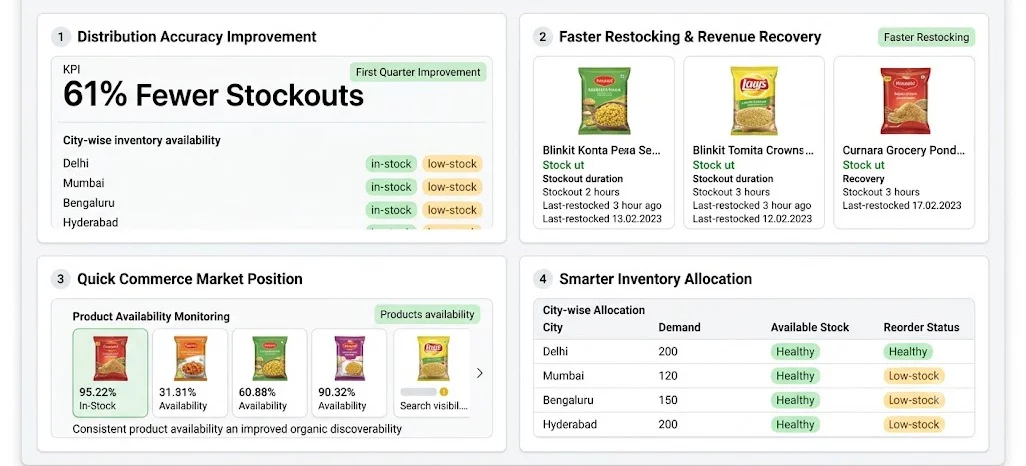
- Distribution Accuracy Improvement
With precise location data in hand, the supply chain team restructured their fulfillment routing and reduced overall stockout incidents by 61% within the first quarter of implementation. Multi Location Inventory Tracking Using Blinkit Data allowed the brand to identify and correct systematic distribution imbalances that had persisted undetected for over a year. - Revenue Recovery Through Faster Restocking
By demonstrating specific stockout durations with timestamped evidence, the brand secured faster restocking commitments and recovered a significant portion of previously lost sales. Blinkit Grocery Datasets delivered through our pipeline gave the procurement team a factual basis for renegotiating service level agreements with distribution partners. - Stronger Quick Commerce Market Position
With FMCG Product Availability Tracking in India now embedded into their weekly planning cycle, the brand elevated its overall platform ranking on Blinkit by maintaining consistently higher in-stock rates. Better availability directly improved the brand's search ranking within the app, driving organic visibility without any additional marketing investment. - Smarter Inventory Allocation Across Cities
By connecting availability signals to actual demand patterns rather than distributor estimates, the brand redistributed inventory more intelligently across its active cities. This reduced excess stock in low-velocity locations while ensuring adequate supply in high-demand nodes, improving overall working capital efficiency across the supply chain.
Client's Testimonial

Before working with Retail Scrape, we had no real understanding of what was happening at the store level across our Blinkit listings. We were making distribution decisions based on reports that were often days old and inconsistently accurate. The Blinkit Product Availability Data intelligence we now receive has completely transformed how we manage replenishment. The impact on our availability rate and Blinkit Stock Tracking efficiency has been extraordinary—our on-shelf presence improved by 58% across monitored locations within three months.
– Head of Modern Trade & Quick Commerce, Leading FMCG Brand
Conclusion
Competing effectively in India's quick commerce ecosystem demands more than strong product quality and aggressive pricing. Blinkit Product Availability Data gives FMCG brands the operational visibility they need to close availability gaps before they compound into structural distribution problems.
Our purpose-built data infrastructure enables brands to move beyond assumption-driven supply chain decisions. Through continuous FMCG Retail Data Intelligence, we deliver store-level insights that connect directly to procurement, logistics, and trade marketing workflows.
Whether you are managing 10 dark store locations or scaling across 100, Blinkit Store-Level Availability Monitoring through our platform provides the clarity your distribution teams need to act decisively. Contact Retail Scrape today to build a real-time availability intelligence system tailored to your product portfolio and geographic footprint.