
What Role Does AI-Powered Web Scraping Play in Converting Messy HTML Into Valuable Business Data?
Introduction
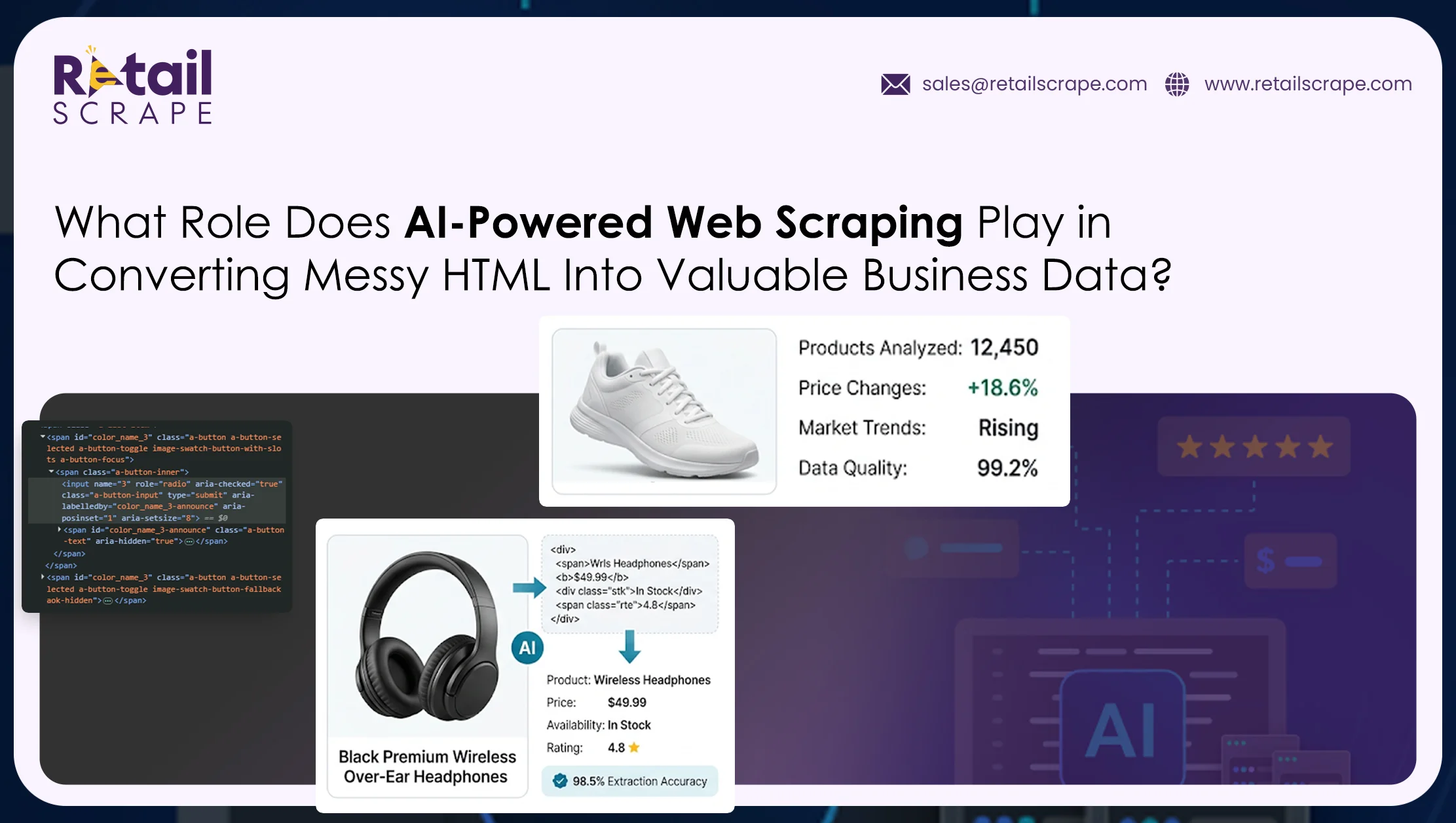
Modern websites are built primarily for human visual consumption rather than automated machine processing. Complex JavaScript frameworks, constantly shifting DOM structures, and unstructured HTML present continuous hurdles for traditional data collection tools. As online platforms become increasingly dynamic, organizations struggle to extract clean, reliable information efficiently.
This technical bottleneck directly impacts strategic decision-making across modern industries. Enterprise teams spend excessive resources writing, maintaining, and updating custom extraction scripts that break whenever a target website updates its front-end code. Without intelligent automation, raw online assets remain trapped behind chaotic markup, rendering critical market signals inaccessible.
Integrating advanced machine learning models changes this equation completely. By using AI-Powered Web Scraping, modern software systems parse raw web interfaces, automatically understand document semantics, and transform unstructured source code into pristine databases. This approach allows enterprise leaders to convert chaotic web pages into actionable operational intelligence seamlessly.
Transforming Unstructured Web Markup Into Scalable Semantic Data
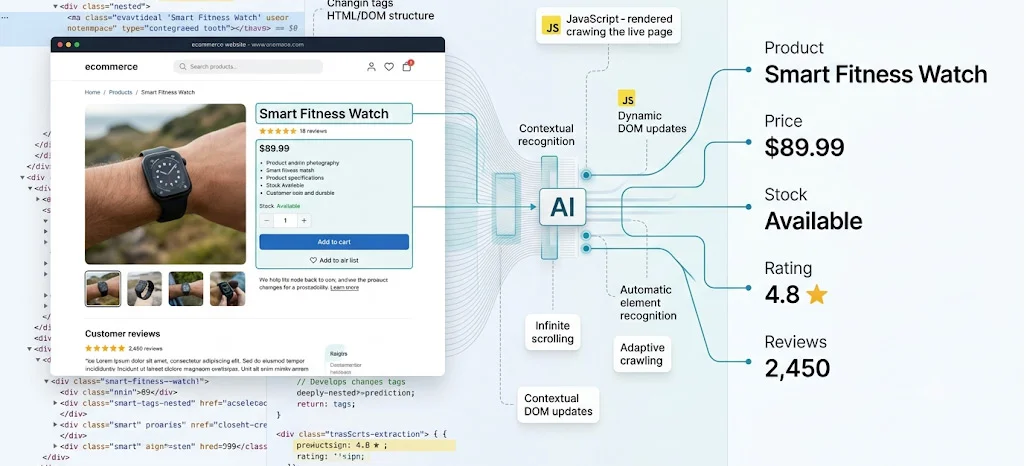
Modern digital environments depend heavily on client-side rendering, dynamic element updates, and variable DOM hierarchies that render rigid scraping rules obsolete. Traditional extraction frameworks rely on rigid CSS selectors or explicit XPath queries, making them prone to total failure whenever a website updates its visual layout or class naming conventions. To overcome these persistent operational barriers, enterprise data teams are increasingly deploying robust AI Live Crawler Solutions to continuously parse raw web layouts, adapt to structural changes autonomously, and maintain high data integrity.
By combining computer vision algorithms with contextual language modeling, intelligent scraping frameworks analyze target web pages visually much like a human user would. This cognitive approach ensures that vital elements such as product specifications, stock levels, and user reviews are accurately identified even when the underlying HTML tags are renamed or restructured. Furthermore, utilizing advanced AI Data Extraction From Dynamic Websites enables organizations to process asynchronous API calls, heavy JavaScript applications, and continuous scroll mechanics without requiring constant manual updates from software engineers.
- Autonomous layout adaptation reduces script maintenance costs while preventing catastrophic data ingestion pipeline breaks during site redesigns.
- Real-time semantic evaluation guarantees precise identification of targeted data points regardless of underlying class name modifications.
- Dynamic rendering capabilities seamlessly handle single-page web applications, shadow DOM elements, and complex asynchronous content loads.
- Visual element recognition ensures robust extraction across multiformat web properties without writing custom parsing logic for each page variant.
To better understand how intelligent parsing compares to traditional methods when navigating modern site structures, examine the technical performance metrics outlined in the table below.
| Platform Ingestion Capability | Traditional Selector Scraping | AI Semantic Scraping |
|---|---|---|
| Resilience to Code Updates | Low (Fails on minor class changes) | High (Adapts dynamically via visual models) |
| Maintenance Overhead | High (Requires frequent manual fixes) | Minimal (Autonomous layout recognition) |
| Dynamic Execution | Limited (Requires rigid headless setups) | Native (Automated rendering and interaction) |
Ultimately, adopting an intelligent parsing architecture ensures that raw web pages are converted into reliable, machine-readable datasets without structural loss. Enterprise teams gain continuous access to vital web information while dramatically lowering the overhead typically associated with script maintenance and pipeline repair.
Converting Noisy Web Elements Into Clean Business Datasets
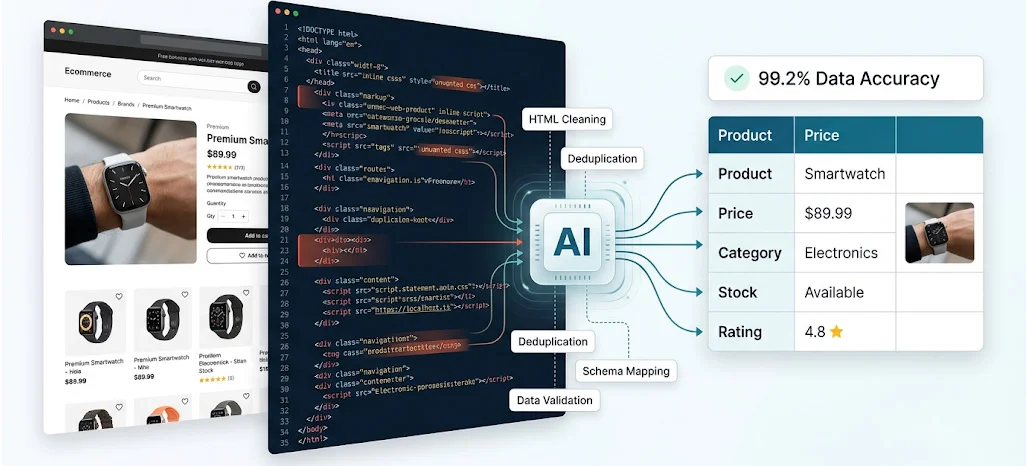
Extracted web source code rarely arrives in a clean or standardized format ready for downstream database ingestion. Raw HTML payload contains substantial noise, including inline CSS declarations, embedded scripts, navigation menus, and auxiliary visual elements that pollute dataset quality. To turn this raw data stream into meaningful intelligence, modern engineering pipelines implement targeted AI Web Crawlers to automatically sanitize, strip irrelevant tags, deduplicate entries, and map unstructured web content to standardized corporate schemas in real time.
Processing web content at enterprise scale requires continuous data ingestion pipelines capable of handling millions of dynamic URLs concurrently. By leveraging comprehensive Enterprise Web Crawling Services, large organizations establish high-throughput collection networks that parse complex domains while maintaining strict data governance standards. Furthermore, applying AI Web Scraping for Enterprise Data Collection allows business units to automatically convert unorganized digital markup into clean relational database entries, significantly accelerating the analytics readiness of collected information.
- Automated tag stripping eliminates visual clutter, inline scripts, and redundant markup to isolate core textual content efficiently.
- Real-time schema normalization maps disparate target formats into unified, structured database records ready for immediate processing.
- Intelligent deduplication algorithms detect identical product listings and repetitive elements across massive web crawl targets.
- High-speed parallel processing handles massive web data ingestion tasks without compromising payload validation or extraction accuracy.
The comparison table below highlights key operational efficiency gains achieved when transitioning from manual data cleaning scripts to automated intelligent transformation pipelines.
| Extraction Benchmark | Manual Rules Ingestion | Automated AI Pipeline |
|---|---|---|
| Parsing Speed Per Page | 1.2 to 2.5 seconds (Rule validation) | 0.3 to 0.7 seconds (Vector parsing) |
| Data Cleaning Accuracy | 82% (Requires manual regex rules) | 99.4% (Autonomous NLP normalization) |
| Schema Flexibility | Rigid (Hardcoded schemas) | Dynamic (Self-adjusting output schemas) |
Integrating automated semantic processing transforms noisy visual content into structured digital assets with minimal human intervention. Organizations streamline their ETL workflows, eliminate data transformation bottlenecks, and ensure that downstream analytics applications receive accurate, highly structured datasets consistently.
Powering Enterprise Market Intelligence With Clean Digital Data
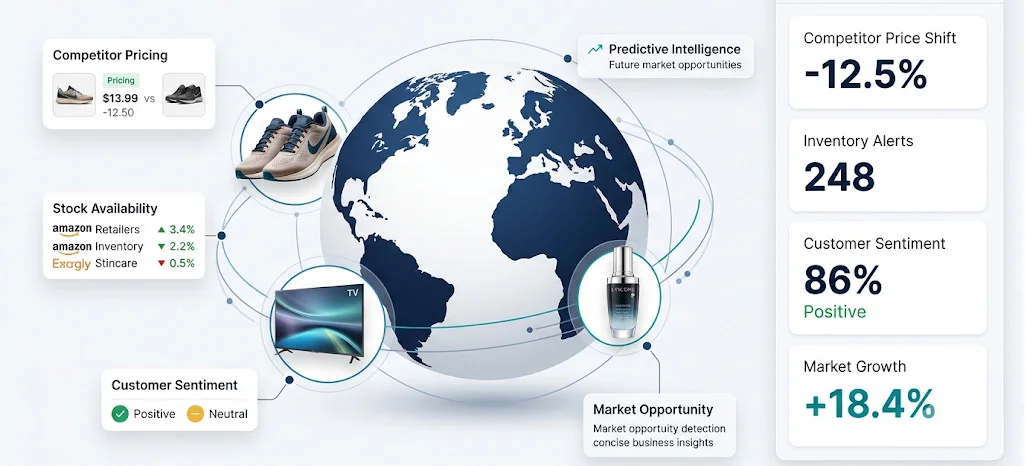
High-level business decisions require consistent access to structured, timely, and verified market intelligence derived directly from public digital channels. When enterprise analytics tools are fed with clean, structured datasets extracted from across the web, companies gain complete visibility into market dynamics, pricing shifts, and customer preferences. Leveraging AI-Based Web Scraping for Business Intelligence equips strategy teams with the continuous data streams necessary to power predictive modeling, refine promotional strategies, and spot emerging market trends.
In fast-paced commercial sectors, accessing dynamic price intelligence provides a critical competitive edge for revenue optimization. Integrating continuous Dynamic Pricing Intelligence allows retail brands to automatically monitor competitor catalog updates, track inventory shifts, and dynamically adjust pricing models across thousands of products. Simultaneously, employing AI Web Scraping for Business Data ensures that strategic leaders base their critical operations on clean, real-time market data extracted automatically from dynamic online environments.
- Automated market monitoring captures daily competitor pricing shifts, catalog expansions, and promotional campaigns at scale.
- Structured feedback extraction transforms customer reviews and forum discussions into clear brand sentiment metrics.
- Real-time inventory tracking alerts commercial teams to out-of-stock events across competing retail platforms instantly.
- Predictive modeling support ensures downstream machine learning tools receive reliable, normalized data inputs continuously.
Review the structural comparison below to see how structured web extraction directly fuels diverse strategic outcomes across modern business functions.
| Strategic Application | Raw Data Input | Business Outcome |
|---|---|---|
| Market Intelligence | E-commerce catalogs and inventory | Real-time pricing & stock repositioning |
| Sentiment Analysis | Consumer reviews and forum discussions | Early identification of product issues |
| Competitive Benchmarking | Competitor sites & landing pages | Rapid adjustments to marketing strategies |
Converting raw web content into accurate operational data fundamentally changes how modern companies compete. By automating data ingestion, cleaning, and integration, strategic leaders turn web content into actionable assets that drive smarter decision-making, improve market responsiveness, and fuel long-term operational success.
How Retail Scrape Can Help You?
Extracting unstructured content across diverse web environments demands a resilient infrastructure built for scale. Deploying AI-Powered Web Scraping through our specialized infrastructure enables your organization to collect clean, accurate web data continuously without engineering bottlenecks.
Our enterprise-grade scraping solutions handle complex rendering, bypass blockages automatically, and transform raw page content into clean data streams ready for immediate analysis.
- Access real-time product pricing, inventory changes, and promotional updates across global retail sites.
- Ingest unstructured text, user reviews, and product attributes into standardized data formats automatically.
- Bypass complex anti-scraping systems, rate limits, and regional content restrictions without interruption.
- Maintain pipeline stability even when target sites update layout structures or class attributes.
- Scale collection infrastructure effortlessly across millions of dynamic web pages simultaneously.
- Stream structured market data directly into your analytical databases, internal dashboards, and predictive models.
To simplify integration and maintain reliable data flows across modern architectures, our robust Web Scraping API Services provide a flexible interface designed to deliver structured outputs on demand.
Leveraging our reliable Web Scraping Automation for Enterprise Data, your teams eliminate manual script maintenance and focus entirely on high-impact analytical initiatives.
Conclusion
Converting chaotic HTML code into organized data assets requires advanced extraction technologies capable of managing modern website complexity. Utilizing AI-Powered Web Scraping empowers forward-thinking companies to bypass structural fragility, automate data normalization, and extract clean information at scale.
Applying Website Data Parsing With Artificial Intelligence converts noisy visual web pages into precise databases, providing your analytical models with reliable information every day. Partner with Retail Scrape today to turn unstructured web content into your company's greatest strategic advantage.