.gif)


Helping Grocers Deploy Private Label vs National Brand Price Tracking for Modern Online Grocers
Introduction
The modern grocery landscape has become increasingly complex as online retail growth forces grocery operators to rethink how they position products at every price tier. Consumer expectations around value, quality, and convenience have shifted dramatically, pushing retailers to develop sharper category strategies that account for both national brand authority and the rising prominence of private label assortments. Private Label vs National Brand Price Tracking has emerged as a foundational capability for grocers seeking to build a defensible position in saturated digital markets.
Retailers who operate without structured pricing visibility across brand tiers often find themselves reactive rather than proactive, adjusting prices after competitors have already captured market share. The need for Grocery Brand Price Tracking has never been more urgent, as the gap between winning and losing on digital grocery shelves frequently comes down to pricing accuracy at the SKU level. Grocers who invest in systematic tracking frameworks are consistently better positioned to respond to promotional cycles, demand shifts, and competitive pressure.
As online grocery platforms grow in both reach and complexity, building a scalable intelligence infrastructure becomes non-negotiable. Through Retail Price Benchmarking for Grocery Categories, grocery businesses can generate continuous visibility into how their pricing compares across the brand spectrum, enabling smarter category decisions, stronger margin control, and long-term competitive resilience that supports every layer of their product hierarchy.
The Client
A fast-scaling online grocery platform operating across fourteen metropolitan markets found itself at a crossroads in its pricing strategy. With an extensive catalog spanning fresh produce, packaged goods, beverages, and household essentials, the retailer managed a broad mix of private label and national brand products across hundreds of categories. Private Label vs National Brand Price Tracking was identified early in their diagnostic process as the missing infrastructure layer that would bring structural clarity to their pricing decisions.
The company had built a reputation for offering competitive pricing on national brands, yet their private label range, representing nearly 34% of total SKUs, was priced without reference to real market benchmarks. The absence of Grocery Private Label Price Comparison capability meant that high-potential private label items were either underpriced, leaving significant margin on the table, or overpriced relative to national equivalents, resulting in poor conversion rates and category underperformance.
Complicating matters further, the client’s pricing team operated across four separate internal systems that did not communicate with each other, making consolidated category analysis nearly impossible. Seasonal pricing decisions were driven by intuition rather than data, and price change implementation often lagged three to four weeks behind competitor movements. The absence of FMCG Brand-Level Competitor Price Intelligence meant that the team was consistently working with stale pricing signals at precisely the moments when market conditions were shifting most rapidly.
Key Challenges Faced by the Client
The client faced a set of deeply interconnected pricing challenges that made it difficult to operate competitively across a dual brand-tier catalog:
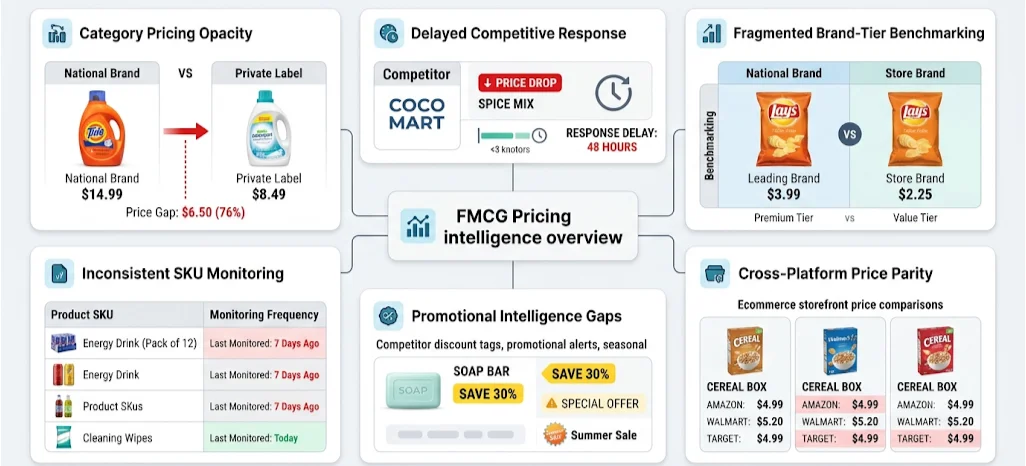
- Category Pricing Opacity
Without a systematic approach to Fmcg Price Intelligence across national and store brand segments, the client lacked visibility into competitor price positioning. Category managers could not distinguish whether pricing gaps existed due to brand premium expectations or actual market mispricing. - Delayed Competitive Response Windows
Competitor price changes were identified days or weeks after implementation, leaving the client perpetually a step behind. This lag undermined flash sale performance, weekly promotional efficiency, and the ability to capitalize on competitor stockouts or price increases. - Fragmented Brand-Tier Benchmarking
No unified framework existed for evaluating private label pricing relative to its national brand equivalents within the same category. This meant pricing decisions were made in isolation, without understanding how the relationship between tiers influenced consumer choice behavior. - Inconsistent SKU-Level Monitoring Depth
The client’s monitoring coverage was selective and inconsistent, with high-velocity SKUs tracked more frequently than slow-movers, despite the fact that slow-moving private label items often contributed disproportionately to overall category margins. - Promotional Intelligence Gaps
The retailer had no mechanism to detect competitor promotional patterns in advance, making it nearly impossible to prepare counter-promotions or protect share during high-traffic selling events such as national holidays or seasonal campaigns. - Cross-Platform Price Parity Issues
As the client expanded across multiple digital storefronts, maintaining pricing consistency between their own platforms while also remaining competitive externally became a resource-intensive burden that manual processes could not sustainably support.
Key Solutions for Addressing Client Challenges
To address these pricing and intelligence challenges, Retail Scrape designed a modular intelligence infrastructure calibrated specifically for dual brand-tier grocery environments:
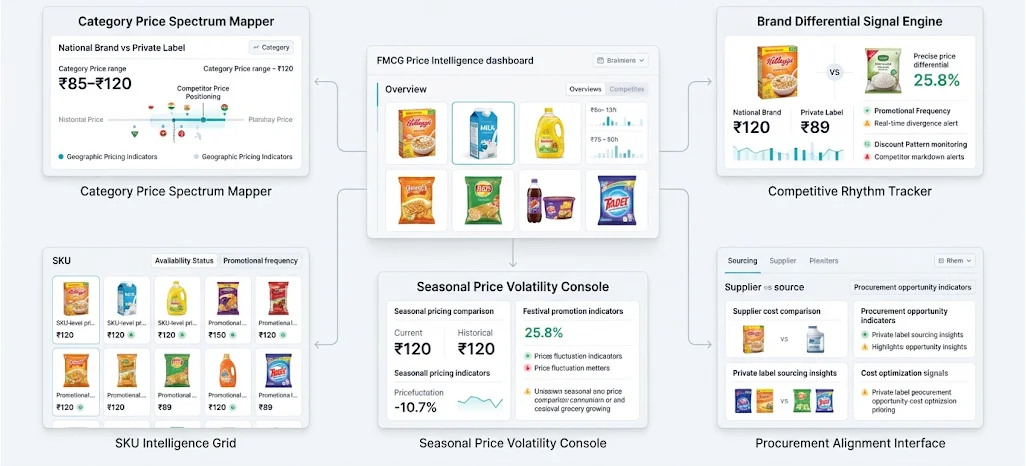
- Category Price Spectrum Mapper
A continuously updated pricing layer that maps How Retailers Benchmark Private Label Product Prices across all relevant competitor platforms, delivering category-level pricing spreads broken down by brand tier, SKU volume, and market geography. - Brand Differential Signal Engine
A real-time detection module that identifies price divergence between national brand and private label equivalents, surfacing actionable signals that category managers can use to adjust positioning, reformulate bundles, or trigger promotional responses. - Competitive Rhythm Tracker
Using Web Scraping Services, this module captures and analyzes competitor promotional cadences, weekly price cycles, and markdown patterns, giving the client advance intelligence into competitor pricing behavior before changes affect shelf-level conversion. - SKU Intelligence Grid
An item-level benchmarking system that enables Grocery Brand Pricing Intelligence for Retailers by scoring every SKU in the catalog against competitor equivalents on price, availability, and promotional frequency, updated daily across both brand tiers. - Seasonal Price Volatility Console
A forward-looking analytics dashboard that maps historical seasonal price patterns against current market data, enabling the client to plan promotional pricing strategies with greater precision and reduce reactive discounting events. - Procurement Alignment Interface
A bridge between pricing intelligence outputs and procurement decision workflows, ensuring that sourcing teams receive timely signals about cost arbitrage opportunities, particularly for private label categories where supplier flexibility and market pricing are closely linked.
Key Insights Gained from Private Label vs National Brand Price Tracking
| Intelligence Area | Outcome Delivered |
|---|---|
| Brand Tier Price Gap Analysis | Identified optimal price spread between private label and national brands across 18 key categories |
| Promotional Pattern Recognition | Mapped competitor promotional cycles across weekly and seasonal windows for strategic counter-planning |
| Private Label Conversion Benchmarks | Measured price elasticity thresholds where private label items outperformed national brand alternatives |
| Cross-Category Margin Profiling | Surfaced high-margin category clusters where private label pricing could be refined without volume impact |
| Competitive Pricing Response Time | Reduced average price adjustment lag from 22 days to under 36 hours across priority SKUs |
Benefits of Private Label vs National Brand Price Tracking From Retail Scrape
The deployment of Retail Scrape’s pricing intelligence framework delivered transformative outcomes across the client’s commercial operations:
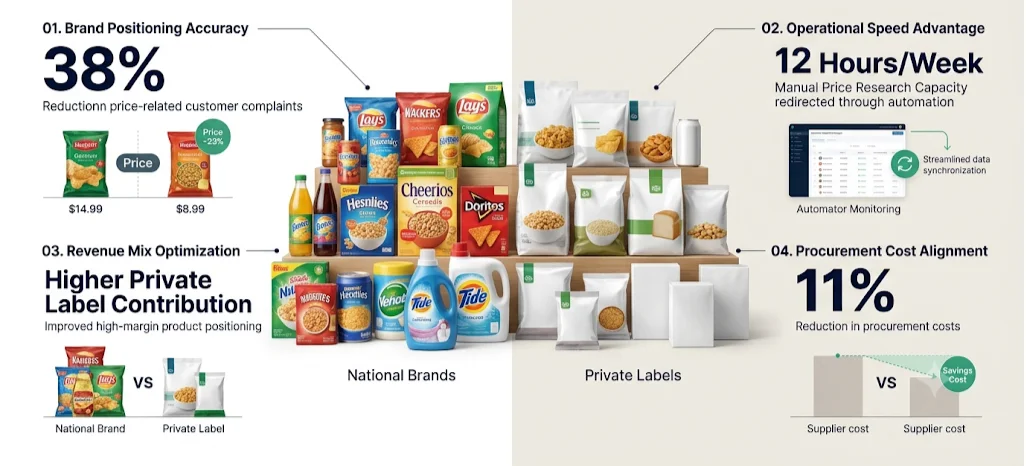
- Brand Positioning Accuracy
By enabling Retail Price Benchmarking for Grocery Categories at the SKU and category level, the client achieved a measurably improved ability to position private label products at price points that maximized conversion without cannibalizing margin. Category teams reported a 38% reduction in price-related customer complaints. - Operational Speed Advantage
Web Scraping API Services eliminated manual monitoring bottlenecks by automating data collection across competitor platforms on a continuous basis. Teams previously spending twelve hours per week on price research redirected that capacity toward strategic analysis and category planning. - Revenue Mix Optimization
With sharper Grocery Price Comparison data informing category decisions, the client systematically shifted consumer purchasing behavior toward higher-margin private label products, improving the overall revenue mix without requiring additional promotional spend. - Procurement Cost Alignment
Pricing intelligence outputs directly informed procurement negotiations, enabling buyers to anchor cost discussions with live market data rather than internal benchmarks, reducing average procurement costs in key categories by 11%.
Client's Testimonial

Retail Scrape fundamentally changed how we think about category pricing. The depth of intelligence we now have around Private Label vs National Brand Price Tracking is something we could not have built internally at any comparable speed or cost. The platform gave us an entirely new layer of Grocery Brand Pricing Intelligence for Retailers that connects directly to our buying and promotional planning workflows. The impact on margins and category performance has been both measurable and sustained.
– Head of Digital Commerce Strategy, National Online Grocery Platform
Conclusion
Competitive success in modern online grocery requires more than strong product selection, it demands structured, real-time intelligence that connects pricing decisions across every brand tier and category. Private Label vs National Brand Price Tracking is no longer an optional capability for grocery retailers; it is the operational backbone that separates margin-leaders from margin-followers in a market where price differences of a few cents shift significant purchase volume.
Retail Scrape equips grocery businesses with the intelligence infrastructure needed to close the visibility gap between their own pricing and what the market demands. Through FMCG Brand-Level Competitor Price Intelligence, retailers gain the analytical foundation to make brand-tier pricing decisions with confidence, speed, and precision that manual processes simply cannot match.
Contact Retail Scrape today to build your grocery pricing intelligence framework, sharpen your category strategies, eliminate unnecessary margin loss, strengthen your competitive positioning across brand tiers, and create a sustainable pricing advantage that scales with your digital grocery ambitions.