.gif)


Why Compare Product Availability API vs Price Monitoring API Before Choosing Your Retail Data Feed?
Introduction
Modern e-commerce brands constantly struggle to balance seamless inventory operations with aggressive dynamic pricing strategies. Choosing between a Product Availability API vs Price Monitoring API determines whether your store prevents costly stockouts or captures high-margin retail market share. Both tools deliver crucial data feeds, yet they solve fundamentally different commercial challenges across your supply chain and digital storefront.
Integrating a robust Product Availability and Price Tracking API allows growing brands to build a balanced, real-time intelligence engine. While continuous availability monitoring keeps your supply chain responsive, dynamic price surveillance ensures your store never loses margin to aggressive competitors. Aligning these data pipelines with your overall strategy is vital before committing your engineering resources to a specific feed.
Understanding the structural differences between inventory tracking and price scraping keeps your business agile. Prioritizing inventory feeds secures steady fulfillment and customer trust, while price feeds protect your gross margins in volatile target markets. Evaluating a Retail Product Data API Comparison gives you the exact metrics required to make an informed tech stack decision.
Evaluating Core Differences Between Stock Tracking and Pricing Intelligence Data
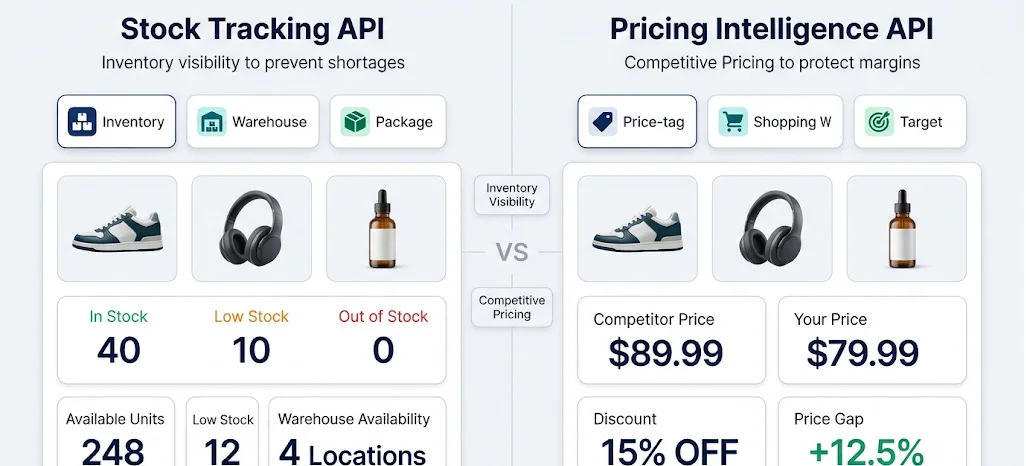
Supply chain stability and digital storefront performance rely heavily on continuous market visibility across your entire product inventory. Selecting an intelligence infrastructure requires understanding how stock monitoring differs from active price surveillance in everyday operations. While inventory tracking focuses primarily on catalog presence, pricing feeds capture real-time shifts in retail valuations, promotional discounts, and competitor margins.
Deploying E-Commerce Price Monitoring empowers merchant teams to analyze competitive market movements while protecting profit margins across volatile sales channels. Retailers must carefully examine these functional differences to prevent stockouts while simultaneously maintaining an aggressive market posture. Implementing automated surveillance prevents revenue loss caused by uncompetitive pricing or sudden inventory depletion across key regional hubs.
Selecting the Best API for Competitor Price Monitoring enables enterprise brands to benchmark competitor catalogs without sacrificing operational efficiency. Aligning these technical capabilities with strategic commercial goals ensures long-term market dominance and higher customer retention rates.
- Real-time stock status monitoring across regional distribution centers and local retail storefronts
- Automated surveillance of competitor promotional discounts, seasonal markdowns, and price shifts
- Seamless integration with internal enterprise resource planning and dynamic repricing systems
- High-frequency data delivery tailored to fast-moving digital catalogs and multi-channel fulfillment
| Feature Metric | Availability Engine | Pricing Engine |
|---|---|---|
| Primary Focus | In-Stock / Out-of-Stock Status | Competitor Price & Discount Rates |
| Refresh Frequency | High-frequency (Near Real-Time) | Scheduled Batch / Hourly Scrapes |
| Key Business Metric | Fulfillment Rate & Cart Lift | Profit Margin & Conversion Rate |
| Primary Data Source | Regional Warehouses & Stores | Digital Catalog Frontends & Feeds |
Engineering teams must evaluate how each data stream impacts internal databases, analytics pipelines, and dynamic repricing software. Data frequencies and structural payloads vary significantly depending on whether your primary objective is tracking regional stock or capturing complex pricing tiers. Balancing both pipelines ensures your digital storefront remains resilient, responsive, and completely aligned with customer demand patterns.
Analyzing Scraping Architecture Performance and Data Processing Extraction Frequencies
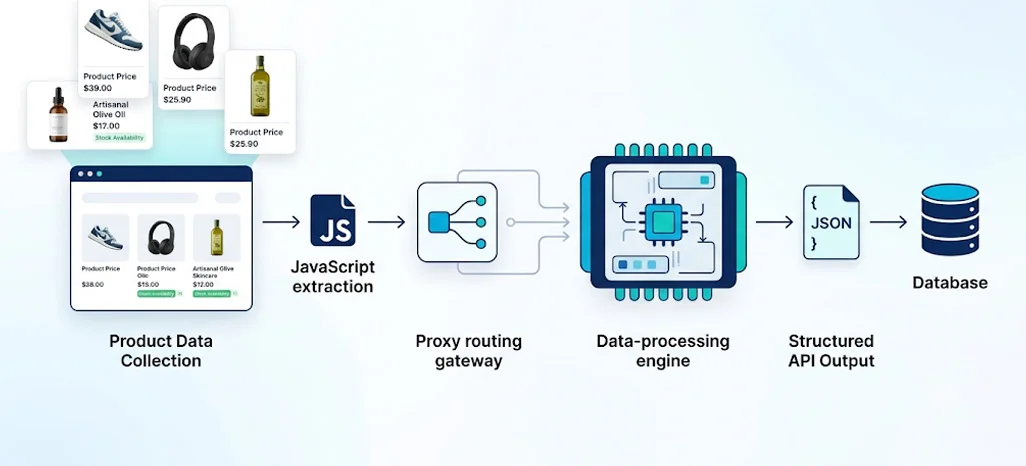
Data extraction architectures vary significantly depending on whether your infrastructure prioritizes localized stock updates or complex catalog pricing streams. Availability tracking demands high-frequency polling across specific postal codes and local fulfillment nodes to monitor rapid inventory depletion rates. Conversely, pricing extraction focuses on parsing client-side JavaScript rendering, localized currency variations, dynamic cart calculations, and complex promotional structures.
Leveraging an E-Commerce Product Data API for Market Research allows technical teams to evaluate catalog breadth while building robust data pipelines. Modern scraping architectures utilize specialized proxy networks and browser rendering engines to ensure consistent data extraction across restrictive retail websites. Infrastructure engineers must optimize request frequencies to capture essential changes without overtaxing target servers or incurring unnecessary operational costs.
Enterprise platforms depend on high-throughput extraction setups to process millions of product URLs daily without structural failures or rate limits. System architects must continuously refine proxy rotation, anti-bot bypass strategies, and error-handling routines to maintain uninterrupted data feeds. Investing in a scalable data extraction setup drives actionable market intelligence and supports long-term enterprise growth strategies.
- Distributed proxy rotation designed to handle regional localization and localized store views
- Dynamic headful browser rendering for extracting complex JavaScript web applications seamlessly
- Automated payload parsing that converts raw unstructured HTML into normalized JSON datasets
- High-availability architecture capable of maintaining consistent throughput during peak shopping periods
| Architecture Element | Availability Engine | Pricing Engine |
|---|---|---|
| Geo-Targeting Need | Zip Code / Local Store Level | Country / Regional Currency Level |
| Data Payload Size | Light (SKU ID, Stock Flag) | Heavy (HTML, CSS, JSON Pricing) |
| Average Extraction Rate | 99.4% Uptime Accuracy | 98.8% Parsing Accuracy |
| Scraping Complexity | High Proxy Rotation per Location | Complex Anti-Bot & JS Execution |
Parsing algorithms must process diverse HTML structures, hidden API endpoints, and dynamic content layers to deliver structured datasets for downstream applications. Clean data ingestion prevents database corruption and ensures that executive reporting dashboards reflect accurate operational metrics. Establishing resilient extraction pipelines minimizes downtime and guarantees high data fidelity across global e-commerce monitoring operations.
Understanding Business Impact and Return on Investment Across Diverse Retail Sectors
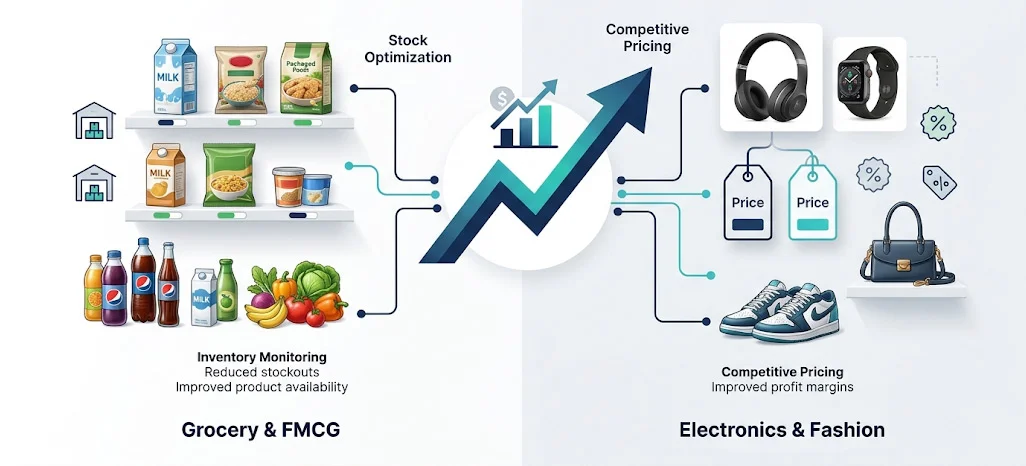
The commercial return on investment differs dramatically depending on your specific retail sector, inventory velocity, and competitive landscape. Fast-moving consumer goods and grocery sellers rely heavily on hyper-local availability feeds to manage perishable stock and local delivery promises. Conversely, high-ticket electronics and fashion brands prioritize price surveillance to enforce MAP policies, execute seasonal markdowns, and protect market positioning.
Integrating a SKU-Level Product Availability Monitoring API helps high-volume sellers manage complex stock allocations across multiple regional hubs seamlessly. Quantifying financial returns involves evaluating reduced cart abandonment, optimized stock levels, improved buy box win rates, and higher gross margins. Retail executives can pinpoint precise operational inefficiencies by deploying structured data feeds tailored specifically to their core commercial objectives.
Long-term success in digital retail requires continuous monitoring, data validation, and rapid execution based on real-time market signals. Enterprise teams that align technical data capabilities with strategic commercial targets capture higher market share and foster stronger customer loyalty. Building an adaptable retail intelligence framework safeguards your digital operations against unexpected market shifts and aggressive competitive pressures.
- Measurable reduction in cart abandonment caused by unexpected out-of-stock product listings
- Enhanced buy box competitiveness through automated dynamic repricing algorithms and surveillance
- Improved inventory turnover rates by identifying localized demand spikes and fulfillment gaps
- Maximum ROI achieved through the integration of real-time pricing and stock data streams
| Industry Application | Priority API Feed | Expected Business ROI |
|---|---|---|
| On-Demand Grocery | Availability & Location Tracking | 18% Increase in Order Fulfillment |
| Consumer Electronics | Price & Bundle Tracking | 14% Margin Improvement via Repricing |
| Fashion & Apparel | Assortment & Markdown Tracking | 22% Reduction in Excess Inventory |
| Marketplace Sellers | Combined Availability & Price | 35% Higher Buy Box Win Rate |
Deploying an API for Tracking Grocery Prices and Availability guarantees that hyper-local fulfillment operations maintain accurate catalog visibility across volatile markets. Enterprise organizations that combine availability monitoring with price tracking achieve superior agility compared to competitors relying on single-dimensional data streams.
How Retail Scrape Can Help You?
Navigating complex retail data feeds requires specialized infrastructure that scales effortlessly with your business demands. When evaluating a Product Availability API vs Price Monitoring API, our enterprise-grade extraction pipeline delivers pristine, structured data tailored precisely to your operational requirements.
Our custom extraction solutions deliver fully managed data feeds across global e-commerce platforms, marketplaces, and localized retail storefronts:
- Fully automated proxy rotation and anti-bot handling to ensure continuous data access
- Enterprise-grade delivery formats including JSON, CSV, and direct S3/Database integration
- Customizable scraping frequencies ranging from real-time webhooks to scheduled batch updates
- Hyper-local extraction capabilities down to specific postal codes and store locations
- Automated data validation and normalization pipelines for immediate analytical consumption
- Scalable architecture capable of handling millions of SKU extractions daily without downtime
Partnering with professional Web Scraping Services ensures your enterprise receives a continuous Retail Competitor Pricing Data Feed that accelerates strategic decision-making.
Conclusion
Choosing the ideal data architecture depends entirely on your immediate business priorities, inventory turnover, and market positioning. Integrating a Product Availability API vs Price Monitoring API ensures your e-commerce engine maintains optimal stock levels while simultaneously maximizing your competitive pricing edge.
Enterprise retailers that combine both streams consistently outperform single-focus competitors in cart conversion, customer retention, and overall margin growth. Ready to transform your e-commerce operations with high-precision retail data feeds? Streamline your market intelligence today with Retail Scrape custom Retail Product Data Extraction solutions.