
How AI-Powered Dynamic Pricing Strategies for Retailers Automate Smarter Price Changes in 2026?
Introduction
Retail pricing in 2026 is becoming increasingly data-driven as retailers manage changing demand, competitor movements, inventory levels, promotions, and customer expectations. AI-Powered Dynamic Pricing Strategies for Retailers help businesses evaluate these signals continuously and recommend timely price adjustments without relying entirely on manual analysis.
The growth of E-Commerce Data Intelligence is also giving pricing teams access to broader market signals. By combining transaction history, competitor information, product availability, and customer behavior, retailers can make more informed decisions. Retail Dynamic Pricing: Ai-Powered Automated Pricing enables pricing systems to move from fixed schedules toward responsive, data-supported decisions.
At the same time, retailers are looking beyond simple repricing. AI Dynamic Pricing: How Retailers Automate Price Changes connects forecasting, pricing rules, competitive intelligence, and business objectives within a coordinated workflow. This approach can help retailers reduce unnecessary markdowns, protect margins, respond to market changes, and create more consistent pricing decisions across digital and physical channels.
Building Smarter Retail Pricing Decisions Through Continuous Intelligence
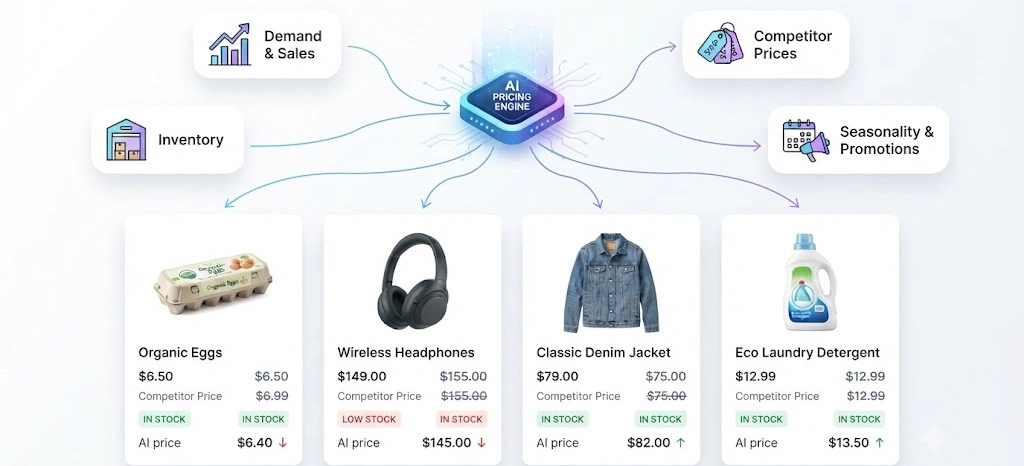
Retailers increasingly need pricing systems that can interpret several market signals simultaneously instead of depending on isolated observations. Retail Dynamic Pricing: Ai-Powered Automated Pricing can connect demand patterns, inventory conditions, competitor movements, and historical sales to support more timely decisions. This makes pricing more responsive while allowing businesses to establish clear limits around acceptable price movements.
Another important capability is understanding what may happen before a pricing decision is made. AI Demand & Availability Forecasting can estimate future purchasing patterns, stock pressure, and potential demand fluctuations. When these predictions are combined with current market observations, retailers can determine whether a product requires a competitive adjustment, a margin-protective approach, or no immediate change.
Key signals that can support these decisions include:
- Demand changes and historical sales patterns
- Competitor pricing movements across comparable products
- Inventory levels and product availability
- Seasonal and promotional purchasing behavior
Retailers can also use Dynamic Pricing for Retailers Using AI and Automation to coordinate pricing decisions across large product catalogs. Instead of manually reviewing individual products, automated systems can prioritize products according to business conditions and predefined objectives. McKinsey reports that sophisticated retailers can reprice selected online products multiple times daily, while reported dynamic-pricing programs have produced 2–5% sales growth and 5–10% margin growth.
| Signal | AI Evaluation | Business Purpose |
|---|---|---|
| Demand | Purchase pattern analysis | Improve price timing |
| Inventory | Stock condition analysis | Manage product movement |
| Competition | Market comparison | Maintain positioning |
| Seasonality | Pattern recognition | Plan adjustments |
Connecting Automated Pricing With Smarter Assortment Planning
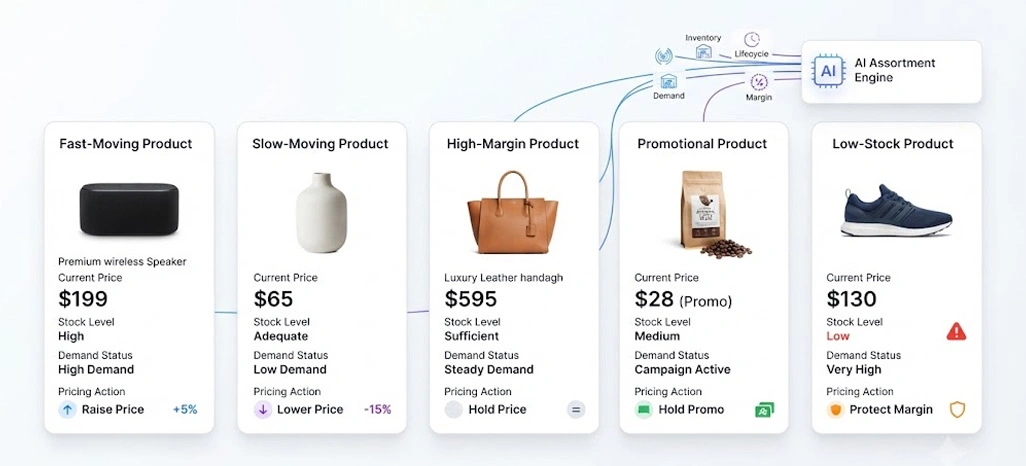
Pricing performance depends heavily on understanding which products deserve stronger competitive positioning and which products can maintain healthier margins. Dynamic Pricing Automation for Retailers allows pricing workflows to connect product performance, inventory conditions, demand patterns, and commercial objectives. This reduces repetitive manual reviews while helping teams maintain consistent decision rules across large assortments.
Assortment decisions can become more precise when pricing systems understand individual product roles. AI-Powered Assortment Optimization can identify products that require different treatment according to demand, availability, lifecycle stage, and category importance. This helps retailers avoid applying identical pricing approaches to products that have significantly different commercial conditions.
Retailers can strengthen this workflow by focusing on:
- Product-level demand and sales velocity
- Inventory depth and replenishment conditions
- Product lifecycle and category position
- Margin objectives and promotional requirements
The connection between assortment and pricing also supports better markdown planning. Retailers can identify slow-moving products earlier, recognize products experiencing stronger demand, and adjust pricing priorities accordingly. McKinsey reports that predictive assortment models can reduce markdowns and stockouts by 15–30%, showing the potential value of connecting predictive intelligence with merchandising decisions.
| Business Factor | Evaluation Approach | Potential Result |
|---|---|---|
| Product demand | Forecast purchasing | Better prioritization |
| Inventory depth | Assess stock pressure | Controlled markdowns |
| Lifecycle | Identify maturity | Appropriate price positioning |
| Category role | Assess importance | Focused pricing actions |
Improving Retail Execution Through Responsive Pricing Systems
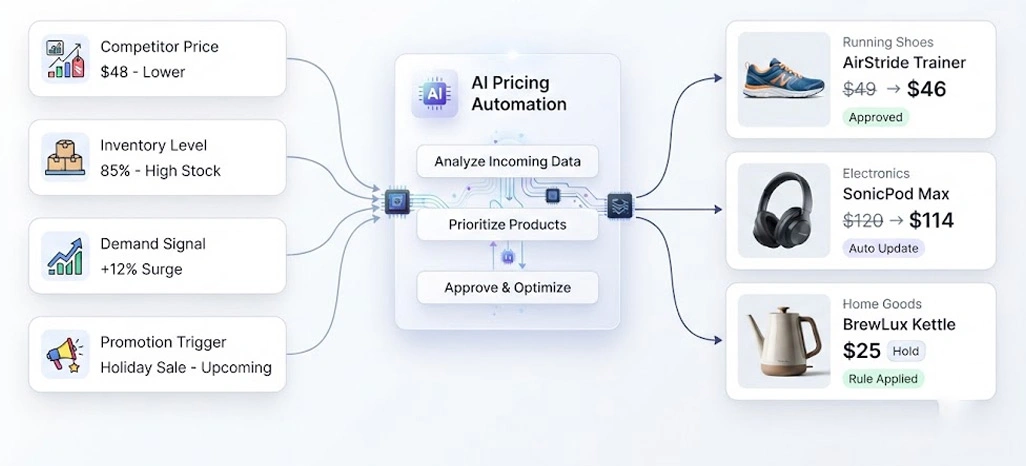
Pricing recommendations become more valuable when retailers can move efficiently from analysis to controlled execution. Automated Price Changes for Retailers can apply approved rules when competitor movements, demand conditions, inventory levels, or promotional triggers reach predefined thresholds. This reduces repetitive operational work while keeping pricing decisions within established commercial boundaries.
Retailers can also connect Dynamic Pricing Software for Retailers with existing data pipelines, pricing rules, dashboards, and business intelligence platforms. This creates a centralized workflow where market information can be evaluated before recommended changes are passed into appropriate systems. Such integration is particularly useful for businesses managing thousands of products across multiple channels.
A practical pricing execution framework can focus on:
- Competitive changes requiring timely responses
- Inventory conditions affecting product movement
- Promotional events influencing purchasing behavior
- Approval rules controlling automated adjustments
Real-time execution can improve responsiveness when market conditions change quickly. Dynamic Pricing Technology for Retailers can help organizations evaluate fresh signals, prioritize important products, and initiate controlled adjustments. McKinsey has reported pilot outcomes including improvements of up to 3% in both revenue and margins, while another retailer achieved a 10% gross-margin increase and 3% GMV improvement after implementing a tailored pricing module.
| Capability | Pricing Action | Retail Impact |
|---|---|---|
| Competition | Evaluate market position | Faster response |
| Inventory | Review stock pressure | Healthier movement |
| Promotions | Assess campaign conditions | Better coordination |
| Rules | Apply approved thresholds | Reduced manual effort |
How Retail Scrape Can Help You?
AI-Powered Dynamic Pricing Strategies for Retailers depend on reliable external market information. We can help retailers collect structured competitor and product information from relevant online sources, creating a stronger data foundation for pricing analysis. Its data collection approach can support product-level comparisons across categories, sellers, locations, and channels.
- Collect competitor product and pricing information
- Track product availability across selected sources
- Structure product attributes for comparison
- Monitor promotional offers and discounts
- Organize historical pricing information
- Prepare datasets for analytics and AI workflows
Using Real-Time Retail Price Monitoring Data, pricing teams can compare current market conditions with internal sales, inventory, and demand signals. This helps identify meaningful pricing movements instead of relying on isolated observations.
With Dynamic Pricing Technology for Retailers, businesses can build more responsive workflows while maintaining internal pricing rules and approval controls. We can support these workflows by supplying organized external data that can feed dashboards, analytical models, repricing systems, and business intelligence environments.
Conclusion
Retailers entering 2026 need pricing systems capable of responding to rapidly changing market conditions without sacrificing control or customer trust. AI-Powered Dynamic Pricing Strategies for Retailers combine demand signals, inventory intelligence, competitive information, and automated decision rules to make pricing more responsive. Businesses can begin with selected categories, validate outcomes, and gradually expand automation across their assortment.
A strong implementation also requires accurate data, transparent governance, and human oversight. AI Pricing Optimization Software can help translate complex pricing signals into actionable recommendations while allowing teams to define boundaries and business objectives. Start building smarter retail pricing intelligence with Retail Scrape today.