What Do Retail Grocery Price Trends and Inflation in 2026 Reveal After 5% Grocery Price Surges?
Introduction
Retail grocery markets in 2026 continue to show uneven price movements rather than a uniform inflation pattern. Retail Grocery Price Trends and Inflation in 2026 indicate that some categories are stabilizing while others remain elevated, making timely monitoring important for pricing, promotions, assortment, and demand planning.
In the United States, food-at-home prices increased 2.7% year over year through July 2026, while fruits and vegetables rose 5.1% and nonalcoholic beverages increased 4.1%. These differences show why retailers need category-level visibility instead of relying only on broad inflation figures. Grocery Scraping API Services can support continuous collection of comparable pricing signals.
For retailers, suppliers, and analysts, Grocery Price Trends Using Real-Time Data can reveal how prices move across competitors and categories. Current data can also identify promotion changes, price gaps, and fast-moving products before monthly reports fully capture market shifts.
Grocery Inflation Patterns Reveal Diverging Category Movements
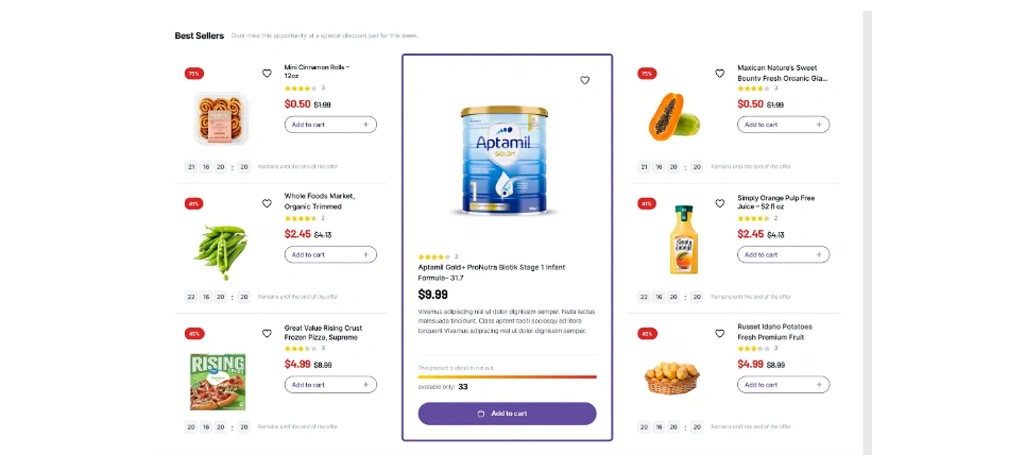
Grocery inflation in 2026 is showing different patterns across individual product categories, making broad market averages less informative for detailed retail decisions. Food-at-home prices increased 2.7% year over year through July, but fruits and vegetables recorded a considerably higher 5.1% increase. This difference highlights the importance of examining individual categories when evaluating retail pricing pressure.
Retailers can use Real-Time Data for Grocery Price Tracking to compare current shelf prices with previous observations and competitor listings. Such information can show whether a category is experiencing widespread inflation or whether individual retailers are adjusting prices independently. Frequent observations can also identify promotional changes that may not be visible in monthly inflation statistics.
| Grocery indicator | July 2026 annual movement | Monthly movement |
|---|---|---|
| Food at home | 2.7% | -0.1% |
| Fruits and vegetables | 5.1% | -0.1% |
| Nonalcoholic beverages | 4.1% | +0.9% |
| Dairy products | -0.5% | -0.1% |
These differences create opportunities for retailers to evaluate pricing strategies at a more granular level. A category with sustained increases may require different promotional planning from one experiencing temporary volatility. Monitoring product-level changes can therefore support better decisions around pricing, assortment, and inventory allocation.
- Compare category-level price movements across retailers.
- Identify products experiencing repeated price increases.
- Track promotional changes alongside regular prices.
- Evaluate category-specific inflation exposure.
Retail Price Changes Reflect Evolving Shopper Behavior
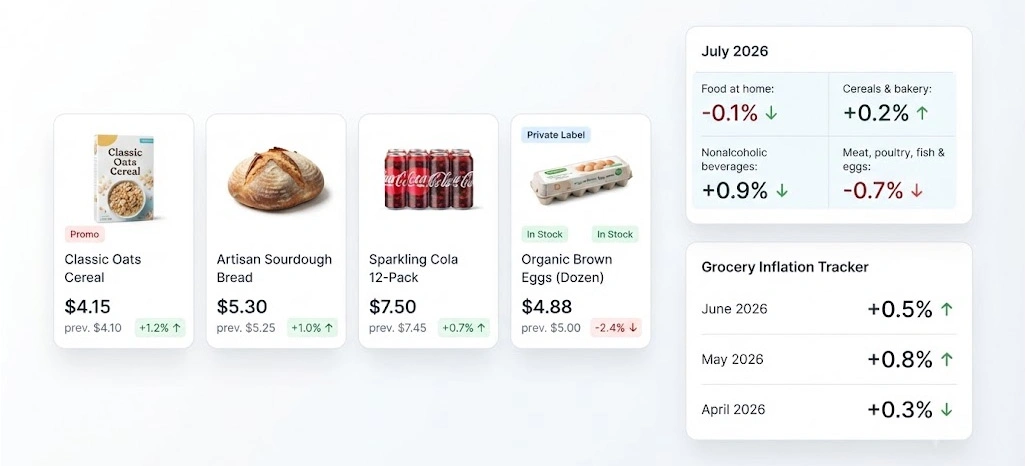
Changing grocery prices can influence how consumers compare products, switch brands, respond to promotions, and prioritize essential purchases. Although food-at-home prices declined 0.1% month over month in July 2026, several categories still recorded annual increases, demonstrating that short-term stabilization does not necessarily mean inflationary pressure has disappeared.
Web Scraping Grocery Data can help retailers observe these movements more frequently across online stores and digital grocery marketplaces. Capturing product prices, discounts, availability, and assortment information creates a broader view of how competitors are responding to market conditions. These observations can also help businesses identify pricing gaps that may affect consumer purchasing decisions.
| Grocery indicator | July 2026 monthly movement |
|---|---|
| Food at home | -0.1% |
| Cereals and bakery products | +0.2% |
| Nonalcoholic beverages | +0.9% |
| Meat, poultry, fish and eggs | -0.7% |
A detailed Grocery Inflation Tracker can organize historical observations and make recurring changes easier to identify. Retailers can compare current prices with earlier records, assess competitor movements, and determine whether changes are isolated or occurring across multiple sellers. This can support more informed promotional planning and pricing reviews.
- Monitor changes across comparable grocery products.
- Identify products with frequent promotional adjustments.
- Compare brand and private-label pricing.
- Observe availability alongside pricing changes.
Competitive Pricing Signals Strengthen Retail Strategy Decisions
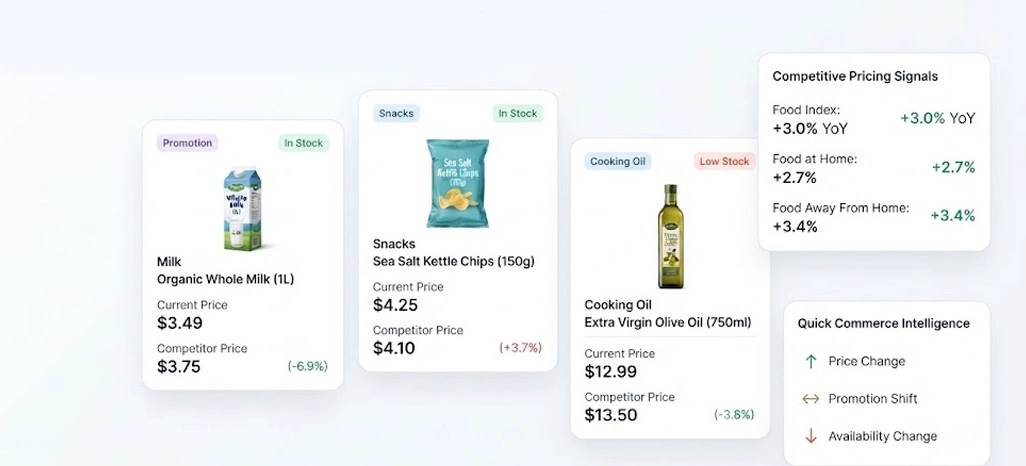
Competitive pricing becomes particularly important when inflation affects grocery categories unevenly. In July 2026, the overall food index increased 3.0% year over year, while food-at-home prices increased 2.7% and food-away-from-home prices increased 3.4%. These differences indicate that consumers may face varying cost pressures depending on where and how they purchase food.
Quick Commerce Data Intelligence can add another layer of visibility by examining fast-changing grocery prices, promotions, availability, and assortment across digital delivery channels. Because quick-commerce environments can experience frequent price and stock changes, regular data collection can help retailers understand competitive movements and identify opportunities for pricing adjustments.
| Food pricing indicator | July 2026 annual movement |
|---|---|
| Food | 3.0% |
| Food at home | 2.7% |
| Food away from home | 3.4% |
Retailers can also apply Grocery Inflation and Price Trends 2026 analysis to understand how category movements connect with competitive positioning. Comparing historical and current observations can reveal recurring price patterns, promotional intensity, and differences between competing retailers. This information can contribute to more responsive pricing strategies while helping businesses evaluate where shoppers may be more sensitive to price changes.
- Compare prices across competing digital retailers.
- Track promotional intensity across categories.
- Monitor availability and assortment changes.
- Identify recurring competitive pricing patterns.
How Retail Scrape Can Help You?
Retailers need detailed visibility when category-level inflation differs sharply from the broader market. Retail Grocery Price Trends and Inflation in 2026 can be analyzed more effectively when pricing information is collected frequently across competitors, products, locations, and digital channels rather than reviewed only through periodic reports.
We can help businesses build a structured monitoring workflow that captures changing grocery prices and market signals. Key capabilities include:
- Monitor competitor product prices across multiple retail websites.
- Track promotional offers, discounts, and markdown activity.
- Compare identical products across competing retailers.
- Capture product availability and assortment changes.
- Organize pricing information for historical comparisons.
- Support dashboards for recurring market intelligence.
This approach can make Scrape Grocery Inflation Data Tracking more practical for teams evaluating category movements and competitive pricing. A structured Grocery Price Monitoring 2026 can also help organize historical observations, identify recurring fluctuations, and connect price changes with broader market conditions. With consistent data collection, retailers can move from occasional price checks toward systematic monitoring and more responsive commercial decisions.
Conclusion
The latest figures suggest that grocery inflation in 2026 is not moving uniformly across categories. Retail Grocery Price Trends and Inflation in 2026 show a market where some products remain under pressure while others stabilize or decline, making detailed monitoring essential for retailers managing pricing, promotions, and assortment decisions.
For businesses, Grocery Inflation and Price Trends 2026 can provide a useful framework for evaluating category-level movements, competitor positioning, and changing shopper behavior. Combining frequent data collection with structured analysis can turn scattered market signals into actionable pricing intelligence. Start building a smarter grocery pricing strategy with Retail Scrape today.