
Reinventing Hotel Profitability With Hotel Dynamic Pricing Increased Revenue for Hotel Chains
Introduction
The hospitality industry operates in one of the most price-sensitive environments in retail and service sectors alike. Competing across multiple booking platforms, managing fluctuating demand cycles, and responding to real-time market shifts require a level of pricing sophistication that most hotel chains struggle to maintain manually. Hotel Dynamic Pricing Increased Revenue for Hotel Chains by replacing outdated fixed-rate models with intelligent, data-backed pricing systems that respond dynamically to occupancy signals, local events, and competitor rate shifts.
Modern revenue management is no longer about setting seasonal rates and waiting. It now demands continuous monitoring, predictive analytics, and automated adjustments that align with consumer behavior patterns. Hotel Pricing Intelligence Data plays a central role in this transformation, enabling hotel operators to benchmark their rates against the competitive landscape with precision and act on pricing opportunities before they disappear. Using Web Scraping Hotel Data as a foundational collection mechanism, we empower hotel businesses to build intelligence layers that drive smarter pricing at scale.
The convergence of rate analytics and market intelligence is reshaping how hotel chains approach profitability. With demand volatility accelerating across leisure and business travel segments, the need for structured, real-time pricing insight has never been more critical. Dynamic Pricing for Hotels equips revenue management teams with the competitive awareness and agility needed to protect margins, improve occupancy, and build long-term revenue stability in markets that rarely stay still.
The Client
A prominent multi-brand hotel group managing over 85 properties across metropolitan and resort destinations had reached a strategic inflection point. Despite strong brand recognition and consistent occupancy in peak periods, the group was leaving measurable revenue on the table during mid-week lulls, off-peak months, and event-driven demand windows. Hotel Dynamic Pricing Increased Revenue for Hotel Chains emerged as the framework the leadership team needed to rethink their entire rate management structure and close the gap between potential and actual revenue performance.
The group's existing revenue management infrastructure relied on quarterly rate reviews and manually assembled competitor reports, a process that was labor-intensive, inconsistently executed, and always operating with a time delay. Without access to Hotel Data Scraping Services, the team had no efficient way to track how competitors were adjusting rates across OTA platforms in real time, nor could they predict how pricing shifts might affect their own booking velocity and average daily rate.
Leadership recognized that the problem was structural, not operational. Individual property managers were making rate decisions in isolation, with no centralized intelligence layer guiding consistent pricing behavior across the portfolio. Implementing a Hotel Dynamic Pricing Strategy required not just better technology but a comprehensive data infrastructure capable of collecting, normalizing, and delivering competitor rate signals across all 85 properties simultaneously enabling portfolio-wide rate optimization rather than fragmented, property-level guesswork.
Key Challenges Faced by the Client
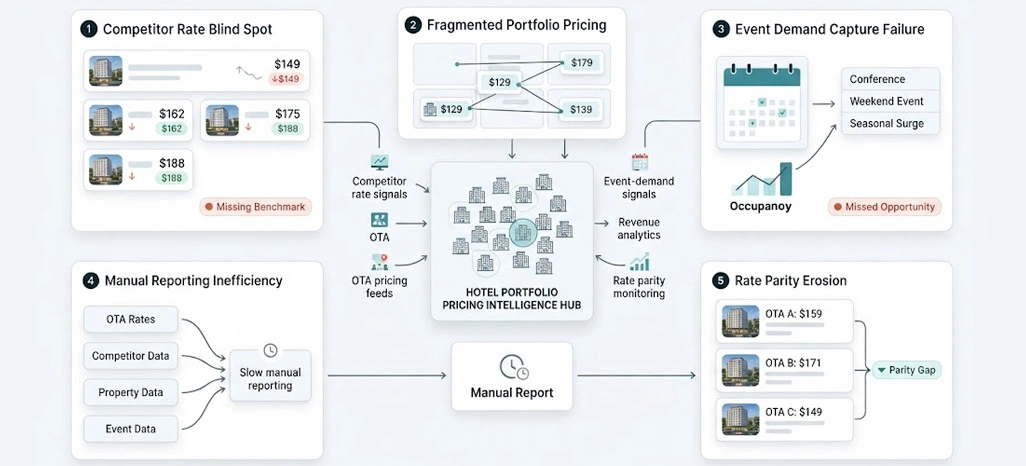
- Competitor Rate Blind Spot
Food Data Scraping Services aside, the group lacked any structured mechanism to monitor competitor pricing changes across booking channels in real time. Rate decisions were made without reliable benchmarks, leaving the group perpetually reactive rather than strategically proactive in competitive pricing environments. - Fragmented Portfolio Pricing
With 85 properties operating under separate revenue management processes, pricing consistency was impossible to maintain. Properties in the same market were often undercutting each other, creating brand confusion and suppressing portfolio-level average daily rate during periods when demand could have supported premium pricing. - Event Demand Capture Failure
Local events, conferences, and seasonal surges created predictable demand windows that the group consistently failed to capitalize on. Without a system for anticipating event-driven pricing opportunities, properties defaulted to standard rates while competitors filled their rooms at significantly higher average values. - Manual Reporting Inefficiency
Revenue analysts spent too much time compiling rate reports from multiple sources instead of turning insights into action. This manual process slowed decision-making and limited the team's ability to focus on strategic planning, revenue optimization, and Food Delivery Data Intelligence. - Rate Parity Erosion
Inconsistent pricing across OTA platforms created rate parity violations that damaged brand credibility and customer trust. Without automated monitoring, parity issues went undetected for extended periods, giving competitors a pricing advantage and undermining the group's positioning on third-party booking channels.
Key Solutions for Addressing Client Challenges
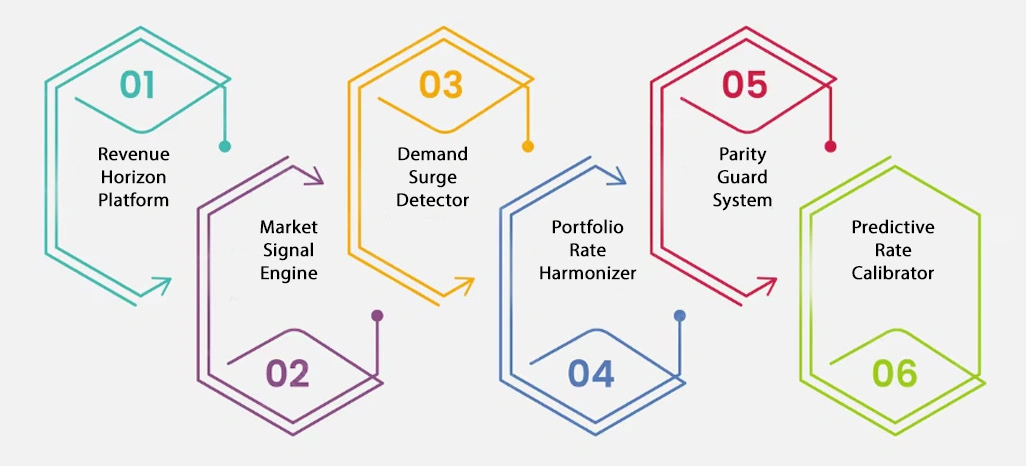
- Revenue Horizon Platform
A centralized rate intelligence system that aggregates competitor pricing data from OTAs, direct booking channels, and metasearch platforms in real time. This platform provided portfolio-wide visibility into competitive rate positioning, empowering revenue leadership to make data-driven decisions across all 85 properties simultaneously rather than relying on disconnected property-level reporting. - Market Signal Engine
Built using Real-Time Hotel Pricing Optimization methodology, this tool automatically detects competitor rate adjustments and demand fluctuations and delivers instant alerts to revenue managers. The engine eliminated the information delay that had been costing the group revenue opportunities and enabled same-day rate responses to market movements that previously took weeks to identify. - Demand Surge Detector
An event intelligence module designed to identify upcoming local events, conferences, seasonal travel peaks, and market demand anomalies. By connecting event data with historical occupancy patterns, the Restaurant Data Intelligence framework adapted for hospitality contexts this module forecasted demand windows and recommended rate uplift strategies well in advance, maximizing revenue capture during high-value periods. - Portfolio Rate Harmonizer
A cross-property pricing consistency engine that aligned rate strategies across the entire hotel portfolio while preserving the flexibility for individual properties to respond to their specific local market conditions. This solution eliminated internal rate conflicts, strengthened brand pricing integrity, and supported the group's effort toward Dynamic Pricing to Increase Hotel Revenue at a portfolio level rather than a property level. - Parity Guard System
An automated rate parity monitoring tool that continuously scans OTA listings and flags parity violations in real time. This system reduced parity breach resolution time from weeks to hours, protecting the group's OTA standing, maintaining consistent brand pricing, and preventing the revenue dilution that undetected parity violations consistently caused. - Predictive Rate Calibrator
A forward-looking pricing model that uses booking pace, demand signals, and competitive rate trends to recommend optimal rates up to 90 days in advance. This solution enabled revenue teams to shift from reactive pricing adjustments to proactive rate planning, supporting How Dynamic Pricing Increases Hotel Revenue through sustained occupancy improvements and ADR growth over time.
Key Insights Gained from Hotel Dynamic Pricing Increased Revenue for Hotel Chains
| Intelligence Area | Strategic Value Delivered |
|---|---|
| Competitor Rate Movement Tracking | Continuous visibility into rival pricing shifts across OTAs and direct channels |
| Event-Driven Demand Mapping | Advanced identification of demand surge windows for proactive rate uplift |
| Booking Pace Analysis | Early signals on occupancy trajectory enabling timely rate corrections |
| Rate Parity Compliance Monitoring | Automated detection and resolution of OTA pricing inconsistencies |
| Segment-Level Revenue Attribution | Clarity on which guest segments contributed most to ADR improvement |
Benefits of Hotel Dynamic Pricing Increased Revenue for Hotel Chains From Retail Scrape
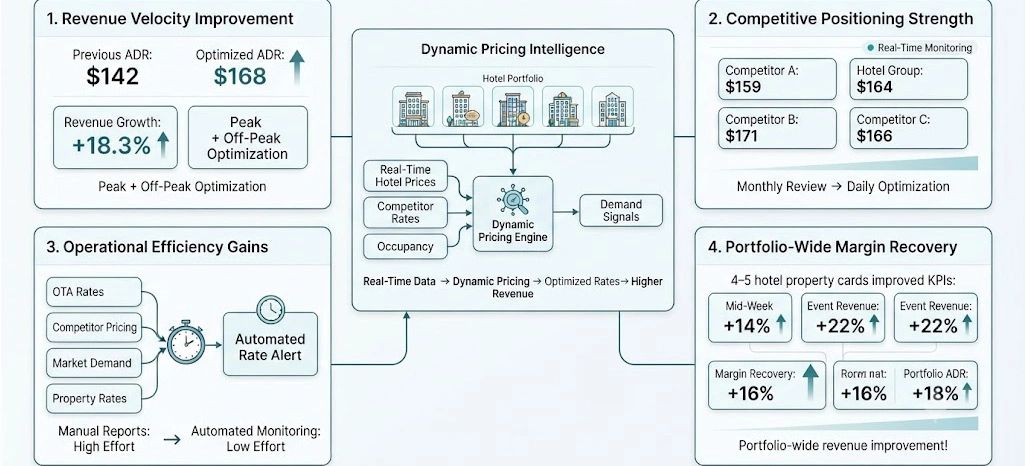
- Revenue Velocity Improvement
By deploying Hotel Price Optimization Using Real-Time Data, the group achieved consistent ADR growth across both peak and off-peak periods, reversing the revenue stagnation that had persisted under their previous fixed-rate pricing model. - Competitive Positioning Strength
Continuous access to Real-Time Hotel Price Monitoring transformed how the group responded to competitor rate changes. Revenue teams moved from monthly rate reviews to daily rate optimization cycles, significantly strengthening their competitive positioning across all major booking platforms. - Operational Efficiency Gains
Automated data collection and rate alerting reduced the manual reporting burden on revenue analysts by a substantial margin. Teams redirected their time toward strategic planning and guest experience improvements rather than compiling competitor rate spreadsheets that were outdated before they were even distributed. - Portfolio-Wide Margin Recovery
The Hotel Chain Increased Revenue with Dynamic Pricing approach enabled the group to recover margin across previously underperforming properties, with mid-week occupancy rates improving notably and event-period revenue capture reaching its highest levels in the group's history.
Client's Testimonial

Retail Scrape fundamentally changed how we think about pricing across our portfolio. The intelligence we now have access to through their platform has made us sharper, faster, and far more confident in our rate decisions. Hotel Dynamic Pricing Increased Revenue for Hotel Chains is not just a concept for us anymore it is our daily operating reality. With Scrape Hotel Data capabilities powering our competitive monitoring, we have eliminated the pricing blind spots that were quietly eroding our revenue performance for years.
– Vice President of Revenue Strategy, Multi-Brand Hotel Group
Conclusion
Sustainable revenue growth in hospitality demands more than strong brand recognition or prime locations; it requires pricing intelligence that keeps pace with a market that never stops moving. Hotel Dynamic Pricing Increased Revenue for Hotel Chains by replacing guesswork with structured competitive insight, enabling hotel groups to capture demand more effectively, protect margins, and build rate strategies that perform across every season.
With Hotel Pricing Intelligence Data at the core of every rate decision, properties gain the market awareness needed to price confidently rather than defensively. The ability to Scrape Hotel Data from live competitor feeds and booking platforms gives revenue teams a continuous, unfiltered view of the competitive landscape, one that no manual process could ever replicate.
Contact Retail Scrape today to transform how your hotel portfolio approaches revenue management.