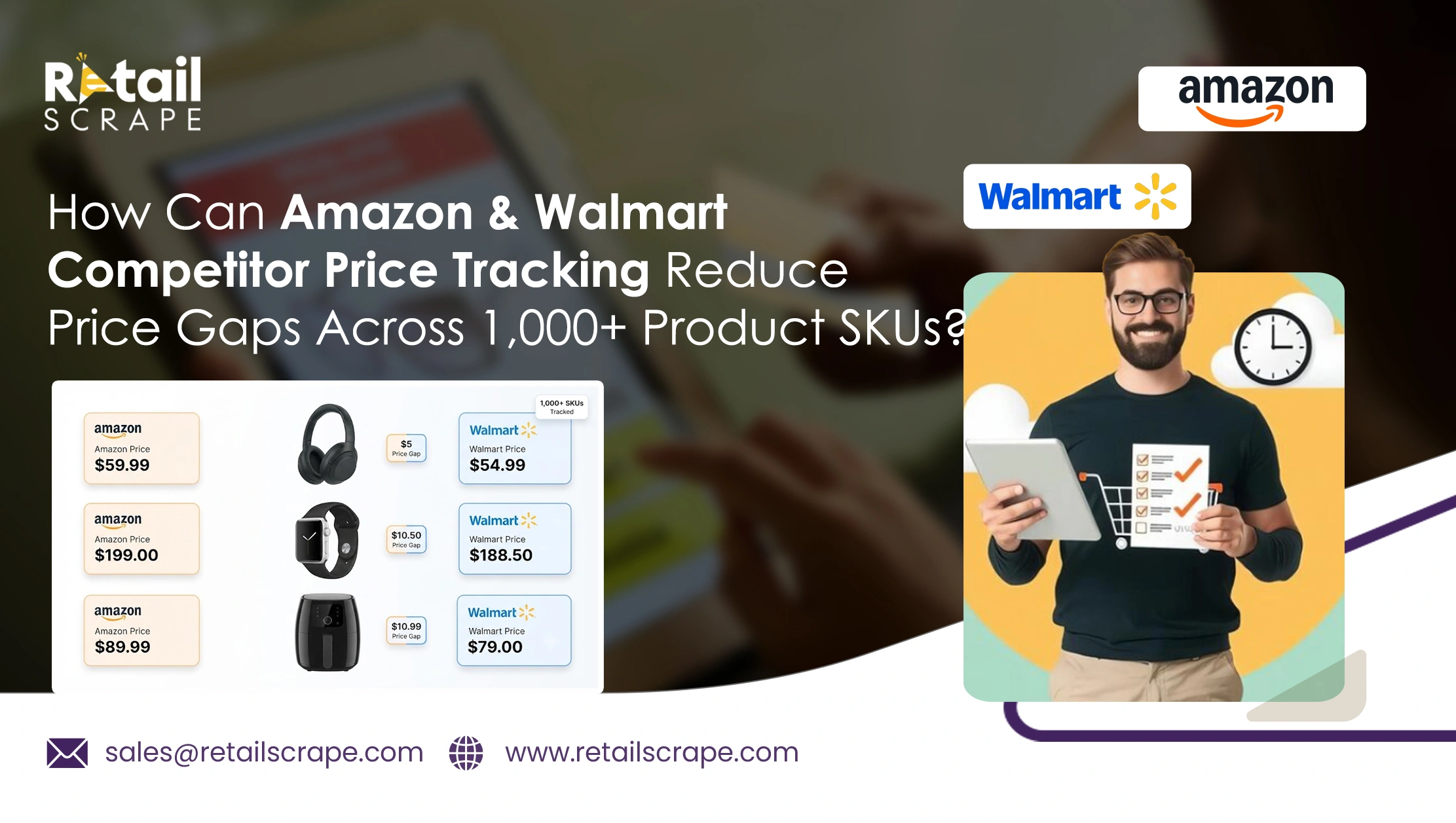
How Can Amazon & Walmart Competitor Price Tracking Reduce Price Gaps Across 1,000+ Product SKUs?
Introduction
Retailers managing thousands of products often face frequent price changes across marketplaces. Amazon & Walmart Competitor Price Tracking helps pricing teams compare market movements, identify gaps, and adjust prices using structured information. For brands operating across the United States, consistent monitoring can support stronger US Retail Competitor Price Intelligence and more informed pricing decisions.
A 1,000-SKU catalog can experience hundreds of competitor price changes within a single monitoring cycle. Amazon and Walmart Price Data Scraping for Businesses organizes product prices, discounts, availability, ratings, and related attributes into usable datasets. This allows teams to identify where products are overpriced, underpriced, or positioned appropriately against competing listings.
Using Competitor Pricing Intelligence Across Amazon and Walmart, retailers can establish SKU-level benchmarks instead of relying on occasional manual checks. Automated collection can also reveal recurring pricing patterns, promotional movements, and marketplace differences. The result is a clearer foundation for optimizing product-level pricing while reducing unnecessary gaps across large catalogs.
Establishing Reliable Benchmarks For Thousands Of Retail Products
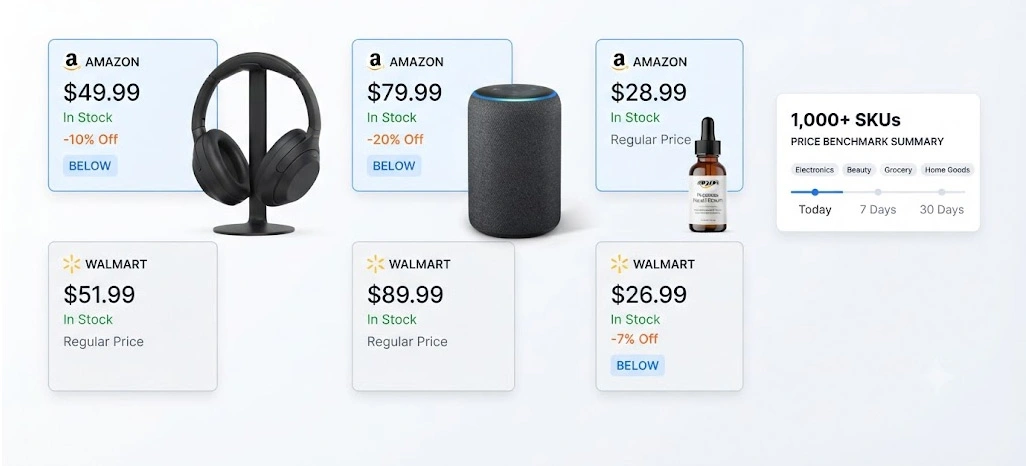
Managing prices across more than 1,000 SKUs requires consistent benchmarks that can be compared over time. Retail teams need to know whether a product is priced above, below, or close to competing marketplace listings. Amazon Walmart Price Monitoring for Ecommerce Brands can organize recurring observations around product prices, discounts, availability, and promotional changes. This creates a structured foundation for identifying products that require closer evaluation.
A benchmark becomes more useful when product-level observations are collected at consistent intervals. Teams can group SKUs by category, brand, price range, and promotional status before reviewing marketplace differences. Amazon and Walmart Price Comparison can then help identify variations between equivalent products and determine whether those differences are temporary or persistent. This approach reduces dependence on irregular manual checks.
| Monitoring Area | Example Coverage |
|---|---|
| Product SKUs | 1,000+ |
| Daily observations | 24,000 |
| Categories monitored | 12 |
| Priority products | 173 |
Once pricing information is structured, analysts can prioritize products according to predefined thresholds. For example, a retailer may identify 173 SKUs showing notable price differences and review those products before examining the remaining catalog. This allows pricing teams to direct resources toward the products where adjustments could have a stronger commercial impact.
- Establish SKU-level pricing benchmarks
- Group products by relevant categories
- Identify unusual marketplace price differences
- Prioritize products requiring review
- Compare repeated observations over time
A consistent benchmark also makes it easier to evaluate pricing decisions after implementation. Teams can compare subsequent observations with previous records and determine whether price gaps narrowed, remained stable, or widened. This creates a repeatable monitoring cycle that supports large catalogs without requiring analysts to manually inspect every product listing during each review.
Detecting Amazon Price Differences Across Large Product Catalogs
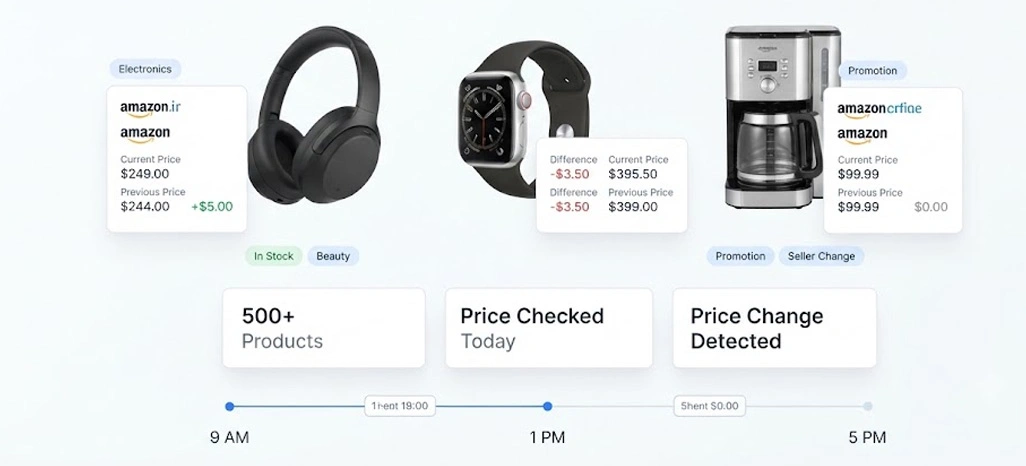
Amazon prices can change frequently because of promotions, seller competition, inventory conditions, and demand fluctuations. Monitoring these changes across hundreds of products can become difficult when information is gathered manually. Amazon Price Scraping USA can provide structured product observations that allow retailers to evaluate current prices against predefined benchmarks and historical records. This makes it easier to identify products requiring immediate pricing attention.
A large catalog can contain significant differences between listed prices at different points throughout the day. Scheduled collection helps businesses create a continuous record of these movements rather than relying on isolated observations. Product information can also be organized according to categories, sellers, promotional conditions, and availability, enabling analysts to distinguish genuine pricing trends from short-term marketplace fluctuations.
| Amazon Tracking Area | Example Coverage |
|---|---|
| Amazon SKUs | 600 |
| Daily observations | 14,400 |
| Promotional listings | 92 |
| Priority price gaps | 118 |
For example, a retailer monitoring 600 products may identify 118 priority gaps during a selected period. Analysts can investigate these products first, compare their historical movement, and determine whether an adjustment is appropriate. Repeated observations can also indicate whether a competitor's pricing behavior is consistent or linked to specific promotional events.
- Monitor product prices at scheduled intervals
- Record promotional pricing movements
- Track seller-level pricing variations
- Compare current and historical observations
- Prioritize significant price deviations
Combining marketplace observations with broader pricing records creates a more complete view of competitive movement. Real-Time Amazon and Walmart Price Data Extraction can help organize frequent updates for analysis, allowing teams to evaluate changes across multiple categories without rebuilding datasets manually. This supports faster investigation of price gaps and provides useful information for ongoing retail pricing reviews.
Evaluating Walmart Price Movements Across Diverse Retail Categories
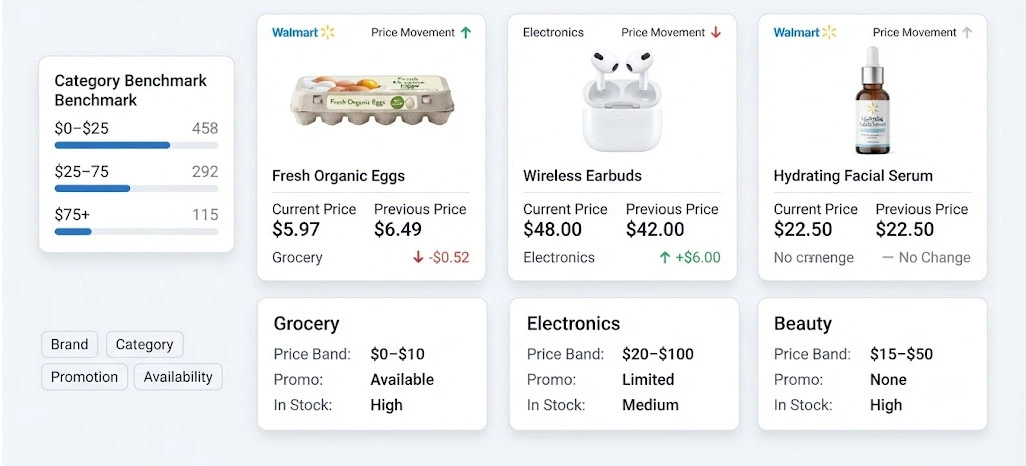
Walmart pricing can vary because of promotions, category-specific demand, seller activity, inventory conditions, and changing market conditions. Retailers managing hundreds of Walmart products therefore need a structured process for observing price movements. Walmart Price Scraping USA can help collect comparable product information so teams can evaluate marketplace changes consistently across different categories and price ranges.
Organized data makes it possible to separate ordinary pricing fluctuations from meaningful differences. Retailers can classify products according to category, brand, price band, promotional status, and availability before comparing observations. This creates a clearer framework for determining which products require further investigation and which price changes can be considered normal marketplace movement.
| Walmart Tracking Area | Example Coverage |
|---|---|
| Walmart SKUs | 400 |
| Daily observations | 9,600 |
| Promotional changes | 135 |
| Priority gap alerts | 76 |
Suppose 400 Walmart SKUs are monitored regularly and 76 products produce notable price-gap alerts. Analysts can examine these products against historical records and corresponding marketplace observations before recommending an adjustment. This prevents teams from treating every price movement as an immediate pricing issue and instead focuses attention on measurable deviations.
- Monitor Walmart product prices consistently
- Categorize products for structured comparison
- Identify notable pricing fluctuations
- Review promotional price movements
- Prioritize high-impact SKU differences
A broader dataset can also support category-level analysis and recurring pricing reviews. Price Intelligence Solutions USA can provide a structured foundation for evaluating marketplace observations, helping retailers organize pricing information for ongoing analysis. By reviewing Walmart movements alongside relevant Amazon observations, teams can better understand whether price differences originate from individual marketplace activity or wider category trends.
How Retail Scrape Can Help You?
We can support large-scale pricing programs by organizing marketplace information into structured, analysis-ready datasets. When teams apply Amazon & Walmart Competitor Price Tracking across 1,000+ SKUs, they can establish repeatable monitoring processes instead of depending on scattered manual checks. The approach can support product-level comparisons, historical analysis, and prioritized price-gap identification.
Key capabilities include:
- Automated collection of marketplace product information
- Scheduled monitoring across large SKU catalogs
- Structured datasets for pricing analysis
- Identification of significant price differences
- Historical records for trend evaluation
- Custom outputs aligned with business requirements
The collected information can be cleaned, categorized, and delivered according to a retailer's preferred workflow. Ecommerce Data Scraping USA can also support broader marketplace intelligence requirements by combining pricing, product, availability, and promotional information into consistent datasets. This gives analysts a practical foundation for evaluating pricing strategies across extensive retail catalogs.
Conclusion
Reducing price gaps across 1,000+ SKUs requires consistent marketplace visibility, structured comparisons, and timely analysis. Amazon & Walmart Competitor Price Tracking can help retailers identify meaningful differences, prioritize high-impact products, and create repeatable pricing review processes. Historical observations also provide useful context for separating temporary promotions from persistent pricing patterns.
With Price Intelligence Solutions USA, businesses can organize large volumes of marketplace information into actionable datasets for competitive monitoring and pricing analysis. We can support customized collection requirements across extensive product catalogs and deliver structured data for further analysis. Contact Retail Scrape today to discuss a customized retail pricing data solution for your 1,000+ SKU catalog.