Case Study - Modernize Pricing Decisions with Multi-Marketplace Price Intelligence for Consumer Brands Solutions

Introduction
Consumer brands today operate in a fragmented pricing environment where identical products appear across dozens of digital storefronts each with its own pricing logic, promotional cadence, and competitive pressure. Multi-Marketplace Price Intelligence for Consumer Brands has emerged as the foundational layer that bridges this gap, giving brands a real-time view of how their prices stack up across every relevant channel.
The shift from single-channel to omnichannel retail has made Multi Marketplace Price Intelligence not just a convenience but a strategic necessity. Brands that still rely on periodic manual audits or siloed platform dashboards are working with incomplete pictures missing competitive signals that could reshape their pricing strategy within hours.
As Ecommerce Product Catalog Market Insights Scraping becomes more sophisticated, consumer brands now have the ability to map their entire assortment against competitor listings with unprecedented accuracy. This kind of visibility goes beyond price tags; it surfaces packaging variations, bundle configurations, and promotional timing that influence buyer behavior. The result is a smarter, faster pricing function that responds to market reality rather than internal assumptions.
The Client
A mid-to-large consumer goods manufacturer with an extensive product portfolio spanning personal care, household essentials, and wellness categories found itself at a crossroads. The brand distributed across seven major online marketplaces simultaneously, yet had no centralized system to monitor how its pricing held up against category rivals. Price Intelligence for Consumer Brands was the missing capability that their internal teams had been attempting to build manually without sustainable results.
Leadership noticed the symptoms before diagnosing the root cause: certain SKUs were consistently undercut by third-party sellers, promotional windows were being anticipated by competitors before launch, and category managers were operating on pricing data that was sometimes weeks old. A fragmented vendor ecosystem and no standardized reporting made it nearly impossible to identify where margin erosion was actually occurring. Implementing Competitor Price Tracking Data collection became a clear organizational priority once the financial impact was quantified.
The brand's internal analytics team had attempted to build a lightweight monitoring tool, but Real-Time Price Monitoring at the scale required tracking thousands of SKUs across multiple platforms simultaneously and quickly exceeded their in-house technical capacity. They needed a partner with established infrastructure, proven methodology, and the ability to deliver structured, reliable datasets that could integrate directly with their existing BI tools and procurement workflows.
Key Challenges Faced by the Client
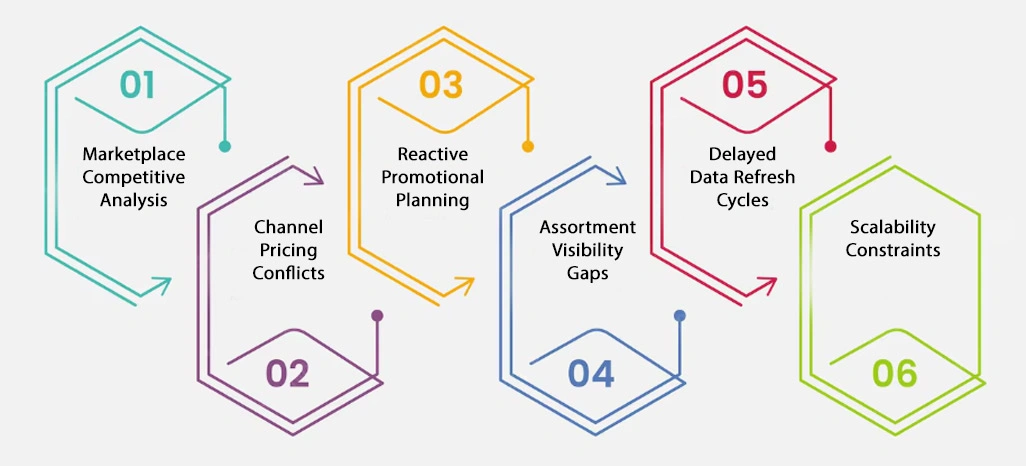
- Marketplace Competitive Analysis
The brand lacked a systematic way to benchmark its pricing across competitor storefronts. Category-level comparisons were done inconsistently, leaving significant blind spots in how the brand understood its own competitive standing across different platforms and regions. - Channel Pricing Conflicts
Different marketplace algorithms and third-party seller behavior were creating unintended price disparities for the same product. Without cross-channel oversight, the brand had no mechanism to detect or correct these inconsistencies before they affected customer trust. - Reactive Promotional Planning
Campaign pricing decisions were made without knowledge of what competitors had done in the previous cycle. Competitive Analysis helped identify competitor actions and market shifts. Teams often launched promotions into a market that had already shifted, resulting in missed volume opportunities and unnecessary margin sacrifice. - Assortment Visibility Gaps
The brand struggled to understand which competitor SKUs were gaining traction and why. Without Competitor Pricing Market Intelligence Dataset capabilities, product team decisions around new launches and discontinuations lacked sufficient market grounding. - Delayed Data Refresh Cycles
Pricing data collected through manual methods became stale within days, sometimes hours. In fast-moving categories, this lag meant decisions were being made on outdated snapshots rather than current market conditions. - Scalability Constraints
As the brand expanded into additional marketplaces, the manual effort required to maintain even basic price awareness grew unsustainably. The existing approach could not scale without dramatically increasing headcount.
Key Solutions for Addressing Client Challenges
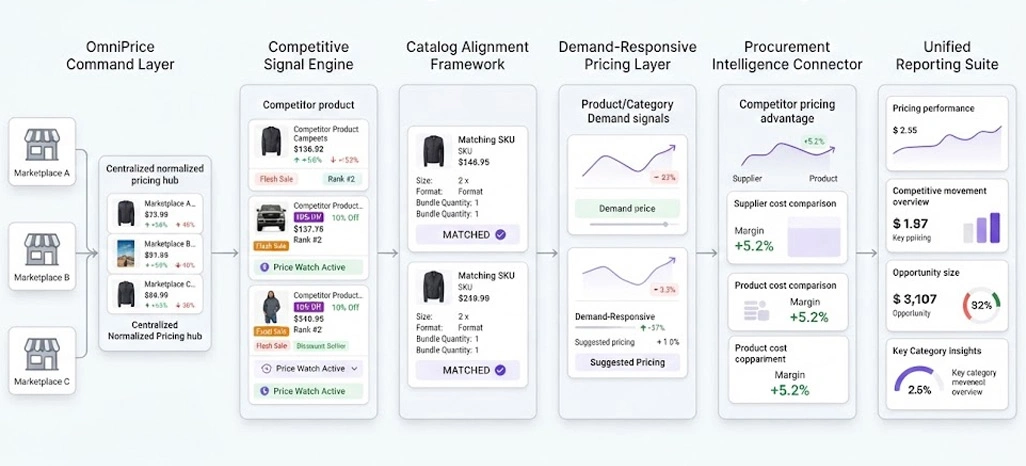
- OmniPrice Command Layer
A centralized price intelligence platform was deployed using Marketplace Product Dataset API architecture, aggregating live pricing signals from all active storefronts into a single normalized feed. - Competitive Signal Engine
Powered by Digital Shelf Price Monitoring technology, this component continuously scans competitor product pages across marketplaces, capturing price changes, seller rankings, and promotional badge appearances. - Catalog Alignment Framework
Using Ecommerce Price Intelligence methodologies, this module maps the brand's SKU catalog against competitor equivalents, accounting for size, format, and bundling differences. - Demand-Responsive Pricing Layer
By integrating Marketplace Product Demand Analytics Dataset signals with real-time pricing feeds, this component identifies when demand surges or softens for specific product categories. - Procurement Intelligence Connector
When Marketplace Product Data Analytics Scraping identifies a sustained pricing advantage held by a competitor, the system flags relevant sourcing variables allowing procurement teams to explore cost-reduction levers that could support a more competitive price point. - Unified Reporting Suite
Decision-makers at the category, brand, and executive level receive tailored views of pricing performance, competitive movement, and opportunity sizing formatted for immediate use in strategy sessions and quarterly reviews.
Key Insights Gained from Multi-Marketplace Price Intelligence for Consumer Brands
| Intelligence Dimension | Strategic Value Delivered |
|---|---|
| Cross-Platform Price Benchmarking | Identified consistent pricing gaps across seven marketplaces, enabling targeted realignment |
| Competitor Promotional Pattern Analysis | Mapped rival discount cycles to inform smarter campaign timing and depth |
| SKU-Level Margin Erosion Tracking | Pinpointed which products faced the steepest third-party undercutting pressure |
| Demand Sensitivity Mapping | Correlated search volume spikes with pricing windows to optimize capture rates |
| Assortment Gap Detection | Revealed competitor SKU expansion patterns that informed new product prioritization |
Benefits of Multi-Marketplace Price Intelligence for Consumer Brands From Retail Scrape
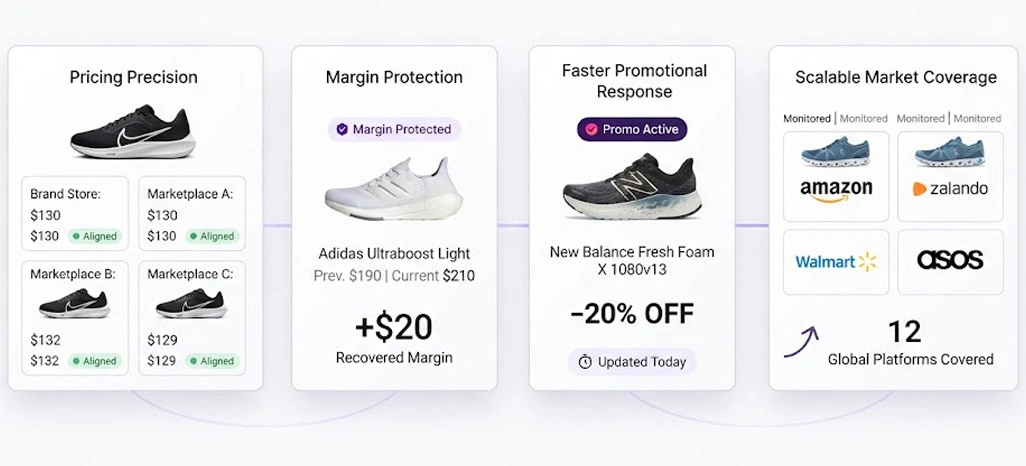
- Pricing Precision Across Channels
By deploying Ecommerce Competitor Price Monitoring capabilities at scale, the brand eliminated the guesswork that had long plagued its cross-channel pricing function. - Margin Recovery and Protection
Competitor Pricing Market Intelligence Dataset enabled the team to identify margin erosion patterns before they compounded. By catching undercutting behavior early and responding systematically, the brand recovered meaningful margin points that had previously been ceded to more agile competitors. - Faster Promotional Response Cycles
With pricing intelligence refreshed continuously rather than weekly, the promotional planning process became significantly more responsive. Teams could enter campaign windows with confidence that their pricing position reflected current market conditions reducing the frequency of poorly timed promotions. - Scalable Market Coverage
As the brand added new marketplace presence, the intelligence infrastructure scaled with it. There was no proportional increase in manual effort, and new platforms were onboarded into the monitoring system within days rather than months.
Client's Testimonial

Working with Retail Scrape changed how we think about pricing as a discipline. The Multi-Marketplace Price Intelligence for Consumer Brands framework gave our category teams a level of visibility we had never had before real-time, structured, and actually usable in daily decision-making. Product Matching Across Marketplaces was something we had tried to build internally without success, and seeing it work at full scale across our entire catalog was genuinely impressive.
– VP of Commercial Strategy, National Consumer Goods Brand
Conclusion
Pricing decisions made without complete market visibility are decisions made at a disadvantage. Multi-Marketplace Price Intelligence for Consumer Brands is what transforms pricing from a reactive function into a proactive competitive lever one that responds to market reality at the speed the modern retail environment demands.
Retail Scrape brings proven infrastructure and deep domain experience to help consumer brands build pricing intelligence programs that scale. Through Marketplace Product Data Analytics Scraping, brands gain structured, decision-ready data across every relevant channel without the overhead of building and maintaining internal extraction systems.
For brands ready to move beyond manual monitoring and disconnected data, Digital Shelf Price Monitoring delivers the continuous signal coverage needed to protect margins, respond to competitors, and price with precision across every marketplace. Contact Retail Scrape today to start a conversation about your pricing intelligence needs.