
How Can USA Price Benchmarking Across Online Marketplaces Improve Cross-Marketplace Price Analysis?
Introduction
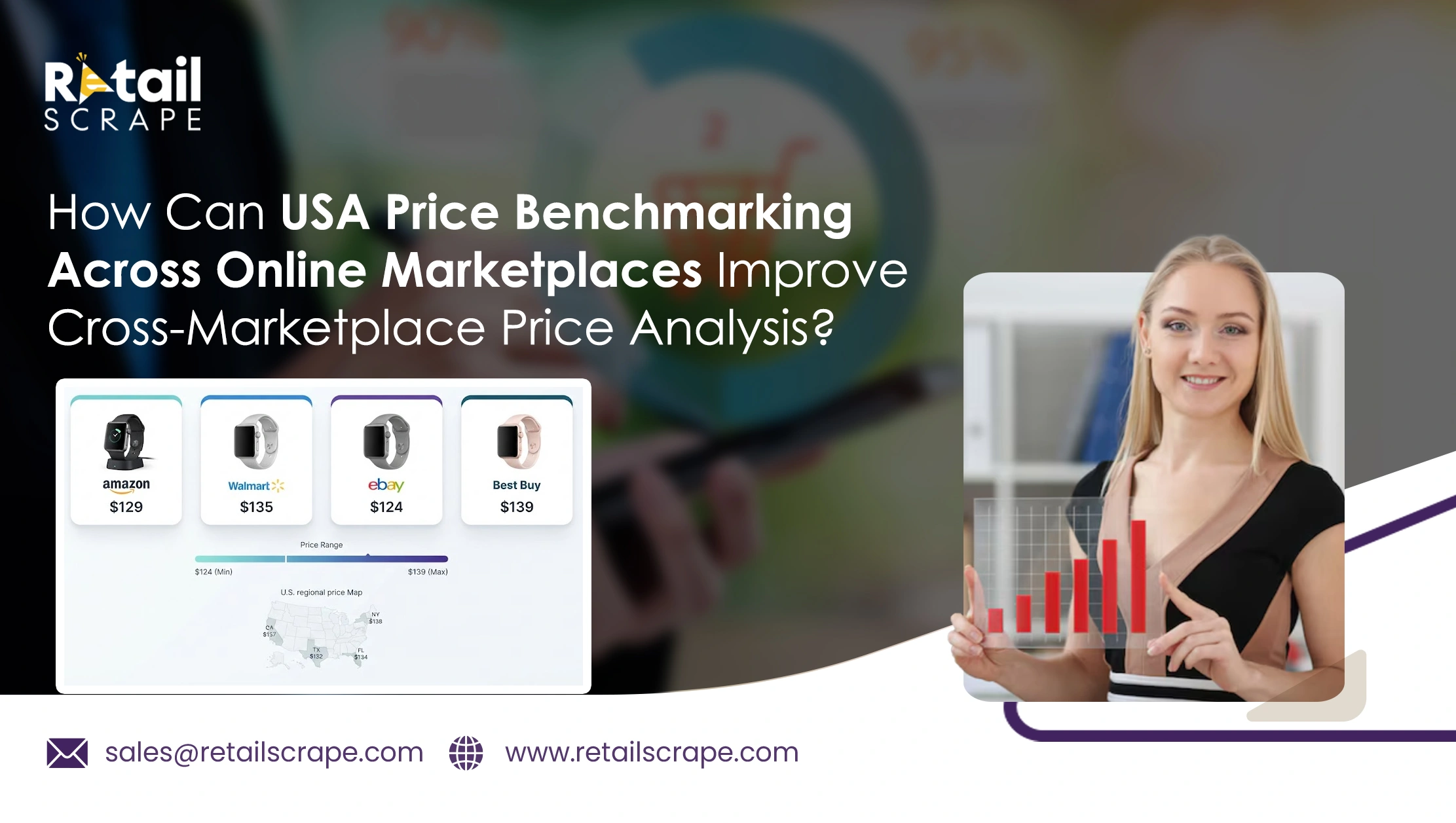
Online marketplaces in the USA change prices rapidly across categories, sellers, locations, and promotional periods. Comparing these movements helps retailers understand where their prices stand against competitors and identify meaningful gaps. USA Price Benchmarking Across Online Marketplaces creates a structured foundation for evaluating product prices across multiple digital storefronts with greater consistency.
Retailers can combine pricing, product availability, seller information, ratings, discounts, and promotional details to build a broader market view. Web Scraping USA Marketplace Data supports systematic collection from relevant platforms, allowing businesses to examine price differences without relying on isolated manual checks. This creates a more reliable basis for recurring marketplace monitoring.
A structured comparison also supports decisions around pricing adjustments, product positioning, assortment planning, and promotional timing. When marketplace information is organized into comparable datasets, teams can evaluate competitors more efficiently and identify recurring pricing patterns. The resulting analysis can improve planning across multiple channels while reducing the effort required to maintain current market intelligence.
Strategic Market Signals Shaping Cross-Marketplace Retail Price Comparisons
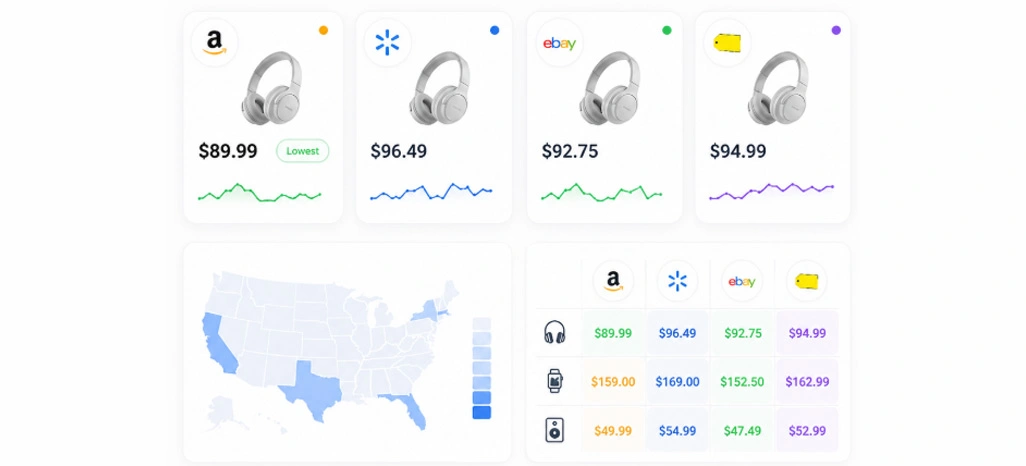
Comparing prices across several online marketplaces gives retailers a clearer view of how products are positioned within competitive digital channels. Differences can emerge because of seller activity, temporary promotions, inventory levels, shipping charges, and changing consumer demand. Marketplace Pricing Intelligence USA helps organize these signals into a structured view, allowing businesses to identify meaningful price gaps rather than reacting to isolated changes.
A consistent benchmarking framework can also separate short-term promotional movements from longer pricing patterns. USA Price Benchmarking gives teams a practical reference point for evaluating average prices, minimum and maximum offers, and marketplace-specific variations. This supports decisions around pricing adjustments while helping retailers understand whether a product is positioned competitively across multiple sales channels.
| Pricing Indicator | Example Observation | Analytical Purpose |
|---|---|---|
| Average listed price | $48.20 | Establishes baseline |
| Lowest listed price | $42.50 | Identifies market floor |
| Highest listed price | $55.90 | Shows premium range |
| Price variation | 27.8% | Highlights channel differences |
Retailers can strengthen comparisons by monitoring several product and marketplace signals together. Useful observations include:
- Product-level price movements
- Seller price differences
- Discount frequency and depth
- Inventory availability changes
- Shipping-related price variations
This broader approach makes cross-channel observations easier to interpret and supports more consistent pricing decisions. Rather than relying on occasional checks, retailers can review recurring patterns and prioritize products where significant differences continue to appear across marketplaces.
Powerful Data Connections Improving Marketplace Pricing Decision Accuracy
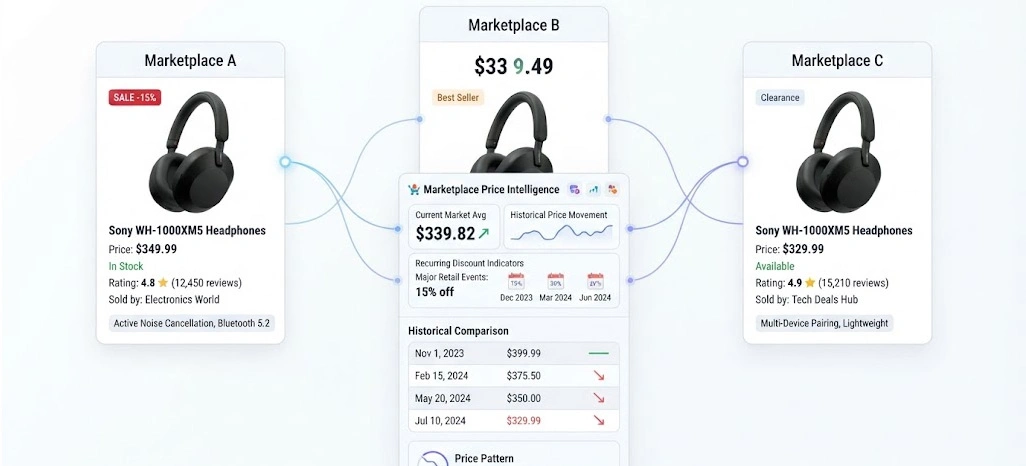
Pricing information becomes considerably more useful when it is connected with additional product and marketplace attributes. Retailers can examine availability, ratings, reviews, seller counts, discounts, and product specifications alongside listed prices. E-Commerce Data Intelligence brings these signals together, creating stronger context for understanding why a particular offer may appear cheaper or more expensive than comparable listings.
Historical comparisons can reveal whether pricing movements are temporary or part of a recurring pattern. US Ecommerce Price Benchmarking supports this process by helping teams compare product-level pricing across different channels and periods. When structured records are refreshed regularly, businesses can identify recurring discount behavior, unusual price changes, and products that require closer competitive monitoring.
| Supporting Signal | Example Value | Business Application |
|---|---|---|
| Products monitored | 25,000 | Coverage measurement |
| Average discount | 14% | Promotion assessment |
| Active sellers | 7 | Competition context |
| Availability rate | 91% | Supply evaluation |
Combining pricing records with supporting attributes can improve the quality of marketplace analysis. Important areas for evaluation include:
- Product availability and stock status
- Seller participation across channels
- Ratings and customer feedback
- Discount and promotion patterns
- Product attributes and specifications
These connections allow retailers to move beyond simple price comparisons and evaluate the circumstances surrounding marketplace offers. A structured analytical foundation can therefore support better pricing reviews, product prioritization, and channel-specific planning while reducing dependence on fragmented manual observations.
Emerging Cross-Channel Patterns Guiding Smarter Retail Pricing Strategies
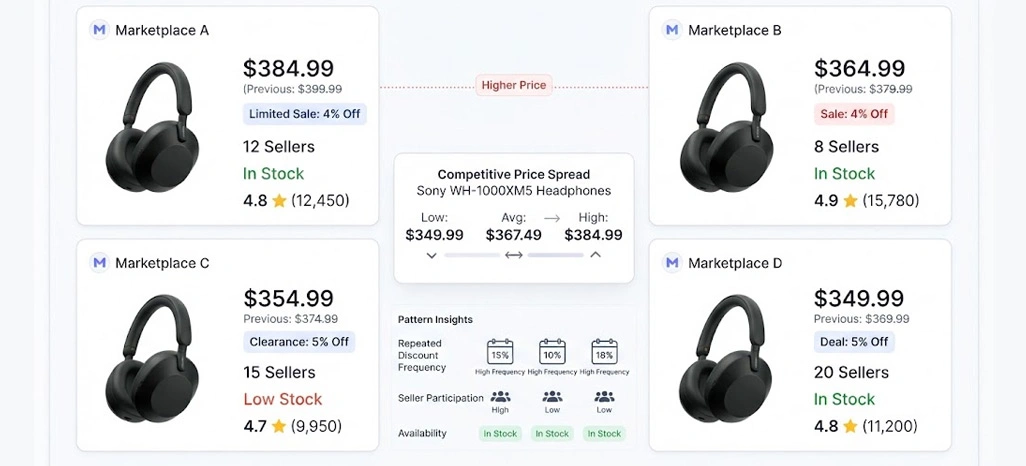
Cross-marketplace comparisons become more valuable when retailers evaluate recurring patterns instead of focusing on individual price observations. Differences between channels can indicate variations in seller competition, promotional activity, inventory conditions, or product positioning. Online Marketplace Competitor Price Comparison USA helps organize these observations so teams can identify where products repeatedly fall outside expected market ranges.
A broader competitive view can reveal products that consistently carry higher prices on one marketplace than another. Ecommerce Competitor Price Benchmarking USA provides a structured way to evaluate these differences across competing offers. Reviewing price spreads, discount frequency, seller participation, and availability together can help businesses determine whether a pricing gap reflects a genuine market opportunity or a temporary marketplace condition.
| Comparison Factor | Example Finding | Strategic Purpose |
|---|---|---|
| Price variance | 11.8% | Detects pricing gaps |
| Discount frequency | 32% | Reviews promotion intensity |
| Seller variation | 5 sellers | Measures competition |
| Stock availability | 88% | Adds supply context |
Retailers can use recurring comparisons to prioritize products and categories requiring closer attention. Useful focus areas include:
- Products with persistent price gaps
- Frequently discounted products
- Highly competitive categories
- Listings with changing availability
- Products showing unusual price movements
Organized observations can support more informed decisions around pricing, promotions, assortment, and marketplace positioning. US Marketplace Price Comparison for Retailers further helps teams structure channel-level findings, making it easier to compare competitive conditions and identify patterns that can influence future retail strategies.
How Retail Scrape Can Help You?
We can support structured marketplace data collection by gathering product prices, discounts, seller details, availability, ratings, reviews, and other relevant attributes from online retail channels. This creates a consistent foundation for USA Price Benchmarking Across Online Marketplaces, helping teams compare market conditions across products and marketplaces.
Key capabilities can include:
- Monitoring product prices across selected marketplaces
- Tracking discounts and promotional changes over time
- Collecting seller and availability information
- Matching comparable products across different platforms
- Structuring marketplace records for recurring analysis
- Supporting scalable data delivery for analytical workflows
With organized data, teams can evaluate pricing movements while connecting market observations with broader business metrics. Competitor Pricing Analysis becomes more practical when current marketplace records are available in a structured format. We can also support datasets and API-ready outputs for different analytical requirements.
Conclusion
USA Price Benchmarking Across Online Marketplaces gives retailers a structured way to compare prices, promotions, seller activity, and availability across competing digital channels. Consistent marketplace observations can reveal pricing gaps, recurring market patterns, and product-level opportunities that manual checks may overlook.
A reliable data foundation also supports Online Marketplace Price Benchmarking in the US, helping businesses organize cross-channel observations for ongoing strategic decisions. Connect with Retail Scrape to build scalable marketplace pricing data and strengthen your cross-marketplace analysis.