
Powering Best Seller Analytics for Ecommerce Revenue Growth With Proven Revenue Improvement

Introduction
We have consistently helped ecommerce businesses cut through market noise by delivering structured, intelligence-driven solutions. This case study walks through how our data capabilities helped a growing ecommerce brand transform its product strategy using Best Seller Analytics for Ecommerce Revenue Growth, turning scattered market data into a focused engine for revenue improvement.
In an era where product trends shift overnight, businesses can no longer afford guesswork when selecting which products to promote, stock, or discontinue. Through Ecommerce Product Intelligence, our team helped the client build a structured layer of insight that translated raw product data into meaningful commercial decisions across all major categories.
The impact was measurable and immediate. By combining real-time tracking with historical pattern recognition, our solutions allowed the client to stay calibrated with shifting consumer preferences. Backed by Ecommerce Best Seller Tracking Software, the client moved from reactive to proactive making product and inventory decisions well ahead of demand cycles rather than scrambling to catch up.
The Client
The client was a mid-sized ecommerce brand operating across multiple product verticals electronics, home essentials, and personal care with a catalog spanning over 15,000 active SKUs. Despite consistent traffic and a loyal customer base, their revenue growth had plateaued over three consecutive quarters. Reliance on instinct-based merchandising and surface-level sales reports left significant opportunity unrealized. Best Seller Analytics for Ecommerce Revenue Growth emerged as the defining framework the business needed to rethink its approach to product prioritization.
Behind the scenes, the team struggled with fragmented data sources, inconsistent reporting cycles, and no clear method for identifying which products were gaining traction versus quietly underperforming. Decisions about promotions, restocking, and catalogue expansion were made with incomplete information. Access to Ecommerce Pricing Intelligence was particularly lacking; the client had no visibility into how competitor pricing influenced their own conversion rates and product rankings.
With leadership under pressure to demonstrate tangible revenue outcomes, the urgency to act became undeniable. The brand needed a partner capable of building a reliable data foundation one that connected product performance signals to business outcomes in real time. That's precisely where we stepped in, equipped with the tools, methodology, and experience to deliver results that moved the needle.
Key Challenges Faced by the Client
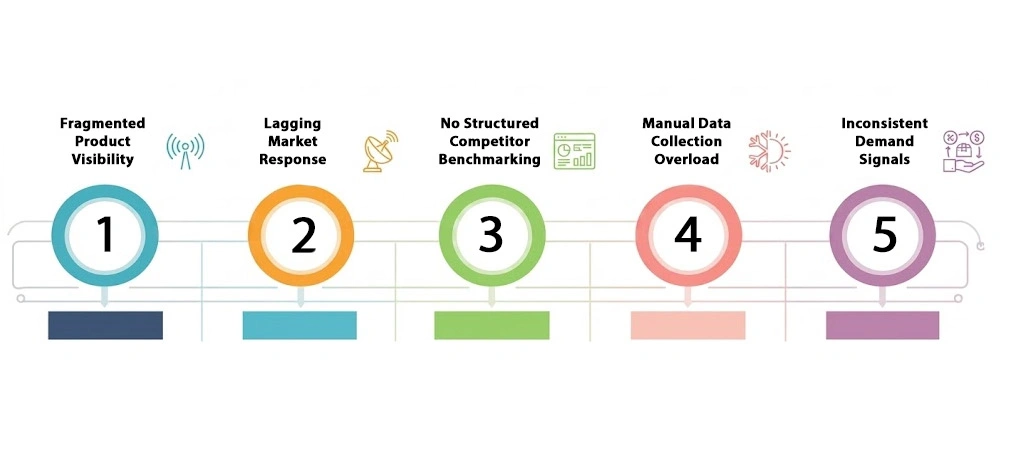
- Fragmented Product Visibility
The client had no unified view of product performance across categories. Without Ecommerce Product Database API integration, product-level data existed in silos, making cross-category analysis and performance benchmarking nearly impossible to execute consistently. - Lagging Market Response
Trend identification happened too late for the team to act meaningfully. By the time a bestselling product was recognized internally, competitors had already capitalized on the demand window, leaving the client trailing in both ranking and revenue. - No Structured Competitor Benchmarking
The brand lacked a reliable process to assess how rival sellers positioned their top products. Without structured Product Performance Analytics, the team could not determine whether their bestsellers were truly competitive or simply the best of an underperforming subset. - Manual Data Collection Overload
Analysts were spending the majority of their time pulling and cleaning raw data instead of interpreting it. This bottleneck slowed every downstream decision, from pricing adjustments to catalog additions and promotional planning. - Inconsistent Demand Signals
Seasonal spikes and trending categories went largely undetected. The absence of a reliable tracking mechanism meant inventory planning relied more on assumption than evidence, resulting in either overstock or missed sales windows.
Key Solutions for Addressing Client Challenges
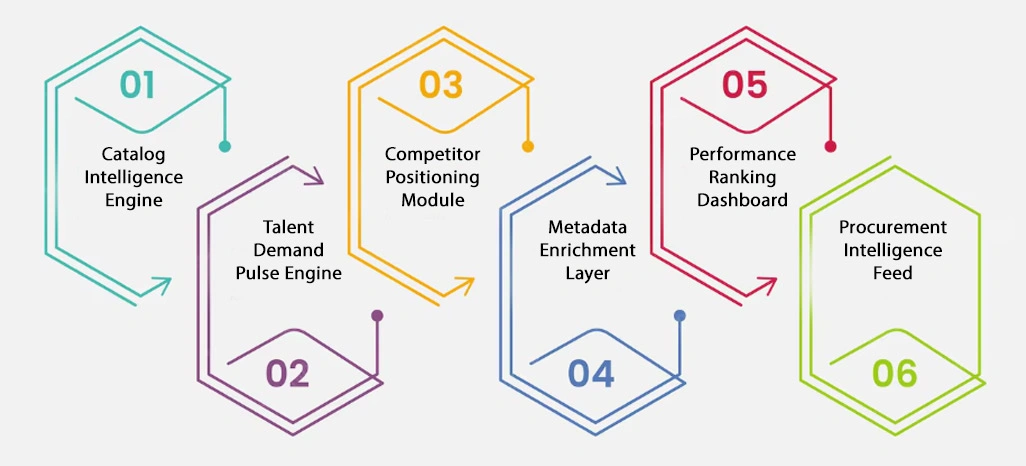
- Catalog Intelligence Engine
Using Ecommerce Product Catalog API Dataset, this system aggregated product-level data across competitor platforms and internal inventory systems, creating a single, continuously refreshed source of catalog truth for the client's merchandising team. - Trend Signal Tracker
Powered by Best Seller Intelligence Tools for Ecommerce, this module identifies rising product trends across categories by analyzing ranking shifts, review velocity, and search prominence giving the client a meaningful head start on demand cycles. - Competitor Positioning Module
This solution performed structured Competitor Analysis across key rival storefronts, mapping pricing strategies, promotional patterns, and product assortment changes so the client could calibrate their own positioning with confidence. - Metadata Enrichment Layer
Built on Ecommerce Product Metadata API Dataset, this layer standardized and enriched product records across the catalog, ensuring that analytics were built on clean, consistent data rather than fragmented and duplicated entries. - Performance Ranking Dashboard
An intuitive reporting interface that surfaced product performance tiers in real time, enabling category managers to make stocking, pricing, and promotion decisions grounded in current market evidence rather than historical guesswork. - Procurement Intelligence Feed
This feed connected market-level demand signals directly to sourcing workflows, allowing the procurement team to align purchase volumes with actual trend data, reducing overstock and improving margins across fast-moving categories.
Key Insights Gained from Best Seller Analytics for Ecommerce Revenue Growth
| Intelligence Area | Finding |
|---|---|
| Top Category Revenue Drivers | Identified the top 8% of SKUs contributing over 63% of total revenue |
| Competitor Assortment Gaps | Revealed underserved product segments where the client held a positioning advantage |
| Seasonal Demand Patterns | Mapped four distinct demand surges across the annual product calendar |
| Pricing Deviation Analysis | Found a 17–23% pricing misalignment in high-conversion product clusters |
| Review Velocity Correlation | Confirmed that products with rising review rates outperformed static listings by 3.1x |
Benefits of Best Seller Analytics for Ecommerce Revenue Growth From Retail Scrape
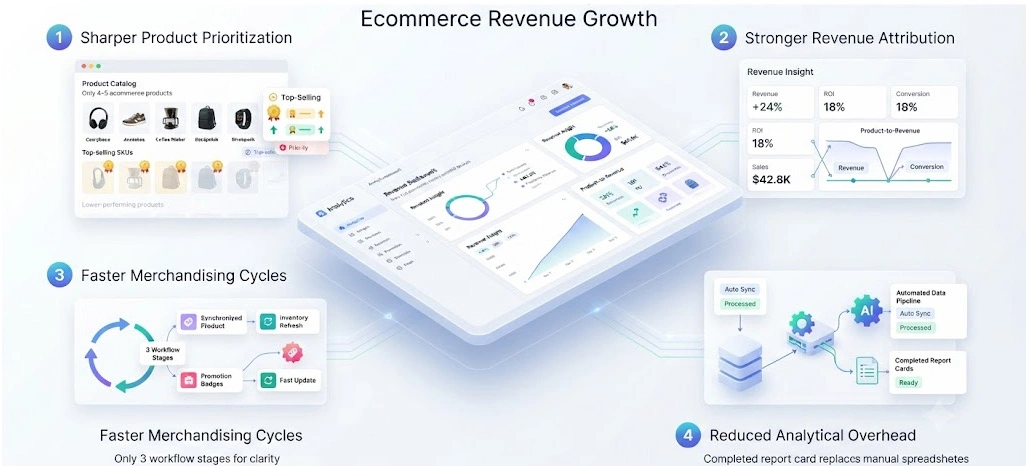
- Sharper Product Prioritization
By activating Best Selling Product Tracking for Ecommerce, the team gained precise visibility into which SKUs deserved promotional investment and which needed repositioning or removal, dramatically improving catalog efficiency. - Stronger Revenue Attribution
The Ecommerce Scraping API integration enabled direct connection between product data signals and revenue outcomes, allowing leadership to see exactly which data-driven decisions contributed to measurable financial improvement. - Faster Merchandising Cycles
With Ecommerce Seller Intelligence Platform capabilities embedded into their workflow, the time between identifying a product opportunity and executing a merchandising response dropped significantly giving the brand an operational speed advantage. - Reduced Analytical Overhead
Automation of data collection and reporting freed internal analysts to focus on strategic interpretation rather than data preparation, multiplying the value of the team's existing capacity without adding headcount.
Client's Testimonial

Working with Retail Scrape redefined how we approach product strategy. Their Best Seller Analytics for Ecommerce Revenue Growth framework gave us clarity we simply didn't have before. We now know exactly which products to back, when to act, and how to stay ahead of market shifts. The Product Intelligence for Ecommerce Businesses capability they built for us has become a permanent part of how we make decisions.
– Head of Digital Commerce, Ecommerce Growth Brand
Conclusion
Sustainable ecommerce growth is no longer achievable through guesswork or delayed reporting. Best Seller Analytics for Ecommerce Revenue Growth gives businesses the structural advantage they need to make faster, smarter product decisions in a market that waits for no one.
Our expertise in Ecommerce Product Catalog API Dataset ensures your product intelligence is built on a reliable, continuously refreshed data foundation one that scales with your catalog and competitive environment. Contact Retail Scrape today to schedule a consultation with our product intelligence specialists.