Recasting Regional Demand Planning With Netflix Data Analytics for Regional Demand Forecasting
Introduction
The media analytics landscape has undergone a fundamental shift, with regional content consumption patterns becoming increasingly complex and difficult to predict through conventional planning methods. Netflix Data Analytics for Regional Demand Forecasting has emerged as a transformative capability for companies seeking precision in understanding how audiences engage with content across varied geographic markets. Our team helped bridge this intelligence gap by deploying structured data frameworks tailored for media-specific demand cycles.
As regional viewership behavior continued to fragment across devices and demographics, manual forecasting approaches proved fundamentally unreliable. The integration of Netflix Data Scraping into our data pipeline enabled the extraction of granular viewership signals, genre preferences, and regional content trends at a scale that human-driven research simply cannot match. These signals formed the foundation of a demand planning model that responded dynamically to audience behavior rather than trailing behind it.
Ultimately, this engagement demonstrated how Netflix Audience Demand Forecasting can reshape planning workflows for media businesses operating across diverse regions. With actionable intelligence flowing continuously into decision-making layers, our client was equipped to move from reactive content planning to proactive regional strategy, an operational shift that produced measurable improvements across procurement, scheduling, and resource allocation.
The Client
A growing media analytics consultancy with regional operations spanning fourteen metropolitan markets faced persistent forecasting inaccuracies that affected content acquisition budgets and partner negotiations. Despite a capable internal team, their planning cycles were anchored to outdated viewership surveys and quarterly reporting windows. Netflix Data for Regional Demand Forecasting became central to their transformation journey as they sought a more intelligent, real-time approach to understanding regional content demand.
The firm managed analytics contracts across broadcast, streaming, and digital channels simultaneously, making cohesive demand planning an operational necessity. Their teams were spending significant time and resources on manual research workflows that still produced inconsistent outputs. OTT Data Scraping was identified as an underutilized capability that could deliver the automation and consistency their planning function desperately needed, particularly for tracking content performance signals across streaming environments at a regional level.
Leadership recognized that without a data foundation capable of reflecting real audience behavior in near real-time, their clients would increasingly question the reliability of the forecasts they delivered. The reputational and revenue implications of continued inaccuracy were significant enough to prompt investment in a comprehensive data intelligence overhaul, one that prioritized speed, regional granularity, and platform-specific content trend analysis.
Key Challenges Faced by the Client
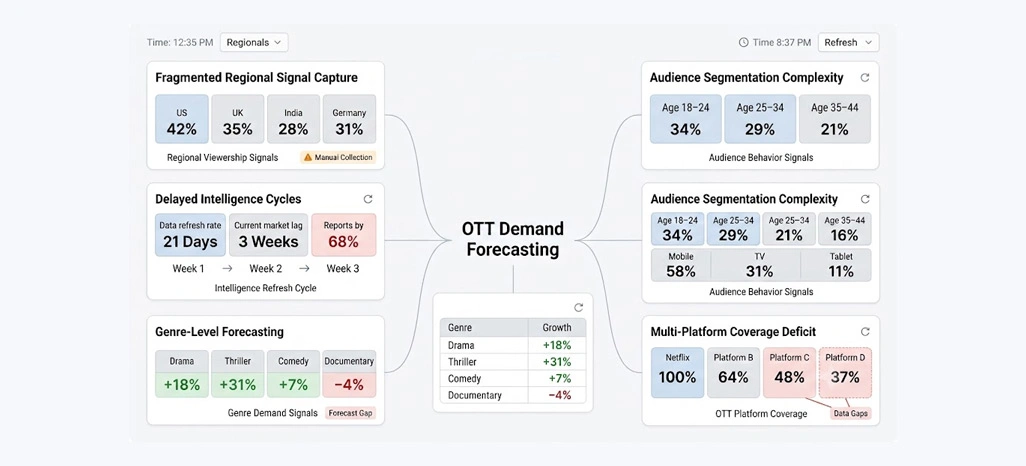
The consultancy encountered a series of structural challenges that collectively undermined their forecasting effectiveness and client confidence:
- Fragmented Regional Signal Capture
The absence of Netflix Data Scraping API integration meant regional viewership signals were collected manually and inconsistently, creating data gaps that distorted demand trend analysis and made cross-market comparisons unreliable for strategic decision-making. - Delayed Intelligence Cycles
Without automated data refresh capabilities, the firm's content demand reports lagged behind actual market movements by several weeks, significantly reducing the actionability of insights delivered to media clients relying on timely planning data. - Inconsistent Genre-Level Forecasting
The team lacked the infrastructure to track genre-level content performance shifts across regions systematically. This made it difficult to anticipate demand spikes for specific content categories ahead of acquisition windows. - Audience Segmentation Complexity
Regional audience preferences varied significantly across demographic groups, and without structured data pipelines, segmenting demand forecasts by age, device, and viewing behavior remained an aspirational rather than operational capability. - Multi-Platform Coverage Deficit
The client's existing tools captured data from limited platform sources, leaving critical OTT Demand Forecasting signals unmonitored and creating blind spots in their content performance benchmarking across competitive streaming environments.
Key Solutions for Addressing Client Challenges
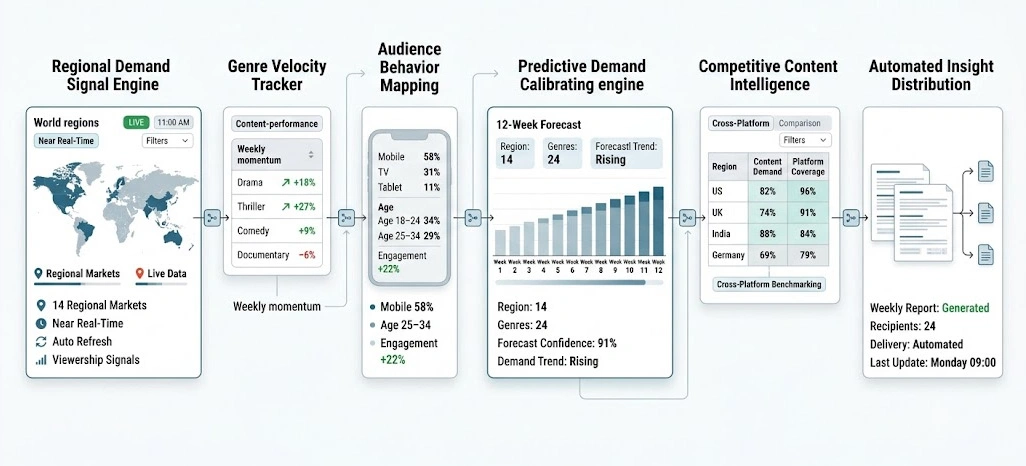
We developed a layered solution architecture designed specifically to address each planning friction point identified during initial discovery:
- Regional Demand Signal Engine
A purpose-built data collection framework using Netflix Data for Media Intelligence principles, this engine aggregated viewership trends across fourteen regional markets in near real-time, creating a unified intelligence layer that updated automatically based on defined frequency parameters. - Genre Velocity Tracker
This module monitored content category performance trajectories across regions, identifying which genres were gaining or losing momentum on a rolling weekly basis to inform proactive acquisition and scheduling decisions for media clients. - Audience Behavior Mapping Console
Android App Scraping methodologies were applied to capture mobile viewing behavior patterns, supplementing web-based data collection with device-specific engagement signals that enriched regional audience segmentation models significantly. - Predictive Demand Calibration Layer
Powered by machine learning models trained on historical regional viewing patterns, this layer generated forward-looking demand forecasts with genre, region, and demographic dimensions, enabling clients to plan content acquisition up to twelve weeks in advance. - Competitive Content Intelligence Dashboard
A consolidated reporting interface tracking how regional content preferences compare across streaming environments, giving the client's analysts a benchmark-driven view of demand dynamics without requiring manual cross-platform research. - Automated Insight Distribution Framework
Structured weekly intelligence reports were automatically generated and distributed to client stakeholders, ensuring that forecast updates reached planning teams without delay and in a format aligned with their existing workflow tools.
Key Insights Gained from Netflix Data Analytics for Regional Demand Forecasting
| Intelligence Dimension | Analytical Outcome |
|---|---|
| Regional Genre Preference Mapping | Identified high-demand content categories across specific metro markets, enabling targeted acquisition recommendations |
| Seasonal Viewership Trend Analysis | Revealed quarterly content consumption peaks by region, supporting advance scheduling and licensing decisions |
| Audience Demographic Demand Shifts | Tracked age-segment preference evolution across markets, refining demographic-specific content planning accuracy |
| Multi-Market Performance Benchmarking | Enabled cross-regional content performance comparisons, highlighting underserved demand pockets with growth potential |
| Platform Engagement Pattern Profiling | Surfaced device and session-length behavior patterns influencing content format and duration planning strategies |
Benefits of Netflix Data Analytics for Regional Demand Forecasting From Retail Scrape
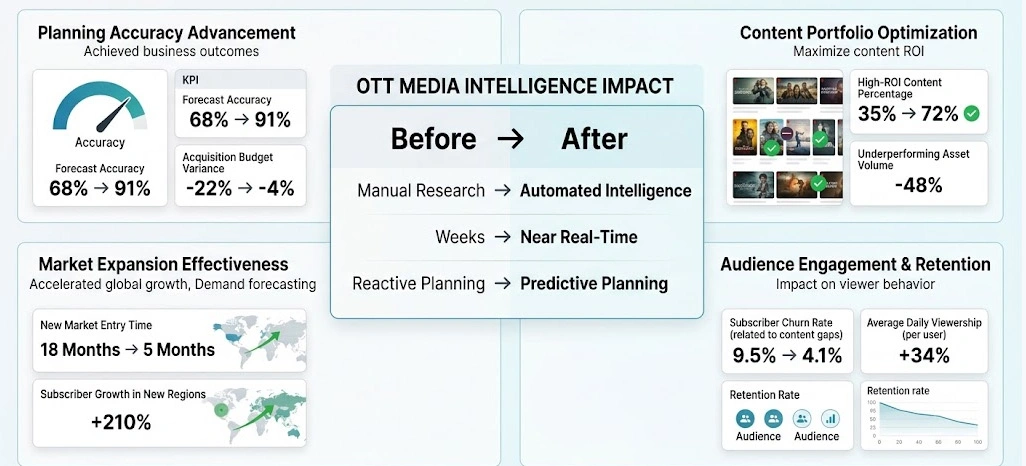
- Planning Accuracy Advancement
Through the systematic application of Netflix Data Analysis for Media Companies, the client's demand forecast accuracy improved substantially, reducing acquisition budget misalignment and enabling more confident content partnership negotiations across all regional markets. - Competitive Positioning Strength
Competitor Analysis conducted through structured content intelligence benchmarking revealed gaps in competitors' regional content coverage, allowing the client to advise media partners on positioning opportunities that generated measurable viewership growth. - Operational Efficiency Gains
By replacing manual research workflows with automated data pipelines built on Using Netflix Datasets for Media Analytics, the firm's analyst teams reclaimed significant productive hours weekly, redirecting that capacity toward higher-value strategic interpretation and client advisory work. - Revenue Impact Realization
Improved forecast reliability strengthened client retention and supported contract renewals with expanded service scopes, contributing directly to a 38% increase in recurring media analytics revenue within two financial quarters of implementation.
Client's Testimonial

Retail Scrape transformed how we think about regional content planning. Their approach to Netflix Data Analytics for Regional Demand Forecasting gave us intelligence capabilities we had never previously accessed at this level of regional and genre-specific detail. The shift from guesswork to data-driven planning was immediate, and Netflix Audience Demand Forecasting became central to how we serve our media clients today. Our forecast accuracy improved dramatically, and so did our client relationships.
– Head of Analytics Strategy, Regional Media Intelligence Consultancy
Conclusion
For media analytics firms navigating the complexity of regional content demand, building on structured intelligence frameworks is no longer optional, it is a competitive necessity. Netflix Data Analytics for Regional Demand Forecasting provides the foundation that transforms planning teams from reactive reporters into strategic advisors.
Our specialists are ready to assess your current forecasting infrastructure, identify coverage gaps, and design a data pipeline built specifically for your market scope and client commitments. Netflix Data for Regional Demand Forecasting offers a layer of precision that conventional research methods cannot replicate, particularly when regional audience behavior shifts rapidly across genres and demographic segments.
Firms that commit to structured data intelligence through OTT Demand Forecasting consistently outperform peers relying on manual or delayed data sources, delivering more confident recommendations and stronger client outcomes across the media planning lifecycle. Contact Retail Scrape today to explore how our media data intelligence solutions can reshape your regional planning capabilities.