Eliminating Price Leakage Using Quick-Commerce Price Tracking for D2C Snack Brands Across Apps
Introduction
The quick-commerce ecosystem has fundamentally altered how D2C snack brands manage their pricing across multiple delivery platforms. With consumer purchasing decisions made within seconds on apps like Blinkit, Zepto, and Swiggy Instamart, even a marginal pricing inconsistency can erode brand credibility and profitability overnight. Quick-Commerce Price Tracking for D2C Snack Brands has become a non-negotiable operational priority for brands that want to protect margins while staying relevant across platforms.
What many brands underestimate is how pricing discrepancies quietly accumulate into significant revenue gaps, a phenomenon increasingly referred to as price leakage. To address this challenge at scale, we developed a Quick Commerce Price Tracking Solution that continuously maps price variations across all major quick-commerce platforms, giving brands a real-time view of where and how their margins are being silently compromised.
Our intervention helped snack brands shift from reactive guesswork to structured, data-backed pricing governance. By deploying Real Time Quick Commerce Price Tracking across category-specific product portfolios, brands gained granular visibility into pricing anomalies, enabling them to act swiftly before revenue damage compounded. This case study explores the full journey, from operational chaos to systematic pricing control.
The Client
A fast-scaling D2C snack brand with a strong digital-first identity had successfully carved out a niche in the health-conscious and impulse-snacking segments. Despite impressive top-line growth, the brand's leadership noticed recurring margin inconsistencies that could not be traced through standard financial reporting alone. Swiggy Instamart Price Monitoring was identified as a critical starting point, given that the platform showed the highest frequency of unauthorized discount events impacting their premium SKUs.
The core issue was structural. The brand's pricing team relied on periodic manual checks, often weekly or biweekly, to audit platform-level prices. Product Price Monitoring for D2C Brands was not embedded into any automated workflow, which meant the brand was perpetually catching up rather than staying current. The procurement and category teams operated in silos, making coordinated pricing responses nearly impossible.
To bridge this operational gap, the brand leadership engaged with us for a full-scale diagnostic and solution deployment. AI Demand & Availability Forecasting was integrated as a complementary layer to help the brand not only track existing price leakage but also anticipate demand-driven pricing shifts that could create future vulnerabilities. This three-pronged operational challenge, fragmented monitoring, siloed decision-making, and demand unpredictability, formed the foundation of the challenges addressed below.
Key Challenges Faced by the Client
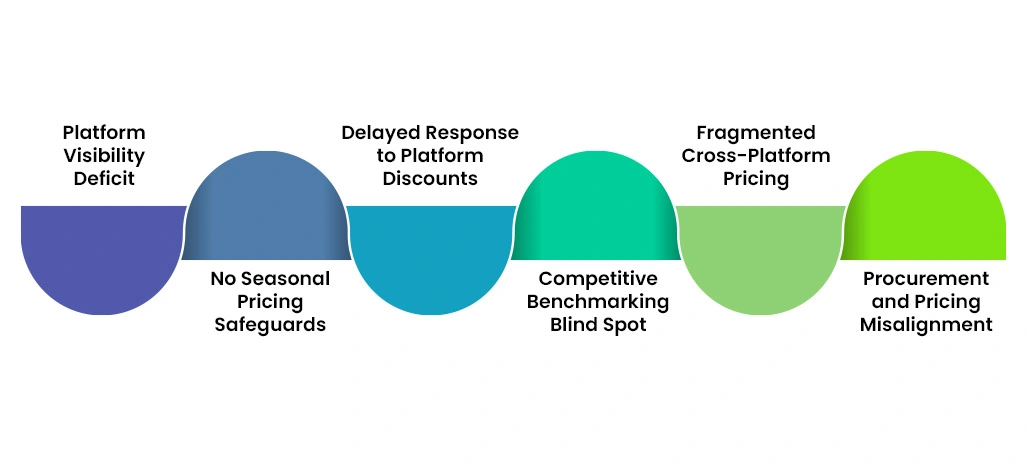
Our initial audit revealed a complex web of pricing challenges embedded across the brand's quick-commerce operations:
- Platform Visibility Deficit
The absence of structured data collection meant pricing decisions were made without adequate platform-level context. Quick Commerce Datasets pulled from Blinkit, Zepto, and Instamart revealed significant gaps in how the brand's products were being priced relative to their own MRP and competitor benchmarks. - Delayed Response to Platform Discounts
Without Blinkit Zepto Instamart Price Tracking in place, the brand could not detect when platforms applied algorithm-driven discounts to their SKUs without explicit approval. These auto-discount events regularly cut into margins before the brand's team even became aware of them. - Fragmented Cross-Platform Pricing
Different prices for the same SKU across apps created consumer confusion and undercut the brand's premium positioning. The lack of Scrape Quick Commerce Price Leakage capability meant these inconsistencies went untracked and uncorrected for extended periods. - No Seasonal Pricing Safeguards
During festive seasons and health trend cycles, quick-commerce platforms frequently adjusted promotional pricing without brand consent. The brand lacked a system to monitor and respond to these shifts within the same pricing cycle. - Competitive Benchmarking Blind Spot
The brand had no structured method to compare its pricing against category competitors listed on the same platforms. This left them unable to assess whether their pricing was competitively positioned or unintentionally overpriced in specific geographies. - Procurement and Pricing Misalignment
The internal disconnect between procurement costs and platform-facing prices meant that even when input costs changed, platform prices were not adjusted accordingly, further widening the margin gap.
Key Solutions for Addressing Client Challenges
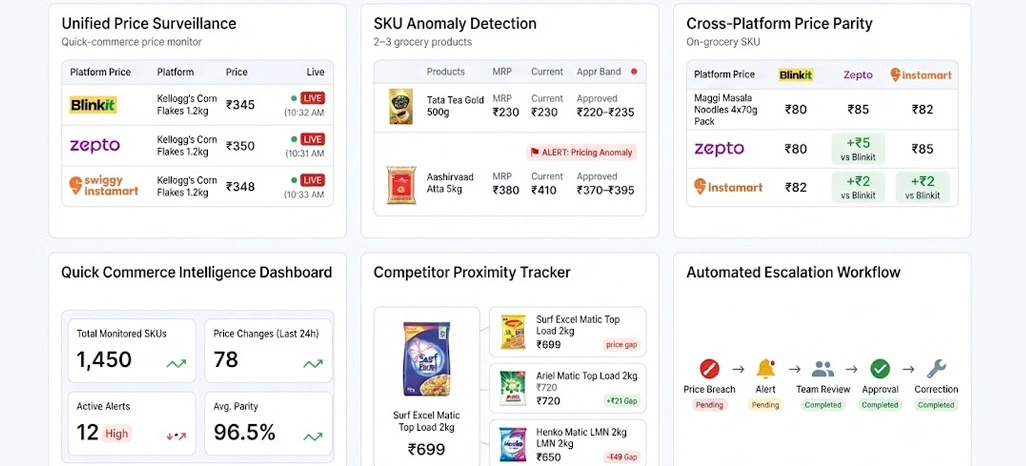
We deployed six targeted modules to systematically eliminate price leakage and restore pricing coherence across platforms:
- Unified Price Surveillance Engine
A centralized monitoring infrastructure was built to track live prices across Blinkit, Zepto, and Swiggy Instamart simultaneously. How Brands Track Quick Commerce Pricing was restructured from a manual, reactive process into an automated, continuous workflow with configurable alert thresholds. - SKU-Level Anomaly Detection Framework
This module used rule-based logic to flag SKUs where platform-facing prices deviated from the brand's approved price bands. Real Time Grocery Price Monitoring was enabled at the individual product level, ensuring even low-volume SKUs were covered within the surveillance net. - Cross-Platform Price Parity Module
Designed to enforce consistent pricing across all apps, this module generated daily parity reports that highlighted which SKUs were priced differently across platforms and by what margin, enabling fast corrective action. - Quick Commerce Data Intelligence Dashboard
A Quick Commerce Data Intelligence dashboard consolidated all pricing signals into one interface, allowing the brand's pricing and category teams to view, compare, and respond to pricing data without switching between multiple tools or spreadsheets. - Competitor Proximity Tracker
This module mapped the brand's prices against the closest competing SKUs on each platform, giving the team a real-time view of their competitive positioning without relying on assumptions or outdated category reports. - Automated Escalation and Workflow Integration
When a pricing breach was detected, the system automatically escalated alerts to the relevant team member with contextual data, recommended corrective pricing, and an approval workflow, reducing the time from detection to resolution by a significant margin.
Key Insights Gained from Quick-Commerce Price Tracking for D2C Snack Brands
| Intelligence Dimension | Operational Finding |
|---|---|
| SKU-Level Price Drift Detection | Identified 34% of SKUs with recurring unauthorized price deviations across platforms |
| Platform Discount Event Mapping | Mapped 120+ algorithm-triggered discount events over a 90-day period without brand approval |
| Geo-Specific Pricing Variance | Revealed city-level pricing inconsistencies affecting premium SKU perception in 8 metro markets |
| Competitor Pricing Proximity Index | Benchmarked brand SKUs against 15+ direct competitors across all three platforms weekly |
| Seasonal Pricing Exposure Windows | Detected 6 high-risk promotional windows where margin erosion risk exceeded 20% |
Benefits of Quick-Commerce Price Tracking for D2C Snack Brands From Retail Scrape
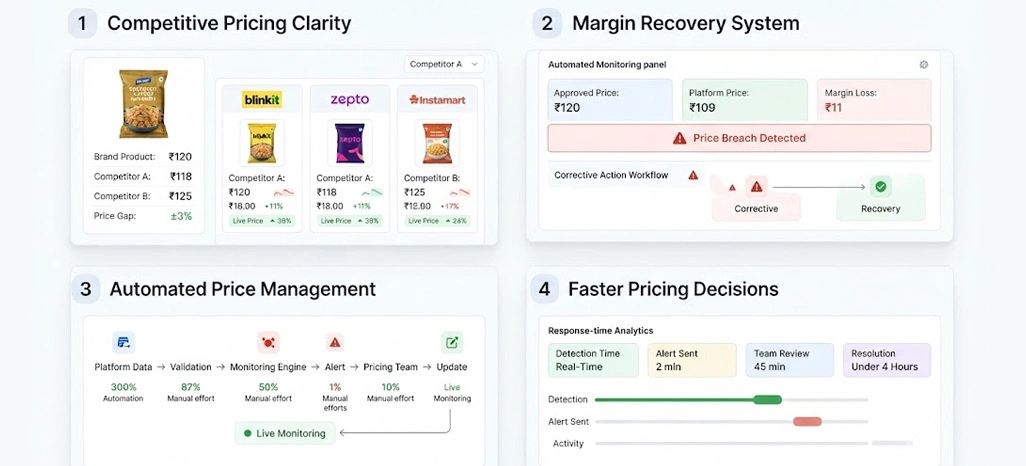
- Competitive Pricing Clarity
With Quick Commerce Competitor Analysis Data integrated into daily workflows, the brand's pricing team could for the first time benchmark their SKUs against category rivals in real time, enabling sharper and more confident pricing decisions across all platforms. - Margin Recovery at Scale
Blinkit Zepto Instamart Price Tracking allowed the brand to proactively catch and correct unauthorized platform discounts, directly recovering margins that had previously been written off as acceptable platform variance. - Operational Efficiency in Price Management
By replacing manual audit cycles with automated surveillance, the team freed up significant bandwidth. How Brands Track Quick Commerce Pricing evolved from a time-intensive task into a streamlined, system-driven process with minimal manual intervention. - Faster Pricing Decisions
Real-time alerts and structured escalation workflows cut the average response time to a pricing breach from several days to under four hours, significantly reducing the window of revenue exposure for each incident.
Client's Testimonial

Before working with Retail Scrape, we had no reliable way of knowing how our products were actually being priced on quick-commerce apps at any given moment. Product Price Monitoring for D2C Brands changed how we make decisions entirely. Their system gave us complete visibility, and the impact on our margins was almost immediate. Quick-Commerce Price Tracking for D2C Snack Brands finally gave our team the control we needed.
– Co-Founder & Head of Revenue, D2C Snack Brand
Conclusion
For D2C snack brands operating across multiple delivery apps, the ability to detect and respond to price leakage in real time is not a competitive advantage anymore, it is a baseline operational requirement. Quick-Commerce Price Tracking for D2C Snack Brands provides exactly that foundation: a structured, scalable approach to pricing governance that keeps every SKU aligned with the brand's margin objectives across every platform it appears on.
Contact Retail Scrape today to schedule a pricing audit, understand exactly where your price leakage is occurring, and deploy a monitoring solution tailored to your platform mix and SKU structure. Scrape Quick Commerce Price Leakage data continuously, and you create a pricing environment where nothing slips through undetected.