


How Can Google POI Data Scraping Build Business Datasets Across Kazakhstan and Pakistan in 2026?
Introduction
Rapid urbanization and digital transformation across Central and South Asia are reshaping how enterprises map local markets. As organizations expand regionally, implementing Google POI Data Scraping allows data teams to capture verified commercial locations, store operating hours, and consumer ratings directly from mapping platforms without manual collection delays.
Building structured location intelligence requires robust technical infrastructure capable of handling regional language variations and dynamic map interfaces. Integrating a reliable Web Scraping API ensures seamless automated extraction of geospatial attributes, helping analysts turn raw map listings into actionable market expansion strategies across emerging economic corridors.
Accurate location records remain essential for logistics optimization, retail site selection, and competitive benchmarking in fast-growing territories. By standardizing Google Maps Business Data Scraping, companies can eliminate outdated directory errors and maintain clean, high-resolution commercial registries ready for immediate integration into enterprise CRM and GIS environments.
Mapping Urban Commercial Growth Across Regional Markets In Kazakhstan
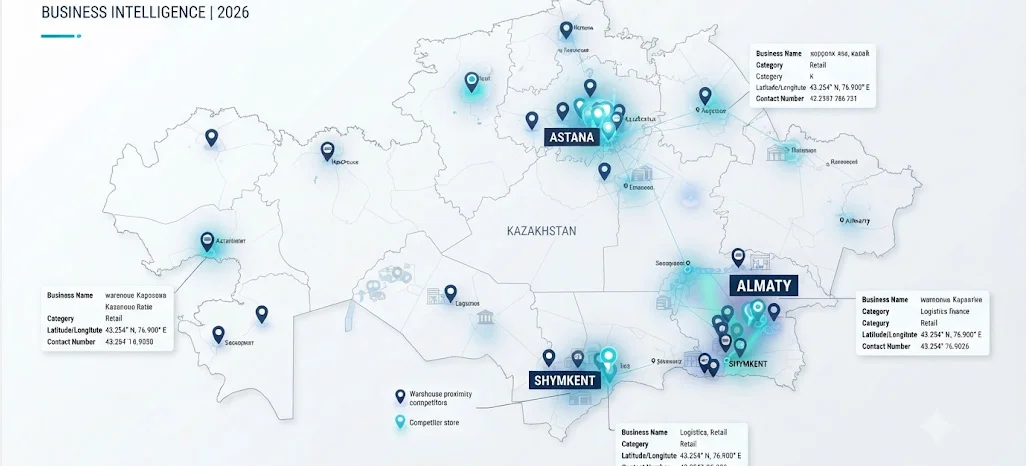
Kazakhstan’s retail, logistics, and financial sectors are experiencing sustained digital growth across major urban hubs like Almaty, Astana, and Shymkent. Enterprises entering this market increasingly rely on Google POI Data Scraping for Kazakhstan to identify commercial density, competitor store footprints, and underserved residential zones before committing capital to physical storefronts or regional distribution hubs.
Building reliable regional datasets requires specialized infrastructure capable of handling Cyrillic, Kazakh, and Latin script variations across thousands of commercial listings. Partnering with dedicated POI Data Collection Services in Kazakhstan helps data teams capture exact latitude-longitude coordinates, verified business categories, and active contact numbers without manual verification bottlenecks or outdated directory records.
Comprehensive geospatial datasets empower executive teams to benchmark competitor saturation, optimize warehouse proximity, and accelerate profitable expansion throughout Kazakhstan’s evolving commercial landscape in 2026.
- Automated geocoding verification ensures exact storefront placement across rapidly expanding suburban developments.
- Scheduled monthly extraction captures seasonal operating hour adjustments and newly registered commercial entities.
- Standardized category mapping aligns local retail classifications with international enterprise taxonomy models.
| Key Market Metric (Kazakhstan - 2026) | Data Benchmark | Commercial Impact |
|---|---|---|
| Urban Retail & Service Digitalization | 78% Active Map Listings | High visibility for modern trade & services |
| Regional Language Coverage | Kazakh, Russian, English | Requires multilingual parsing accuracy |
| Logistics & Delivery Hub Growth | +18.5% YoY Expansion | High demand for accurate coordinate verification |
| Average Monthly POI Attribute Updates | 22% Listing Modifications | Necessitates scheduled automated refreshes |
To maximize analytical value across vast geographic distances, enterprises often integrate Custom Web Data Extraction Services that tailor output schemas directly for regional supply chain routing and franchise territory planning. Structured delivery formats allow GIS analysts and commercial strategists to overlay demographic metrics against real-time store activity across every major oblast.
Strengthening Commercial Expansion Across Emerging Urban Centers In Pakistan
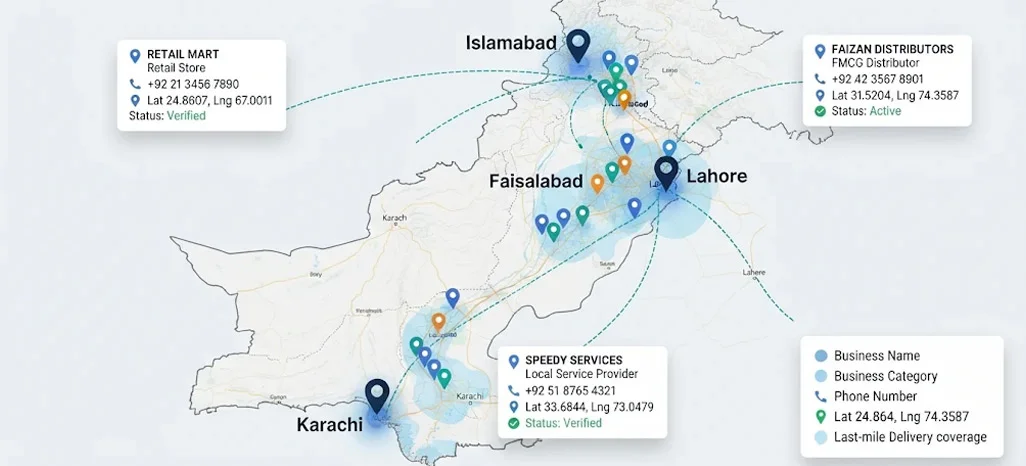
Pakistan’s rapidly expanding consumer economy spans high-density metropolitan centers including Karachi, Lahore, Islamabad, and Faisalabad. Accessing structured Google Maps Business Data for Pakistan empowers FMCG distributors, fintech providers, and e-commerce platforms to verify merchant networks and map neighborhood-level commercial activity across both tier-one cities and emerging regional trade hubs.
Maintaining high accuracy across millions of informal and formal storefronts requires systematic deduplication and continuous listing validation. Working alongside a trusted Google Maps POI Data Provider ensures clean categorization of local service providers, accurate pin locations, and verified phone numbers that field sales and last-mile delivery teams can rely on daily.
Equipping regional managers with validated commercial registries transforms territory planning, enabling faster market entry and stronger operational execution across Pakistan’s dynamic retail ecosystem.
- Neighborhood-level merchant density mapping supports targeted B2B onboarding for digital payment and supply chain platforms.
- Verified operating hours and contact metadata improve field representative routing and reduce failed delivery attempts.
- Consumer rating aggregation highlights high-performing retail corridors and underserved service gaps across major districts.
| Key Market Metric (Pakistan - 2026) | Data Benchmark | Commercial Impact |
|---|---|---|
| SME & Merchant Map Adoption | 64% Urban Penetration | Accelerates B2B merchant onboarding |
| Top Commercial Categories Tracked | Retail, Healthcare, Dining | Supports targeted distribution mapping |
| Cross-City Route Optimization | 31% Faster Delivery Planning | Reduces last-mile transit bottlenecks |
| Review & Rating Sentiment Volume | +42% Annual Growth | Enhances local brand reputation tracking |
Beyond basic address registries, combining geospatial location intelligence with Pricing Intelligence allows commercial analysts to evaluate regional product availability, benchmark local service rates, and align distribution budgets with real consumer demand across major Pakistani provinces.
Scaling Cross Border Location Intelligence Across Central And South Asia
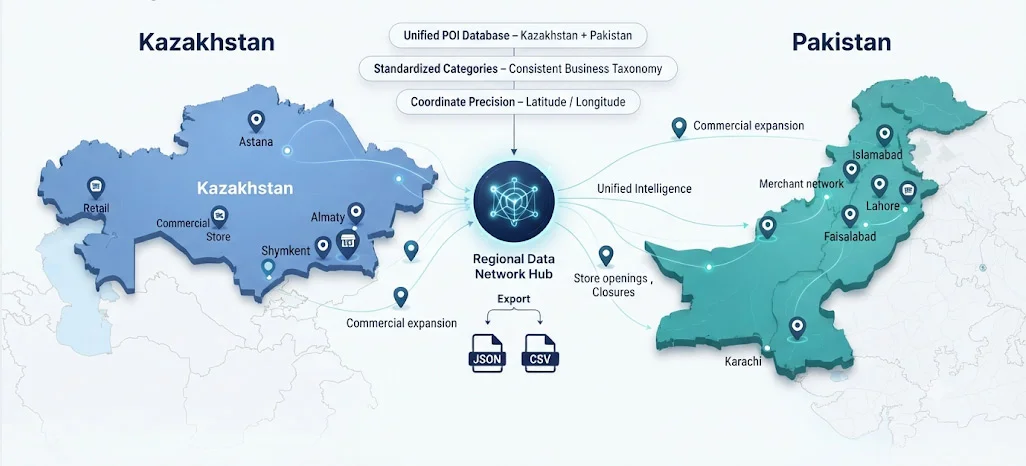
Operating simultaneously across Central and South Asian trade corridors requires unified data standards that bridge linguistic, regulatory, and infrastructure differences. Deploying Google POI Data Scraping for Kazakhstan and Pakistan gives regional headquarters a single, standardized view of store openings, closures, and market saturation across both nations without managing fragmented local research vendors.
Consolidating multi-market location pipelines enables enterprise analytics teams to compare commercial growth rates across border cities and regional logistics hubs on equal footing. Utilizing Multi-Country POI Database Collection Services ensures harmonized JSON or CSV schemas, consistent category taxonomies, and reliable coordinate precision ready for immediate business intelligence dashboard integration.
By standardizing regional dataset architecture, multinational enterprises gain the clarity needed to scale operations confidently across both Kazakhstan and Pakistan throughout 2026.
- Unified schema normalization eliminates manual data cleaning when merging Central and South Asian market registries.
- Automated change-detection alerts notify expansion teams immediately when competitors open or close regional branches.
- Cross-border geospatial benchmarking supports strategic capital allocation across high-growth Asian trade corridors.
| Cross-Border Dataset Attribute | Kazakhstan Coverage | Pakistan Coverage | Enterprise Application |
|---|---|---|---|
| Geospatial Coordinates (Lat/Long) | 99.4% Precision | 98.9% Precision | GIS mapping & territory alignment |
| Business Category & Sub-Type | Standardized Taxonomy | Localized + Standard | Competitor density benchmarking |
| Operating Hours & Status | Real-Time Sync | Real-Time Sync | Fleet scheduling & field sales routing |
| Customer Ratings & Review Counts | Multilingual Support | Multilingual Support | Service quality & market sentiment analysis |
To build deeper commercial visibility, pairing dedicated Pakistan Local Business Data Extraction Services alongside Central Asian pipelines—while integrating Price Scraping Services, allows organizations to correlate physical storefront locations with regional pricing dynamics in one cohesive analytical framework.
How Retail Scrape Can Help You?
Expanding into unfamiliar regional markets demands clean, verified location datasets that internal teams often struggle to maintain manually. By implementing Google POI Data Scraping, Retail Scrape delivers structured, deduplicated business records tailored to your exact geographic and industry parameters across Kazakhstan and Pakistan.
Our automated infrastructure handles complex map pagination, multilingual text normalization, and continuous data validation so your analysts can focus entirely on strategic execution.
- Automated extraction of verified business names, full street addresses, and exact GPS coordinates across major cities and tier-two towns.
- Structured capture of business categories, sub-classifications, official websites, and validated contact numbers for B2B lead generation.
- Scheduled data refreshes that track newly opened storefronts, permanent closures, and updated operating hours in near real time.
- Multilingual parsing capabilities supporting Kazakh, Russian, Urdu, and English characters without encoding errors or missing fields.
- Seamless delivery in enterprise-ready formats including CSV, JSON, Parquet, and direct cloud storage integration for immediate BI ingestion.
- Custom compliance and quality assurance pipelines that remove duplicate listings and verify geographic accuracy before dataset delivery.
Combining geospatial datasets with Real-Time Price Monitoring and POI Data Collection Services in Kazakhstan gives your commercial teams complete visibility into both store locations and local market competitiveness.
Conclusion
Building reliable commercial datasets across emerging Asian markets requires scalable automation, localized parsing, and consistent quality verification. When enterprises adopt Google POI Data Scraping, they replace guesswork with verified location intelligence that drives smarter store placement, efficient logistics routing, and stronger B2B outreach across every target city.
Partnering with experienced Multi-Country POI Database Collection Services ensures your organization maintains accurate, up-to-date geospatial registries as local markets evolve throughout 2026 and beyond. Connect with Retail Scrape today to request a customized sample dataset and accelerate your regional expansion strategy.