
Cutting Out-Of-Stock Revenue Losses Using Our PIN Code Level Product Availability Tracking System
Introduction
Stockout losses have become one of the most damaging yet preventable challenges facing modern retail and quick commerce businesses today. When customers place orders and find items unavailable at their nearest dark store or fulfillment hub, the resulting revenue loss goes beyond a single transaction, it erodes brand trust and pushes loyal buyers toward competitors permanently. This case study details how we helped a growing retail client overcome exactly this problem using PIN Code Level Product Availability to monitor inventory health at the most granular geographic level possible.
The scale and speed of quick commerce platforms today demand more than traditional inventory reporting dashboards. Businesses need Product Availability capabilities that reflect what is actually in stock, in a specific location, at a specific moment, not aggregated regional averages. Our client’s core problem was precisely this mismatch between assumed availability and ground-level reality across dozens of delivery zones.
By deploying a structured tracking and intelligence system tied to delivery zones and postal codes, we empowered the client to monitor inventory gaps before they translated into lost sales. Through continuous data feeds and actionable alerts, the client moved from reactive firefighting to proactive restocking, transforming how their procurement and operations teams approached daily inventory management across all serviceable PIN codes.
The Client
Fast-scaling consumer goods brand operating across multiple metropolitan regions in India had built significant traction on quick commerce platforms like Blinkit, Swiggy Instamart, and Zepto. With SKUs listed across hundreds of dark stores spread over 15 cities, managing Quick Commerce Availability Tracking manually had become an operational impossibility for their lean supply chain team. Despite strong demand signals, recurring out-of-stock events were silently eating into monthly revenue targets.
The company served a wide demographic, urban households, young professionals, and family shoppers, all of whom expected near-instant product availability. The absence of a reliable PIN Code Level Inventory Tracking system meant that the brand often learned about stockouts only after customer complaints surfaced on support channels or negative reviews appeared on platform listings. The team recognized that Quick Commerce Data Intelligence tools were no longer optional, they were mission-critical.
Internally, the brand’s category managers spent considerable time manually checking platform listings region by region, a process that was both time-consuming and error-prone. Without a centralized view of availability by postal code, procurement planning remained disconnected from real fulfillment realities. Leadership understood that unless they deployed a data-first approach to monitor product presence across every delivery zone, their growth ambitions on quick commerce platforms would continue to be undermined by avoidable inventory failures.
Key Challenges Faced by the Client
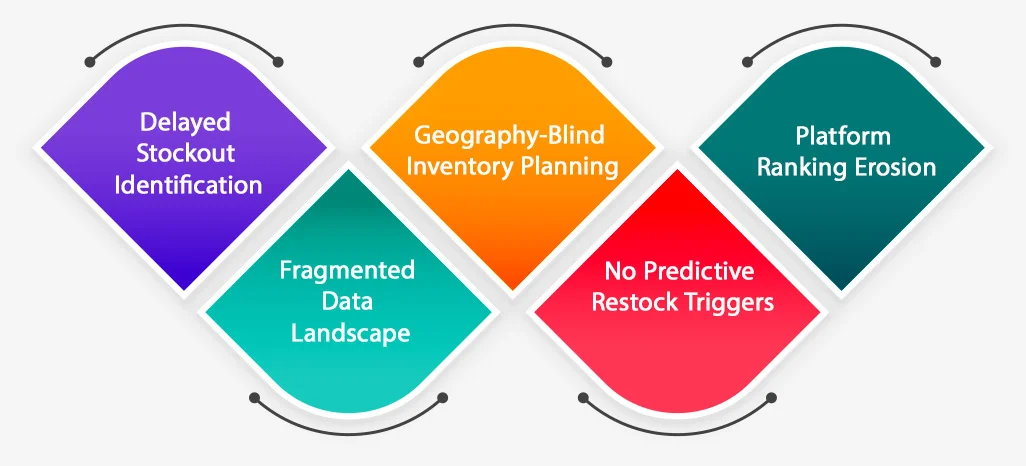
The client’s journey toward effective inventory intelligence was blocked by several structural and operational gaps that compounded over time:
- Delayed Stockout Identification
The client had no mechanism for Real-Time Price Monitoring or availability alerts at the PIN code level. By the time stockouts were flagged internally, the platform algorithm had already downranked affected listings, suppressing visibility and directly reducing order volumes across impacted zones. - Fragmented Data Landscape
Availability data was collected from multiple platforms through separate manual processes with no unification layer. Without Quick Commerce Out-Of-Stock Data Tracking, cross-platform stockout patterns remained invisible, making it impossible to identify which SKUs were chronically unavailable in specific delivery areas. - Geography-Blind Inventory Planning
Procurement decisions were made based on city-level aggregates, completely ignoring hyperlocal demand variations. The absence of Hyperlocal Product Availability Monitoring meant that high-demand PIN codes in dense urban neighborhoods were frequently understocked while other zones held excess inventory unnecessarily. - No Predictive Restock Triggers
Without structured data on how quickly specific SKUs depleted across delivery zones, the client lacked any predictive capability. Replenishment decisions were calendar-based rather than demand-driven, creating recurring out-of-stock cycles on fast-moving product categories. - Platform Ranking Erosion
Persistent stockouts caused steady degradation in platform search rankings. The team had no data to correlate availability gaps with ranking declines, leaving them unable to make the case internally for infrastructure investment in tracking systems.
Key Solutions for Addressing Client Challenges
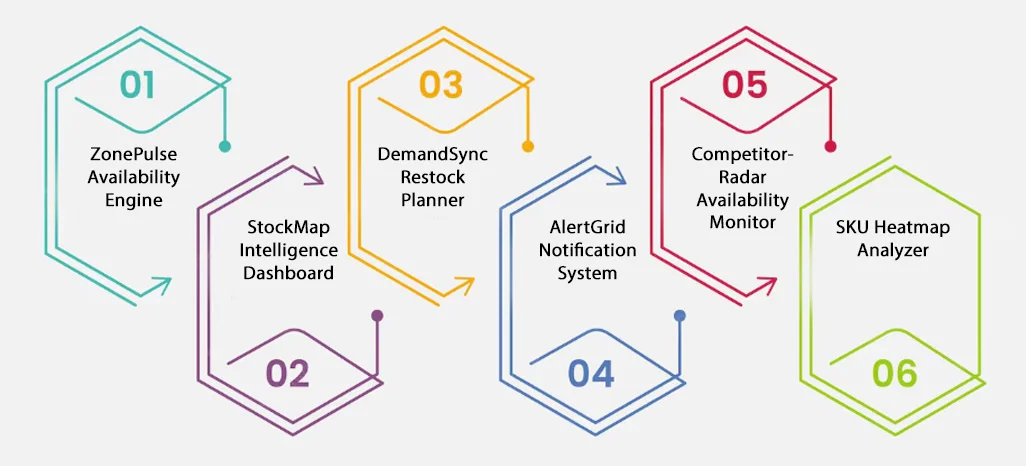
We designed and deployed a multi-layered inventory intelligence infrastructure tailored specifically to the client’s platform presence, SKU complexity, and geographic spread:
- ZonePulse
Availability Engine A real-time data extraction system built to track product presence on major quick commerce platforms at the individual PIN code level, enabling the client to identify stockouts the moment they occur rather than hours after the fact. - StockMap
Intelligence Dashboard A centralized visual dashboard aggregating Pin-Code-Wise Grocery Product Availability data across all monitored platforms and regions, giving category managers a single source of truth for inventory health at any given time of day. - DemandSync
Restock Planner This module analyzed historical availability patterns and Price Tracking Data alongside depletion rates to generate automated restock recommendations, transforming procurement decisions from intuition-based to evidence-driven. - AlertGrid
Notification System A configurable alert framework that notified relevant teams the moment a critical SKU crossed a predefined availability threshold in any monitored zone, enabling same-day restock action before listing visibility was impacted. - CompetitorRadar
Availability Monitor By tracking Quick Commerce Availability by PIN Code for competing brands across the same dark store zones, this module delivered competitive benchmarking data that helped the client understand relative shelf presence and act strategically. - SKU Heatmap Analyzer
A geographic visualization tool mapping stockout frequency by delivery zone and product category, allowing the client to prioritize high-risk PIN codes for safety stock increases and platform-specific inventory negotiations.
Key Insights Gained from PIN Code Level Product Availability Tracking
| Intelligence Category | What It Revealed |
|---|---|
| Stockout Frequency by PIN Code | Identified the top 20 delivery zones with the highest recurring out-of-stock events per week |
| SKU-Level Depletion Velocity | Measured how quickly specific products sold out within individual dark store catchment areas |
| Platform-Wise Availability Gaps | Compared stock presence across Blinkit, Zepto, and Swiggy Instamart for the same products |
| Peak Hour Stockout Windows | Pinpointed the time slots within which inventory depletion occurred most frequently |
| Category-Level Risk Scoring | Ranked product categories by out-of-stock risk based on historical availability data |
Benefits of BJ’s Wholesale Club Product Data Scraping From Retail Scrape
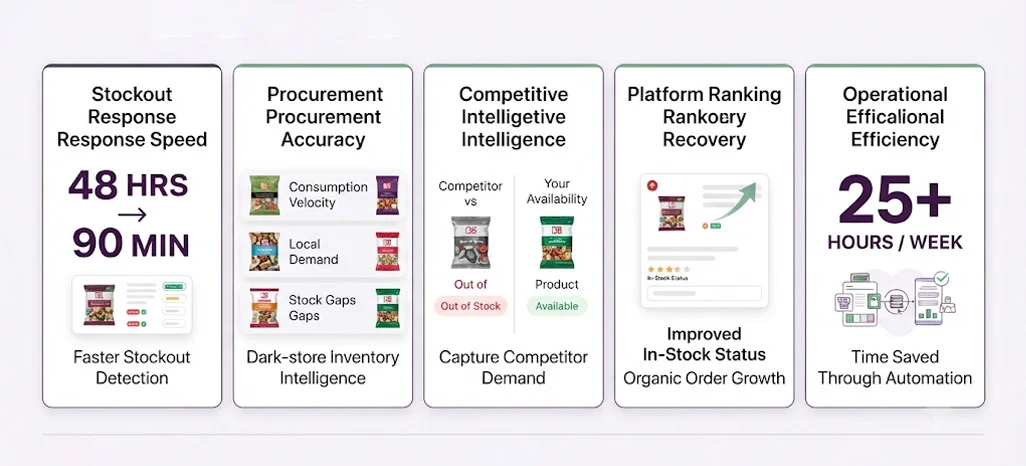
- Stockout Response Speed
Through deployment of Quick Commerce Out-Of-Stock Data Tracking, the client reduced their average stockout detection time from 48 hours to under 90 minutes, allowing operations teams to initiate restock action while sales impact remained minimal. - Procurement Accuracy
Quick Commerce Data Scraping powered smarter buying decisions by giving procurement teams visibility into actual consumption velocity at the dark store level rather than relying on platform-reported aggregates that masked hyperlocal gaps. - Competitive Intelligence Advantage
Using competitor availability benchmarks across the same delivery zones, the client consistently identified windows where rival brands were out of stock and capitalized on those gaps through targeted promotional pushes to increase order capture. - Platform Ranking Recovery
Consistent in-stock status across monitored PIN codes led to measurable improvements in search ranking on key quick commerce platforms, driving organic order volume growth without additional marketing spend. - Operational Efficiency Gains
Category managers reclaimed an estimated 25+ hours per week previously spent on manual platform checks, redirecting that effort toward higher-value strategic planning activities powered by Grocery Market Intelligence Data.
Client's Testimonial

“Working with Retail Scrape completely transformed how we manage inventory across quick commerce platforms. The PIN Code Level Product Availability system they built for us gave us real-time visibility we never had before. What used to be a reactive scramble is now a structured, data-driven process. Our Grocery Market Intelligence Data capabilities have improved significantly, and the reduction in stockout losses has directly reflected in our monthly revenue numbers.”
– Head of Supply Chain, Leading Consumer Goods Brand
Conclusion
Maintaining consistent product presence across quick commerce platforms is no longer just a supply chain challenge, it is a direct revenue and brand equity issue that demands structured, data-first solutions. PIN Code Level Product Availability gives businesses the precision they need to act on stockouts before they compound into lost rankings and erode customer trust.
We specialize in building customized inventory intelligence systems that deliver Quick Commerce Availability Tracking at the most granular level, ensuring our clients always know what is in stock, where, and when restocking is needed.
Our Product Availability Services are designed to serve brands of all sizes operating across the quick commerce ecosystem, from emerging D2C labels to established consumer goods companies. Contact Retail Scrape today to eliminate stockout losses, improve your platform rankings, and build a smarter, more responsive inventory management operation.