Advancing Retail Pricing With Tesco Price Scraping for Automated Pricing Intelligence Solutions
Introduction
The grocery retail sector is under constant pressure from fluctuating prices, supply chain disruptions, and rising consumer expectations. Retailers who lack structured data systems often find themselves reacting to market changes rather than anticipating them. Tesco Price Scraping for Automated Pricing Intelligence has emerged as a decisive capability for businesses seeking to sharpen their procurement strategies and align product pricing with real-time market conditions.
Competing in a market dominated by Tesco requires more than intuition, it demands systematic monitoring of price movements across thousands of SKUs. Tesco Competitor Price Monitoring allows retailers to benchmark their assortment continuously, identifying gaps and opportunities that manual tracking simply cannot surface. This kind of structured visibility transforms raw pricing data into actionable intelligence that informs both purchasing and selling decisions.
Sustained profitability in modern retail requires an ecosystem of smart tools and structured data pipelines. Tesco Pricing Data Scraping enables businesses to build this ecosystem by automating the collection of competitor data across categories, regions, and promotional cycles. Retailers that embrace this approach gain the consistency and speed required to compete effectively in a price-sensitive environment where margins are always under scrutiny.
The Client
A mid-sized grocery retail chain operating across 90-plus locations throughout the UK faced growing pressure to modernize its pricing infrastructure. Despite strong customer loyalty and a well-curated product range, the company struggled to keep pace with Tesco's frequent price revisions. Leadership recognized that without structured Tesco Grocery Price Data, procurement and category teams were making critical decisions based on incomplete information, which directly impacted margin performance.
The retailer's internal teams had been relying on spreadsheet-based tracking for years, pulling competitor prices manually from retail websites and compiling reports on a bi-weekly schedule. This approach not only consumed significant staff hours but also introduced reporting lags that rendered pricing decisions obsolete before they could be implemented. As the company explored digital transformation options, the absence of Tesco Product Data Scraping became a clear operational bottleneck that demanded immediate resolution.
An initial assessment of the company's technology stack revealed that they lacked integration between pricing data and inventory systems, making it impossible to execute responsive procurement decisions. Vendors were approached for potential Tesco API Data Scraping solutions, but API-based access proved restrictive and commercially unviable for the volume and frequency of data the client required. This gap accelerated their search for a more scalable, automated alternative that could operate at speed without compromising accuracy.
Key Challenges Faced by the Client
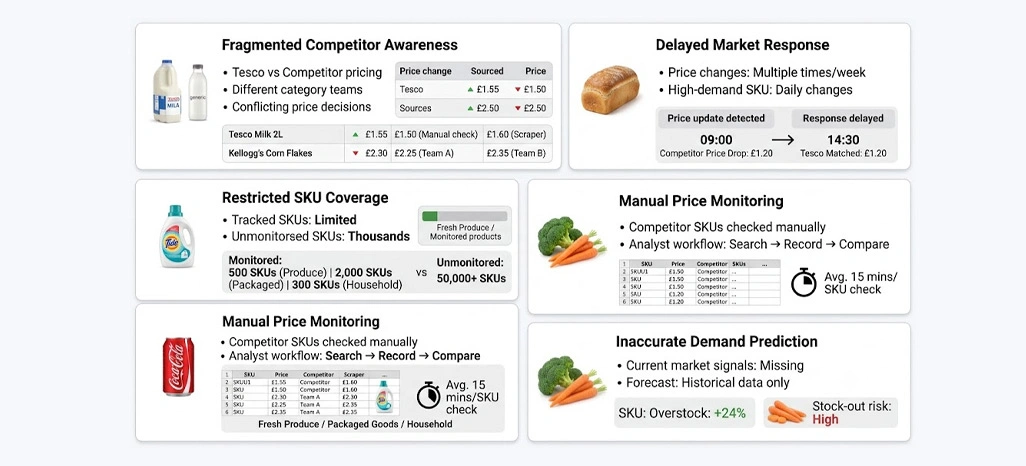
The following challenges were identified as the primary obstacles preventing the client from achieving efficient retail pricing operations:
- Fragmented Competitor Awareness
The client's teams had no centralized system to perform Competitor Pricing Analysis Using Web Scraping, which meant that individual category managers were working with inconsistent data sets. This fragmentation created conflicting pricing decisions across departments, damaging both margin consistency and shopper confidence. - Delayed Market Response
Price changes on Tesco's platform occurred multiple times each week, sometimes daily for high-demand categories. Without How Retailers Track Competitor Prices solutions in place, the client's teams were responding to pricing events that had already passed, resulting in consistent revenue loss and missed promotional alignment windows. - Inaccurate Demand Prediction
Without structured access to Tesco Grocery Price Data, the client's forecasting models were built on historical assumptions rather than current market signals. This led to overstocking in slow-moving categories and stock-outs in high-velocity segments, both of which eroded profitability and customer satisfaction. - Over-Reliance on Manual Workflows
Category analysts spent the majority of their working week gathering competitor pricing data by hand. The absence of Using Web Scraping for Price Monitoring tools created a resource drain that prevented teams from focusing on higher-value strategic responsibilities. - Restricted SKU Coverage
The client was only tracking pricing across a small percentage of their total product range due to manual limitations. Thousands of SKUs across fresh produce, packaged goods, and household products went unmonitored, leaving significant competitive blind spots in their assortment strategy.
Key Solutions for Addressing Client Challenges
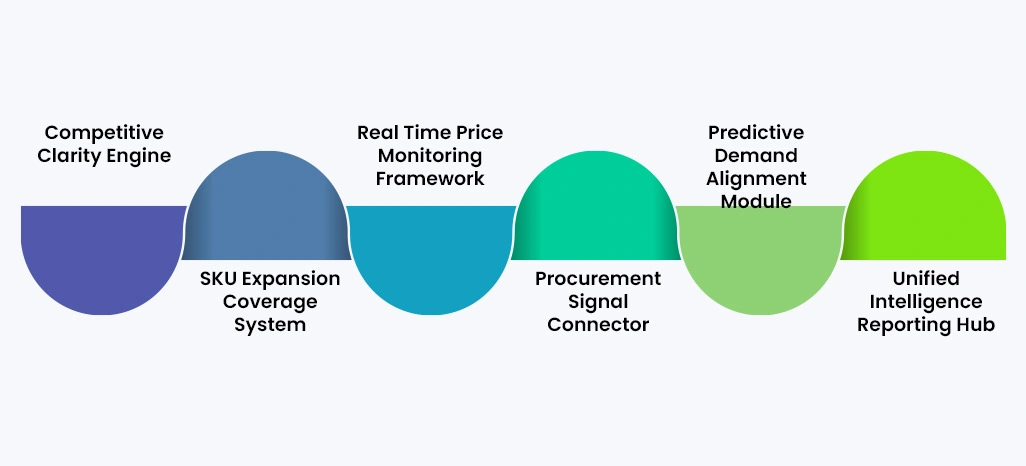
To address each identified challenge, we designed and deployed a suite of interconnected pricing intelligence modules:
- Competitive Clarity Engine
This module provided category-level pricing benchmarks extracted directly from Tesco's live product listings. By deploying structured crawlers across priority categories, teams received consolidated dashboards reflecting real-time price positioning relative to the market leader, enabling immediate and evidence-based decision-making. - Real Time Price Monitoring Framework
We implemented Real Time Retail Price Monitoring infrastructure that captured price changes across thousands of SKUs on a continuous basis. Alerts were triggered whenever significant price movements were detected, giving procurement and marketing teams the agility to respond within hours rather than weeks. - Predictive Demand Alignment Module
By combining scraped pricing trends with seasonal sales patterns, this module generated forward-looking demand projections. Category managers could proactively adjust procurement volumes based on anticipated pricing movements, reducing both overstock risk and supply gaps. - SKU Expansion Coverage System
We extended monitoring coverage to the client's full product catalogue, not just high-priority items. Automated pipelines tracked price changes across every relevant category on Tesco's platform, ensuring no significant competitive movement went undetected. - Procurement Signal Connector
This component linked competitive pricing data directly to internal purchase order workflows. When Tesco's prices dropped below a defined threshold, automated procurement recommendations were generated, accelerating sourcing decisions while reducing dependency on analyst judgment alone. - Unified Intelligence Reporting Hub
A consolidated reporting environment gave senior leadership visibility into pricing trends, margin implications, and competitive positioning through a single interface. Weekly summary reports and real-time dashboards reduced the communication gap between data teams and decision-makers.
Key Insights Gained from Tesco Price Scraping for Automated Pricing Intelligence
| Intelligence Dimension | Key Finding |
|---|---|
| Price Revision Frequency | Tesco updates pricing across key grocery categories multiple times weekly |
| Promotional Cycle Mapping | Recurring discount windows identified across seasonal and festive periods |
| Category Margin Benchmarks | Significant margin gaps uncovered in fresh produce and packaged snacks |
| SKU-Level Price Sensitivity | High-demand SKUs showed frequent micro-adjustments tied to demand signals |
| Regional Pricing Variation | Tesco applied localized pricing strategies in competitive postcode clusters |
Benefits of Tesco Price Scraping for Automated Pricing Intelligence From Retail Scrape
- Faster Pricing Decisions
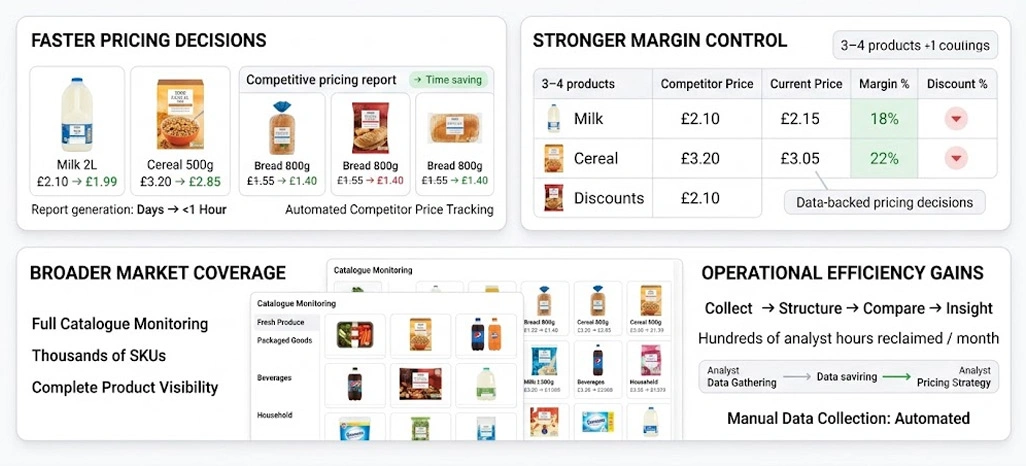
The time required to generate a full competitive pricing report dropped from several days to under an hour, accelerating the entire pricing decision cycle. Automated Competitor Price Tracking replaced manual data collection entirely, freeing category teams to focus on strategy. - Stronger Margin Control
With consistent access to structured competitor data through Tesco Pricing Intelligence, the client was able to set prices with far greater precision. Margin leakage caused by reactive discounting was significantly reduced, and teams could defend pricing decisions with data rather than instinct. - Broader Market Coverage
Full-catalogue monitoring gave the business complete visibility across every product segment they operated in. For the first time, leadership could assess their competitive position holistically rather than relying on a narrow sample of manually tracked products. - Operational Efficiency Gains
Automating the data collection process reclaimed hundreds of analyst hours each month. Teams previously burdened with data gathering shifted their focus toward interpreting insights and building longer-term pricing strategies, a shift that measurably improved departmental output.
Client's Testimonial

Before working with Retail Scrape, our pricing decisions were always one step behind the market. The implementation of Tesco Price Scraping for Automated Pricing Intelligence gave our teams immediate access to competitor data we previously had to chase manually. The impact was substantial, we recorded a 38% improvement in pricing accuracy and saw margin recovery within the first quarter. Tesco Pricing Intelligence now sits at the core of how we plan and execute our procurement strategy.
– Head of Category Management, Regional Grocery Retail Chain
Conclusion
In a retail landscape where price is one of the most powerful drivers of consumer behavior, the ability to monitor and respond to competitor movements is no longer optional. Tesco Price Scraping for Automated Pricing Intelligence provides the infrastructure businesses need to move from reactive pricing to proactive market positioning. By automating what was once a slow, error-prone manual process, retailers can finally act on pricing intelligence at the speed the market demands.
Whether you operate across 10 locations or 500, our scalable infrastructure adapts to your monitoring requirements. Tesco Product Data Scraping opens up visibility across thousands of product lines simultaneously, giving procurement and category teams the depth of insight they need to make confident, margin-protecting decisions every day.
Contact Retail Scrape today and let our team design a custom data solution built around your business goals. Retailers who integrate How Retailers Track Competitor Prices methodologies into their core operations consistently outperform those relying on outdated tracking approaches, reducing pricing errors, improving stock efficiency, and building the kind of competitive agility that sustains long-term growth.