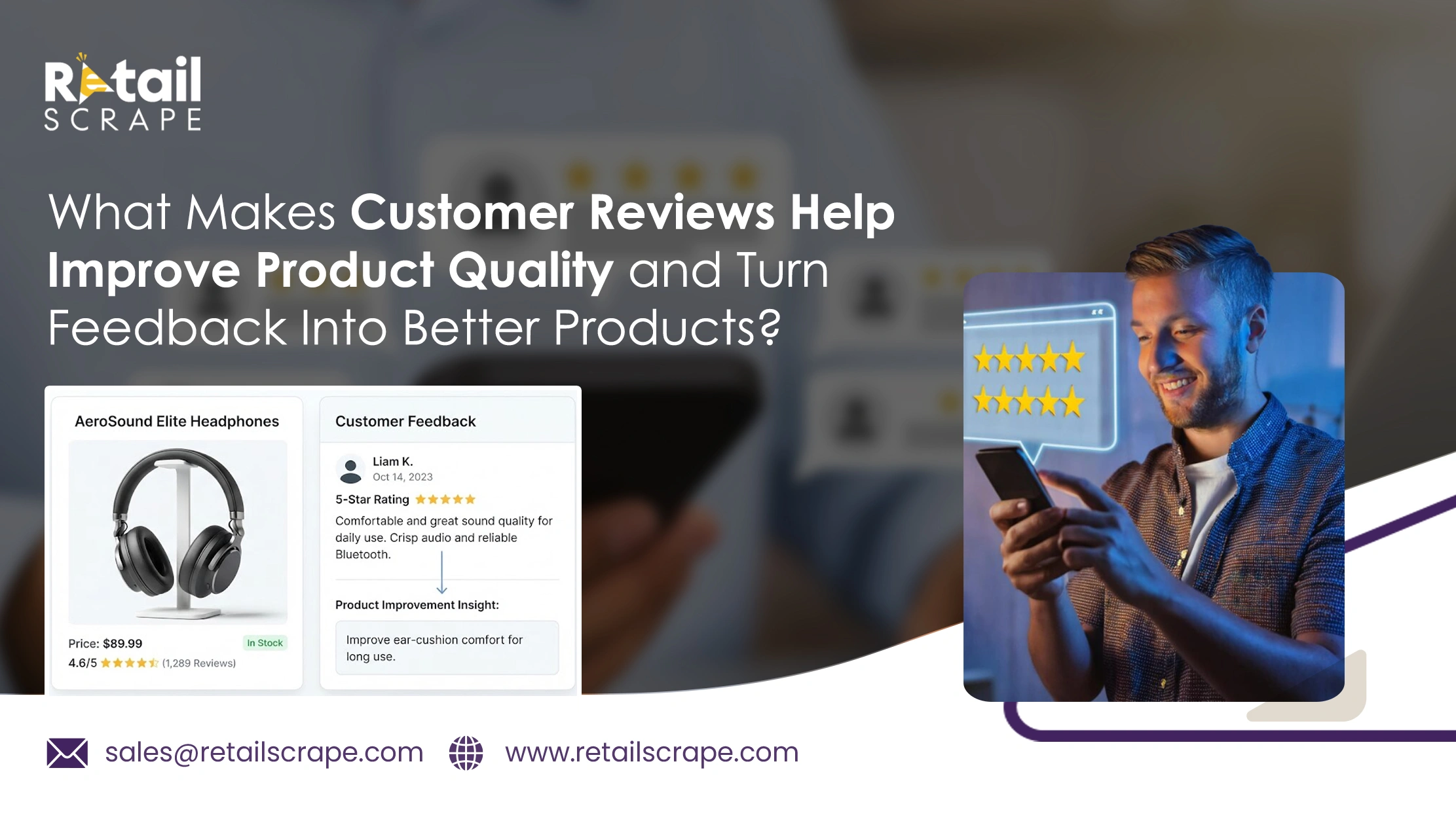
What Makes Customer Reviews Help Improve Product Quality and Turn Feedback Into Better Products?
Introduction
Customer feedback has become a source of product intelligence, not merely a reputation signal. Reviews explain what shoppers appreciate, where expectations fall short, and which issues repeatedly affect satisfaction. In 2026, BrightLocal reported that 97% of consumers read online reviews for local businesses, showing how widely feedback influences research and decisions.
When brands organize Customer Reviews & Ratings Data, they can connect recurring complaints with product attributes, service experiences, packaging concerns, usability issues, and value perceptions. This turns scattered comments into evidence that product, quality, and teams can act on instead of relying on isolated anecdotes.
The real advantage comes from closing the feedback loop. Scrape Customer Reviews Data can help teams collect review information at scale, while structured Customer Review Analysis can reveal patterns across products and channels. With consistent monitoring, brands can prioritize improvements, validate whether changes solve problems, and build products that better reflect customer expectations.
Turning Everyday Customer Experiences Into Actionable Product Improvements
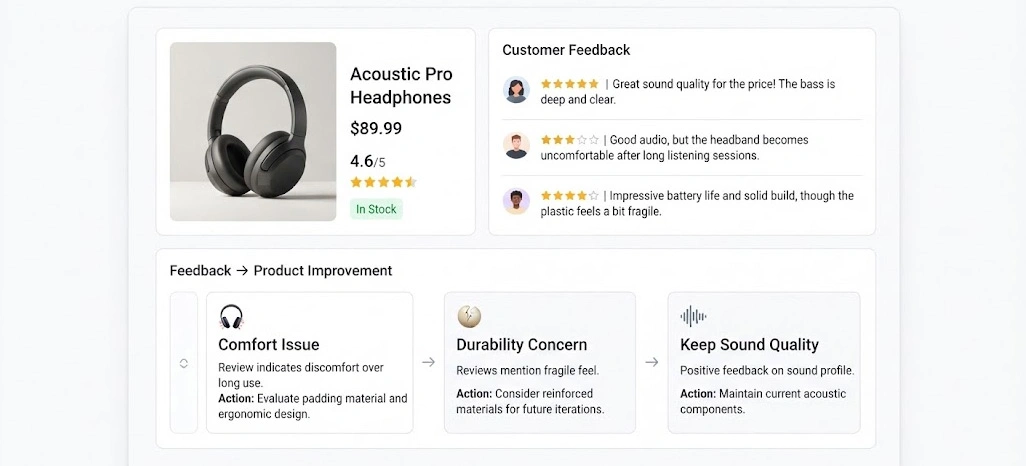
Customer feedback becomes more useful when brands systematically connect recurring experiences with specific product characteristics. Scrape Customer Reviews Data can help collect large volumes of comments, ratings, and observations from relevant sources. Instead of reviewing scattered comments individually, teams can organize information around recurring defects, usability concerns, packaging problems, and feature expectations.
A structured Customer Review Analysis process can then identify which issues appear repeatedly and which concerns are isolated. This distinction helps product teams focus resources on problems that affect larger customer groups. Positive comments can also reveal features worth preserving, while repeated complaints may indicate areas requiring design, testing, or quality adjustments.
Brands can further use AI Product Review Analysis to categorize large datasets into themes such as durability, functionality, appearance, pricing, and usability. This approach makes it easier to compare customer experiences across product variations and identify patterns that may not be obvious through manual assessment. Such insights can support faster prioritization and clearer product-development discussions.
- Identify recurring product complaints
- Separate isolated issues from common concerns
- Compare feedback across product variations
- Prioritize improvements based on frequency
- Monitor responses after product changes
A broader Web Scraping Product Quality Data workflow can add product attributes and contextual information to customer feedback, creating a stronger basis for evaluation. Teams can then translate findings into measurable improvement priorities.
| Feedback Signal | Potential Product Action |
|---|---|
| Repeated defect | Quality investigation |
| Feature complaint | Design review |
| Durability concern | Material assessment |
| Positive feature | Maintain capability |
Reading Customer Sentiment To Guide Smarter Product Development Decisions
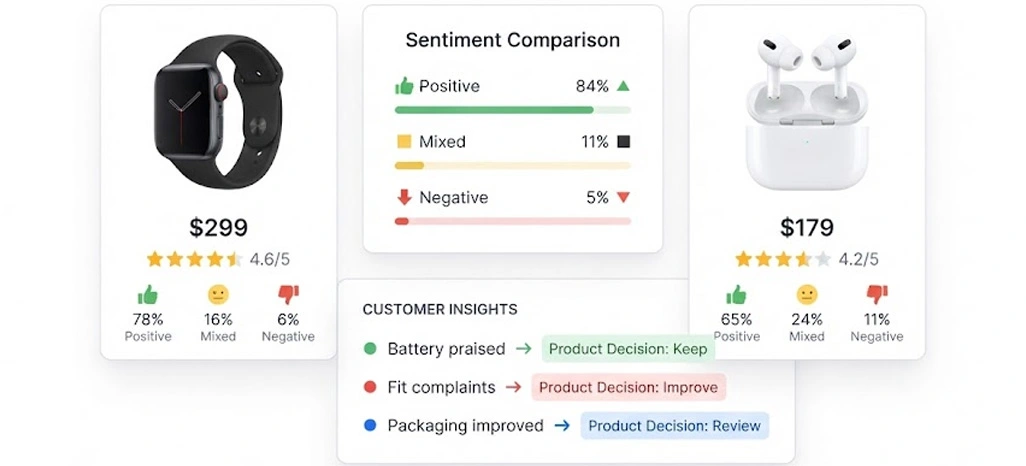
Customer opinions often contain valuable context behind ratings, helping brands understand why shoppers feel satisfied or disappointed. Customer Review Data Scraping Services can collect feedback from multiple relevant sources and organize it into structured datasets. This creates a broader evidence base for identifying repeated experiences across products, categories, and customer segments.
Once feedback is organized, Automated Customer Feedback Analysis can classify recurring themes and highlight changes in customer responses. Teams can identify whether complaints relate to performance, usability, delivery experience, packaging, or perceived value. These patterns help decision-makers determine which concerns require immediate investigation and which can be addressed during future product iterations.
Customer Sentiment Analysis adds another layer by distinguishing positive, negative, and mixed customer reactions. Sentiment patterns can reveal whether a frequently mentioned feature creates satisfaction or frustration. When combined with review frequency and product attributes, these signals help teams prioritize improvements according to customer impact rather than relying only on overall star ratings.
- Group feedback by recurring themes
- Compare sentiment across product versions
- Identify high-impact customer concerns
- Assign issues to responsible teams
- Track reactions after improvements
Brands can connect these findings with Customer Feedback for Product Improvement by assigning relevant themes to product, quality, and merchandising teams. This creates a clearer feedback loop from customer experience to corrective action and future development.
| Customer Pattern | Recommended Response |
|---|---|
| Strong positive reaction | Preserve feature |
| Frequent complaint | Investigate cause |
| Mixed feedback | Segment findings |
| Emerging concern | Monitor closely |
Connecting Review Patterns With Market Signals For Better Product Outcomes
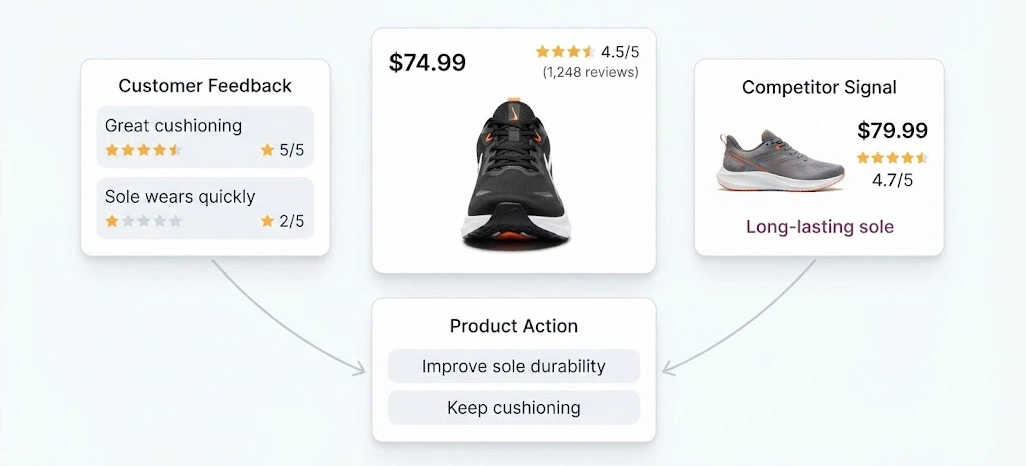
Product feedback becomes more actionable when brands evaluate customer comments alongside broader market information. Scrape Customer Feedback Data Analysis can organize recurring observations around specific products, attributes, and customer expectations. This helps teams understand whether an issue represents an isolated experience or a broader pattern affecting product perception.
Through Scraping Product Review Data Analysis, businesses can compare review themes across competing products, product versions, and categories. Such comparisons may reveal features customers consistently praise elsewhere or weaknesses that repeatedly influence dissatisfaction. These insights can support benchmarking while giving product teams clearer direction for future modifications and positioning.
E-Commerce Data Scraping can provide additional context by connecting review observations with product listings, pricing information, specifications, and catalog changes. When these datasets are evaluated together, teams can identify relationships between product characteristics and customer responses. This broader view supports more informed decisions about quality improvements, feature prioritization, and product positioning.
- Compare products across competing categories
- Identify frequently praised characteristics
- Detect recurring weaknesses across listings
- Connect feedback with market context
- Monitor customer responses after changes
The resulting insights can show how Customer Reviews Improve Product Quality when feedback is continuously connected to practical decisions. Instead of treating reviews as isolated comments, brands can use recurring evidence to evaluate changes, monitor customer responses, and refine products according to measurable market signals.
| Market Signal | Business Use |
|---|---|
| Feature comparison | Product benchmarking |
| Pricing difference | Value assessment |
| Specification change | Performance review |
| Review trend | Improvement monitoring |
How Retail Scrape Can Help You?
We can help brands turn scattered customer feedback into a repeatable product-quality workflow. When teams need broader evidence, Customer Reviews Help Improve Product Quality by connecting review themes with catalog information, ratings, prices, and Product Availability. The process can support ongoing monitoring without depending on manual review collection.
A practical workflow can include:
- Collect reviews from selected public sources
- Standardize ratings, dates, and product identifiers
- Group recurring complaints and positive themes
- Compare feedback across products and competitors
- Flag emerging issues for quality teams
- Track changes after product updates
After the workflow is established, teams can use Customer Feedback for Product Improvement to connect findings with product, merchandising, and customer experience decisions. This helps create a clearer feedback loop, where recurring issues are prioritized, changes are monitored, and successful improvements can be validated against later customer responses using measurable signals across channels over time.
Conclusion
Customer feedback is most useful when it moves beyond ratings and becomes part of product decision-making. Customer Reviews Help Improve Product Quality by showing where customer expectations, product performance, usability, and value perceptions align or diverge.
The strongest approach connects review intelligence with action rather than treating feedback as a reporting exercise. Customer Reviews Improve Product Quality when recurring themes reach product, quality, merchandising, and customer experience teams with enough context to support decisions. Contact Retail Scrape today to build a scalable review-data workflow for better-informed product decisions today.