Revamping Market Coverage with Zepto Grocery Data Scraping for Market Insights and Retail Growth
Introduction
The quick-commerce grocery space has become one of the most data-rich yet analytically underserved verticals in modern retail. Brands that once relied on quarterly store audits and delayed sales reports are now operating in an environment where pricing shifts happen within hours and product availability changes by the hour. Zepto Grocery Data Scraping for Market Insights has emerged as a critical capability for grocery brands looking to cut through this complexity and make decisions rooted in actual market conditions rather than assumptions.
Regional and national grocery brands are increasingly turning to intelligent data pipelines to understand how their products and competitors behave across hyperlocal delivery zones. Real-Time Zepto Data Scraping for Grocery Brands gives organizations the ability to track not just what is listed on the platform, but how pricing, availability, and positioning shift across different delivery windows, pin codes, and seasonal events.
We partner with grocery businesses to operationalize this kind of intelligence into daily procurement, marketing, and category planning workflows. Our approach goes beyond raw extraction, we structure, normalize, and deliver insights that are immediately actionable. Through Zepto Data Intelligence for Grocery Brands, we help clients move from reactive firefighting to proactive strategy, building a foundation for sustained competitive relevance in an increasingly crowded quick-commerce marketplace.
The Client
A mid-sized packaged grocery brand operating across seven major metropolitan markets in India came to us with a pressing concern: despite strong offline distribution and healthy brand recall, their performance on quick-commerce platforms particularly Zepto was underperforming relative to market share expectations. The brand managed a portfolio of over 380 active SKUs spanning staples, health foods, and ready-to-cook segments.
Without a systematic approach to Zepto Price and Product Data Scraping for Retailers, their category managers were making restocking and promotional decisions based on outdated internal data and anecdotal feedback from field teams. Zepto Product Assortment Monitoring was entirely absent from their workflow, meaning they had no visibility into how competitors were structuring their product bundles, what new SKUs were entering the market, and which categories were witnessing the most aggressive pricing activity.
By the time leadership recognized the depth of the problem, two competing brands had already captured a measurable share of their core grocery segments on Zepto. The urgency was clear: they needed a reliable, scalable intelligence system that could inform not just pricing decisions but broader go-to-market adjustments across their entire quick-commerce presence.
Key Challenges Faced by the Client
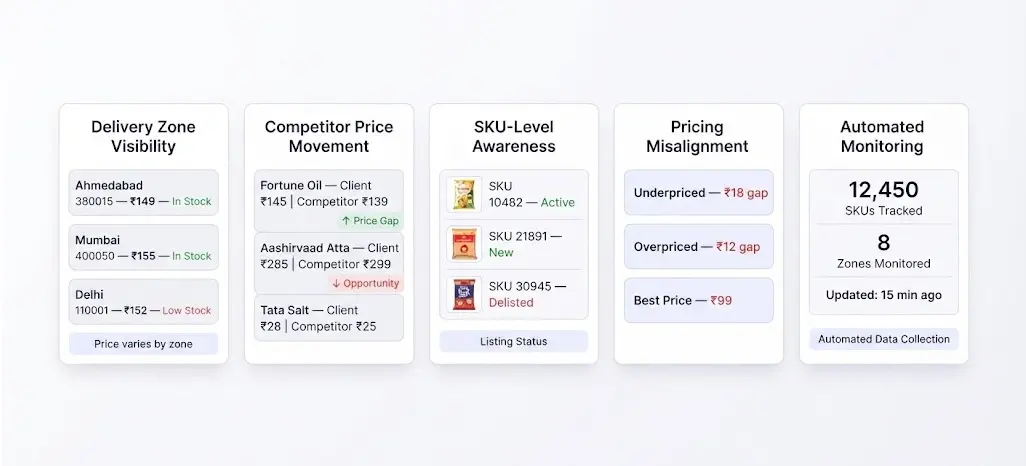
- Fragmented Visibility Across Delivery Zones
The client had no mechanism to compare their product pricing or listing status across different Zepto pin codes. Pricing on quick-commerce platforms often varies by locality, and without Zepto Grocery API Scraping Solutions, the client was blind to how their price points compared with direct competitors in the same hyperlocal delivery zones. - Slow Response to Competitor Movements
Competitor brands were frequently adjusting promotional pricing, running platform-exclusive offers, and refreshing product bundling strategies. The client's response cycle was running anywhere from two to three weeks behind, making real-time competitive response nearly impossible. - Incomplete SKU-Level Awareness
The team lacked the infrastructure to systematically track which competitor products were gaining shelf prominence, which SKUs were being delisted, and how new product introductions were performing all critical dimensions for maintaining category leadership. - Pricing Misalignment at Scale
Internal pricing decisions were being made without reference to actual live market data. This led to repeated instances where the client was either overpriced relative to comparable products or leaving margin on the table in categories where competitors were charging significantly more. - Manual Effort Consuming Analyst Bandwidth
What little competitive research the team conducted was performed manually by two analysts who split their time across multiple platforms. The process was inconsistent, non-scalable, and incapable of delivering the frequency of data updates the situation demanded.
Key Solutions for Addressing Client Challenges
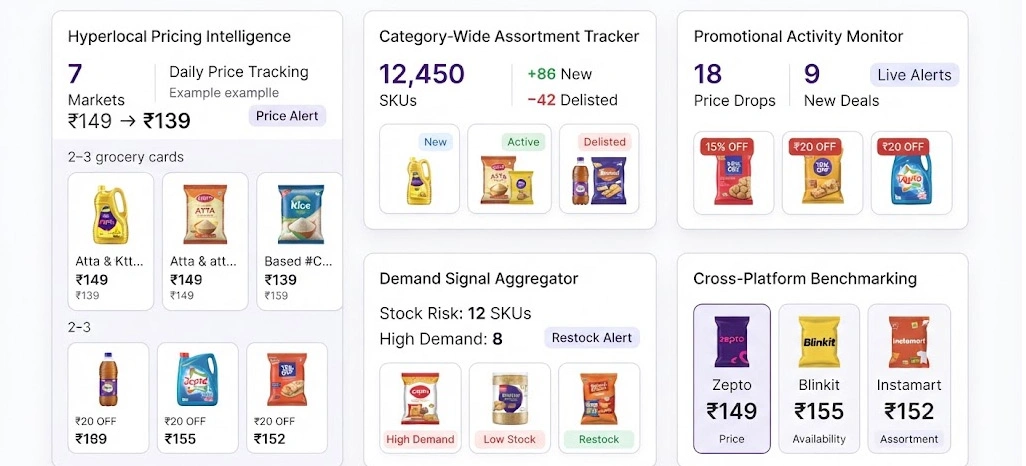
- Hyperlocal Pricing Intelligence Engine
We built a pin-code-level pricing extraction pipeline that captured Zepto product prices across the client's seven markets on a daily basis. This system enabled the client to identify pricing anomalies, competitive undercutting, and platform-specific discounting patterns that would otherwise remain invisible. - Category-Wide Assortment Tracker
Using our Zepto Grocery Scraper, we deployed a continuous SKU monitoring layer that tracked product entries, delistings, and bundling shifts across the client's core categories. This gave the brand a real-time picture of how competitor assortments were evolving and where gaps existed in their own product coverage. - Competitor Promotional Activity Monitor
We structured an automated alert system that flagged significant pricing drops, new promotional tags, and platform-exclusive deal activations from competing brands. This dramatically shortened the client's competitive response window and enabled timely counter-promotional planning. - Demand Signal Aggregator
By correlating availability data with timing patterns and category-level demand shifts, we built a demand signal layer that allowed the client's procurement team to anticipate restocking needs before stockouts impacted their platform ranking or customer ratings. - Cross-Platform Benchmarking Dashboard
We developed a unified dashboard that consolidated pricing, availability, and assortment intelligence into a single interface accessible to category managers, marketing leads, and the procurement team. Decision-relevant data was presented in role-specific views to minimize cognitive load.
Key Insights Gained from Zepto Grocery Data Scraping for Market Insights
| Intelligence Dimension | Key Finding |
|---|---|
| Hyperlocal Pricing Variance | Significant price gaps identified across delivery zones for identical SKUs of competing brands |
| Competitor SKU Introduction Rate | New product entries by top 3 competitors tracked across 12 active grocery categories |
| Availability Consistency Gaps | Stockout frequency patterns mapped across weekdays, weekends, and festive windows |
| Promotional Frequency Benchmarks | Competitor discount activation cycles identified for targeted counter-promotional timing |
| Assortment Depth Analysis | Category coverage comparison revealed underrepresented segments in client's Zepto portfolio |
Benefits of Zepto Grocery Data Scraping for Market Insights From Retail Scrape
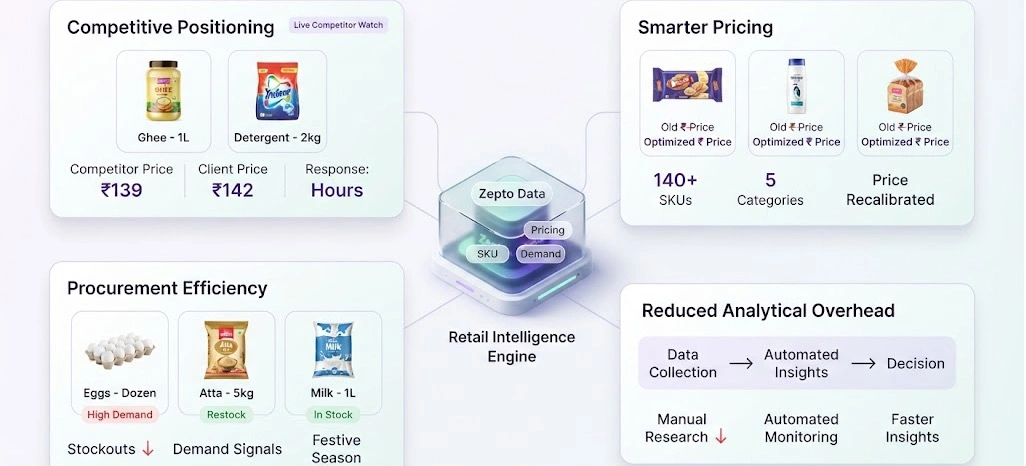
- Sharper Competitive Positioning
Through Zepto Competitor Monitoring for FMCG Brands, the client achieved near real-time awareness of competitor pricing and promotional movements, allowing their category teams to respond within hours rather than weeks. - Smarter Pricing Decisions
Leveraging Zepto Grocery Datasets, the client restructured pricing across 140+ SKUs within the first two months. The recalibration eliminated systematic overpricing in five key categories while protecting margins where competitor prices were demonstrably higher. - Procurement Efficiency Gains
With demand signal intelligence integrated into restocking workflows, the client reduced stockout incidents on Zepto by a measurable margin during their next festive season cycle directly improving their platform ranking and visibility. - Reduced Analytical Overhead
Automated data pipelines replaced the bulk of manual research effort, freeing analyst bandwidth for strategic interpretation rather than data collection. This reallocation meaningfully improved the quality and frequency of insights reaching decision-makers.
Client's Testimonial

Working with Retail Scrape completely changed how we approach quick-commerce. Before this engagement, we were essentially guessing our way through Zepto. Zepto Grocery Data Scraping for Market Insights gave us a level of competitive clarity we hadn't experienced before in this channel. How Grocery Brands Use Zepto Data Intelligence was no longer a theoretical question. Within three months, we had restructured pricing across our core categories and started winning back shelf prominence we didn't even realize we had lost.
– Category Head, Packaged Grocery Brand, India
Conclusion
Competing effectively on quick-commerce platforms demands more than good products and healthy distribution; it demands continuous, structured market intelligence that informs decisions at the speed the channel operates. Zepto Grocery Data Scraping for Market Insights gives grocery brands the visibility they need to move from reactive positioning to genuine market leadership.
Grocery Market Intelligence Using Zepto Data is no longer optional for brands that are serious about quick-commerce performance. The brands winning on Zepto today are not necessarily the ones with the largest budgets, they are the ones with the clearest picture of what is actually happening on the platform.
We specialize in building that clarity. Through Zepto Data Scraping for Product Availability Analysis, our solutions are designed to deliver intelligence that is precise, timely, and directly connected to the decisions that matter most from pricing and procurement to assortment planning and promotional strategy. Contact Retail Scrape today to schedule a consultation with our quick-commerce intelligence specialists.