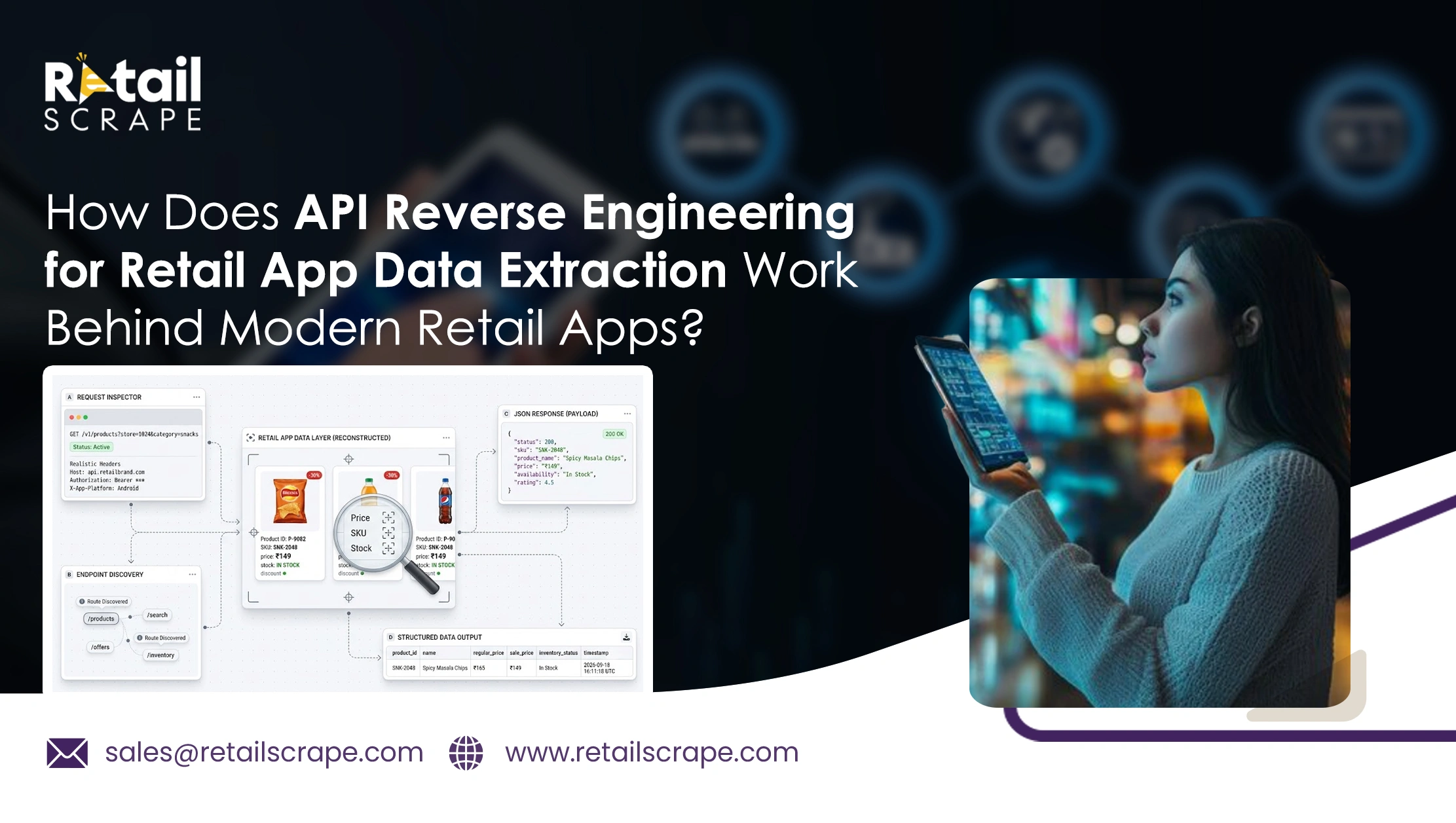
How Does API Reverse Engineering for Retail App Data Extraction Work Behind Modern Retail Apps?
Introduction
Modern retail applications continuously exchange product, pricing, inventory, category, and availability information through structured backend requests. Understanding these exchanges creates a practical approach for collecting organized retail intelligence. API Reverse Engineering for Retail App Data Extraction helps businesses examine application communication and identify relevant data fields for structured analysis and monitoring.
Retail applications can contain thousands of products across categories, locations, sellers, and pricing conditions. Instead of depending only on visible interface elements, businesses can examine application requests to identify useful data fields. Mobile App Scraping API can support recurring collection workflows, allowing structured information to be processed for pricing, catalog, inventory, and competitive research.
This approach benefits retailers, marketplaces, analysts, and research teams monitoring rapidly changing product environments. Product names, prices, discounts, stock indicators, ratings, and category attributes can be organized into consistent datasets. A structured workflow also supports comparisons across products, locations, and time periods while reducing dependence on repetitive manual research.
Examining Backend Signals Within Modern Retail Applications
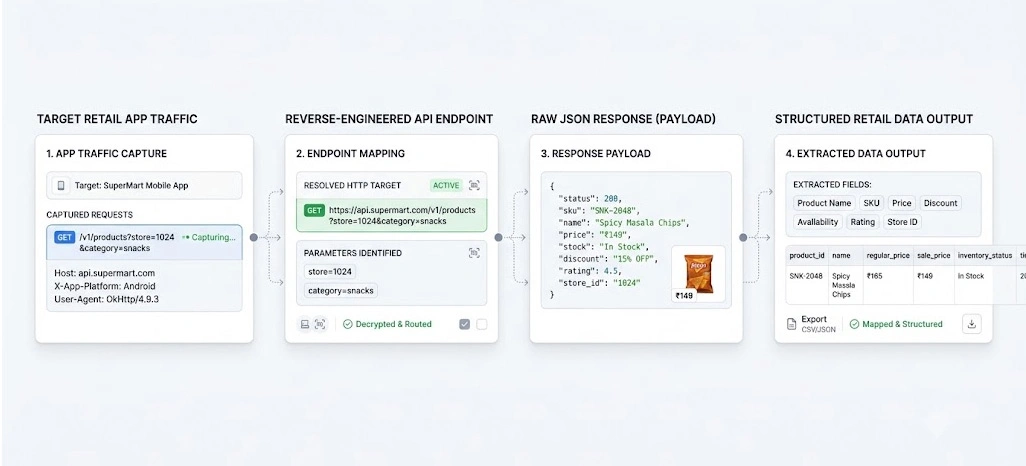
Retail applications communicate with backend systems through requests that transfer information between the interface and servers. Examining these exchanges helps identify endpoints, parameters, response structures, authentication requirements, and useful fields. Mobile App Data Extraction becomes more effective when these communication patterns are documented before automation begins. Mapping these elements creates a clearer foundation for organizing application-derived information into datasets suitable for monitoring and analysis.
The next stage involves understanding which requests produce commercially relevant information and which are unrelated to the required retail dataset. Teams can inspect search responses, product details, category requests, location-based availability, and pricing responses to establish field relationships. When businesses evaluate How to Extract App Data Using API, the process generally involves identifying relevant requests, examining their parameters, understanding returned structures, and determining how frequently information changes.
Businesses managing large-scale collection may use specialized technical support to maintain recurring workflows, handle changing response structures, and organize output formats. API Data Scraping Services can assist with scalable extraction requirements where product catalogs or retail signals need regular monitoring. The workflow can include defined fields, collection frequencies, geographic parameters, validation procedures, and structured delivery formats.
Key collection considerations include:
- Identifying relevant application request patterns
- Mapping product and category relationships
- Standardizing pricing and availability fields
- Maintaining consistent historical datasets
- Validating extracted records before analysis
Structured extraction can then transform raw responses into standardized records containing product names, identifiers, brands, prices, discounts, ratings, availability, and category information. API Data Extraction for Business Intelligence becomes valuable when collected information is normalized and connected with historical datasets, enabling teams to compare pricing movements, assortment changes, promotional activity, and availability patterns over time.
| Data Category | Example Information | Business Application |
|---|---|---|
| Products | Name, ID, brand | Catalog analysis |
| Pricing | Price, discount | Price monitoring |
| Inventory | Stock status | Availability analysis |
| Categories | Category, attributes | Assortment research |
Mapping Request Patterns Across Retail App Interfaces
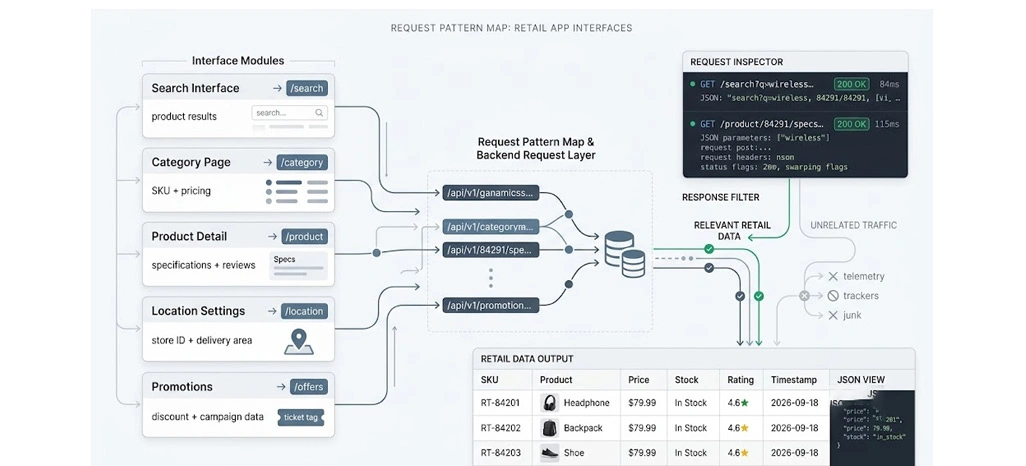
Understanding application communication requires examining how different screens generate backend requests. Search pages, category sections, product details, location settings, and promotional areas can trigger separate request patterns. How API Reverse Engineering Works becomes clearer when these relationships are mapped systematically and relevant responses are separated from unrelated technical traffic. A large application assessment may involve reviewing numerous request types before the useful structures become apparent.
Different requests may return overlapping information while others provide fields unavailable through visible application screens. API Reverse Engineering for Mobile Apps can therefore involve examining how application functions communicate with backend services and determining which responses contain useful retail attributes. A documented request map can make recurring collection more organized and help reduce redundant processing across product categories.
A similar technical principle can be applied when structured web communication is examined for automated collection. API Reverse Engineering for Web Scraping can help teams understand how browser-based interfaces exchange information with backend services and how relevant responses are organized. Combining documented request patterns with validation and scheduling procedures can improve dataset consistency.
Important mapping activities include:
- Reviewing requests generated by major app screens
- Identifying parameters associated with product searches
- Comparing response structures across categories
- Tracking location-specific information
- Validating recurring request behavior
The resulting structures can also support automated workflows that collect selected information at defined intervals. Price fields, seller details, ratings, promotional values, stock indicators, and product attributes can be normalized into records for comparison. When businesses apply Reverse Engineering Mobile App APIs, historical snapshots can help identify changes in prices, newly introduced products, removed listings, altered discounts, or regional availability differences.
| Interface Area | Information Observed | Monitoring Purpose |
|---|---|---|
| Search | Product details | Catalog research |
| Categories | Product grouping | Assortment monitoring |
| Product Pages | Commercial attributes | Product analysis |
| Locations | Regional status | Availability comparison |
Converting Application Signals Into Retail Intelligence
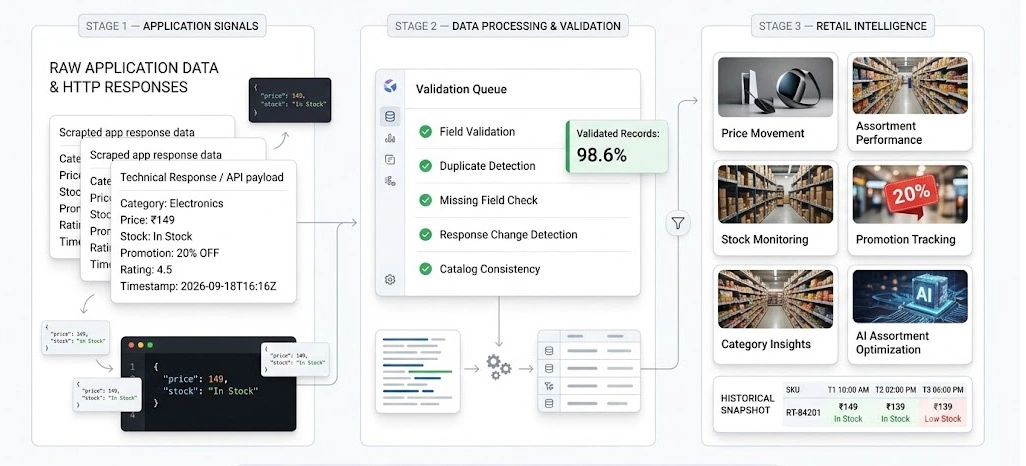
Once application responses are structured, the collected information can support broader retail intelligence programs. How Mobile App Data Extraction Works becomes particularly important when businesses require recurring datasets instead of isolated observations. Historical snapshots can further show how individual products and categories change over time, providing a stronger foundation for recurring market and competitive analysis.
Structured application data can also be connected with analytical models that evaluate product relationships and assortment performance. Product attributes, category structures, pricing observations, stock signals, and promotional activity can be combined to identify patterns across large catalogs. AI-Powered Assortment Optimization can use these structured inputs to support assortment planning and help teams evaluate which product groups require greater attention.
A well-designed workflow should also include validation procedures to identify missing fields, duplicate records, unexpected response changes, and inconsistent values. Regular checks help maintain dataset reliability when application structures or product catalogs change. Businesses can define collection schedules according to the volatility of the information being monitored, with frequently changing prices or stock indicators requiring more regular observations than relatively stable category attributes.
Retail intelligence workflows can support:
- Comparing product prices over time
- Monitoring assortment additions and removals
- Tracking regional availability differences
- Identifying promotional changes
- Organizing historical retail observations
Businesses can further organize extracted records into dashboards and reporting systems for ongoing evaluation. Daily price observations may reveal promotional changes, while weekly assortment comparisons can identify newly introduced or discontinued products. These structured datasets allow analysts to compare multiple dimensions simultaneously rather than reviewing individual application screens, making recurring retail research more systematic and measurable.
| Intelligence Area | Data Compared | Typical Frequency |
|---|---|---|
| Pricing | Current and historical prices | Daily |
| Assortment | New and removed products | Weekly |
| Availability | Regional stock status | Multiple intervals |
| Promotions | Offers and discounts | Daily |
How Retail Scrape Can Help You?
We can support structured workflows for businesses that require organized application-derived retail information. By examining application communication and relevant data structures, teams can build collection processes around product, pricing, inventory, category, and availability requirements. API Reverse Engineering for Retail App Data Extraction can form part of this workflow by helping identify useful application signals before they are transformed into datasets for research and analysis.
Key ways we can support retail data projects include:
- Collecting structured product information from retail applications
- Monitoring price and discount changes across selected products
- Tracking stock and availability across different locations
- Organizing category and brand information into consistent datasets
- Supporting recurring retail market and competitor analysis
- Delivering extracted information in formats suitable for analytics platforms
These capabilities can reduce repetitive manual research while creating a consistent foundation for retail intelligence. Businesses can define required fields, locations, product groups, and collection schedules according to project objectives.
For Apple devices and related application environments, iOS App Scraping can support structured collection requirements where application information is relevant to analysis. The resulting datasets can feed dashboards, reports, comparison systems, and internal analytics processes.
Conclusion
Modern retail applications contain valuable signals covering products, prices, inventory, promotions, categories, and regional availability. When organized through a structured workflow, API Reverse Engineering for Retail App Data Extraction can help businesses convert relevant application responses into usable datasets for pricing research, assortment analysis, competitor monitoring, and catalog intelligence while reducing repetitive manual collection.
These datasets become more useful when technical teams understand recurring application request patterns and maintain consistent extraction structures. Reverse Engineering Mobile App APIs can support this process by providing greater visibility into application communication and data relationships. Contact Retail Scrape to discuss your retail data requirements and build a structured extraction workflow aligned with your business objectives.