
Supporting Restaurant Expansion Via Web Scraping for Restaurant Food Delivery Trends in Europe
Introduction
The European food delivery landscape has never been more competitive or complex. Web Scraping for Restaurant Food Delivery Trends in Europe has emerged as a practical foundation for restaurant groups that need precise, current, and scalable data to drive confident expansion decisions. Web Scraping Services for Restaurant Analytics Europe further strengthens this foundation by delivering structured outputs that feed directly into business planning workflows.
Understanding the competitive terrain across cities like Berlin, Amsterdam, Paris, and Warsaw requires more than periodic surveys or anecdotal competitor checks. The delivery ecosystem operates across multiple platforms simultaneously, and pricing, menu composition, and promotional activity change without notice. Web Scraping for Restaurant Market Trends Europe equips expansion teams with the ongoing visibility they need to evaluate entry timing, benchmark pricing, and identify underserved market segments before committing capital to new locations.
Restaurant groups that have embraced data-first expansion strategies consistently outperform those relying on intuition alone. Real-time competitive tracking, automated menu monitoring, and demand pattern recognition have become standard tools for brands serious about sustainable growth. Web Scraping for Restaurant Food Delivery Trends in Europe forms the intelligence core that connects raw market data to strategic decisions helping leadership teams reduce guesswork, tighten margins, and enter new markets with greater confidence and better preparation.
The Client
A rapidly scaling pan-European restaurant brand operating across eight countries came to Retail Scrape with a pressing challenge. With over 340 active locations and an aggressive plan to add 90 more across Southern and Eastern Europe within 18 months, the group needed reliable market intelligence that their internal team could not produce manually. Restaurant Menu Data Scraping Solutions Europe was identified early in our discovery phase as a critical capability gap holding back their growth planning.
Despite having a dedicated analytics function, the team struggled to maintain consistent data coverage across Uber Eats, Deliveroo, Glovo, and local platforms simultaneously. Pricing intelligence was weeks old by the time it reached decision-makers, and menu comparisons across competitors were incomplete and inconsistent. Food Delivery Data Scraping Services Europe was flagged as an immediate operational need rather than a future enhancement.
The restaurant group's procurement and strategy teams were also experiencing friction between departments because data discrepancies caused conflicting signals about where and when to expand. These structural data gaps were creating real delays in decision-making and exposing the brand to avoidable competitive risks in new markets they were preparing to enter. Automated Restaurant Data Collection Europe Market was the systemic solution they required to bring consistency and scalability to their intelligence operations.
Key Challenges Faced by the Client
The client entered this engagement with several compounding challenges that collectively constrained their expansion capacity and competitive responsiveness across European markets.
- Market Blind Zones
Without structured Restaurant Pricing Intelligence Tools Europe, the client had no consistent visibility into how competitors priced equivalent menu items across different delivery platforms, making city-level pricing strategy nearly impossible to develop accurately. - Delayed Intelligence Cycles
Manual data collection introduced significant latency into the strategy process. By the time competitor pricing or menu changes were reviewed internally, market conditions had already shifted, weakening the value of any analysis produced. Competitor Price Monitoring for Restaurants Europe Tools was absent from their operational setup entirely. - Fragmented Platform Coverage
The client monitored only two of the six major delivery platforms operating in their target expansion markets. This created an incomplete picture of competitive activity and left significant market intelligence uncaptured across high-value cities and regions. - Inconsistent Menu Benchmarking
Without the ability to Extract Restaurant Menu Data From Delivery Apps at scale, the client's menu strategy teams were comparing offerings using outdated screenshots and inconsistent notes rather than structured, comparable datasets. - Seasonal Pricing Gaps
No mechanism existed to track how competitor pricing shifted during peak demand periods, holidays, or regional events. This made it impossible to forecast optimal pricing windows or time promotional launches effectively. - Procurement Misalignment
Supply chain decisions were being made without reliable demand-side data from delivery platforms. The disconnect between purchasing commitments and actual market consumption patterns was contributing to margin erosion across multiple locations.
Key Solutions for Addressing Client Challenges
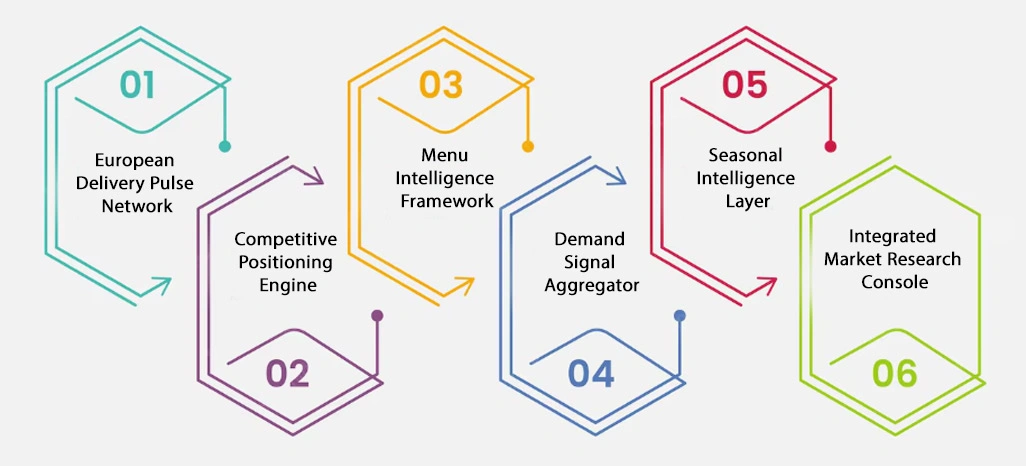
Retail Scrape designed a layered data intelligence system tailored to the restaurant group's expansion objectives and operational structure.
- European Delivery Pulse Network
A continuously operating data pipeline was deployed across all major European food delivery platforms, capturing pricing, menu structure, availability, and promotional data in near real-time. This gave the client's strategy team a live view of competitor behavior across every target expansion market, enabling responsive and informed decision-making at the city level. - Competitive Positioning Engine
Using Competitor Price Monitoring for Restaurants Europe Tools, this module tracked item-level pricing movements across competitor menus daily. Alerts were triggered whenever significant pricing changes occurred, allowing the client's commercial team to respond within hours rather than weeks—protecting margin and positioning in established markets while informing entry pricing in new ones. - Menu Intelligence Framework
This system used Restaurant Menu Data Scraping Solutions Europe to map competitor menu architectures across platforms and regions. It identified category gaps, tracked new item introductions, and flagged menu removals—giving the client's product development team a structured basis for their own menu planning and localization decisions. - Demand Signal Aggregator
Built using Food Delivery App Datasets sourced from six major platforms, this module identified demand concentration patterns by city, cuisine type, and delivery time window. It produced weekly demand heatmaps that the expansion planning team used to prioritize new location investments based on actual consumer behavior rather than assumption. - Seasonal Intelligence Layer
This component analyzed historical pricing and availability patterns to model seasonal behavior across European markets. It gave the procurement and operations teams a forward-looking view of demand peaks, allowing better inventory preparation and promotional timing across both existing and planned locations. - Integrated Market Research Console
Built on a Restaurant Market Research Dataset architecture, this console allowed decision-makers to compare markets, track competitor movements, and validate expansion assumptions without switching between multiple tools or data sources.
Key Insights Gained from Web Scraping for Restaurant Food Delivery Trends in Europe
| Intelligence Area | Strategic Finding |
|---|---|
| Cross-Platform Pricing Variance | Competitor pricing for equivalent items varied by up to 31% across delivery platforms in the same city. |
| Menu Localization Patterns | Top-performing competitors adapted 40–60% of menu offerings to regional tastes in each new market. |
| Peak Demand Windows | Friday and Saturday evenings drove 48% of weekly delivery volume across Southern European markets. |
| Entry Pricing Benchmarks | New market entrants priced 12–18% below established competitors in the first 90 days consistently. |
| Seasonal Demand Shifts | Summer months showed a 35% increase in cold beverage and lighter meal category demand across Northern Europe. |
Benefits of Web Scraping for Restaurant Food Delivery Trends in Europe From Retail Scrape
- Expansion Confidence
By integrating Real-Time Food Delivery Price Tracking Europe into the pre-entry assessment process, the client reduced their market evaluation timeline from eleven weeks to under three, enabling faster location decisions backed by current and reliable competitive data. - Menu Performance Gains
Food Delivery Competitor Analysis Data revealed specific category gaps in target markets that competitors had overlooked. Acting on these findings, the client introduced localized menu items that outperformed projections by 27% in the first quarter of launch across two new markets. - Pricing Accuracy Improvement
The client achieved measurably better margin outcomes by aligning their entry and ongoing pricing to real competitor benchmarks derived from Restaurant Competitor Pricing Data. Pricing decisions that previously took two weeks now took under 48 hours. - Operational Alignment
With consistent, platform-wide data flowing into their planning systems, the friction between strategy, procurement, and operations teams was significantly reduced. Shared access to a Restaurant Data Monitoring Service created a single source of truth that aligned cross-functional decisions and reduced internal disagreement over market conditions.
Client's Testimonial

Working with Retail Scrape transformed how we approach expansion planning. Web Scraping for Restaurant Food Delivery Trends in Europe gave us a real-time intelligence layer we simply did not have before. The Extract Restaurant Menu Data From Delivery Apps capability alone changed how our product team approaches new market menu development entirely.
– Head of Strategy & Expansion, Pan-European Restaurant Group
Conclusion
Sustainable restaurant expansion across Europe demands more than ambition; it requires structured, current, and actionable intelligence. Web Scraping for Restaurant Food Delivery Trends in Europe has proven to be the operational backbone that high-growth restaurant brands need to enter new markets with precision rather than risk.
The competitive landscape shifts daily, and brands that operate with lagging or fragmented data consistently underperform those that invest in structured intelligence systems. Automated Restaurant Data Collection Europe Market capabilities allow restaurant groups to scale their intelligence operations in step with their physical expansion ensuring that data coverage never becomes the constraint that limits growth.
Contact Retail Scrape today to build the market intelligence foundation your expansion strategy deserves. Real-Time Food Delivery Price Tracking Europe remains one of the most impactful tools available to restaurant brands navigating the multi-platform delivery environment across European cities.