
How Does Dairy Market Data Scraping Give Waikato & Taranaki Farmers Better Market Visibility?
Introduction
Dairy farming across Waikato and Taranaki depends on changing milk prices, production conditions, processor signals, and regional demand. Dairy Market Data Scraping can organize these market signals into structured datasets, helping farmers compare pricing movements, assess commercial conditions, and make decisions using clearer evidence rather than fragmented information from multiple market sources.
For Waikato and Taranaki producers, timely visibility can support planning around milk supply, operating costs, contracts, and expected returns. New Zealand Milk Price Tracking can bring recurring price movements into a consistent monitoring workflow, while regional records help farmers identify patterns that may affect budgeting, production timing, and market positioning across different seasonal and commercial conditions.
Reliable market information also supports more informed benchmarking between regions and periods. By combining price, production, demand, and market indicators, farmers can build a broader view of commercial conditions. This approach can make routine planning more responsive while helping agricultural businesses evaluate opportunities through organized, current market evidence and recurring performance comparisons.
Strengthening Regional Price Visibility For Better Farm Planning
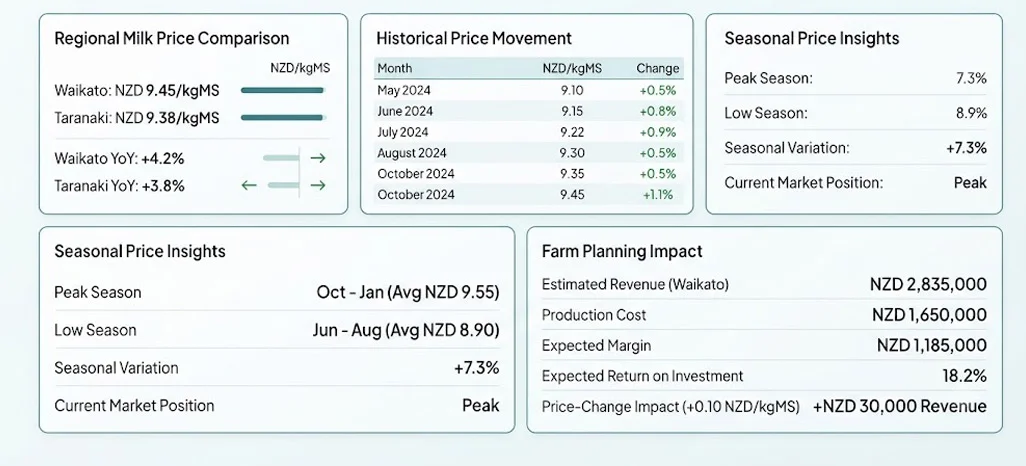
Milk price movements can significantly influence revenue expectations, production planning, and operating decisions for dairy farms across Waikato and Taranaki. Farmers need consistent information that allows them to compare current prices with previous periods, identify seasonal variations, and understand how regional market conditions may affect expected returns. Organized pricing information can also make discussions with advisers and processors more practical because historical records provide a stronger basis for reviewing changes.
When pricing information is collected systematically, farmers can examine different market indicators together rather than reviewing individual updates separately. New Zealand Dairy Price Data Analysis can help organize historical pricing movements and provide a clearer basis for comparing periods, market conditions, and potential revenue scenarios. This supports better budgeting decisions and helps farming businesses assess how changes in market prices may influence production costs and financial expectations.
Farmers can review historical movements, compare market periods, and identify changes requiring closer attention. Dairy Price Intelligence for Waikato Farmers can further support regional comparisons by organizing relevant pricing information into a repeatable analytical workflow. This approach creates a practical foundation for informed budgeting, seasonal planning, and ongoing evaluation of commercial conditions.
| Market Indicator | Planning Purpose | Review Frequency |
|---|---|---|
| Milk price movement | Revenue planning | Weekly |
| Regional price variation | Market comparison | Monthly |
| Seasonal changes | Budget preparation | Quarterly |
| Historical pricing | Trend evaluation | Yearly |
Key planning benefits:
- Compare pricing movements across different periods.
- Identify recurring seasonal market patterns.
- Support more realistic revenue forecasting.
- Improve discussions around farm financial planning.
- Review regional market changes consistently.
Regional information can also add greater context to farm-level decisions. Price observations become more useful when they are reviewed alongside demand movements, production patterns, and broader commercial signals. Consistent records allow businesses to identify recurring trends, compare stronger and weaker periods, and develop more realistic assumptions for future planning.
Connecting Production Trends With Practical Farm Decisions
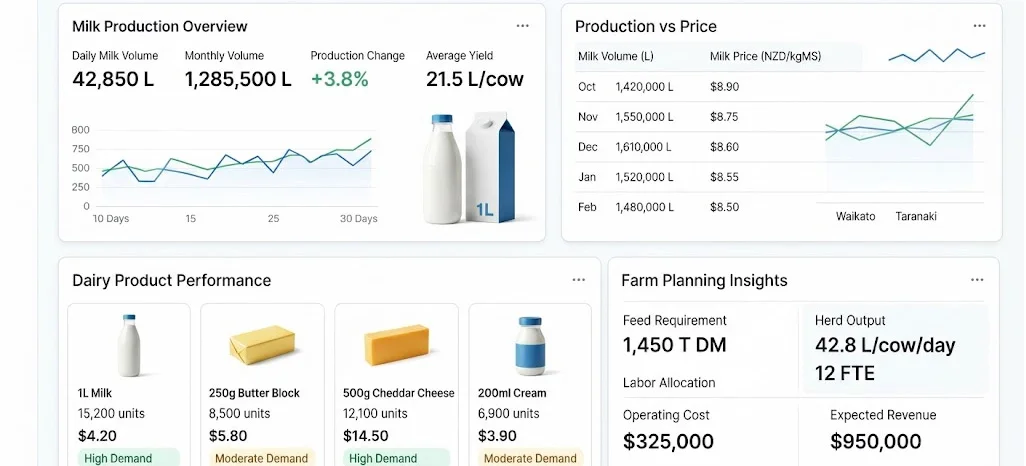
Production information becomes more valuable when farmers can connect output levels with pricing, demand, and operational conditions. Waikato and Taranaki dairy businesses can use structured records to compare production performance across seasons and identify periods where changes in output may influence revenue expectations. This provides a clearer basis for reviewing operational performance and preparing future production scenarios.
A consistent analytical workflow can organize production volumes, price movements, and related market indicators into comparable datasets. Dairy Production Data Analysis New Zealand can help agricultural businesses evaluate production patterns alongside changing commercial conditions. By reviewing these records together, farmers can identify relationships between output and market performance, assess historical results, and prepare more informed assumptions for future production and resource planning.
Farm-level planning can then incorporate these observations into decisions around feed requirements, labor allocation, herd management, operating expenditure, and expected revenue. Dairy Price Data Scraping for Farm Analysis can organize milk prices, production volumes, product categories, and market signals into comparable records.
| Production Indicator | Planning Application | Review Period |
|---|---|---|
| Milk output | Production forecasting | Monthly |
| Production variation | Performance comparison | Quarterly |
| Operating costs | Budget preparation | Monthly |
| Revenue expectations | Financial planning | Seasonal |
Key planning benefits:
- Compare production performance across seasons.
- Identify significant changes in output levels.
- Connect production trends with market conditions.
- Support resource and cost planning.
- Build stronger historical performance benchmarks.
Combining regional records with broader datasets can help farmers assess whether observed changes represent short-term variations or longer-term patterns that deserve attention. Taranaki Dairy Market Data can provide additional regional context for examining market movements, production conditions, and commercial changes affecting local dairy operations.
Turning Market Signals Into Responsive Business Strategies
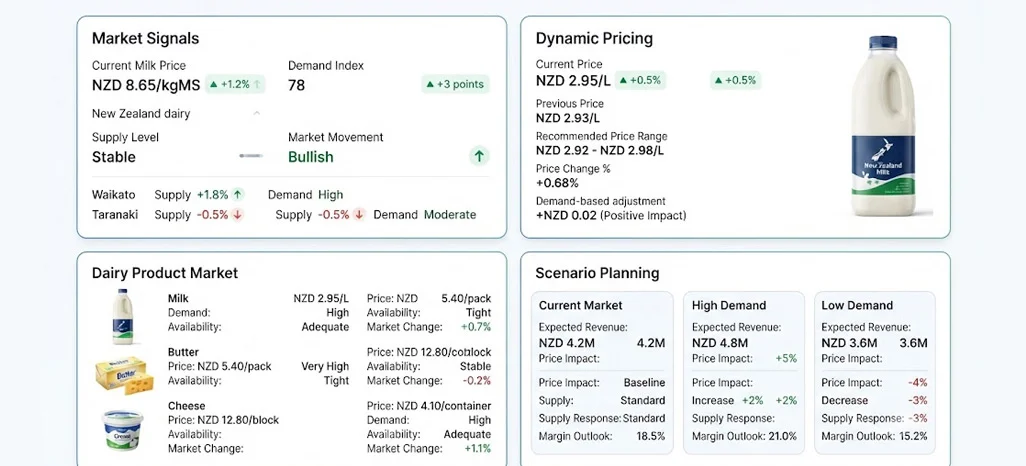
Dairy businesses operate within changing market conditions where pricing, demand, supply, and production factors can shift throughout the year. Farmers therefore benefit from having organized information that helps them review these signals together. A structured market workflow can provide a clearer foundation for assessing commercial conditions before making adjustments to production plans, financial assumptions, or sales strategies.
Timely market information can also help businesses assess different pricing scenarios and understand how changing demand may influence commercial decisions. Dairy Market Insights New Zealand can provide useful context when comparing historical movements, regional conditions, and broader market developments. Bringing these signals together allows farmers and agricultural businesses to evaluate potential scenarios without depending on individual market updates or disconnected records.
Businesses can further use these insights to improve the way they evaluate pricing and planning options. Dynamic Pricing Solutions can support commercial workflows where market conditions, demand movements, and pricing information need to be reviewed together. For dairy-related businesses, this can assist with scenario planning and help decision-makers evaluate potential outcomes before making changes to pricing or supply strategies.
| Market Signal | Business Application | Review Approach |
|---|---|---|
| Price movement | Scenario planning | Weekly |
| Demand change | Commercial assessment | Monthly |
| Supply variation | Production planning | Seasonal |
| Market trend | Strategic review | Quarterly |
Key strategic benefits:
- Monitor important market signals consistently.
- Compare changing demand and supply conditions.
- Support practical pricing scenario planning.
- Improve commercial decision-making processes.
- Create stronger market review routines.
A repeatable monitoring process can also support stronger collaboration between farmers, advisers, processors, and other stakeholders. When market records are consistently organized, teams can review historical changes, identify important trends, and establish practical benchmarks for future planning. This helps convert market information into a useful business resource rather than treating it as occasional background information.
How Retail Scrape Can Help You?
Farmers need market information that is organized, timely, and practical for everyday planning. Dairy Market Data Scraping can collect relevant public market records and arrange them into structured datasets covering pricing, demand, production, and regional indicators.
We can combine Web Scraping Services with repeatable data workflows to support monitoring, reporting, and analysis without leaving information scattered across multiple sources.
Key ways the workflow can support dairy businesses:
- Track market changes across selected regions and periods.
- Organize pricing records for easier historical comparison.
- Monitor product and demand indicators from relevant sources.
- Support recurring reporting with structured datasets.
- Compare regional conditions using consistent data fields.
- Prepare information for business planning and forecasting.
With structured datasets, agricultural businesses can build broader Dairy Market Intelligence workflows that connect regional signals with operational planning. The resulting information can support clearer comparisons, recurring reviews, and more evidence-based decisions across changing market conditions for farmers, processors, analysts, advisers, and agricultural business decision-makers nationwide.
Conclusion
For Waikato and Taranaki farmers, consistent market information can make price and production planning more practical. Dairy Market Data Scraping brings relevant public signals into structured datasets, supporting comparisons across pricing, demand, production, and regional conditions. This can help farm businesses assess scenarios with greater consistency and use market evidence within routine commercial planning, budgeting, and seasonal decision-making.
A stronger data foundation also gives producers a clearer view of the wider New Zealand Dairy Industry Data, helping connect regional observations with broader industry movements. When market information is updated and organized consistently, farmers can review changes, refine assumptions, and respond to shifting conditions with greater confidence. Contact Retail Scrape to discuss a tailored dairy market data solution for Waikato and Taranaki farming analysis.