


How Does USA Grocery Category API Help Compare Grocery Products, Prices, and Zip-Level Availability?
Introduction
Modern American grocery retail operates on hyper-local pricing models that shift dramatically across neighboring counties. Relying on static national averages leaves retailers, CPG brands, and pricing analysts blind to sudden regional discounts or localized stockouts. Automated data feeds replace manual store checks with structured, machine-readable intelligence across thousands of retail locations simultaneously.
Deploying a USA Grocery Category API transforms fragmented web storefronts into unified datasets ready for immediate competitive analysis. Instead of scraping individual product pages one by one, enterprises pull entire department hierarchies—from fresh organic produce to frozen meals—capturing live shelf prices, promotional tags, and exact package sizes at scale.
Integrating a USA Grocery Product Data API by Zip Code bridges the gap between national brand strategy and neighborhood execution. Teams pinpoint exactly where competitors undercut pricing or run out of stock, enabling rapid price adjustments, smarter regional ad spend, and superior supply chain allocation across every targeted U.S. postal market.
Streamlining Standardized Catalog Mapping Across Competing Regional Storefronts
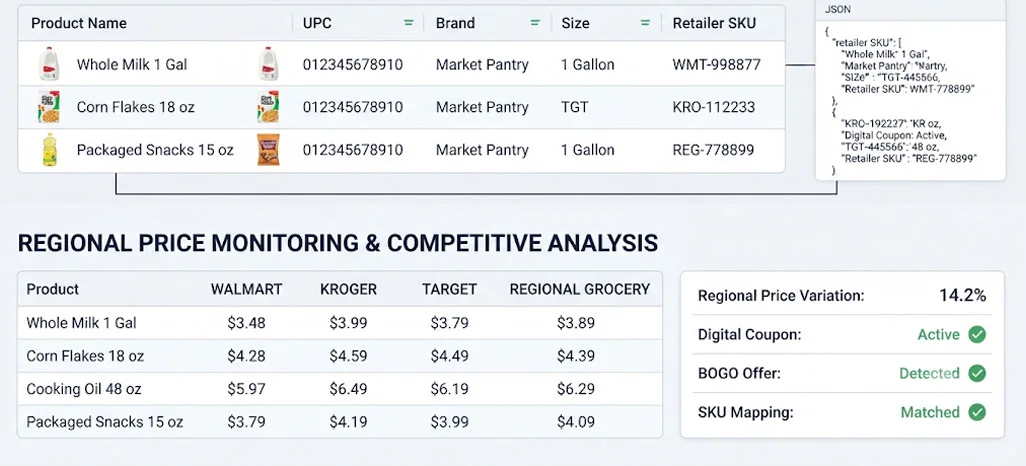
Managing thousands of individual grocery items across national chains like Walmart, Kroger, Target, and regional grocers requires automated taxonomy alignment. Implementing a Grocery Product Catalog API With Pricing standardizes messy retailer hierarchies into clean, comparable product attributes. Rather than manually matching brand variations, unit weights, and nutritional tags, data teams ingest structured JSON payloads that map identical UPCs across competing regional storefronts.
According to recent U.S. retail analytics benchmarks, regional grocery prices fluctuate by an average of 14.2% between neighboring metropolitan zip codes due to localized fulfillment costs and regional competitor promotions. Incorporating a Grocery SKU Price Monitoring API captures temporary loyalty discounts, BOGO offers, and digital coupon adjustments the exact moment they go live on retailer portals.
By pairing structured Grocery Store Product Data USA with historical price tracking, CPG manufacturers verify MAP compliance and spot unauthorized third-party markdowns immediately. Category managers gain complete visibility into how private-label alternatives are priced relative to national brands within specific regional territories.
| Retail Pricing Metric | Traditional Manual Audits | Automated Feed Extraction |
|---|---|---|
| Catalog Refresh Rate | Weekly or Bi-Weekly | Every 15 to 60 Minutes |
| Regional Zip Coverage | 5 to 15 Sample Stores | 40,000+ U.S. Zip Codes |
| Promotional Accuracy | ~78% (Human Entry Error) | 99.6% Automated Validation |
| Data Ingestion Latency | 48 to 72 Hours | Near Real-Time (Sub-Second) |
- Normalized UPC and GTIN matching across diverse national and regional supermarket banners
- Automated unit-ounce and per-pack cost normalization for accurate value benchmarking
- Structured extraction of dietary tags, nutritional facts, and brand hierarchy attributes
Continuous catalog synchronization ensures revenue teams never make merchandising decisions based on stale spreadsheets. Clean product hierarchies allow analysts to isolate regional assortment gaps and adjust wholesale pricing strategies before competitors capture loyal neighborhood shoppers.
Monitoring Hyper-Local Stock Levels and Store Fulfillment Shifts
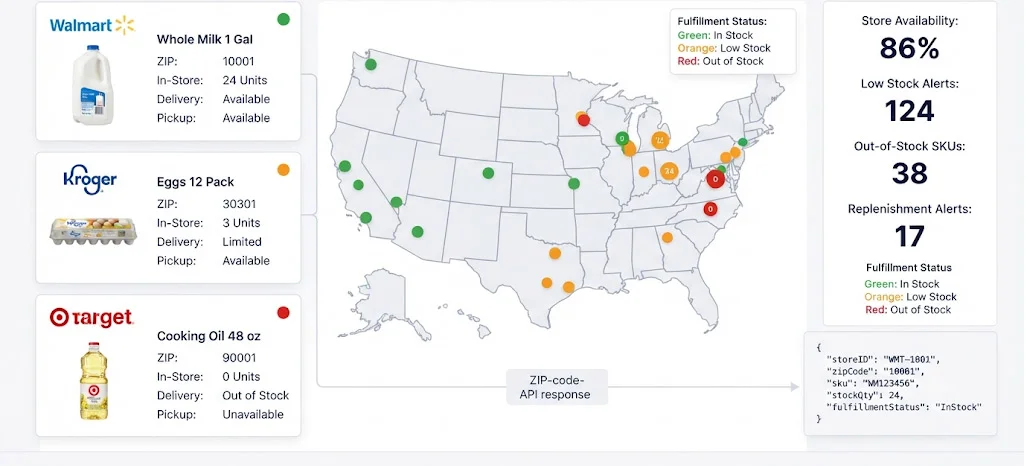
National inventory averages frequently mask severe regional stockouts that frustrate online shoppers and distort demand forecasting. Utilizing a Grocery Price and Availability API USA allows brands and logistics planners to query live fulfillment status, including curbside pickup, same-day delivery, and in-aisle stock, for specific postal codes across the United States.
Industry supply chain studies indicate that online grocery shoppers abandon carts 68% of the time when a staple item shows as unavailable at their selected local store, with nearly 41% switching immediately to a competing retailer. Accessing Real-Time Grocery Product Availability Data USA empowers brands to detect regional shelf depletion before it cascades into lost weekly velocity.
When sudden weather events, local promotions, or supply bottlenecks drain specific retail hubs, automated zip-code feeds highlight exact store IDs requiring emergency replenishment. Marketing teams also sync local availability feeds with paid search and social campaigns to eliminate wasted media spend.
| Inventory & Fulfillment Parameter | National E-Commerce View | Zip-Level Granularity |
|---|---|---|
| Out-of-Stock Detection | Delayed by 24+ Hours | Immediate Store-Level Alert |
| Fulfillment Channel Split | Aggregated Warehouse Data | Pickup vs. Delivery vs. In-Store |
| Regional Assortment Gaps | Invisible in National Feeds | Mapped per Store ID & Zip |
| Restock Cycle Tracking | Estimated Weekly Averages | Exact Timestamped Availability |
- Instant store-level alerts when core high-velocity SKUs drop out of stock
- Channel-specific visibility separating curbside pickup inventory from local delivery hubs
- Automated ad-spend triggers that pause regional campaigns in depleted postal codes
Accurate fulfillment tracking gives supply chain leaders the lead time required to reroute safety stock toward high-demand neighborhoods. Retail partners strengthen shopper trust by maintaining consistent shelf presence across every suburban and urban territory.
Benchmarking Rival Assortments and Dynamic Promotional Pricing Strategies
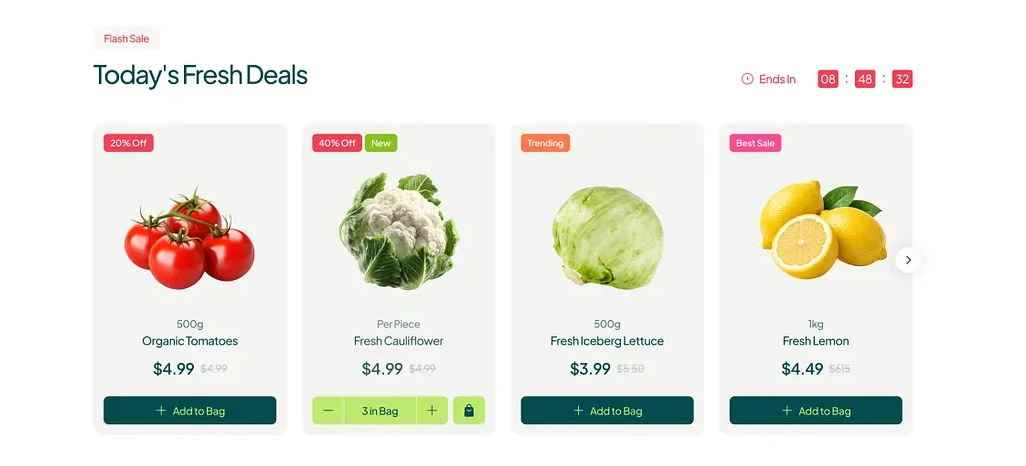
Winning shelf share in competitive U.S. grocery markets requires continuous visibility into rival pricing tiers, pack-size innovations, and seasonal assortment shifts. Integrating a Grocery Competitor Price Data API USA systematically tracks competing banners across identical product categories, revealing how regional chains adjust base prices versus temporary rollback promotions to capture budget-conscious households.
Data from U.S. digital grocery trackers shows that over 54% of online grocery purchases involve at least one promotional or discounted item, making promotional intelligence just as critical as everyday shelf pricing. Implementing a Grocery Product Price Comparison Data API enables revenue teams to run automated elasticity models across varying household income brackets and urban-versus-suburban zip codes.
Data-driven promotional intelligence prevents unnecessary margin erosion caused by reactive price matching. Merchandising teams identify exactly where to hold everyday margin and where targeted regional promotions yield maximum unit lift.
| Competitive Benchmark Indicator | Impact on Category Margin | Tracking Frequency |
|---|---|---|
| Multi-Buy & BOGO Mechanics | +18% Unit Volume Shift | Hourly Store-Level Scans |
| Private Label Price Gaps | 22%–30% Below National Brands | Daily Category Benchmarks |
| Regional Rollback Duration | Average 14-Day Promo Window | Continuous Timestamp Logs |
| New SKU Assortment Entry | Early Regional Test Markets | Automated Catalog Diffing |
- Side-by-side tracking of everyday shelf prices versus temporary digital loyalty discounts
- Early detection of private-label introductions and regional test-market pack sizes
- Historical promotional cadence logs measuring competitor discount depth and duration
Through automated Grocery Product Data Extraction API USA pipelines, analysts compare unit-ounce pricing, organic versus conventional price spreads, and regional bundle strategies without writing custom scrapers for each retailer. Retailers use these cross-banner benchmarks to fine-tune dynamic pricing rules across every category.
How Retail Scrape Can Help You?
Building and maintaining reliable grocery extraction pipelines across dozens of U.S. retail websites often breaks down due to anti-bot defenses, frequent layout updates, and complex zip-code session cookies.
Implementing an enterprise-grade USA Grocery Category API through us removes infrastructure bottlenecks, delivering clean, normalized retail intelligence directly into your cloud warehouse or BI tools.
- Custom delivery schedules tailored to hourly, daily, or weekly competitive tracking cycles
- Automated proxy rotation and session handling across more than 40,000 U.S. postal codes
- Standardized product matching that aligns UPCs, weights, and brand attributes across banners
- Direct integration with Snowflake, BigQuery, AWS S3, or RESTful webhook endpoints
- Dedicated quality assurance pipelines guaranteeing 99.5% field-level data accuracy
- Scalable category coverage spanning fresh produce, pantry staples, beverages, and household essentials
Whether you are tracking regional promotional shifts or auditing nationwide distributor compliance, our managed Grocery Data Scraping solutions scale effortlessly with your catalog volume. You focus entirely on pricing strategy and assortment optimization while our engineering team handles maintenance, compliance, and uninterrupted data delivery.
Conclusion
Navigating the complexities of regional U.S. food retail requires granular visibility that manual audits and static reports simply cannot deliver. By integrating a USA Grocery Category API into your analytics stack, your team gains continuous access to localized pricing tiers, promotional shifts, and store-level stock statuses across every major metropolitan and rural market.
Pairing these feeds with Grocery Store Product Data USA ensures your pricing models reflect true shelf conditions rather than outdated national averages. Sustainable margin growth depends on reacting faster than regional competitors when local demand or promotional pricing shifts.
Deploying a Grocery Price and Availability API USA equips CPG brands and retailers with the exact neighborhood-level intelligence needed to protect shelf share, optimize ad spend, and prevent costly stockouts. Contact Retail Scrape today to schedule a custom data demo and start automating your U.S. grocery intelligence pipeline.