
Modernized Travel Marketplace Data Scraping for Demand Insights Supporting Accurate Route Analysis

Introduction
The travel industry has undergone a substantial transformation with the rapid digitization of booking platforms, fare aggregators, and route scheduling tools. Businesses operating in this sector face increasing pressure to interpret complex demand signals across multiple touchpoints simultaneously. Travel Marketplace Data Scraping for Demand Insights has emerged as a foundational capability for companies seeking to build reliable intelligence systems rooted in real market behavior rather than assumptions.
As route networks expand and passenger expectations shift, companies must move beyond conventional analytics approaches. The integration of Travel Scraping API Data into existing business workflows has allowed travel companies to automate data collection at scale, removing reliance on fragmented reporting and replacing it with structured, queryable datasets that reflect live market conditions. This evolution has repositioned data as a core operational asset rather than a supplementary reporting tool.
The shift toward structured Travel Market Trends Using Scraped Data has opened new avenues for demand forecasting, itinerary planning, and capacity allocation. Organizations that embrace this methodology gain a clearer picture of where demand is growing, which routes are underserved, and how pricing dynamics evolve across different booking windows. These insights form the backbone of smarter, faster, and more profitable travel planning decisions.
The Client
A mid-sized travel technology company operating across fourteen regional markets with a portfolio of over 3,000 active routes had been experiencing a growing disconnect between its forecasting models and actual booking patterns. The business served both leisure and corporate travel segments, and its pricing team was under constant pressure to remain competitive without sacrificing margins. Despite a technically capable internal team, the absence of Real-Time Travel Marketplace Data left planning cycles reactive rather than anticipatory, particularly during peak travel windows.
The company had built its analytics foundation on a combination of internal booking logs and quarterly industry reports. While useful as a historical reference, these sources could not account for sudden demand spikes, competitor fare changes, or route-level shifts driven by external events. The leadership team recognized that Travel Data Scraping Services would need to be integrated into their core planning infrastructure to close this gap and move from periodic reviews to continuous market monitoring.
Over time, the company began to lose ground to more agile competitors who were adjusting prices and adding capacity with apparent precision. Customer satisfaction scores reflected this operational lag, as route availability and fare relevance fell short of expectations. The company needed a structural solution, not a patch. A comprehensive overhaul of its data acquisition and intelligence processing pipeline was identified as the only path to restoring market agility and route-level accuracy.
Key Challenges Faced by the Client
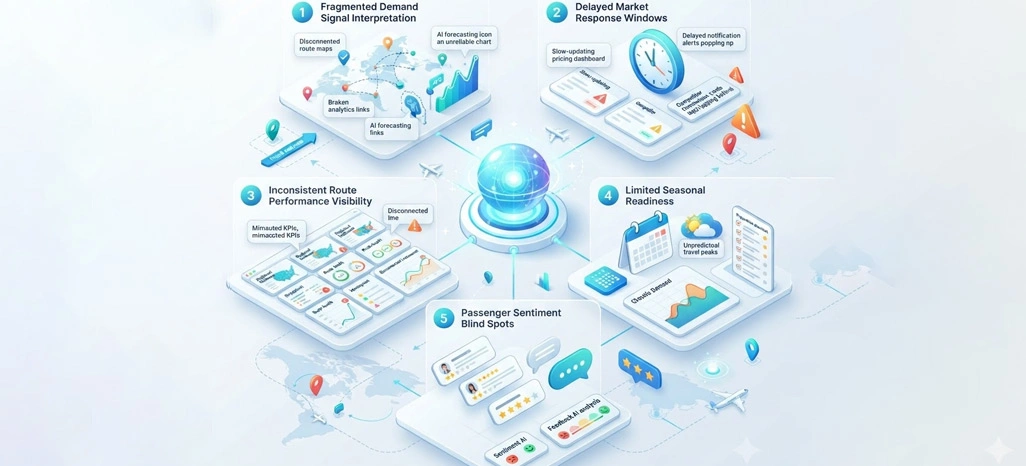
Expanding into new routes and markets exposed a series of interconnected problems that the company's existing tools were not equipped to handle.
- Fragmented Demand Signal Interpretation
The team struggled with Demand Prediction and Trend Analysis across routes due to siloed data sources that could not be unified into a coherent forecasting model. Insights from one market rarely translated into actionable guidance for adjacent corridors, weakening the overall planning process. - Delayed Market Response Windows
Without access to Competitive Travel Intelligence Data, the company's pricing team relied on weekly briefings that were often outdated before decisions could even be implemented. This delay translated directly into missed revenue opportunities and reactive fare adjustments. - Inconsistent Route Performance Visibility
Regional performance metrics were tracked independently by individual market teams, creating inconsistency in how route health was assessed. The absence of a unified monitoring layer meant that underperforming routes often went unaddressed until losses had already accumulated. - Limited Seasonal Readiness
Seasonal demand patterns are notoriously volatile in travel, and the company's preparation cycle was too slow to capture opportunities during high-demand periods. Pre-season intelligence was thin, and adjustments were typically made after demand had already peaked. - Passenger Sentiment Blind Spots
The company lacked a systematic process for capturing and analyzing Customer Review Data for Travel Industry at scale. Traveler feedback remained anecdotal, and without structured sentiment analysis, service gaps and emerging dissatisfaction trends went largely unaddressed.
Key Solutions for Addressing Client Challenges
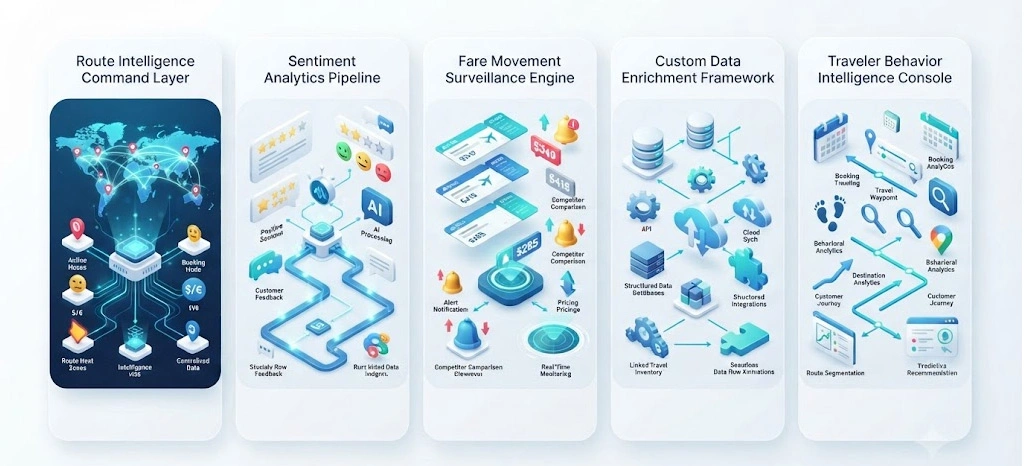
Retail Scrape designed a modular, phased intelligence architecture tailored to the company's specific operational context and route complexity.
- Route Intelligence Command Layer
A centralized data aggregation system was built to consolidate fare data, booking trends, and occupancy patterns across all active routes. This infrastructure enabled the planning team to identify demand concentration zones and allocate capacity more effectively, directly improving route-level profitability. - Sentiment Analytics Pipeline
By systematically collecting and processing Customer Review Data for Travel Industry from major booking portals and review platforms, the company built a structured sentiment map across all routes. This allowed operations teams to identify service friction points early and address them before they affected booking conversion. - Fare Movement Surveillance Engine
A dedicated monitoring layer tracked competitor pricing across matching routes in real time. Informed by Travel Competitor Analysis, the engine flagged significant fare deviations and triggered automated alerts, enabling the pricing team to act within hours rather than days. - Custom Data Enrichment Framework
Built around Custom Travel Data Integration principles, this component linked external marketplace data with internal CRM and inventory systems. The resulting unified dataset gave decision-makers a single source of truth for all route-level and segment-level planning activities. - Traveler Behavior Intelligence Console
A reporting dashboard synthesized multi-source behavioral data into digestible intelligence summaries accessible by regional managers. Teams could review booking lead times, preferred travel windows, and fare sensitivity profiles by route, enabling hyper-targeted strategic adjustments.
Key Insights Gained from Travel Marketplace Data Scraping
| Intelligence Area | Operational Impact |
|---|---|
| Route-Level Demand Mapping | Identified high-growth corridors and underserved routes requiring capacity expansion |
| Fare Sensitivity Profiling | Revealed optimal price points across booking windows for each route segment |
| Competitor Capacity Tracking | Monitored seat availability fluctuations to inform inventory positioning decisions |
| Traveler Sentiment Scoring | Quantified satisfaction trends by route and service category for targeted improvements |
| Seasonal Booking Velocity Analysis | Tracked early booking momentum to guide promotional timing and pricing strategy |
Benefits of Travel Marketplace Data Scraping From Retail Scrape
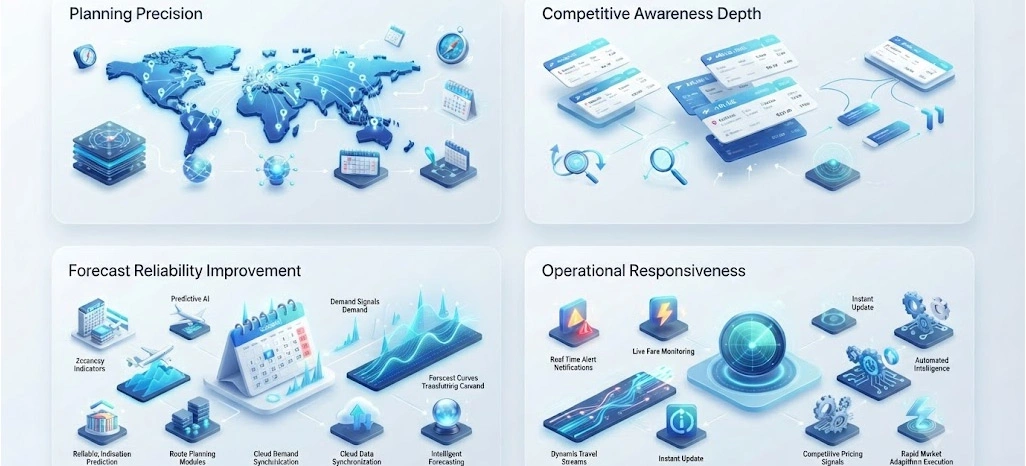
- Planning Precision
Through consistent application of Travel Marketplace Data Scraping for Demand Insights, the company replaced guesswork-driven planning with structured, data-validated route strategies. Decision cycles shortened significantly as teams worked with current intelligence rather than outdated summaries. - Competitive Awareness Depth
By integrating Travel Price Monitoring across key competitive routes, the client developed a detailed understanding of how rivals structured their fare hierarchies. This awareness enabled the pricing team to position fares with greater market relevance and timing accuracy. - Forecast Reliability Improvement
Demand forecasts became substantially more accurate once real-time booking signals and external market data were merged. Planning teams could now model different scenarios with confidence, reducing costly overcapacity and improving load factor consistency across the network. - Operational Responsiveness
The speed of identifying and responding to market changes increased significantly. By integrating Travel Competitor Pricing Intelligence, teams quickly detected fare anomalies, demand spikes, and competitive shifts, ensuring every critical market change was captured and addressed without delay.
Client's Testimonial

Working with Retail Scrape reshaped how we think about market intelligence in travel. The depth and reliability of data provided through Travel Marketplace Data Scraping for Demand Insights allowed us to move from reactive planning to genuine strategic foresight. Our Custom Travel Data Solutions implementation brought everything together into a coherent system that our teams actually use every day.
– Head of Strategy & Network Planning, Regional Travel Technology Company
Conclusion
Sustaining route performance and demand responsiveness in today's travel market demands more than intuition and historical averages. Travel Marketplace Data Scraping for Demand Insights equips travel businesses with the granular, timely intelligence required to make confident decisions across pricing, capacity, and route strategy.
Retail Scrape brings deep expertise in building travel intelligence systems that align with real operational needs. Through Travel Data Intelligence Services, our teams help businesses structure their data pipelines, unify fragmented sources, and translate raw market signals into clear, actionable direction.
For companies serious about route accuracy and sustained growth, the path forward runs through better data. Powered by Custom Travel Data Solutions, our frameworks are built to evolve alongside your market. Contact Retail Scrape today to discuss your travel intelligence requirements.