Maximizing Retail Performance Using Real-Time Price Monitoring Case Study That Delivered Growth
Introduction
Retail pricing has never been more complex. With consumers comparing prices across dozens of platforms in seconds and competitors adjusting their rates multiple times a day, businesses that depend on static pricing strategies are losing ground fast. This Real-Time Price Monitoring Case Study was developed to document how we helped a mid-to-large retail operation reclaim its competitive footing through smarter, faster, and more precise pricing intelligence.
The challenge was not simply about finding cheaper prices, it was about building a sustainable system that could react to the market as it moved. Through a combination of structured data pipelines, competitive benchmarking tools, and dynamic response frameworks powered by AI-Powered Real-Time Price Monitoring Solutions, the client was able to transform pricing from a reactive function into a forward-looking growth driver.
What followed was not just a technology implementation but a shift in how the organization thought about market data. With Real-Time Price Monitoring for Multi-Store Retail Chains woven into the operational core, the business gained the speed, accuracy, and consistency needed to stay competitive across every category and region it served.
The Client
The client was a rapidly scaling retail group operating across more than 140 physical outlets spread across three geographic regions, alongside a high-traffic e-commerce platform. Their assortment spanned general merchandise, household essentials, packaged foods, and personal care putting them firmly within the domain where Real-Time Price Monitoring for Fmcg Brands was not a luxury but a necessity.
Despite generating consistent revenue, the organization had been struggling to translate sales volume into margin improvement. Their internal teams used spreadsheets and monthly vendor reports to guide pricing decisions. The introduction of Retail Scrape Competitor Price Tracking was identified as the turning point of an infrastructure investment that would bring them closer to live market conditions and allow leadership to act with confidence rather than assumption.
The third dimension of their challenge was scale. With thousands of active SKUs across multiple store formats, pricing consistency was nearly impossible to maintain manually. Regional managers would set prices independently, creating gaps in competitiveness from one location to another. A formalized approach to Real-Time Price Monitoring for Retail Competitor Analysis became the foundation upon which a new pricing governance model was eventually built, enabling standardized decision-making across all outlets.
Key Challenges Faced by the Client
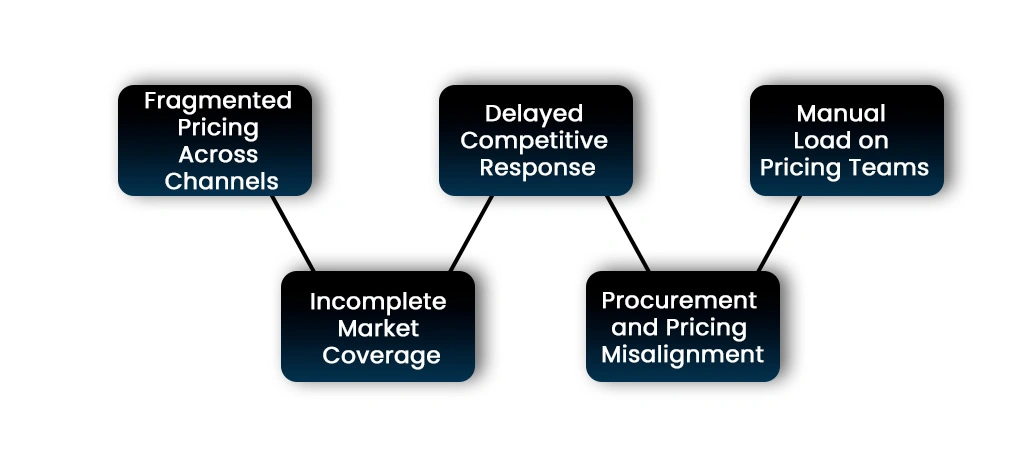
The client's internal audit revealed several structural gaps that were quietly draining revenue and operational efficiency. These were not surface-level issues; they were embedded in how the organization had been functioning for years.
- Fragmented Pricing Across Channels
Prices on the e-commerce platform frequently differed from those in physical outlets with no systematic reconciliation process. This inconsistency frustrated customers and reduced trust, particularly among high-value repeat buyers who moved between both purchase environments. - Delayed Competitive Response
Without Dynamic Pricing Using Real-Time Data, the client's teams could not respond to competitor price changes until the following pricing cycle. In fast-moving FMCG categories especially, this lag translated directly into lost basket share and missed margin opportunities. - Incomplete Market Coverage
The team was tracking only a fraction of the competitors they actually faced. Smaller regional players and private-label competitors were entirely off the radar, creating blind spots that affected category-level strategy. - Procurement and Pricing Misalignment
Buying decisions were made without reference to live competitor pricing, which meant the client would sometimes over-invest in inventory for products where competitors had already undercut the market significantly. - Manual Load on Pricing Teams
Analysts spent an enormous portion of their working week simply gathering and formatting data time that should have been directed toward interpretation and strategy rather than data collection.
Key Solutions for Addressing Client Challenges
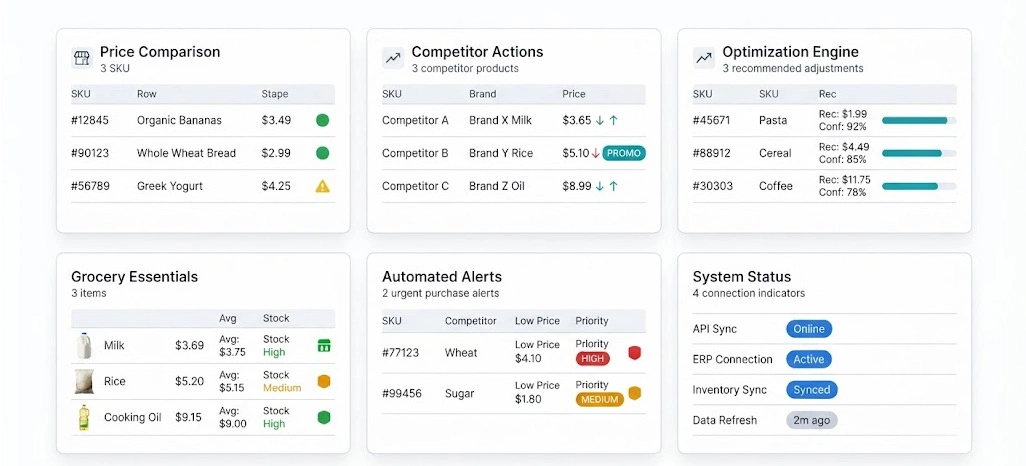
We designed a multi-layered intelligence infrastructure that addressed each of the client's core challenges. Six distinct solution components were deployed in a phased rollout.
- Unified Pricing Command Center
A centralized pricing dashboard was built to bring all SKU-level data into a single interface. Real-Time Price Monitoring for Multi-Store Retail Chains was embedded at the core of this system, ensuring consistency across every outlet. - Competitive Signal Engine
This module continuously scanned competitor platforms for price changes, promotional events, and new product introductions. Retail Scrape Competitor Price Tracking powered this component with structured and validated data feeds. - Price Optimization With Web Scraping
Retail Price Optimization With Web Scraping and Analytics was operationalized through a layered analytics model that identified pricing sweet spots by category, region, and purchase frequency. - FMCG-Specific Price Intelligence Layer
Recognizing the velocity at which FMCG pricing moves, a dedicated tracking layer was configured for household essentials and packaged goods. This gave the FMCG buying team its own view into the market, tuned specifically to the product cycles and promotional rhythms of that category. - Automated Procurement Trigger System
This tool connected pricing intelligence directly to procurement workflows. When a competitor's pricing on a high-volume SKU moved significantly, the system flagged it to the buying team with contextual data on stock levels, recent price history, and volume trends. - Enterprise Integration Layer
A custom Real-Time Price Monitoring API for Enterprise Applications was implemented to allow seamless data exchange between our intelligence infrastructure and the client's existing ERP and inventory management systems.
Key Insights Gained from Real-Time Price Monitoring Case Study
| Performance Dimension | Observed Outcome |
|---|---|
| Price Response Time | Reduced from weekly cycles to under 4 hours across major categories. |
| Competitive Coverage | Expanded from 18 tracked competitors to over 95 within six months. |
| SKU-Level Accuracy | Pricing error rate dropped by 67% following live data integration. |
| FMCG Category Margin | Average margins in fast-moving categories improved by 29%. |
| Manual Analyst Hours | Pricing team freed up approximately 60% of weekly effort for strategy. |
| Procurement Alignment | Over 80% of high-volume buying decisions now informed by live pricing data. |
Benefits of Real-Time Price Monitoring Case Study From Retail Scrape
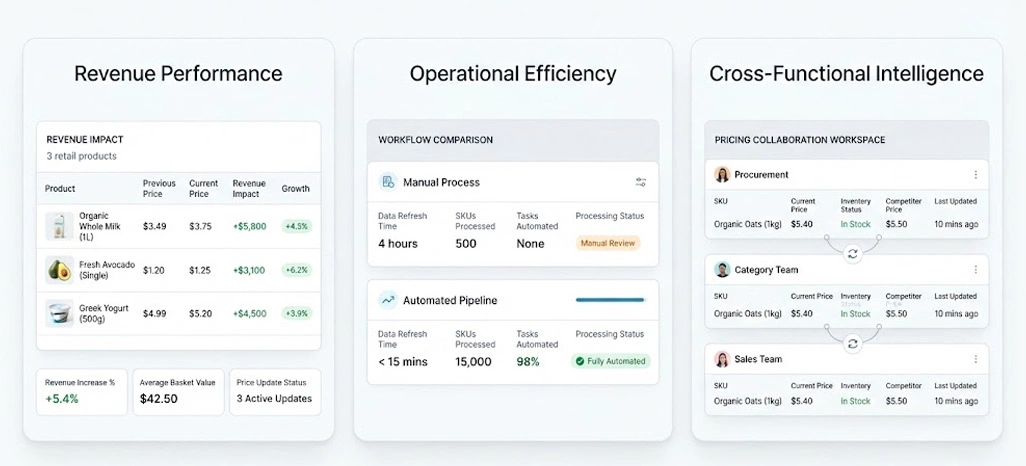
- Revenue Growth Through Price Tracking
Revenue Growth Through Price Monitoring was the most immediate and visible outcome. Within the first quarter of deployment, the client recorded a measurable uplift in category-level revenue particularly in product segments where price sensitivity had historically caused customer drop-off. - Operational Efficiency at Scale
By replacing manual data collection with automated pipelines, the client's pricing team gained the bandwidth to shift from execution to strategy. AI-Powered Real-Time Price Monitoring Solutions made this transition possible by doing the heavy lifting reliably and at scale. - Stronger Cross-Functional Alignment
Procurement, category management, and sales teams began working from the same data source for the first time. The shared intelligence layer created by Real-Time Price Monitoring for Fmcg Brands removed the friction that had previously slowed down cross-departmental decision-making.
Client's Testimonial

Partnering with Retail Scrape gave our teams something we had been lacking for years; genuine confidence in our pricing decisions. The Real-Time Price Monitoring Case Study that emerged from this engagement reflects the kind of transformation that doesn't happen from a single tool but from a well-designed system working together. The speed and accuracy of Real-Time Price Monitoring API for Enterprise Applications integration meant that our ERP and planning systems were finally operating on current data, not last month's reports.
– VP of Commercial Strategy, Multi-Region Retail Group
Conclusion
Competing on price without visibility into the market is not a strategy, it is guesswork. This Real-Time Price Monitoring Case Study demonstrates what becomes possible when retail organizations replace assumption with intelligence and replace lag with speed. The gains seen by this client were not the result of slashing prices or outspending the competition.
From Real-Time Price Monitoring for Fmcg Brands to enterprise-wide deployment, we tailor every engagement to the specific demands of your market. Contact Retail Scrape today to schedule a consultation with our pricing intelligence specialists and take the first step toward a faster, sharper, and more profitable pricing operation.