
What Makes Real-Time Airport Data Scraping for Flight Delay Data Reliable for Delay Verification?
Introduction
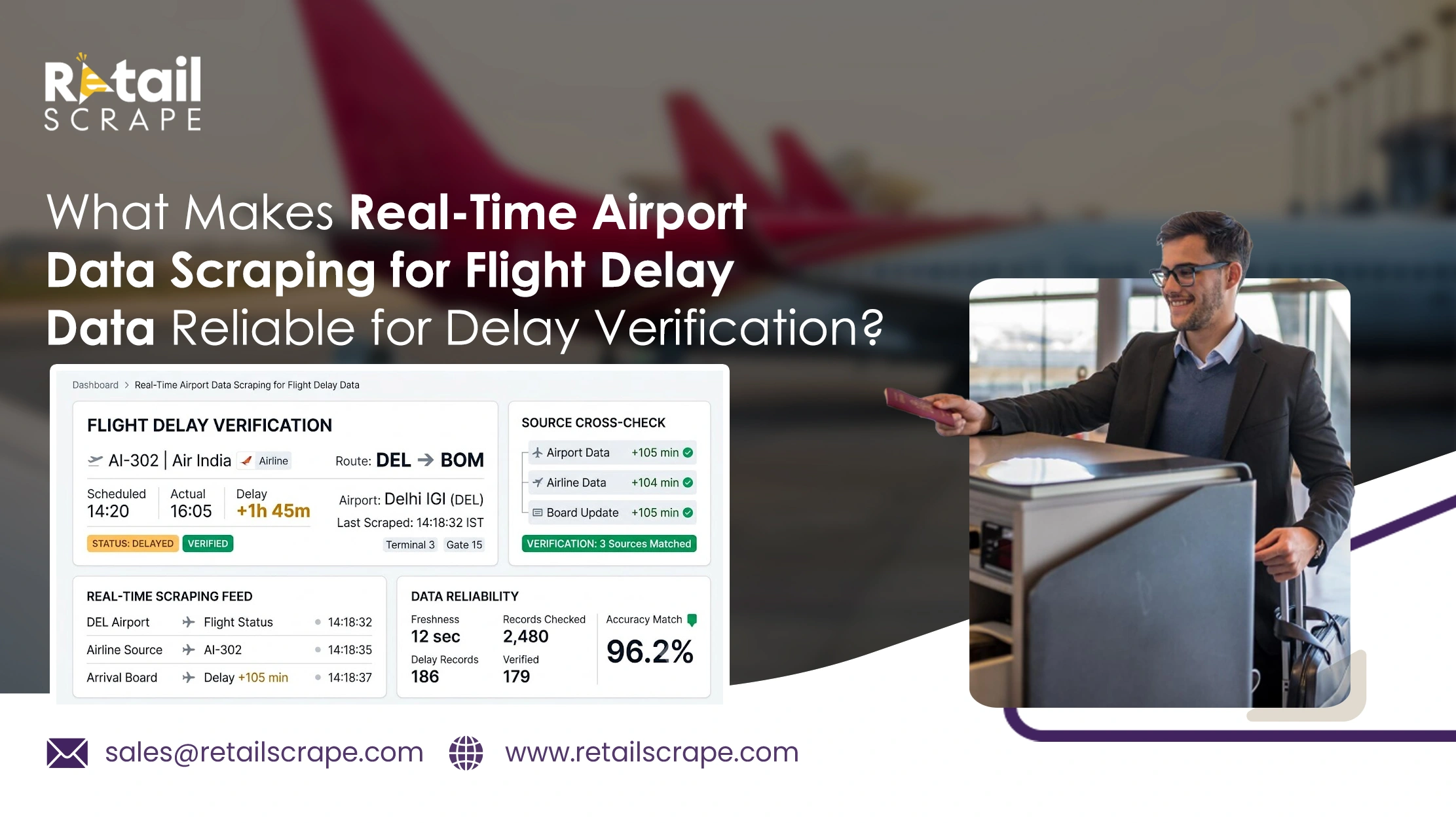
Flight delays can change rapidly because of weather, airport congestion, aircraft rotations, staffing limitations, runway restrictions, and air traffic conditions. Reliable verification therefore requires current operational signals instead of depending only on static schedules. Real-Time Airport Data Scraping for Flight Delay Data helps organize changing flight events into structured records for analysis and verification.
The need for timely information is substantial. The U.S. Bureau of Transportation Statistics reported 76.34% on-time arrivals nationally in 2025, while 7.90% involved aircraft arriving late and 6.74% involved air-carrier delays. Combining live airport information with Real-Time Airport Data Scraping can support cross-checking of reported disruptions and operational changes.
For travel businesses, continuous monitoring can connect delay information with pricing and availability signals. Real-Time Airport Price Monitoring Data can help contextualize fare changes around disruptions, while structured extraction creates a consistent foundation for operational dashboards, customer notifications, and historical analysis. This approach also makes changing airport information easier to review.
Precision Signals Build Stronger Foundations for Verifying Flight Delay Events
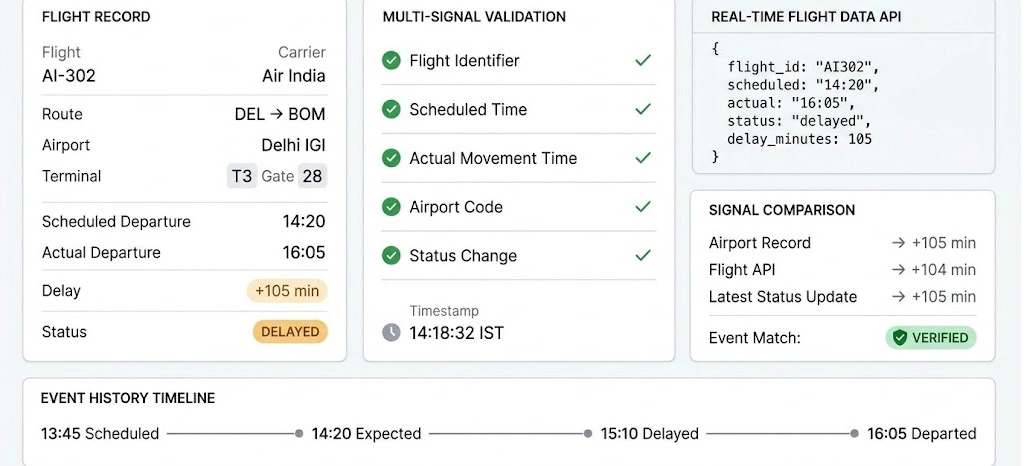
Reliable flight-delay verification begins with collecting multiple time-sensitive signals rather than depending on one isolated status message. Flight identifiers, scheduled timings, actual movement times, airport codes, and status changes can provide the necessary context for determining whether an operational disruption has occurred. This structured approach also helps reduce inconsistencies between different records.
For businesses working with large operational datasets, Real-Time Flight Data API information can complement collected airport records by providing structured timestamps, identifiers, schedules, and status information. When these fields are normalized, analysts can compare expected and actual movements more consistently. The resulting dataset becomes easier to process across airports, carriers, routes, and reporting periods.
Reliable datasets also benefit wider Retail Performance Analytics workflows because the same principles of timestamping, field standardization, and event validation apply when monitoring rapidly changing information. Rather than treating every update as an independent record, businesses can connect successive observations to understand whether a delay is continuing, increasing, or resolved.
| Verification Factor | Purpose |
|---|---|
| Flight identifier | Connects related records |
| Scheduled time | Establishes expected movement |
| Actual time | Shows operational movement |
| Airport code | Identifies the location |
| Status update | Indicates changing conditions |
Several practical checks can strengthen the process further:
- Match flight identifiers across collected records.
- Preserve scheduled and actual timestamps.
- Record each status change with collection time.
- Remove duplicate or incomplete observations.
- Compare related records before final verification.
Connected Flight Records Improve Accuracy Across Multiple Operational Data Sources
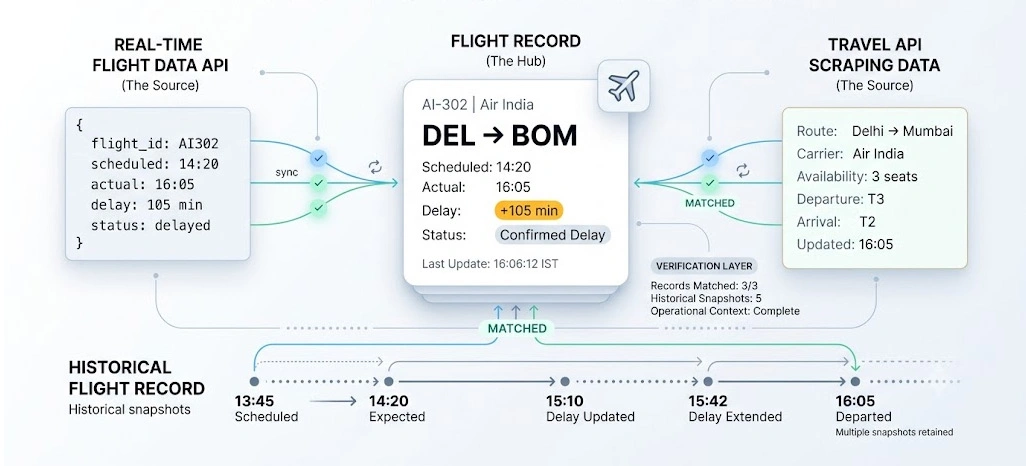
A dependable monitoring workflow should preserve both the latest flight status and the surrounding operational context. Flight schedules, actual movements, delay durations, cancellations, airport identifiers, and timestamps can be organized into standardized records. This allows businesses to compare observations without losing the information needed to understand when and where a disruption occurred.
Using Real-Time Flight Data API & Delay Dataset structures can make this information easier to organize across multiple sources. Fields can be aligned around common identifiers, allowing analysts to distinguish scheduled events from updated operational conditions. Maintaining historical snapshots is also valuable because a flight status can change several times before its final movement is recorded.
Another useful layer comes from Travel API Scraping Data, which can connect flight information with route, carrier, availability, and schedule details. Combining these fields can provide additional context when reviewing whether a reported disruption represents a temporary status change or a confirmed operational delay.
| Data Element | Verification Purpose |
|---|---|
| Scheduled departure | Defines expected timing |
| Actual departure | Confirms movement |
| Arrival timestamp | Measures completed delay |
| Airport information | Establishes location |
| Status history | Tracks changes |
A structured workflow can further improve consistency through several practices:
- Maintain standardized field names across sources.
- Preserve collection timestamps for every update.
- Link repeated observations to the same flight.
- Separate cancellations from ordinary delays.
- Retain historical records for comparison.
These practices make cross-source validation more systematic while allowing businesses to review operational changes without relying on a single data point.
Advanced Extraction Practices Create Deeper Airport Intelligence for Travel Businesses
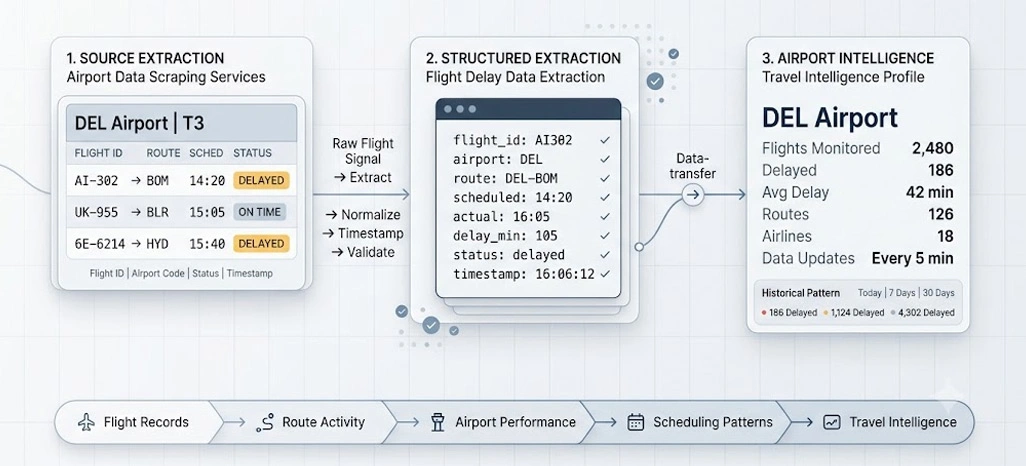
Extraction quality plays an important role in determining whether airport information can support reliable analysis. A consistent process should capture relevant flight fields, preserve timestamps, identify source changes, and organize records into a common structure. This makes information easier to compare across airports, routes, airlines, and different monitoring periods.
Businesses using Airport Data Scraping Services can organize information from permitted airport pages, flight boards, and other relevant sources into structured records. Once collected, Flight Delay Data Extraction can focus on departure and arrival times, delay duration, cancellation indicators, flight identifiers, and status changes. Consistency across these fields improves downstream analysis.
The resulting information can support Airport Data for Travel Intelligence by connecting operational flight records with route activity, airport performance, scheduling patterns, and traveler-facing information. Historical datasets can then help analysts examine recurring delays, compare airport activity, and identify patterns across different periods without depending entirely on manually collected observations.
| Intelligence Area | Useful Information |
|---|---|
| Delay verification | Status and timing information |
| Airport comparison | Flight and disruption records |
| Route analysis | Origin and destination details |
| Disruption tracking | Status and cancellation changes |
| Historical research | Date and event records |
Businesses can also improve collection consistency by following practical extraction steps:
- Define required fields before collection.
- Validate timestamps after extraction.
- Standardize airport and carrier identifiers.
- Track changes across repeated observations.
- Store historical records for future analysis.
For teams developing How to Scrape Flight Delay Data workflows, these practices provide a clearer framework for transforming airport information into structured records. This supports repeatable monitoring while improving the usability of collected information for reporting and analytical applications.
How Retail Scrape Can Help You?
Modern data collection requires more than capturing isolated updates; it requires a repeatable process that turns changing information into usable records. Real-Time Airport Data Scraping for Flight Delay Data can be incorporated into a broader monitoring workflow where source pages are checked at defined intervals, records are normalized, and historical snapshots are retained for comparison.
We can support businesses by organizing large volumes of publicly available information into structured datasets suitable for dashboards, alerts, and analytical systems. Its data collection approach can be adapted to monitor operational fields, validate changing values, and prepare information for downstream business intelligence.
Key capabilities can include:
- Automated collection across multiple airport sources
- Standardized flight and airport field structures
- Timestamp-based monitoring of changing statuses
- Duplicate detection and record validation
- Historical storage for trend comparisons
- Structured outputs for dashboards and analysis
When these processes are combined, Travel Datasets can provide a broader analytical foundation by connecting flight events with route, airport, schedule, and market information. Contact us to discuss a scalable data collection workflow tailored to your airport monitoring, verification, and travel intelligence requirements.
Conclusion
Reliable verification depends on consistent collection, timestamp accuracy, standardized fields, and cross-source validation rather than a single status signal. Businesses can use Real-Time Airport Data Scraping for Flight Delay Data to maintain structured observations that support delay checks, operational reporting, historical comparisons, and more consistent travel information management.
When these records are validated against defined criteria, Real-Time Flight Delay Verification becomes easier to integrate into monitoring workflows and analytical dashboards. Contact Retail Scrape to discuss a scalable data collection approach tailored to your airport monitoring and flight intelligence requirements.