Replacing API Dependence With Real-Time Retail App Data Scraping Without a Public API Solution
Introduction
Modern retail brands operate in a fast-moving environment where pricing intelligence and product availability data shift by the hour. Companies that still depend on traditional API integrations often find themselves locked out of critical market signals the moment a retailer revokes access or modifies endpoint structures. Real-Time Retail App Data Scraping Without a Public API has emerged as a dependable alternative, enabling businesses to access live retail data directly from app environments without relying on third-party permission structures.
The growing adoption of Mobile App Data Scraping across retail verticals reflects a broader recognition that app-native data is often richer, fresher, and more granular than what standard APIs expose. Brands that previously waited for API refreshes now access product pricing, stock levels, and promotional structures in near real time. This immediacy reshapes procurement decisions, category planning, and competitive benchmarking across retail functions.
As mobile-first shopping behavior accelerates, retailers are concentrating more of their transactional and pricing data inside app ecosystems rather than browser-facing platforms. App Data Scraping for Market Intelligence has therefore become a strategic necessity rather than a technical luxury. Businesses that build their intelligence pipelines around direct app data access position themselves to respond to competitor actions faster and with greater precision than those still anchored to outdated API dependencies.
The Client
A mid-sized omnichannel retailer operating across fourteen product verticals and serving customers through both physical outlets and a growing digital storefront had built its entire competitive intelligence operation around API-based data feeds from key retail platforms. Real-Time Retail App Data Scraping Without a Public API became the most viable path forward, as the client needed continuous access to live pricing and product availability data without rebuilding costly API partnerships.
With that infrastructure disrupted, the client turned to Web Scraping API Services to evaluate whether alternative data collection frameworks could replicate or exceed the reliability and coverage they previously enjoyed. The assessment revealed that app-layer data extraction not only matched their previous data quality standards but consistently surfaced insights that API feeds had never captured, including flash discount events, localized pricing variations, and app-exclusive product listings.
By the third quarter of their transition period, leadership recognized that the legacy API dependency had actually constrained their intelligence capabilities rather than strengthening them. The company committed to rebuilding its data infrastructure around Data Extraction Without Public API methodologies, prioritizing coverage breadth, update frequency, and operational independence. This strategic pivot laid the groundwork for a more resilient and insight-rich competitive intelligence program.
Key Challenges Faced by the Client
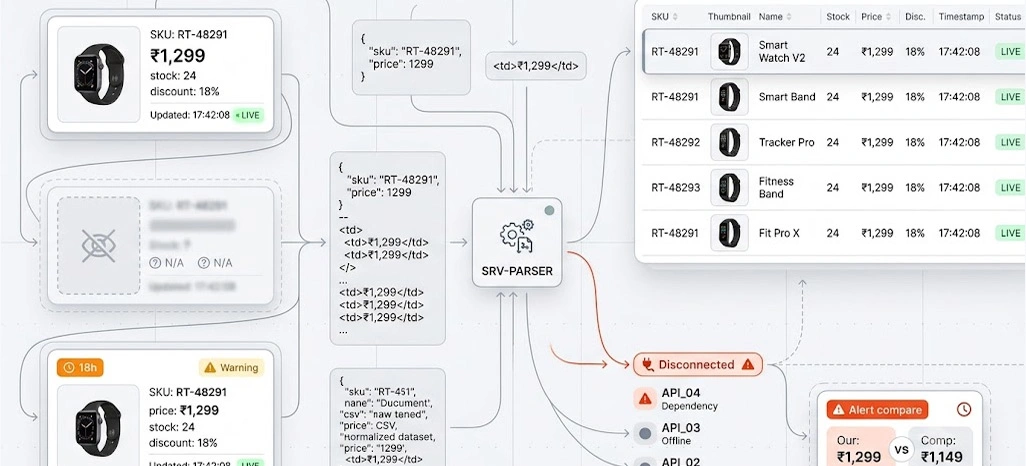
Navigating the transition from API-dependent workflows to app-native data collection exposed several structural vulnerabilities within the client's intelligence operations:
- Limited Data Freshness
The client's previous API-based model delivered data refreshes on fixed schedules, making it impossible to capture intraday pricing movements. Real-Time Mobile App Data Extraction was identified as essential for capturing time-sensitive pricing events that APIs were architecturally incapable of delivering. - Restricted Product Coverage
Many app-exclusive products and promotional bundles never appeared in API-accessible catalogues. Without the ability to Scrape App Data Without API environments, the client's product benchmarking consistently missed a significant portion of the competitive assortment. - Vendor Lock-In Vulnerability
Dependence on external API providers created structural risk. Any change in provider policy, pricing, or access terms immediately disrupted intelligence workflows. The client needed a Real-Time App Data Extraction Solution that operated independently of third-party permission models. - Fragmented Intelligence Inputs
Data sourced from multiple API vendors arrived in inconsistent formats and refresh cycles. This fragmentation made consolidated competitive analysis difficult and slowed down strategic decision-making across procurement and pricing teams. - Delayed Competitive Response
Without access to live app data, the client's ability to respond to competitor promotions was reactive rather than proactive. App Data Scraping for Market Intelligence was critical for enabling faster recognition and response to competitive pricing shifts.
Key Solutions for Addressing Client Challenges
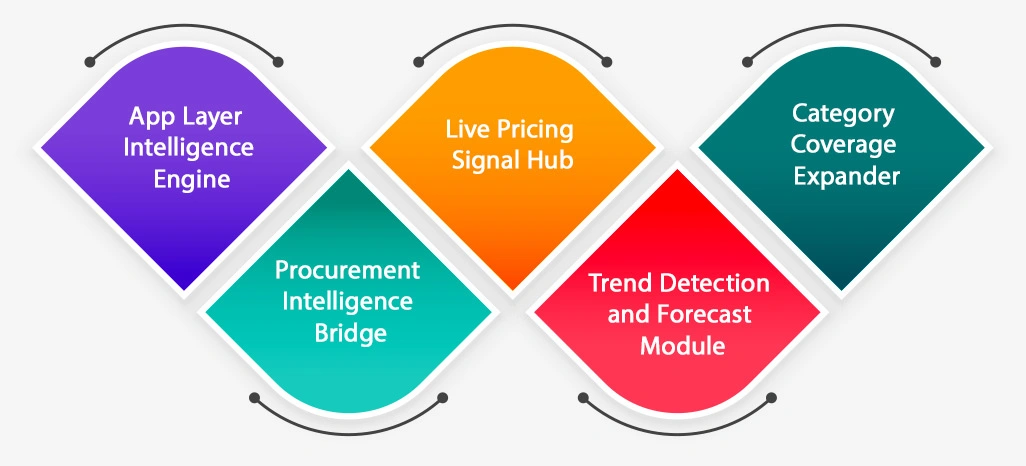
To address the client's operational gaps, a comprehensive app-native intelligence architecture was designed and implemented across six integrated solution pillars:
- App Layer Intelligence Engine
This solution used Android App Scraping protocols to navigate app-specific data structures, bypassing the limitations of traditional web-based scraping while maintaining full compliance with ethical data collection standards. - Live Pricing Signal Hub
A centralized monitoring console was established to aggregate and normalize pricing data extracted in real time from multiple retail apps. The system flagged price changes, promotional activations, and stock level shifts as they occurred, giving the client an always-current view of the competitive pricing landscape. - Category Coverage Expander
Using App Data Extraction Without API frameworks, the solution mapped and tracked app-exclusive product listings that had previously been invisible to the client's intelligence operation. This expansion significantly improved assortment benchmarking accuracy across all fourteen product verticals. - Procurement Intelligence Bridge
Extracted app data was connected directly to the client's procurement planning systems, enabling sourcing teams to align purchasing decisions with live market conditions. Timing recommendations for bulk orders were generated automatically based on detected pricing patterns and competitor inventory signals. - Trend Detection and Forecast Module
Historical extraction datasets were layered with real-time inputs to generate predictive trend models. The system identified recurring promotional cycles, seasonal pricing behaviors, and category-level demand shifts, supporting proactive planning rather than reactive adjustment. - Unified Insight Command Center
A consolidated dashboard brought together extraction outputs, trend signals, and procurement recommendations into a single interface accessible to decision-makers across functions. This centralization eliminated data silos and reduced the time required to move from market signal to strategic action.
Key Insights Gained from Real-Time Retail App Data Scraping Without a Public API
| Intelligence Dimension | Outcome Description |
|---|---|
| App-Exclusive Product Discovery | Identified hundreds of app-only SKUs previously absent from competitive benchmarking datasets |
| Intraday Pricing Pattern Recognition | Captured pricing movements occurring within hours of competitor promotional activations |
| Cross-Category Coverage Expansion | Extended competitive visibility across all tracked product verticals simultaneously |
| Promotional Cycle Mapping | Built historical models of competitor discount patterns to anticipate future pricing events |
| Procurement Timing Optimization | Aligned bulk purchasing windows with competitor pricing valleys to maximize cost efficiency |
Benefits of Real-Time Retail App Data Scraping Without a Public API From Retail Scrape
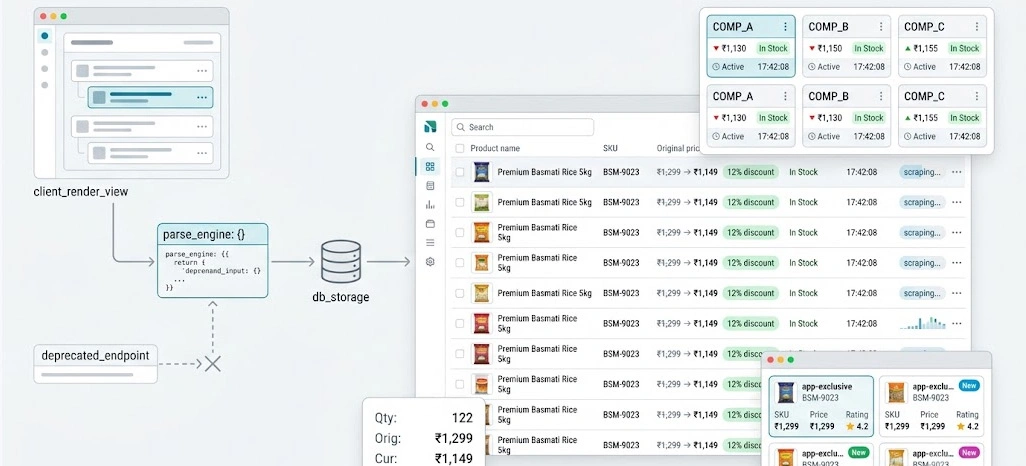
- Competitive Clarity Through Live Data Access
The client achieved a complete view of competitor pricing activity by implementing How to Extract Data From Mobile Apps methodologies into their daily intelligence workflows. This visibility enabled procurement and pricing teams to act on competitor movements within hours rather than days, fundamentally improving their market responsiveness and Competitor Analysis precision. - Operational Independence from API Constraints
By replacing API-dependent infrastructure with a self-sufficient extraction architecture, the client eliminated the vulnerability of third-party access disruptions. Mobile App Data for Competitive Intelligence collection now operated continuously without exposure to vendor policy changes, providing stable and reliable data flows for sustained strategic planning. - Procurement Cost Reduction
The integration of real-time app pricing signals into purchasing workflows enabled the client to consistently time bulk acquisitions at optimal cost points. Category managers reported measurable reductions in sourcing costs as a direct result of data-informed procurement timing driven by Scrape App Data Without API capabilities. - Accelerated Product Benchmarking
App-exclusive product discovery expanded the client's benchmarking universe substantially. Teams that previously evaluated competitor assortments based on incomplete API-sourced data now worked from comprehensive, app-verified product datasets, improving both the speed and accuracy of assortment decisions.
Client's Testimonial

Before working with Retail Scrape, our entire market intelligence program was one API policy change away from collapse. The transition to Real-Time Retail App Data Scraping Without a Public API gave us something we had never genuinely had before, full confidence in our data coverage. The Real-Time Mobile App Data Extraction capabilities have directly contributed to a 38% improvement in procurement cost efficiency and transformed how our category teams approach sourcing decisions.
– Head of Market Intelligence, Omnichannel Retail Enterprise
Conclusion
Retail competitiveness in today's app-driven environment demands intelligence infrastructure that operates independently of permission-based constraints. Real-Time Retail App Data Scraping Without a Public API equips businesses with the agility and coverage depth needed to track competitor behavior, optimize procurement timing, and respond to market shifts with speed and confidence.
Brands that build their intelligence operations around direct app data access no longer need to accept the limitations that API dependency imposes on data freshness, product coverage, or operational continuity. How to Extract Data From Mobile Apps has moved from a technical curiosity to a core strategic capability for forward-thinking retail enterprises.
Mobile App Data for Competitive Intelligence is not a workaround, it is the next standard for retail market intelligence. Contact Retail Scrape today to redesign your data infrastructure around real-time app extraction, eliminate the fragility of API-dependent workflows, close intelligence gaps across your product categories, and build the kind of market visibility that translates directly into stronger margins, sharper procurement decisions, and a competitive position your rivals cannot easily replicate.