
How Does Competitive Price Intelligence Shape a Data-Driven Pricing Strategy for Modern Brands?
Introduction
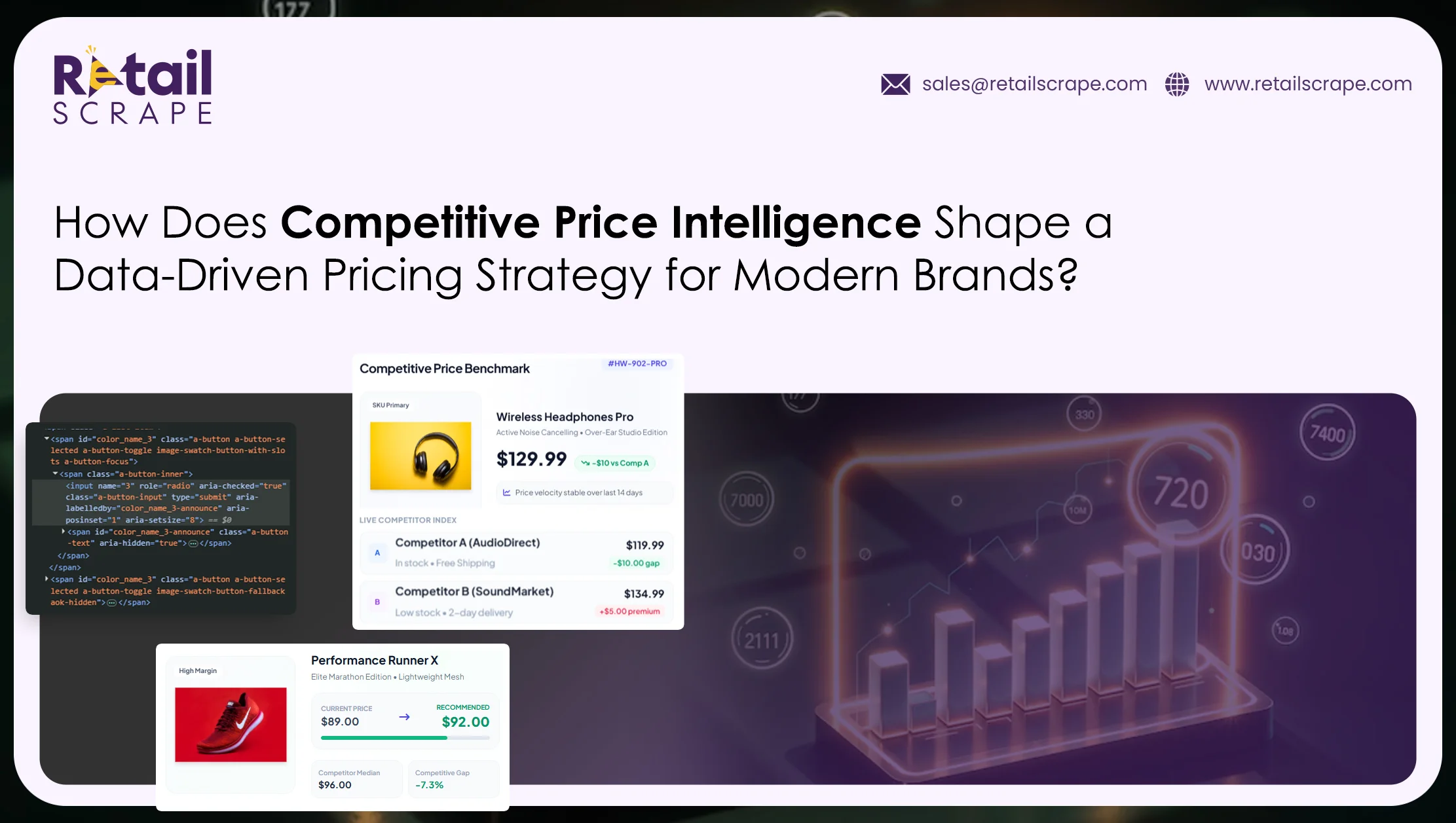
Modern brands operate in markets where prices can shift quickly across products, competitors, regions, and channels. Competitive Price Intelligence helps businesses organize these market signals into actionable pricing insights. By comparing competitor prices, promotions, assortments, and positioning, brands can build pricing decisions around current market conditions instead of relying on outdated assumptions.
A structured pricing framework gives teams better visibility into price movements and competitive gaps. Businesses can combine historical observations with current market information to identify patterns, evaluate positioning, and adjust pricing decisions with greater consistency. This approach also supports Retail Price Intelligence Strategy by connecting market observations with practical pricing actions.
For ecommerce and retail teams, pricing intelligence becomes especially valuable when product ranges and competitors change frequently. A well-planned framework can support Price Intelligence Strategy for Ecommerce by improving price comparisons, identifying market opportunities, and helping teams evaluate how pricing decisions influence demand, margins, and customer expectations.
Building Stronger Pricing Decisions Through Real-Time Market Signals
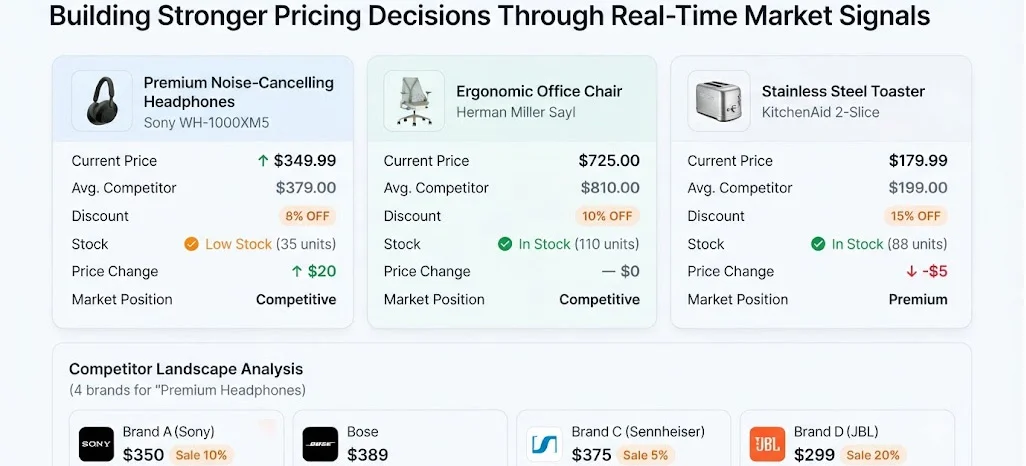
A data-driven pricing strategy begins with reliable information about changing market conditions. Brands need to understand how competitor prices move, where discounts appear, and how product availability changes across different channels. Instead of reviewing isolated price points, pricing teams can evaluate multiple signals together and create a clearer picture of market behavior. This structured approach helps businesses make decisions based on measurable observations rather than assumptions.
A well-organized Retail Price Intelligence Strategy can connect competitive observations with internal commercial objectives. Pricing teams can compare similar products, review promotional intensity, and assess whether current prices remain aligned with broader market conditions. This creates a more consistent process for reviewing pricing performance across categories. It also allows businesses to distinguish temporary promotional movements from longer-term changes in competitive positioning.
| Market Signal | Business Application |
|---|---|
| Competitor price | Compare market positioning |
| Discount level | Assess promotional pressure |
| Product availability | Identify supply changes |
| Price movement | Monitor market direction |
Pricing teams can further strengthen decisions by connecting Price Intelligence for Pricing Optimization with product-level observations and commercial objectives. This makes it easier to identify unusual price gaps, recurring discount patterns, and category-level movements. The resulting information can support merchandising discussions, promotional planning, and broader pricing reviews. Instead of treating pricing as an isolated operational task, organizations can incorporate market observations into a continuous decision-making process.
- Compare prices across competing products
- Track recurring market movements
- Identify unusual pricing gaps
- Review promotional activity consistently
- Support category-level pricing discussions
Reliable market signals ultimately give brands a stronger foundation for evaluating pricing decisions. Teams can use structured information to understand where competitors are positioned, how market conditions are evolving, and which pricing areas deserve closer attention. A consistent process also improves communication between pricing, merchandising, sales, and analytical teams.
Turning Competitive Market Movements Into Smarter Pricing Actions
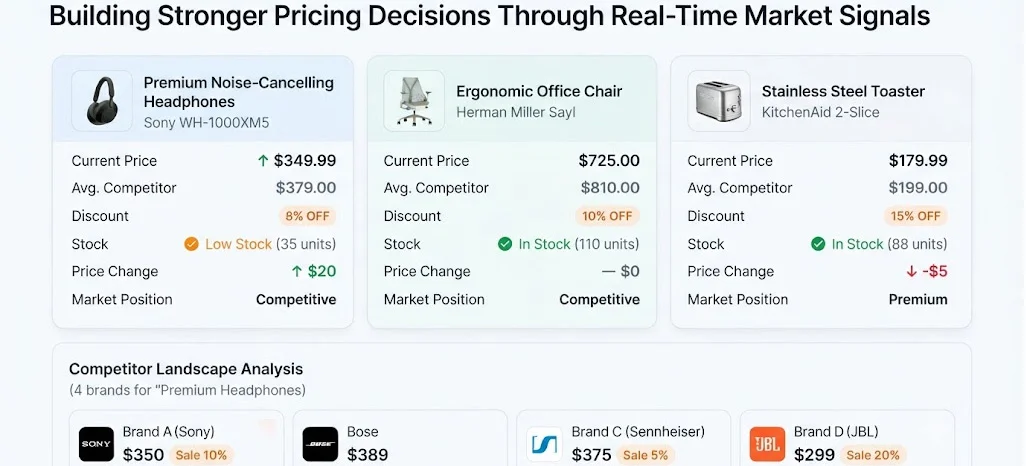
Pricing decisions become more effective when businesses examine market movements rather than individual competitor prices alone. Competitors may introduce temporary discounts, adjust product ranges, change promotional timing, or respond to demand fluctuations. Understanding these movements requires continuous observation and organized analysis. Businesses can evaluate recurring patterns across categories to determine whether a change represents a short-term promotion or a broader shift in market positioning.
A structured Competitor Pricing Analysis Strategy allows businesses to compare pricing behavior across selected competitors and product groups. Teams can examine how frequently prices change, how deeply competitors discount products, and whether certain categories experience stronger pricing pressure. These observations can support more informed decisions around promotional timing, product positioning, and pricing reviews.
| Competitive Indicator | Strategic Purpose |
|---|---|
| Price frequency | Measure market activity |
| Discount depth | Compare promotional intensity |
| Category movement | Identify competitive pressure |
| Product changes | Review assortment shifts |
Businesses can also incorporate Dynamic Pricing Intelligence when pricing decisions require more frequent evaluation. By combining market observations with internal objectives, teams can determine when certain products require attention and which movements should be reviewed more closely. This does not mean changing every price immediately. Such an approach can make pricing operations more responsive while reducing decisions based solely on isolated competitor actions.
- Monitor recurring competitor movements
- Compare promotional intensity across categories
- Evaluate pricing pressure by product
- Review changes against internal objectives
- Prioritize significant market signals
Consistent competitive monitoring can improve coordination between pricing and commercial teams. When market changes are documented systematically, analysts can provide clearer explanations for pricing recommendations and help decision-makers understand the factors behind each adjustment. This also creates a stronger historical reference for future pricing reviews. Over time, organizations can build structured records of competitor activity, identify recurring trends, and refine their decision-making processes.
Creating Consistent Competitive Visibility Across Modern Retail Channels
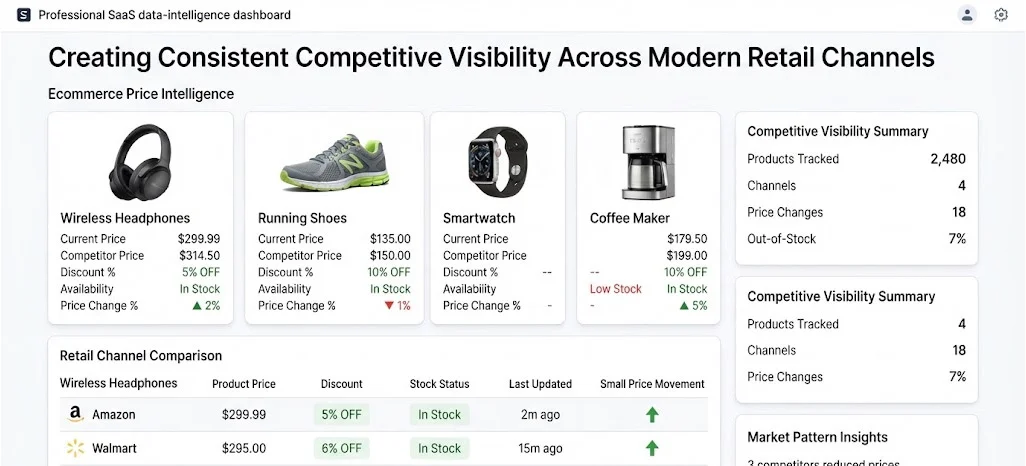
Modern brands often manage extensive product catalogs across marketplaces, retailer websites, and other digital channels. This makes manual pricing comparisons increasingly difficult, especially when product information changes frequently. Businesses need consistent methods for collecting and organizing market observations so analysts can evaluate comparable products efficiently. Structured data can provide visibility into product prices, promotional activity, availability, and assortment changes.
An Ecommerce Price Intelligence Strategy can help businesses organize these observations around specific categories, competitors, and product groups. Teams can compare pricing information at regular intervals and identify movements that require additional review. This approach can also help businesses understand whether pricing differences are isolated or part of broader market patterns.
| Data Element | Pricing Application |
|---|---|
| Product price | Benchmark competing offers |
| Sale price | Measure promotional changes |
| Product title | Support product comparison |
| Availability | Identify supply differences |
At scale, Retail Price Scraping can support the collection of structured product and pricing information from selected retail sources. Automated collection reduces repetitive manual research and can provide information in formats suitable for analysis. Teams can then filter records by product, category, competitor, location, or other relevant dimensions. Consistent collection also makes it easier to compare current observations with historical records.
- Collect product-level pricing information
- Monitor selected retail channels
- Compare comparable product offerings
- Track availability changes
- Organize recurring market observations
Consistent visibility becomes particularly valuable when brands operate across several markets or manage large assortments. A structured monitoring process can help teams identify pricing gaps, understand competitive movements, and prioritize categories requiring closer attention. It can also support communication between pricing analysts, merchandising teams, and business leaders by providing a common information base.
How Retail Scrape Can Help You?
We help brands organize competitive market information into structured datasets that support practical pricing workflows. When Competitive Price Intelligence is incorporated into these processes, businesses can compare market movements, evaluate pricing gaps, and identify changes across large product catalogs without depending on repetitive manual research.
- Monitor competitor product prices across selected channels
- Track promotional and discount movements over time
- Compare product assortments across competing retailers
- Identify pricing gaps between comparable products
- Organize collected information into structured datasets
- Support recurring market and pricing performance reviews
The collected information can strengthen E-Commerce Intelligence by giving pricing, merchandising, and business teams a consistent source for evaluating market conditions. We can also support scheduled data delivery and scalable monitoring workflows, allowing businesses to integrate competitive observations into recurring analytical processes.
Conclusion
A structured pricing framework allows brands to turn changing market information into measurable commercial decisions. Competitive Price Intelligence supports this process by bringing competitor movements, product information, promotions, and pricing patterns together for clearer evaluation. With consistent monitoring, businesses can improve pricing responsiveness while maintaining stronger visibility into market positioning.
A reliable data foundation also makes pricing operations more consistent across products and channels. Competitor Price Intelligence can help teams evaluate market differences, identify pricing gaps, and refine decisions using current competitive signals. Contact Retail Scrape today to build a scalable competitive pricing data solution for your business.