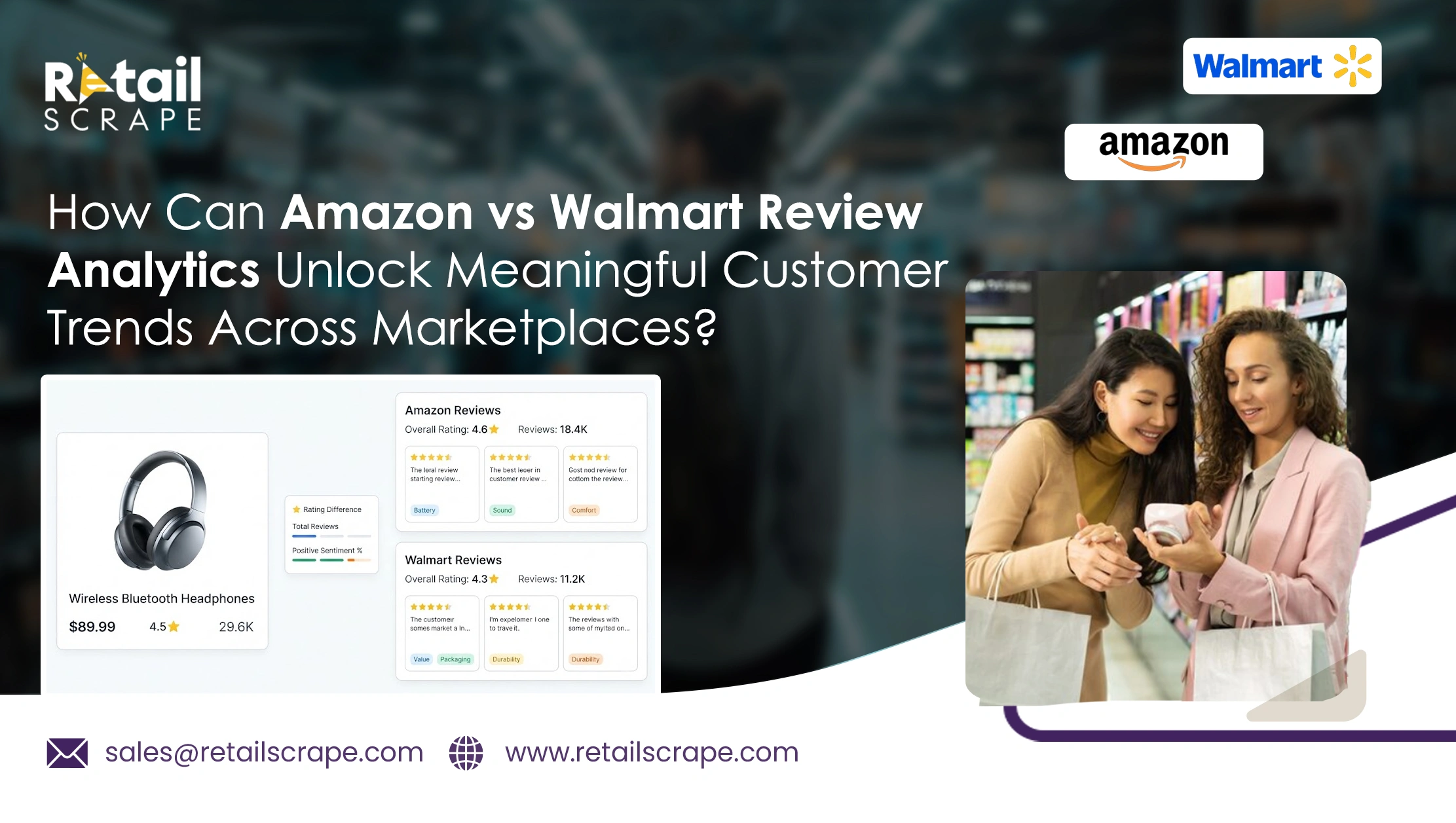
How Can Amazon vs Walmart Review Analytics Unlock Meaningful Customer Trends Across Marketplaces?
Introduction
Customer reviews have become one of the most valuable resources for understanding buyer expectations, product satisfaction, and competitive positioning. Businesses analyze review patterns to identify quality issues, emerging preferences, and purchase influences across major marketplaces. Combining these insights with Amazon Product Data Scraping enables organizations to build accurate datasets for long-term decision-making.
Amazon and Walmart represent two of the largest retail ecosystems, each generating millions of customer opinions every day. Examining review volume, product ratings, verified purchases, and recurring customer concerns provides measurable indicators that help brands improve product strategies while identifying opportunities for differentiation.
Businesses relying on Amazon vs Walmart Review Analytics can evaluate purchasing behavior with greater precision while monitoring customer sentiment across categories. These insights support pricing, merchandising, inventory planning, and customer experience improvements that contribute to stronger marketplace performance.
Decoding Customer Behavior Through Cross Marketplace Feedback Patterns
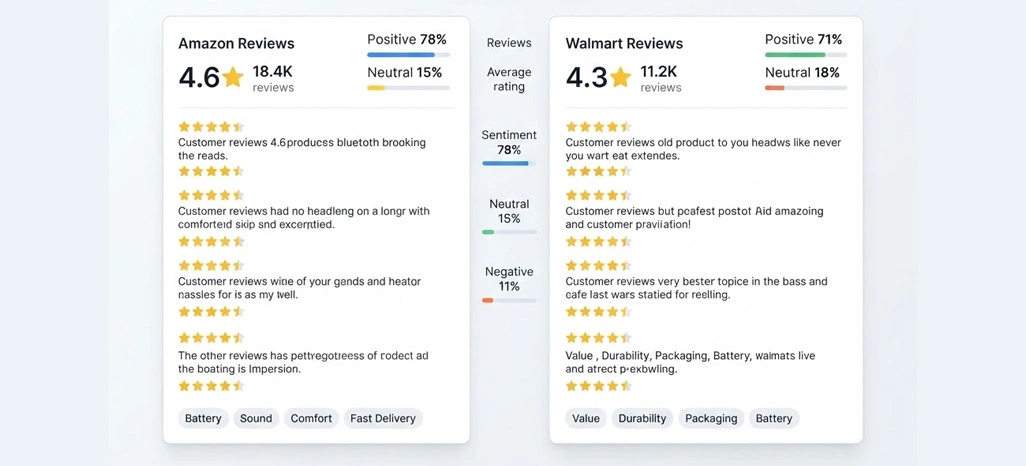
Customer feedback reveals valuable insights into product quality, purchasing preferences, and overall shopping experiences across leading marketplaces. Midway through this evaluation, Amazon vs Walmart Customer Reviews provide meaningful comparisons that help organizations understand where customer satisfaction differs and what improvements can strengthen product performance. Such observations contribute to more informed merchandising, inventory planning, and customer engagement strategies.
Organizations managing large volumes of marketplace information also benefit from automated collection methods. Integrating Walmart API Data Scraping Services into review monitoring workflows helps maintain accurate, structured, and frequently updated datasets for continuous analysis. Instead of relying on scattered feedback, businesses receive standardized information that supports consistent reporting and operational efficiency across multiple product categories.
Businesses commonly use review intelligence to support:
- Identify recurring customer complaints.
- Monitor review growth across products.
- Measure customer engagement levels.
- Improve merchandising strategies.
- Prioritize product enhancements.
- Support competitive benchmarking.
Review intelligence becomes even more valuable when organizations compare Amazon and Walmart Product Review Trends to observe seasonal buying patterns, changing consumer expectations, and emerging product opportunities. These comparisons help brands recognize which marketplace performs better for specific categories while highlighting areas requiring immediate attention before customer satisfaction declines.
Marketplace Review Snapshot:
| Marketplace | Amazon | Walmart |
|---|---|---|
| Average Review Volume | 2,800+ | 1,450+ |
| Verified Purchase Ratio | 84% | 76% |
| Average Rating | 4.3/5 | 4.2/5 |
| Monthly New Reviews | 12,500 | 7,600 |
Industry Insight: Nearly 93% of online shoppers read customer reviews before making purchasing decisions, making review intelligence an essential component of competitive research.
Transforming Review Signals Into Actionable Business Intelligence Strategies
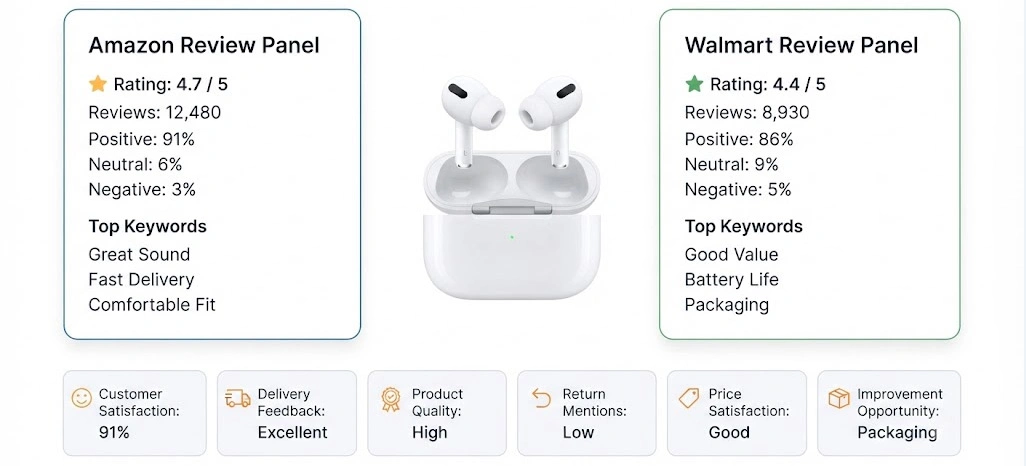
Customer ratings provide only part of the overall buying journey, while written feedback explains the reasons behind purchasing satisfaction or dissatisfaction. Businesses extracting structured review datasets can uncover meaningful product trends, delivery concerns, and quality expectations. During deeper evaluation, Amazon Walmart Review Data Analysis enables organizations to identify recurring customer sentiments that directly influence future buying decisions and long-term marketplace performance.
Reliable data collection also supports broader competitive research. Businesses implementing Amazon vs Walmart Ratings and Reviews Data Scraping can continuously monitor review activity while maintaining updated datasets for analytical reporting. Consistent review tracking allows decision-makers to identify quality improvements, customer expectations, and operational gaps before they affect overall brand perception.
Organizations frequently apply review intelligence to:
- Evaluate customer satisfaction patterns.
- Monitor sentiment fluctuations.
- Detecting quality improvement opportunities.
- Compare marketplace performance.
- Support product enhancement initiatives.
- Improve customer experience planning.
Comparative review intelligence becomes even more valuable when analysts evaluate Amazon Review Data vs Walmart Review Data alongside Sentiment Analysis Using Amazon and Walmart Reviews. Combining rating distributions with textual sentiment helps organizations understand positive experiences, identify recurring complaints, and prioritize improvements based on measurable customer feedback instead of assumptions.
Review Intelligence Metrics:
| Analysis Area | Business Value |
|---|---|
| Positive Sentiment | Product strengths |
| Negative Sentiment | Quality improvements |
| Keyword Frequency | Feature demand |
| Rating Distribution | Customer satisfaction |
Industry Insight: Products maintaining ratings above 4.2 stars generally achieve significantly higher conversion rates compared with lower-rated alternatives.
Converting Marketplace Insights Into Competitive Growth Opportunities
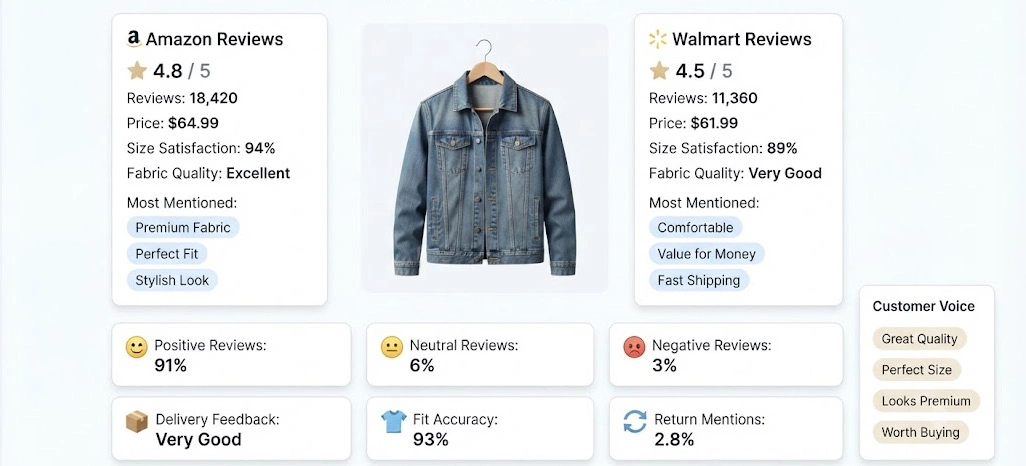
Review intelligence supports strategic planning by revealing how customers evaluate products, compare alternatives, and share post-purchase experiences. Businesses analyzing large-scale marketplace reviews can recognize evolving expectations, identify feature requests, and improve customer satisfaction through data-driven decisions. Within these analytical workflows, Amazon Data Scraper simplifies structured review collection while supporting long-term competitive monitoring across multiple product categories.
Organizations seeking stronger competitive positioning often perform Amazon vs Walmart Product Review Comparison to evaluate differences in customer engagement, review quality, and purchasing preferences. These comparisons reveal product strengths, category-specific opportunities, and emerging market trends that guide assortment planning, pricing strategies, and product optimization initiatives.
Businesses commonly utilize review intelligence to:
- Benchmark competing products.
- Monitor customer expectations.
- Improve product positioning.
- Identify feature demand.
- Support pricing decisions.
- Strengthen marketplace strategies.
Comprehensive marketplace intelligence becomes even more valuable when businesses examine Amazon Review Insights vs Walmart Reviews to understand review consistency, buyer confidence, and product perception across platforms. Such comparative evaluations help organizations respond quickly to changing consumer expectations while improving operational planning and future product development.
Competitive Review Insights:
| Insight Category | Strategic Outcome |
|---|---|
| Product Quality | Better product improvements |
| Feature Requests | Roadmap planning |
| Customer Satisfaction | Service enhancement |
| Competitive Reviews | Market positioning |
Industry Insight: Approximately 88% of consumers consider online reviews as trustworthy as personal recommendations when sufficient review volume is available.
How Retail Scrape Can Help You?
Retail businesses require reliable review intelligence to make informed decisions across highly competitive marketplaces. Through Amazon vs Walmart Review Analytics, we deliver structured datasets that transform customer feedback into measurable business intelligence for product optimization, pricing strategies, and customer experience enhancement.
Our solutions also integrate Walmart Product Scraper capabilities to collect marketplace information with consistency and accuracy.
Our data solutions help organizations:
- Collect large-scale marketplace review datasets.
- Monitor rating changes continuously.
- Track competitor product performance.
- Analyze customer sentiment efficiently.
- Standardize review information across platforms.
- Generate actionable reporting dashboards.
Businesses can further strengthen competitive research using Product Rating Analytics Using Web Scraping, allowing decision-makers to evaluate product reputation, identify recurring customer concerns, and improve strategic planning through reliable review intelligence.
Conclusion
Customer feedback continues to influence buying decisions, product development, and competitive positioning across digital marketplaces. Businesses adopting Amazon vs Walmart Review Analytics can build stronger decision-making frameworks while utilizing Amazon vs Walmart Review Data Scraping Guide to streamline review collection and evaluate marketplace performance with greater confidence.
Consistent review intelligence enables brands to improve customer satisfaction, identify product opportunities, and respond quickly to changing consumer expectations. Start working with Retail Scrape today to transform marketplace reviews into valuable business intelligence and accelerate sustainable growth through smarter analytics.