
How Does AI Product Review Analysis for Ecommerce Brands Reduce Review Processing Time by 40%?
Introduction
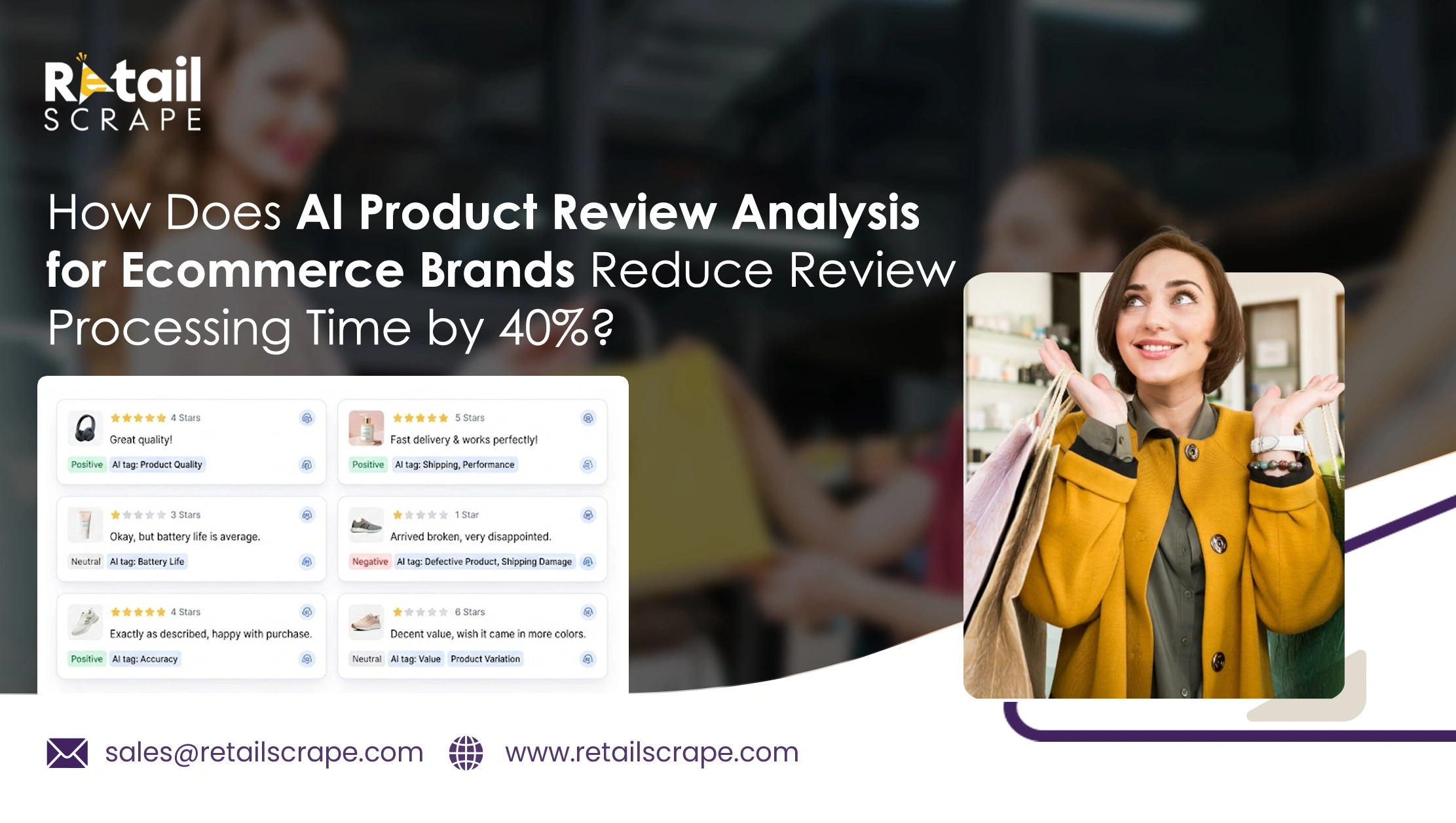
Ecommerce brands receive thousands of customer reviews across marketplaces, websites, and digital storefronts, making manual review processing increasingly time-consuming. AI Product Review Analysis for Ecommerce Brands helps businesses organize large volumes of feedback, identify recurring themes, and interpret customer opinions faster for informed operational decisions.
Customer reviews contain valuable signals about product quality, delivery experiences, pricing perceptions, packaging, and customer expectations. Customer Feedback Ecommerce Intelligence Solutions can structure these signals into actionable insights, helping brands identify positive and negative patterns without spending extensive resources manually reading individual reviews.
With artificial intelligence handling classification, sentiment detection, keyword identification, and trend recognition, brands can reduce repetitive review-processing workloads while improving response speed. Modern systems can process thousands of records simultaneously, allowing teams to focus more on product improvements, customer experience strategies, and business decisions.
Smarter Review Processing That Accelerates Ecommerce Decisions
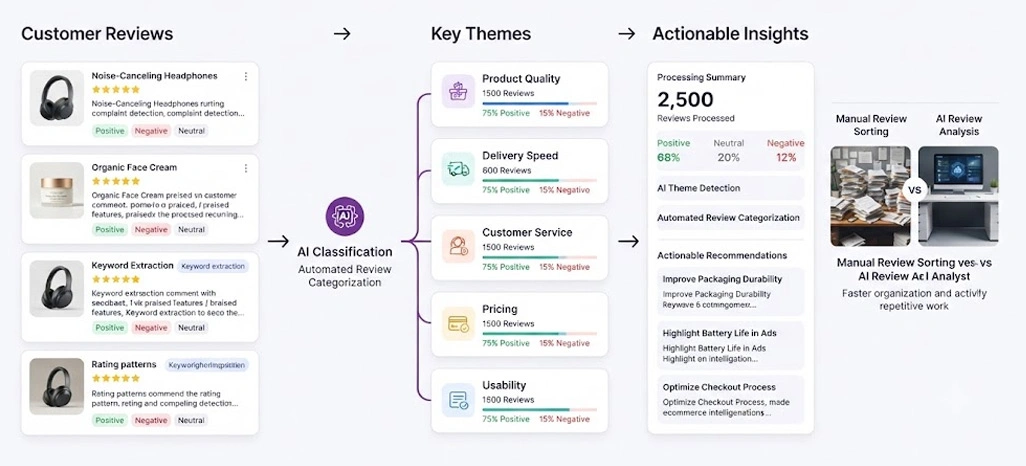
Ecommerce brands increasingly handle thousands of customer reviews across marketplaces, websites, and digital storefronts. AI Product Reviews & Ratings Analysis helps organize this information by identifying sentiment, recurring complaints, praised features, and rating patterns. Instead of manually examining every review, businesses can structure large volumes of feedback into meaningful categories and prioritize the issues requiring attention.
Processing efficiency becomes particularly important when review volumes increase rapidly. AI Review Analysis Tools for Ecommerce Brands can classify customer comments, recognize repeated themes, and separate positive, negative, and neutral opinions automatically. This reduces repetitive manual work and allows teams to spend more time interpreting insights rather than sorting individual records.
A structured workflow can provide several operational benefits:
- Faster classification of customer opinions
- Consistent identification of recurring themes
- Reduced manual review-reading workload
- Easier prioritization of customer complaints
- Quicker identification of product strengths
| Processing Activity | Traditional Workflow | Automated Workflow |
|---|---|---|
| Sentiment identification | Manual reading | Automated classification |
| Theme recognition | Spreadsheet sorting | Pattern detection |
| Complaint tracking | Individual evaluation | Centralized categorization |
| Review prioritization | Manual filtering | Rule-based prioritization |
For organizations processing substantial monthly review volumes, AI Review Analysis for Ecommerce Product workflows can make customer feedback easier to interpret at scale. Businesses can also identify frequently mentioned attributes, understand customer expectations, and create structured datasets for subsequent product and experience improvements.
Faster Sentiment Interpretation Supporting Product Improvements
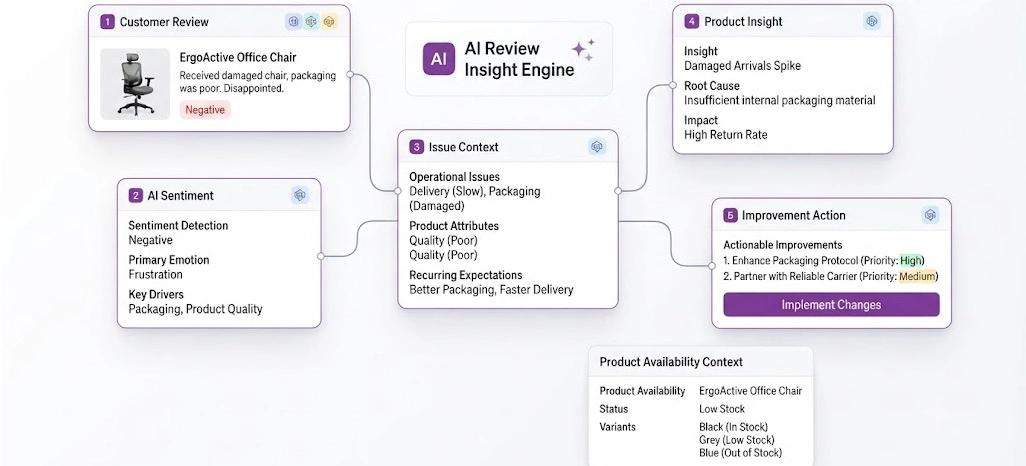
Customer feedback becomes more valuable when sentiment patterns are connected with broader product information. What Is Ecommerce Product Review Sentiment Analysis can be understood through workflows that classify opinions according to satisfaction levels, product attributes, recurring concerns, and customer experiences. This helps businesses distinguish genuine product dissatisfaction from complaints related to delivery, packaging, or availability.
Review intelligence can become more actionable when businesses compare customer opinions with operational conditions. AI Product Availability Data Analysis can help identify whether stock shortages, unavailable variants, or inconsistent inventory contributed to negative experiences. Such comparisons provide a broader context for interpreting review trends and deciding where corrective action is necessary.
Key analytical outcomes can include:
- Identification of frequently criticized product attributes
- Recognition of positive product characteristics
- Separation of operational and product-related complaints
- Detection of recurring customer expectations
- Prioritization of improvement opportunities
| Sentiment Pattern | Business Meaning | Potential Response |
|---|---|---|
| Repeated quality complaints | Product concern | Evaluate specifications |
| Positive feature mentions | Customer preference | Strengthen positioning |
| Delivery-related criticism | Fulfillment issue | Review logistics |
| Availability complaints | Inventory concern | Improve stock planning |
With Ecommerce Product Review Analysis Using AI, businesses can evaluate large collections of opinions consistently while connecting sentiment patterns with product performance. This approach supports faster interpretation, clearer prioritization, and more informed decisions across product development, inventory planning, customer service, and ecommerce operations.
Competitive Review Signals Driving Stronger Market Positioning
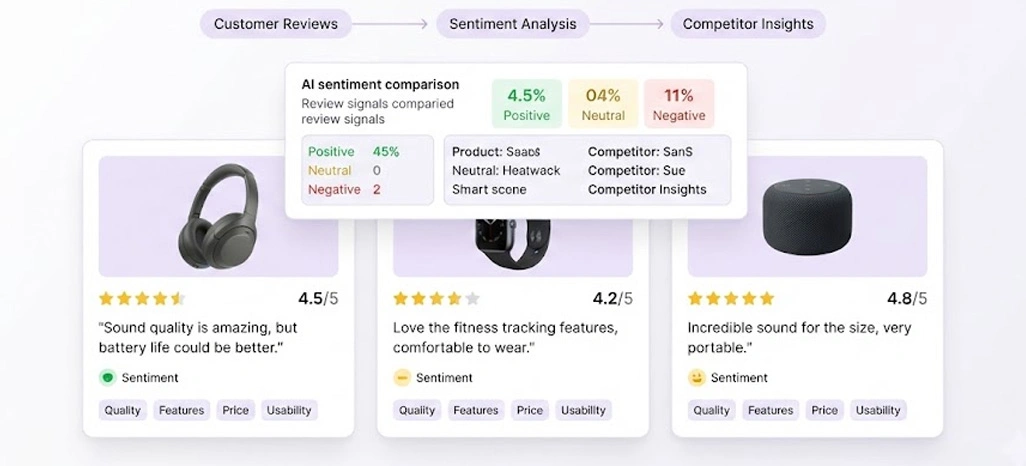
Customer reviews also provide valuable competitive intelligence because shoppers frequently discuss product quality, features, pricing perceptions, usability, and expectations. Competitor Product Review Analysis helps businesses compare these signals across competing products and identify recurring strengths or weaknesses. This creates a practical view of how customers perceive alternatives within the same category.
Large-scale comparison becomes easier when review information is collected and standardized consistently. Product Review Scraping and Sentiment Analysis Services can support structured collection of relevant review information while preparing datasets for sentiment classification and comparative analysis. Businesses can then examine recurring themes across multiple competitors without relying solely on manual research.
Useful competitive signals can include:
- Frequently praised competitor features
- Repeated complaints about competing products
- Emerging customer expectations
- Changes in product satisfaction
- Commonly requested improvements
| Competitive Signal | Intelligence Value | Strategic Use |
|---|---|---|
| Feature praise | Preference identification | Product positioning |
| Recurring complaints | Market weakness | Product refinement |
| Rating movement | Satisfaction trend | Competitive monitoring |
| Customer requests | Unmet expectations | Product planning |
Meanwhile, AI Product Review Analysis Software for Ecommerce can help organize large-scale competitive review datasets into consistent analytical categories. Combined with Automated Product Review Analysis for Online Retailers, these workflows allow brands to monitor customer sentiment more efficiently and identify opportunities for product positioning, feature development, service improvements, and stronger market differentiation.
How Retail Scrape Can Help You?
For ecommerce businesses managing extensive customer feedback, AI Product Review Analysis for Ecommerce Brands becomes more effective when review information is collected consistently from relevant online sources. Retail Scrape can support structured data collection and analysis workflows designed around product reviews, ratings, product attributes, and marketplace intelligence.
Our approach helps businesses organize large-scale review data into structured, usable datasets while maintaining data quality and consistency through E-Commerce Data Scraping. Key capabilities include:
- Collecting reviews from selected ecommerce sources
- Structuring ratings and review information into organized datasets
- Capturing relevant product and customer feedback fields
- Supporting large-scale review data collection workflows
- Preparing datasets for sentiment and trend analysis
- Enabling recurring collection for ongoing market monitoring
Using AI Review Analysis for Ecommerce Product workflows, businesses can transform scattered customer opinions into structured intelligence that supports product development, customer experience improvements, competitive research, and category-level decision-making.
Conclusion
Ecommerce brands can significantly improve the way they manage customer feedback by combining automation, structured datasets, and intelligent interpretation. AI Product Review Analysis for Ecommerce Brands reduces repetitive review-processing workloads while helping teams identify sentiment trends, recurring complaints, and valuable product signals more efficiently.
A scalable workflow can also connect review intelligence with broader business datasets to support faster decisions across product strategy and customer experience. AI Product Review Analysis Software for Ecommerce can help organizations move from manual review reading toward consistent, data-driven analysis at scale. Connect with Retail Scrape to build a structured ecommerce review intelligence workflow tailored to your business needs.