

How Can a Web Scraping Data Pipeline & Transformation Guide Streamline Real-Time Data Management?
Introduction
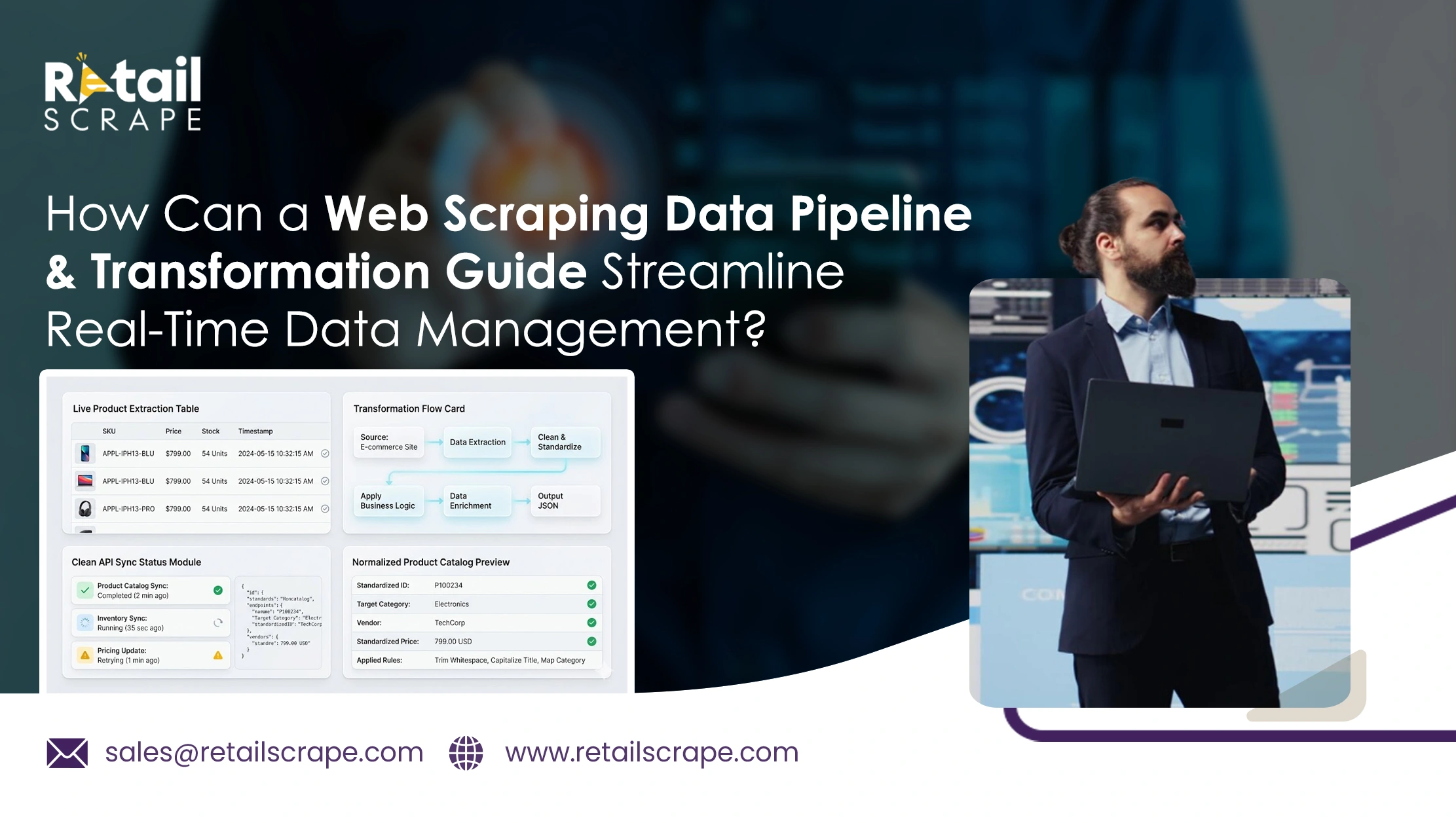
Modern enterprises rely heavily on real-time insights to improve operational efficiency, monitor market changes, and deliver personalized customer experiences. Businesses collecting large volumes of online information often struggle with fragmented sources, inconsistent formatting, duplicate entries, and delayed reporting cycles. This is where a Web Scraping Data Pipeline & Transformation Guide becomes essential for managing extraction workflows and building scalable analytics systems.
Organizations using a robust pipeline architecture can automate collection, cleaning, normalization, validation, and integration across multiple platforms. According to industry studies, companies using automated data workflows reduce manual processing efforts by nearly 60% while improving reporting accuracy by over 45%. Integrating a reliable Web Scraping API further simplifies large-scale extraction by enabling consistent connectivity across websites, applications, and marketplaces.
Businesses implementing Web Scraping Data Transformation strategies can organize unstructured datasets into analysis-ready formats for dashboards, forecasting models, and operational intelligence. As enterprises continue scaling their digital operations, advanced data pipelines play a critical role in delivering structured, high-quality, and actionable datasets for real-time business performance monitoring.
Creating Reliable Systems for Continuous Information Collection
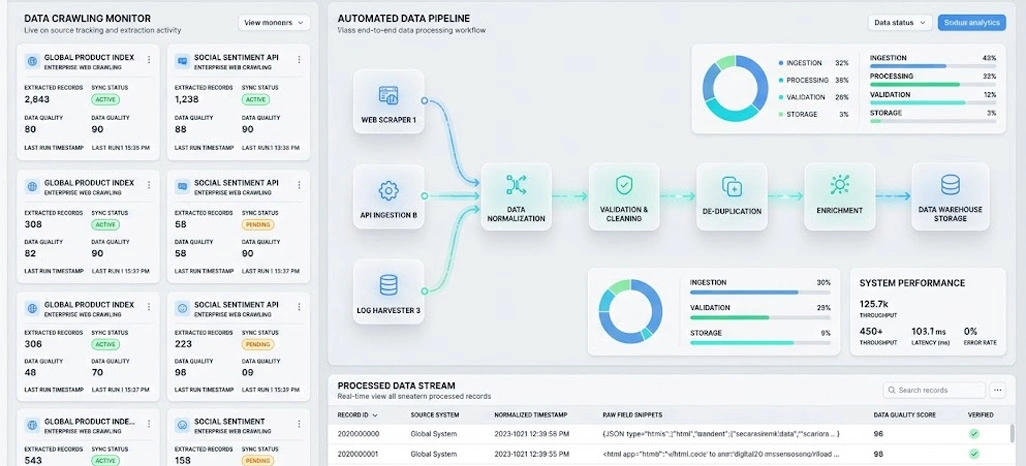
Businesses handling large volumes of online information often struggle with fragmented records, inconsistent formatting, and delayed reporting structures. Without a well-managed workflow, organizations may experience operational inefficiencies that affect forecasting, analytics accuracy, and strategic planning. Modern enterprises are increasingly investing in scalable infrastructures that simplify extraction, validation, and storage processes while supporting continuous synchronization across business platforms.
According to industry reports, automated processing systems can reduce manual data handling efforts by more than 50% while improving reporting efficiency significantly across operational teams. Businesses investing in Scraped Data Processing frameworks can standardize extracted information for improved analytics and operational reporting.
Similarly, adopting Automated Data Pipeline for Scraped Datasets enables enterprises to automate ingestion, organization, and synchronization across large digital environments. Organizations implementing Enterprise Web Crawling infrastructures can monitor multiple digital sources simultaneously while maintaining consistent information quality.
| Operational Challenge | Implemented Solution | Business Outcome |
|---|---|---|
| Fragmented datasets | Centralized workflow systems | Better reporting consistency |
| Slow synchronization | Automated scheduling pipelines | Faster operational visibility |
| Duplicate records | Intelligent validation mechanisms | Improved accuracy |
| Multi-source extraction | Unified monitoring systems | Simplified management |
Companies using Data Pipeline Optimization for Large-Scale Web Scraping solutions can further improve performance scalability, minimize resource consumption, and strengthen long-term data infrastructure management for continuous analytical operations.
Improving Structured Workflows Through Intelligent Transformation Processes
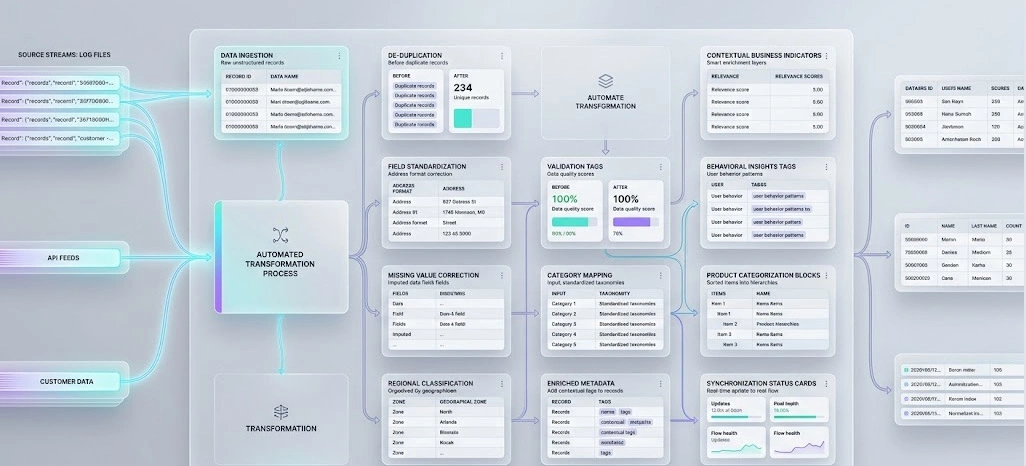
Raw digital information collected from multiple online sources often contains irregular structures, incomplete records, duplicate entries, and inconsistent formatting. These issues can reduce reporting accuracy and create operational inefficiencies for businesses relying on real-time insights. Organizations implementing advanced transformation systems can significantly improve data quality, processing speed, and analytical consistency while supporting scalable enterprise operations.
Businesses implementing Real Time Data Transformation for Scraped Data frameworks can synchronize information instantly across dashboards, reporting systems, and enterprise applications. These automated environments help organizations respond quickly to operational changes while maintaining structured analytical workflows for large-scale digital ecosystems.
Modern enterprises increasingly prioritize Data Enrichment in Web Scraping Pipelines to improve dataset usability and analytical depth. Enrichment systems combine extracted information with contextual business indicators such as regional classifications, behavioral patterns, and category-level intelligence.
| Transformation Process | Functional Purpose | Operational Benefit |
|---|---|---|
| Data normalization | Standardize extracted structures | Improved consistency |
| Record validation | Detect missing information | Better reliability |
| Categorization systems | Organize structured datasets | Faster reporting |
| Contextual enrichment | Enhance analytical depth | Stronger business intelligence |
Organizations also rely on Real-Time Etl Pipelines for Scraped Data Analytics to automate movement between extraction systems, cloud storage environments, and reporting infrastructures. These scalable ETL frameworks reduce manual intervention, improve workflow stability, and support continuous operational visibility.
Strengthening Business Intelligence Using Automated Analytical Frameworks
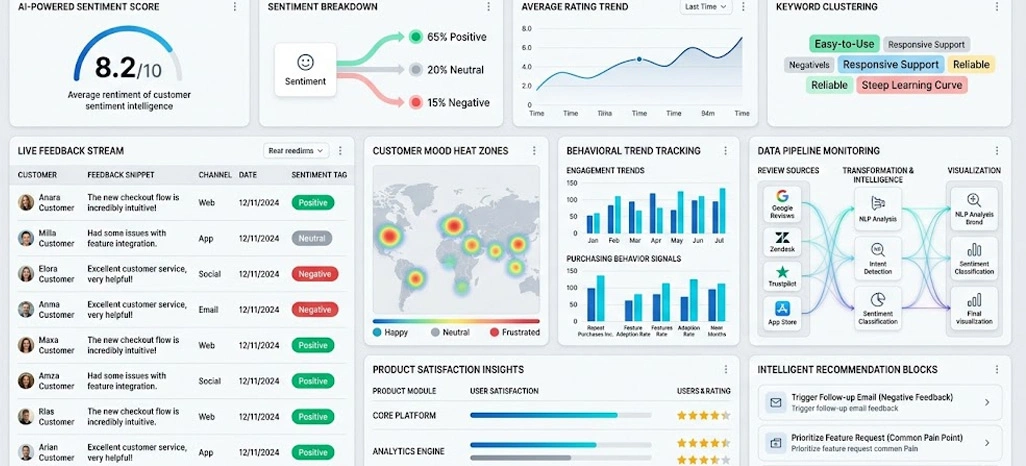
Organizations operating in highly competitive markets require continuously updated information to support forecasting, customer engagement, and operational decision-making. Advanced automation systems help enterprises simplify extraction, transformation, and reporting workflows while improving overall business intelligence performance.
Industry research shows that organizations implementing intelligent automation frameworks achieve nearly 40% faster reporting cycles and improved operational responsiveness. Businesses implementing Enterprise Scraped Data Pipeline Automation Services can streamline large-scale operational workflows while reducing dependency on manual monitoring systems.
Modern enterprises increasingly use Customer Sentiment Analysis systems to evaluate consumer opinions, online reviews, and behavioral feedback across multiple digital platforms. These insights support marketing optimization, customer engagement strategies, and product improvement initiatives by identifying evolving market preferences and purchasing patterns in real time.
| Analytical Requirement | Automated Capability | Business Advantage |
|---|---|---|
| Trend monitoring | Continuous information updates | Faster market response |
| Feedback evaluation | Sentiment classification systems | Improved customer engagement |
| Reporting integration | Centralized analytical workflows | Better visibility |
| Predictive modeling | Automated intelligence systems | Improved forecasting |
Organizations also benefit from Ai-Based Data Transformation Pipelines for Scraped Data, which use intelligent models to classify records, identify anomalies, and optimize transformation accuracy. As digital ecosystems continue expanding, scalable analytical infrastructures remain essential for maintaining reliable business intelligence and long-term operational performance.
How Retail Scrape Can Help You?
A scalable Web Scraping Data Pipeline & Transformation Guide helps organizations simplify data extraction, improve processing efficiency, and maintain structured reporting systems across multiple business functions.
We provide advanced extraction and transformation solutions tailored for enterprise-scale information management requirements.
- Build scalable extraction workflows for large-volume online sources
- Maintain consistent formatting across structured business datasets
- Improve synchronization speed for dynamic information streams
- Reduce manual intervention through automated processing systems
- Support cloud-based storage and enterprise reporting integration
- Deliver scalable monitoring solutions for continuous operational visibility
Organizations using Retail Scrape solutions can improve market visibility, reporting accuracy, and Competitor Analysis performance through advanced automation frameworks. Our infrastructure also supports Ai-Based Data Transformation Pipelines for Scraped Data to streamline intelligent processing, categorization, and large-scale analytical operations for modern enterprises.
Conclusion
Modern organizations require scalable systems capable of processing continuously changing online information with speed, accuracy, and operational consistency. A properly implemented Web Scraping Data Pipeline & Transformation Guide enables enterprises to automate extraction workflows, improve reporting efficiency, and support real-time business intelligence initiatives across multiple operational environments.
Businesses investing in Real-Time Etl Pipelines for Scraped Data Analytics can strengthen analytical performance, reduce operational delays, and improve decision-making accuracy through structured automation systems. Connect with Retail Scrape today to transform large-scale scraped datasets into actionable intelligence that drives measurable business growth.