


Why Does ERP Data Scraping Help Businesses Track Competitor Prices and Spot Market Trends Faster?
Introduction
In today’s hyper-competitive digital commerce landscape, maintaining optimal profit margins requires accurate market awareness. Rapid fluctuations in raw material costs, supply chain dynamics, and consumer demand make traditional pricing strategies obsolete. Enterprises now deploy automated extraction techniques to continuously aggregate external market signals into internal management systems.
Modern commercial infrastructure relies heavily on ERP Pricing Intelligence to combine enterprise resource data with real-time market trends. Leveraging direct data feeds allows operational teams to eliminate manual research overhead completely. By analyzing external catalog shifts alongside internal inventory metrics, companies gain complete visibility over shifting industry benchmarks.
This structured integration empowers leadership to adjust commercial strategies proactively rather than reacting to lost revenue after market shifts occur. Utilizing accurate ERP Data Scraping ensures that organizations capture high-frequency pricing signals across multi-channel environments. This structured capability helps decision-makers uncover high-impact sales trends and respond instantly to aggressive market positioning.
Strategic Enterprise Pricing Systems Enable Fast Competitor Positioning Responses
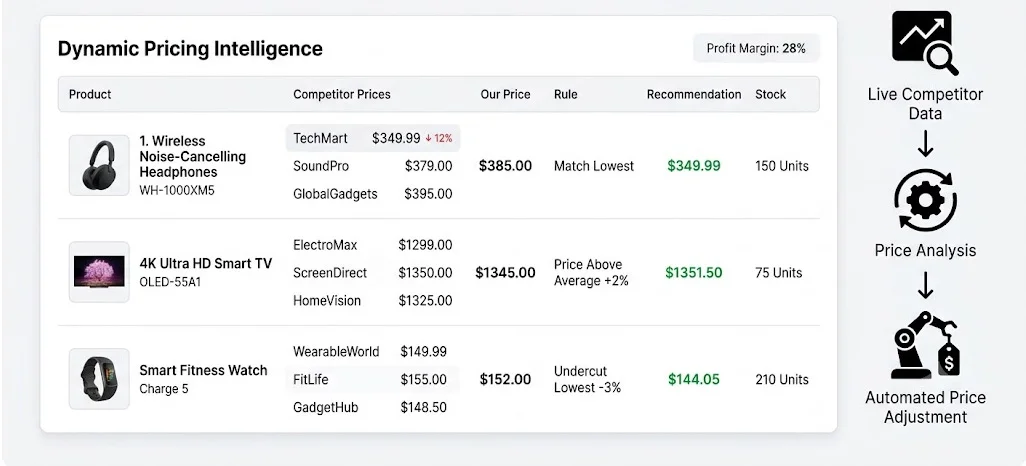
In modern enterprise commerce, static price management creates severe risk for profit margins during sudden competitive shifts. Commercial leadership teams need continuous visibility into external pricing updates across diverse digital selling platforms. By extracting continuous catalog updates directly into core enterprise tools, pricing specialists establish full clarity over shifting market benchmarks without relying on manual research methods.
Deploying responsive enterprise workflows powered by Dynamic Pricing Intelligence helps category managers launch precise price adjustments driven by live stock shifts and competitor strategy changes. Converting raw digital feeds into structured internal database inputs removes operational delays and ensures market strategy stays aligned with real-time consumer behavior. Consequently, brands expand revenue margins during high-demand periods while maintaining tight expense controls.
- Continuous monitoring of thousands of SKUs across multiple digital selling channels.
- Instant price adjustments triggered by real-time competitor stock changes.
- Elimination of human entry errors during rapid market fluctuations.
- Better margin protection during unexpected promotional wars.
| Metric / Parameter | Traditional Manual Monitoring | Automated Enterprise System Integration |
|---|---|---|
| Data Collection Frequency | Weekly / Monthly Batch Processing | Near Real-Time Continuous Feeds |
| Pricing Response Speed | 48–72 Hours Delay | Under 15 Minutes Automated Adjustment |
| Catalog Coverage | Limited to Top 50–100 SKUs | Complete Multi-Channel Coverage (100k+ SKUs) |
| Data Accuracy Rate | ~82% (Human Error Prone) | 99.4% Validated Structured Feeds |
Building efficient commercial strategies requires seamless ERP Data Extraction for Market Research to evaluate live market conditions and align internal targets with current external pricing structures. Combining structural web data with historical sales figures gives strategy teams clear visibility to identify profit opportunities, adjust stock levels appropriately, and sustain long-term operational growth across volatile retail sectors.
Structured Market Intelligence Uncovers Shifting Consumer Demand Patterns Continuously
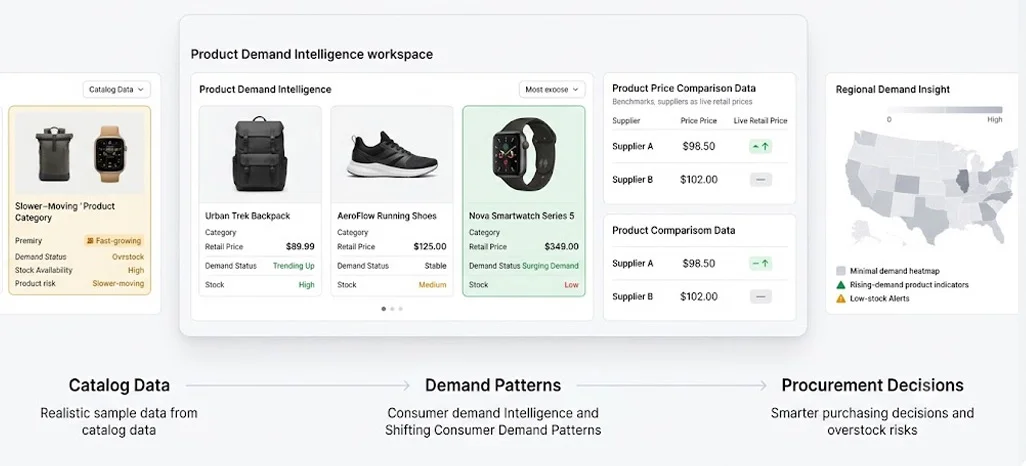
Beyond daily price adjustments, long-term brand growth relies on identifying shifting product category interest early in the buying lifecycle. Collecting web catalog data at scale across multi-vendor channels yields clear structural visibility into changing buyer habits, regional stock shortages, and product variations. Processing this strategic data within centralized enterprise applications converts macro-level market movements into clear, actionable commercial plans.
Integrating accurate Product Price Comparison Data directly into internal purchasing models allows procurement professionals to benchmark supplier pricing against live retail values. This strategic oversight reduces risk around overstocking low-performing SKUs while highlighting rapidly growing product lines ahead of competitors. Merchandising departments can refine inventory purchasing schedules, adjust vendor terms, and launch effective promotions long before competitors notice shifting consumer momentum.
- Early identification of emerging product trends and rising category demand.
- Enhanced inventory planning that reduces holding costs and excess stock.
- Clear visibility into regional supplier pricing across diverse marketplaces.
- Better alignment between procurement orders and active retail pricing strategies.
| Strategic Capability | Industry Impact & Market Performance |
|---|---|
| Stockout Prevention | Decreases inventory stockout occurrences by up to 34% through proactive competitor stock tracking. |
| Promotional Analytics | Enhances promotional Campaign ROI by 28% through precise tracking of competitor discount duration. |
| Supplier Renegotiation | Improves procurement cost efficiency by 12% utilizing baseline market pricing benchmarks. |
Implementing modern enterprise workflows through Real-Time Competitor Price Tracking provides corporate decision-makers with continuous visibility into shifting market realities. Systematically evaluating competitor promotional timing enables category managers to optimize markdown schedules, maximize campaign profitability, and defend key market positions with complete commercial confidence.
Automated Ingestion Infrastructure Optimizes Internal Operations and Workflow Efficiency
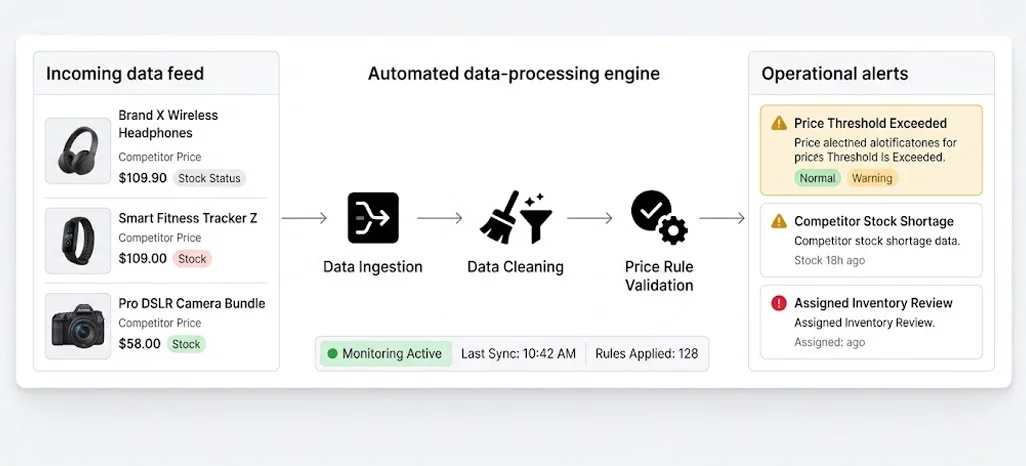
Manual competitive intelligence tracking demands significant labor resources, frequently yielding delayed reporting and inconsistent data points across categories. Upgrading to structured enterprise automation delivers consistent, reliable monitoring across vast product catalogs without human oversight. Enterprise management platforms process raw incoming feeds, clean up formatting discrepancies, and isolate high-priority pricing shifts for immediate strategic review.
Establishing reliable Price Monitoring Automation transforms unstructured digital information into actionable operational assignments across business units. Inventory managers receive instant alerts whenever market pricing moves past predefined profitability limits or when competitors face unexpected inventory shortages. This seamless digital connection unifies internal department goals, allowing strategy teams to focus on revenue expansion rather than routine data management.
- Automated parsing and cleanup of high-volume digital product catalogs.
- Immediate notifications sent to team leaders during drastic market shifts.
- Seamless synchronization between external web data and internal ERP systems.
- Substantial reduction in manual research labor and operational overhead.
| Operational Workflow Stage | Legacy Manual Process | Integrated Enterprise Scraping |
|---|---|---|
| Extraction & Parsing | Manual copy-pasting from store pages | Scalable cloud extraction scripts |
| Data Normalization | Spreadsheets subject to formatting errors | Automated clean-up & SKU mapping |
| System Ingestion | Manual database entry by data operators | Direct API streaming into ERP databases |
| Action Execution | Delayed email approvals across management | Algorithmic re-pricing engine activation |
Establishing a reliable digital architecture using ERP Data Integration ensures seamless cross-departmental alignment, giving pricing and supply chain teams uniform access to live market intelligence. Eliminating manual reporting barriers accelerates decision-making cycles, improves pricing execution speed, and strengthens corporate resilience against aggressive market movements.
How Retail Scrape Can Help You?
Modern enterprise systems require dependable data pipelines to maintain accurate competitor visibility across complex global markets. Deploying reliable ERP Data Scraping infrastructure guarantees that your enterprise systems receive clean, structured, and timely commercial intelligence without technical interruption.
- Custom web scraping architecture tailored to complex enterprise data requirements.
- Continuous anti-bot navigation ensures unbroken data ingestion schedules.
- Automated SKU matching and catalog mapping across diverse multi-vendor platforms.
- High-frequency scraping options delivering real-time competitive pricing updates.
- Flexible data delivery formats compatible with major enterprise management platforms.
- Enterprise-grade security compliance ensures complete data integrity and privacy.
Partnering with specialized Web Scraping Services providers delivers seamless integration to turn raw web content into clear, actionable revenue growth strategies.
Conclusion
Building a resilient enterprise requires continuous access to accurate market intelligence across all sales channels. Integrating reliable ERP Data Scraping into core workflows provides executive teams with clear, real-time competitor pricing visibility.
Implementing modern automated data extraction pipelines ensures your enterprise remains nimble against aggressive market pressures. Transitioning to custom Retail Price Intelligence API integrations provides structured, enterprise-ready data streams that empower teams to execute precise pricing strategies confidently. Contact Retail Scrape today to build your custom data solution.