

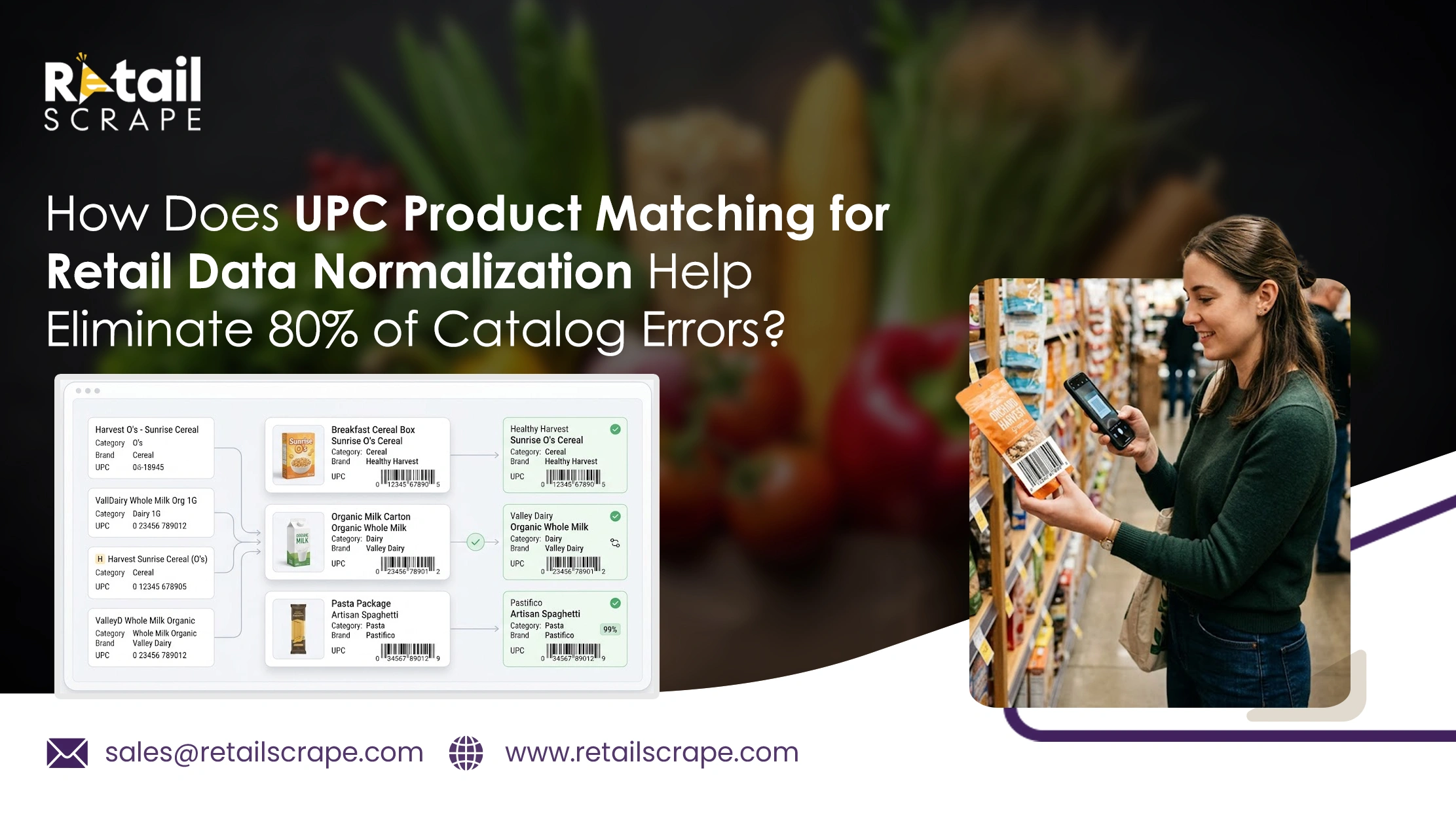
How Does UPC Product Matching for Retail Data Normalization Help Eliminate 80% of Catalog Errors?
Introduction
Retail product catalogs often contain duplicate listings, inconsistent product names, missing attributes, and conflicting pricing information. As retailers expand across multiple marketplaces, supplier networks, and sales channels, maintaining a clean and standardized catalog becomes increasingly challenging. One of the most effective ways to solve these challenges is through UPC Product Matching for Retail Data Normalization, which creates a standardized product identity across fragmented datasets.
The Universal Product Code (UPC) acts as a unique identifier that helps businesses connect equivalent products from different retailers, marketplaces, and distributors. Instead of relying solely on product titles or descriptions that vary widely between sellers, UPC matching provides a consistent framework for identifying identical products. This significantly improves catalog accuracy and enables better reporting, analytics, and pricing comparisons.
Organizations seeking stronger Product Identity Resolution for Pricing Intelligence increasingly rely on UPC-driven normalization methods to improve data quality. By matching products through standardized identifiers, retailers can reduce duplication, enhance product discoverability, and support more accurate competitive analysis.
Creating Consistent Product Records Across Data Sources
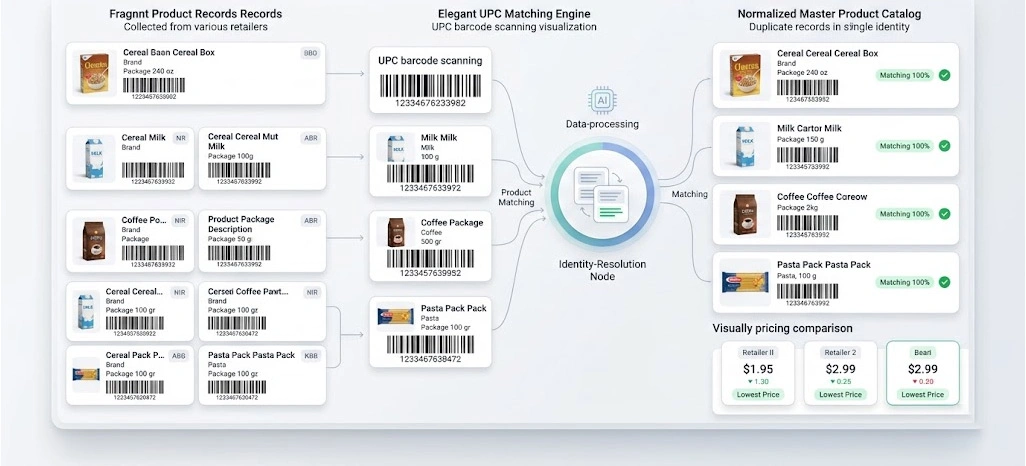
Duplicate listings remain one of the biggest obstacles in retail catalog management. The same product may appear multiple times because suppliers use different naming conventions, abbreviations, packaging descriptions, or attribute formats. These inconsistencies create confusion for merchandising teams and reduce the reliability of inventory and reporting systems. Industry studies indicate that duplicate records can represent 20%–35% of large retail catalogs, leading to inefficiencies across operations.
Standardized identification methods help businesses connect equivalent products from multiple data sources and maintain a single version of the truth. The adoption of Building Unified Retail Datasets Using UPC Matching allows businesses to consolidate supplier feeds, marketplace listings, and internal records into one structured dataset.
Likewise, How to Normalize Product Data Across Retailers Using UPC Codes provides a framework for ensuring that equivalent products remain consistently identified regardless of naming variations. As a result, retailers can reduce manual correction efforts and improve catalog governance. This improves data quality and supports more reliable analytics across departments.
| Catalog Challenge | Business Impact |
|---|---|
| Duplicate SKUs | Inflated inventory counts |
| Naming inconsistencies | Customer confusion |
| Multiple product records | Reporting inaccuracies |
| Supplier formatting variations | Product matching failures |
| Manual catalog maintenance | Higher operational costs |
Organizations that implement standardized matching practices often experience significant reductions in duplicate records, enabling cleaner product catalogs, stronger reporting accuracy, and better operational efficiency.
Improving Competitive Pricing Through Accurate Comparisons
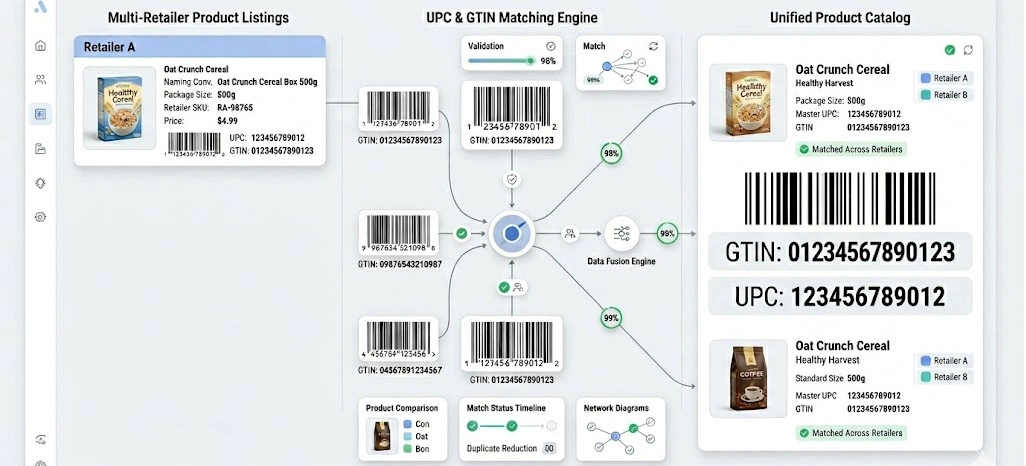
Accurate pricing intelligence depends on the ability to identify identical products across competing retailers. However, product titles often vary by marketplace, supplier, or ecommerce platform, making direct comparisons difficult. Differences in naming structures, package descriptions, and attribute formatting frequently result in mismatched products and unreliable pricing analysis.
Research suggests that pricing discrepancies affect a substantial portion of ecommerce catalogs, creating challenges for revenue management and competitive positioning. Many businesses rely on Cross-Retailer Product Matching Using UPC and Gtin to connect equivalent products listed under different naming conventions. This approach improves confidence in competitor analysis and supports more informed pricing decisions.
Additionally, Web Scraping Services help organizations collect product and pricing information from multiple online sources. Once data is gathered, standardized matching processes ensure that equivalent items are properly aligned before analysis begins. Cleaner datasets reduce pricing errors and strengthen decision-making across merchandising and analytics teams.
| Pricing Challenge | Standardization Benefit |
|---|---|
| Different product names | Consistent identification |
| Marketplace variations | Accurate comparisons |
| Supplier discrepancies | Improved alignment |
| Manual price matching | Faster analysis |
| Reporting inconsistencies | Reliable insights |
Companies also benefit from Retail Product Data Cleansing and Normalization, which removes inconsistencies that often interfere with accurate reporting. When accurate product matching is combined with clean data management, retailers gain stronger visibility into competitor pricing trends and can react more effectively to changing market conditions.
Strengthening Market Insights With Unified Information
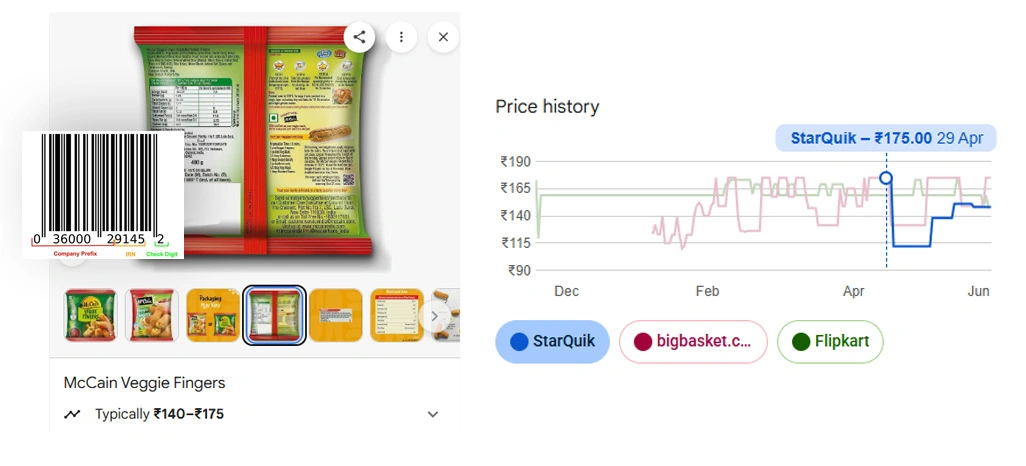
Retail analytics are only as reliable as the product data that supports them. Fragmented catalogs, duplicate listings, and inconsistent attributes can distort inventory reports, forecasting models, and category performance evaluations. These issues make it difficult for retailers to understand market trends and respond effectively to customer demand.
Analysts estimate that poor-quality product information can reduce forecasting accuracy by more than 20%. Standardized product identification helps solve this problem by creating consistency across datasets collected from multiple sources. Retailers increasingly depend on UPC-Based Product Aggregation for Market Analytics to consolidate information from suppliers, marketplaces, and ecommerce platforms into a unified reporting structure.
This approach enables more accurate category analysis and stronger performance benchmarking. Similarly, Product Availability Solutions support inventory visibility by helping businesses track stock status across retailers and identify assortment gaps more efficiently. Improved visibility contributes to better planning and demand forecasting.
| Analytics Area | Improvement Achieved |
|---|---|
| Demand forecasting | Better accuracy |
| Inventory planning | Enhanced visibility |
| Category analysis | Consistent reporting |
| Assortment optimization | Stronger insights |
| Market intelligence | Reliable comparisons |
Many organizations also implement Automated Product Normalization Using UPC Identifiers to reduce manual data management workloads while maintaining high levels of catalog accuracy. As retail ecosystems become increasingly data-driven, unified product information provides a stronger foundation for analytics, inventory management, and long-term business growth.
How Retail Scrape Can Help You?
Retail data accuracy has become a critical competitive advantage for modern businesses. Through UPC Product Matching for Retail Data Normalization, organizations can transform fragmented product information into standardized datasets that support pricing intelligence, inventory management, and market analysis.
Key Capabilities:
- Consolidate fragmented product information from multiple sources.
- Improve catalog consistency across marketplaces and channels.
- Reduce duplicate records through intelligent matching workflows.
- Enhance competitive pricing visibility with accurate comparisons.
- Support inventory optimization through cleaner datasets.
- Deliver scalable retail analytics for strategic decision-making.
Businesses seeking Normalize Product Data Across Retailers Using UPC Matching can utilize our specialized solutions to create reliable, high-quality retail datasets. Combined with our Price Monitoring Service, organizations gain deeper visibility into market dynamics and competitor activity.
Conclusion
Catalog inaccuracies continue to challenge retailers operating across multiple channels, suppliers, and marketplaces. Implementing UPC Product Matching for Retail Data Normalization helps organizations reduce duplication, improve pricing accuracy, and establish a consistent product foundation for analytics and operational efficiency.
As retail ecosystems become increasingly data-driven, strategies such as Ecommerce Product Catalog Normalization With UPC Matching provide a scalable path toward cleaner product information and better business decisions. Ready to eliminate catalog errors and improve retail intelligence? Contact Retail Scrape today to build a more accurate, unified, and competitive retail data ecosystem.
Effortlessly managing intricacies with customized strategies.
Mitigating risks, navigating regulations, and cultivating trust.
Leveraging expertise from our internationally acclaimed team of developers
Reliable guidance and assistance for your business's advancement