How Can a UK Grocery Price Comparison API Simplify Supermarket Price Tracking Across the UK?
Introduction
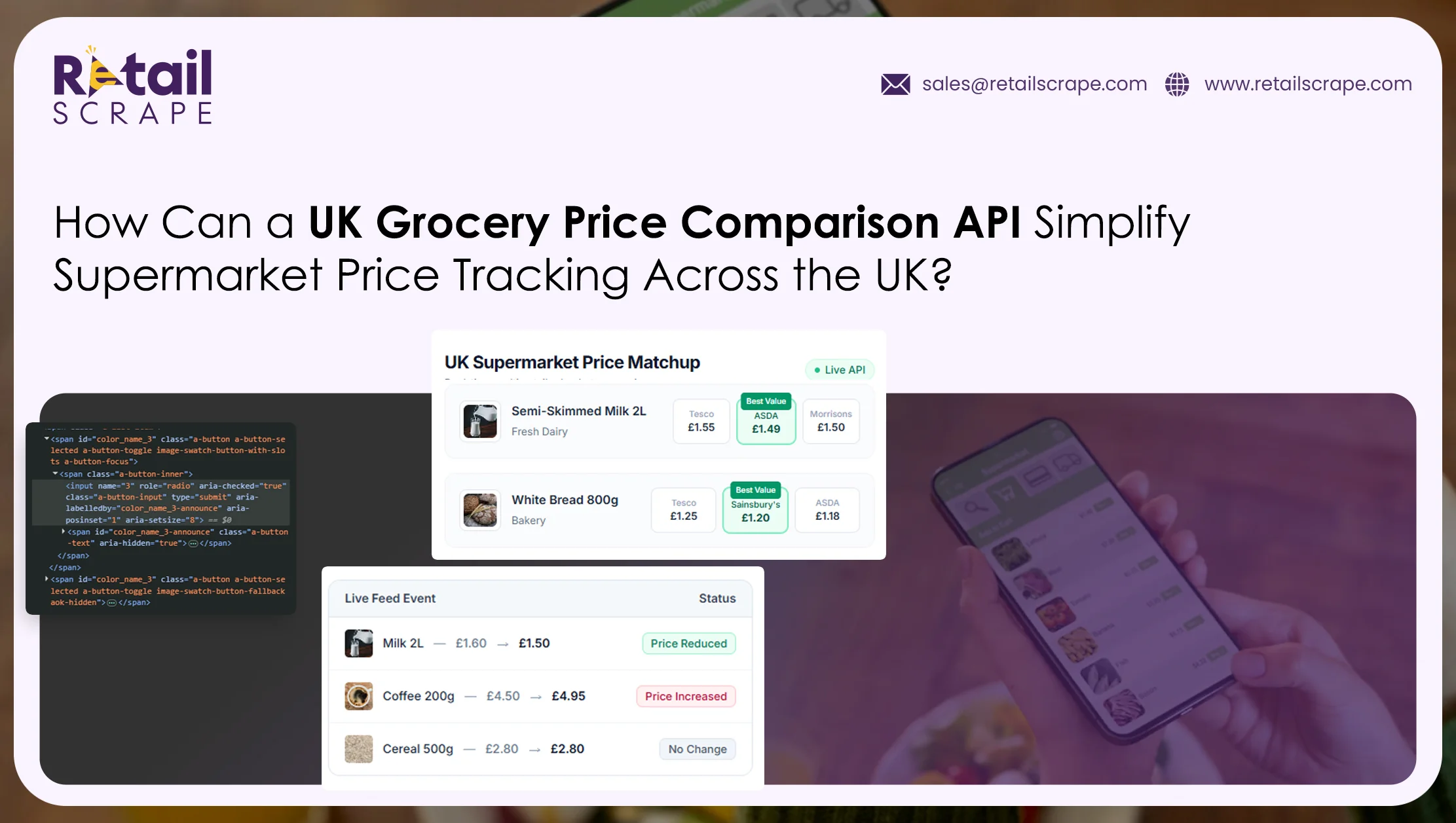
Grocery prices across the United Kingdom fluctuate because of promotions, seasonal demand, supplier costs, and changing retail strategies. Comparing identical products across supermarket websites manually can consume significant time and produce inconsistent results. Businesses and shoppers need structured information to evaluate price differences, identify affordable alternatives, and understand changing grocery market conditions more efficiently.
A UK Grocery Price Comparison API simplifies this process by collecting publicly available product information from supported supermarket sources and organizing it into structured, comparable records. Depending on source availability, these records can include product names, pack sizes, listed prices, promotional offers, categories, and stock indicators. Standardized data helps analysts compare equivalent products across retailers and locations.
For retailers, market researchers, and price comparison platforms, automated collection supports faster reporting and more consistent analysis. Instead of repeatedly checking multiple websites, teams can process updated information through integrated workflows. This approach helps identify pricing patterns, evaluate promotional activity, and support informed decisions while accounting for regional differences, data quality, and source-specific collection limitations.
Streamlining Grocery Price Collection Across Major Supermarkets
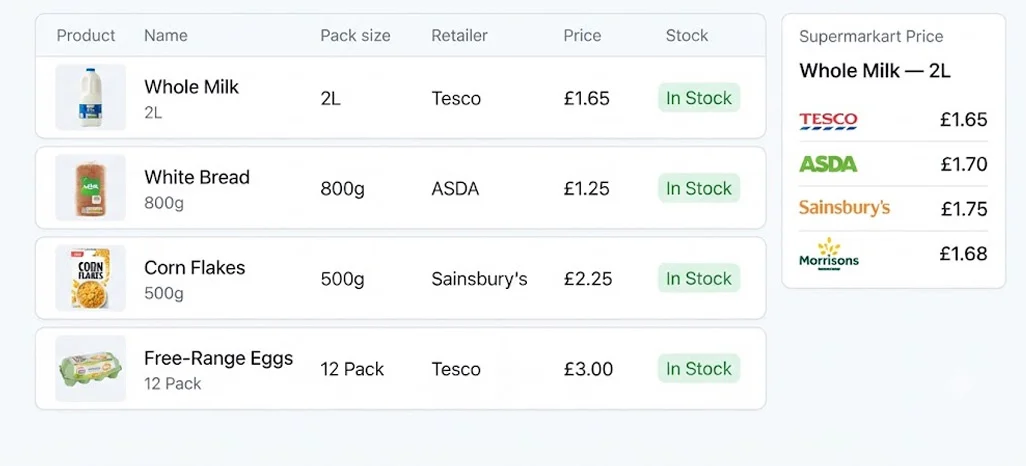
Collecting grocery prices from multiple supermarket websites can become complicated when retailers use different product descriptions, package sizes, category structures, and promotional labels. Manual research often requires employees to revisit the same pages, record individual prices, and check whether products are genuinely comparable. Automated collection provides a more organized approach by gathering available product information and arranging it into consistent records. This helps businesses reduce repetitive work, improve reporting consistency, and compare large product catalogs with greater efficiency.
A UK Grocery Price Tracking API can support recurring data collection by organizing product names, prices, pack sizes, categories, and availability indicators into structured outputs. When connected to suitable sources, a Supermarket Price API UK workflow can also help analysts retrieve comparable information for dashboards and internal reports. Collection frequency should reflect business requirements, source accessibility, and retailer restrictions rather than assuming every listing can be refreshed continuously.
Product matching remains an important part of this process because similar products may differ in weight, quantity, ingredients, or packaging. Teams can establish validation rules to identify duplicate listings, missing fields, and inconsistent measurements before comparing prices. These checks make the resulting information more useful for purchasing research and competitive analysis.
Businesses can prioritize the following collection activities:
- Standardize product names and categories.
- Record package sizes and measurement units.
- Validate collected prices before comparisons.
- Identify incomplete or duplicated listings.
| Collection component | Illustrative setup |
|---|---|
| Supermarket sources | 5 |
| Products monitored | 2,000 |
| Collection schedule | Daily |
| Data fields | Price, size, category, availability |
These figures represent a hypothetical configuration, not verified UK market statistics. Structured UK Supermarket Product Price Data can support repeatable comparisons when source coverage and data quality are maintained.
Identifying Promotional Changes Through Consistent Retail Monitoring
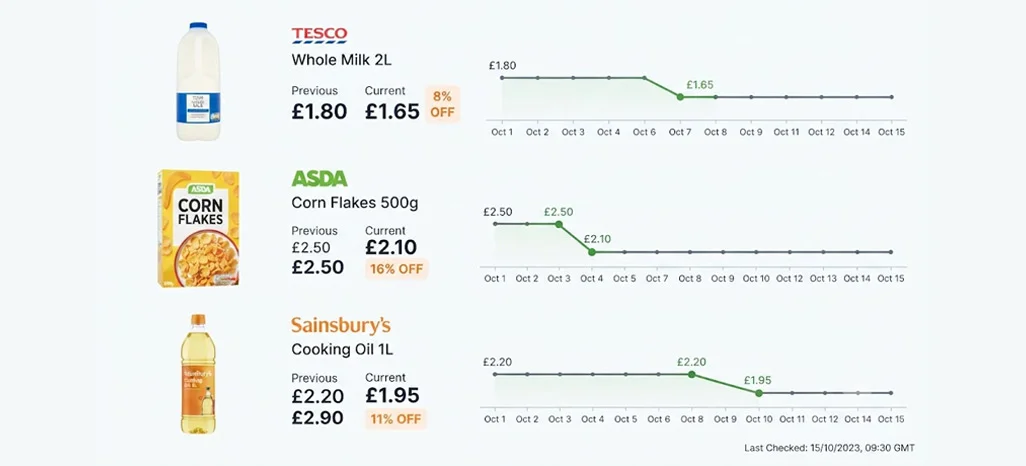
Supermarket prices can change in response to seasonal campaigns, supplier costs, demand fluctuations, and short-term promotional strategies. Tracking these movements across multiple retailers helps businesses understand whether a price adjustment is temporary or part of a longer-term trend. A consistent collection process also allows analysts to compare current listings with earlier records, making it easier to identify unusual movements and prepare timely internal reports. However, comparisons should account for regional availability, loyalty-card conditions, and differences in promotional eligibility.
A structured UK Grocery Price Monitoring workflow helps teams organize price histories and review changes across selected product categories. Integrating a UK Supermarket Pricing Data API into reporting systems can make this information accessible to analysts through scheduled exports, dashboards, or other supported data pipelines. Reliable monitoring depends on suitable source access, accurate timestamps, and clear rules for handling unavailable products and temporary website errors.
Businesses can improve their monitoring process by defining consistent comparison periods and checking whether the same products are being evaluated. Historical records can help teams distinguish genuine price changes from differences caused by package sizes, replacements, or discontinued listings. Reviewing these factors reduces the risk of drawing misleading conclusions from incomplete information.
Useful monitoring activities include:
- Flagging significant price increases or decreases.
- Reviewing promotional start and end dates.
- Comparing equivalent products across retailers.
- Checking missing records before publishing reports.
| Monitoring indicator | Illustrative value |
|---|---|
| Products reviewed | 1,500 |
| Promotional records | 300 |
| Review frequency | Daily |
| Historical review period | 30 days |
The figures are hypothetical examples rather than measured supermarket performance. Consistent records can help teams assess pricing changes without treating every advertised discount as universally available.
Converting Supermarket Price Records Into Actionable Insights
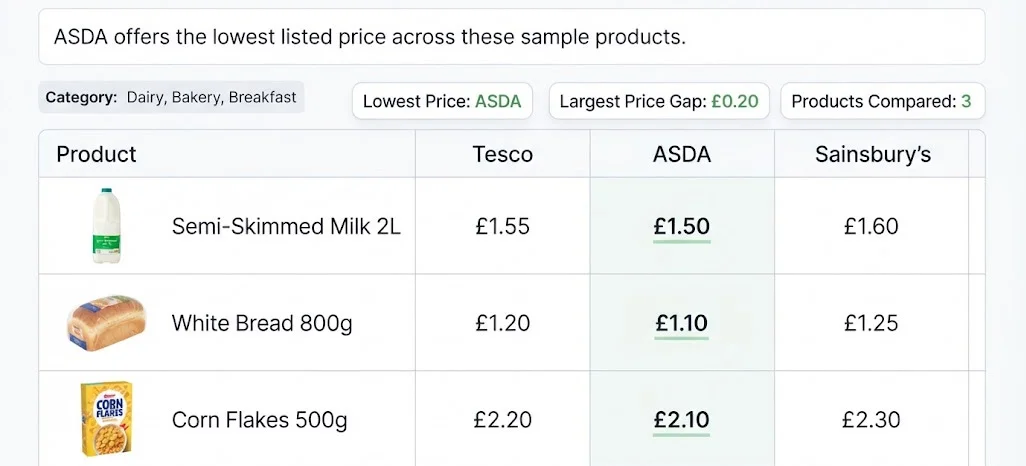
Collected pricing records become more valuable when businesses use them to understand category differences, promotional activity, and changing retail strategies. Rather than reviewing individual listings separately, analysts can group comparable products by category, brand, package size, and location. This approach helps teams identify pricing patterns, evaluate assortment differences, and determine which products require additional investigation.
UK Grocery Price Intelligence supports these analytical activities by helping businesses interpret collected records instead of simply storing product listings. For example, a UK Supermarket Pricing Data for Retailers workflow can organize comparable prices into reports that highlight differences between participating supermarkets. When evaluating Real-Time UK Grocery Price Comparison, businesses should confirm the actual collection frequency because continuously updated information is not guaranteed across every retailer or product.
Analysts should validate product equivalence before drawing conclusions. Different package weights, multi-buy offers, loyalty discounts, and location-based pricing can create apparent differences that do not reflect standard shelf prices. Recording these conditions alongside prices helps teams produce fairer comparisons and more reliable recommendations. Historical data can also help distinguish short-term promotions from longer-lasting price movements.
Businesses can apply the findings through several practical activities:
- Compare equivalent products across selected retailers.
- Identify categories with frequent price changes.
- Review promotional performance over time.
- Prepare reports for merchandising and purchasing teams.
| Insight category | Practical application |
|---|---|
| Price differences | Compare equivalent products |
| Historical trends | Review changing prices |
| Promotional activity | Evaluate advertised offers |
| Product availability | Identify missing listings |
These examples illustrate possible analytical uses, not verified performance outcomes. The quality of resulting insights depends on source coverage, product matching, validation rules, and reporting consistency.
How Retail Scrape Can Help You?
Reliable grocery analysis requires organized collection, consistent product matching, and dependable reporting processes. A UK Grocery Price Comparison API can form part of this workflow, enabling teams to organize available listings, compare product costs, and review pricing changes without relying entirely on manual checks. Collection schedules and delivery methods can be aligned with business requirements and source availability.
Key capabilities include:
- Automated collection of available grocery listings.
- Consistent product and category organization.
- Price comparisons across supported retailers.
- Identification of promotional offers and price changes.
- Historical records for trend analysis.
- Structured exports for dashboards and reporting.
These capabilities can reduce repetitive research and improve the consistency of internal reports. Businesses can use Grocery Pricing Data UK to support category planning, market research, and competitive analysis, subject to suitable source access and data quality controls.
We can help teams define practical collection requirements, evaluate suitable data fields, and select reporting schedules. A Supermarket API for Grocery Price Tracking can support repeatable monitoring when compatible sources and appropriate integrations are available. Contact the team to discuss your requirements and develop a collection workflow suited to your business objectives.
Conclusion
Comparing supermarket prices becomes easier when product information is collected systematically, validated consistently, and organized for analysis. A UK Grocery Price Comparison API can support product comparisons, promotional analysis, and historical reporting, while a UK Supermarket Pricing Data API can help integrate structured information into business applications. Accurate product matching and transparent reporting remain essential for meaningful results.
Retailers, researchers, and price comparison platforms can use these insights to understand market movements and improve pricing decisions. A Supermarket Price API UK workflow can support repeatable comparisons when suitable sources are accessible and reliable. Contact Retail Scrape to discuss your grocery price tracking and data collection requirements.