
How Does AI Retail Data Analytics Help Businesses Transform Retail Data Into Growth Strategies?
Introduction
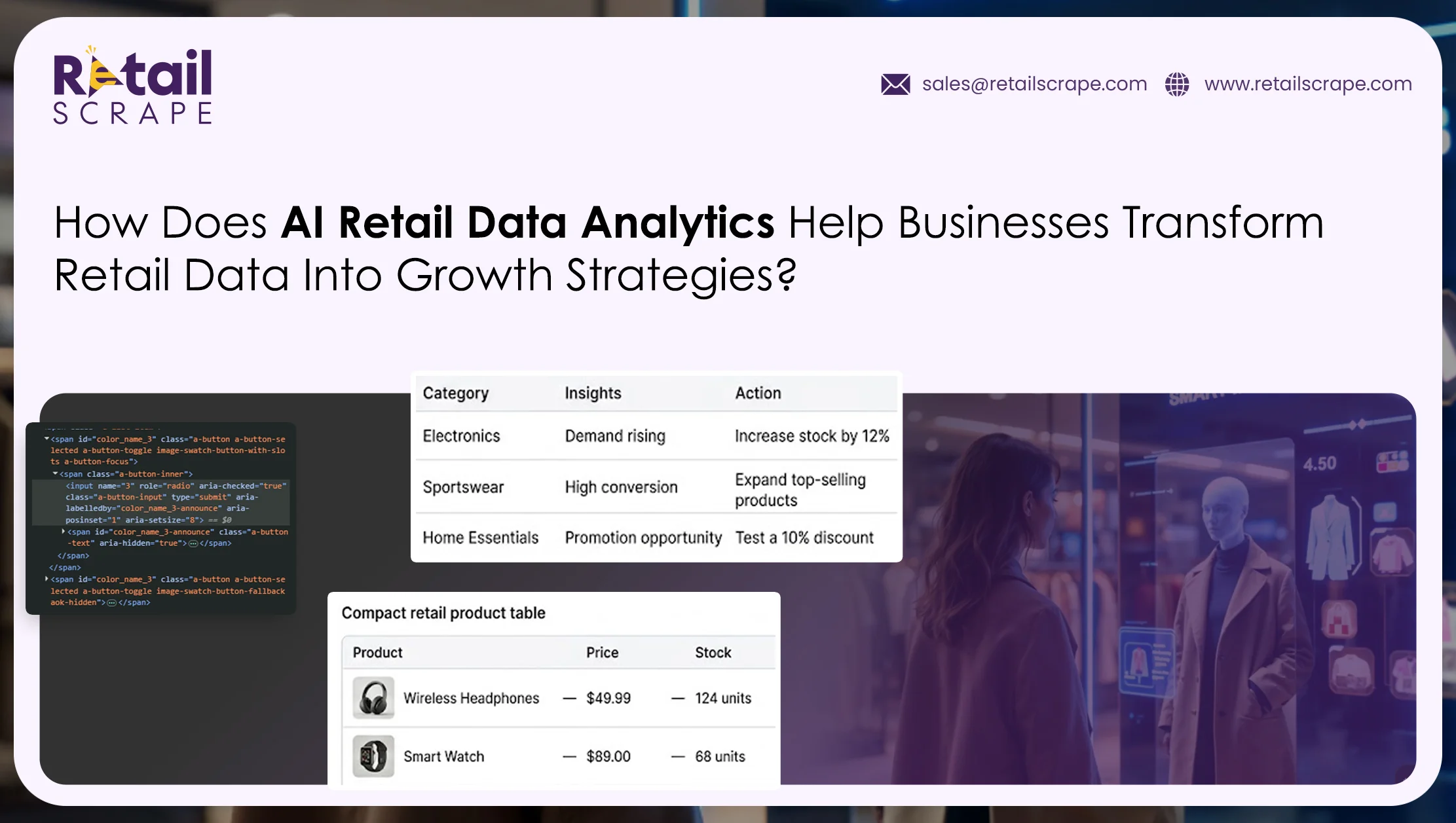
Retail businesses generate extensive information through product listings, customer purchases, competitor pricing, inventory records, and promotional campaigns. Analyzing these details helps retailers understand changing market conditions and identify opportunities for sustainable growth. AI Retail Data Analytics enables businesses to process large datasets, recognize emerging patterns, and translate complex information into practical decisions that support Price Optimization and improve operational efficiency.
Traditional analytical methods often struggle to process information from multiple sales channels and retail platforms efficiently. Artificial intelligence helps simplify this process by identifying purchasing trends, evaluating customer preferences, and highlighting changes in product demand. These capabilities allow retailers to respond to market developments with better planning and more informed commercial strategies.
Retailers can also improve forecasting, inventory allocation, and competitive positioning by combining historical records with frequently updated market information. When analytical findings align with business objectives, organizations can make informed decisions about product selection, promotional activities, and customer engagement. This data-driven approach supports stronger performance while helping businesses adapt to evolving retail expectations.
Improving Product Selection Through Intelligent Market Analysis
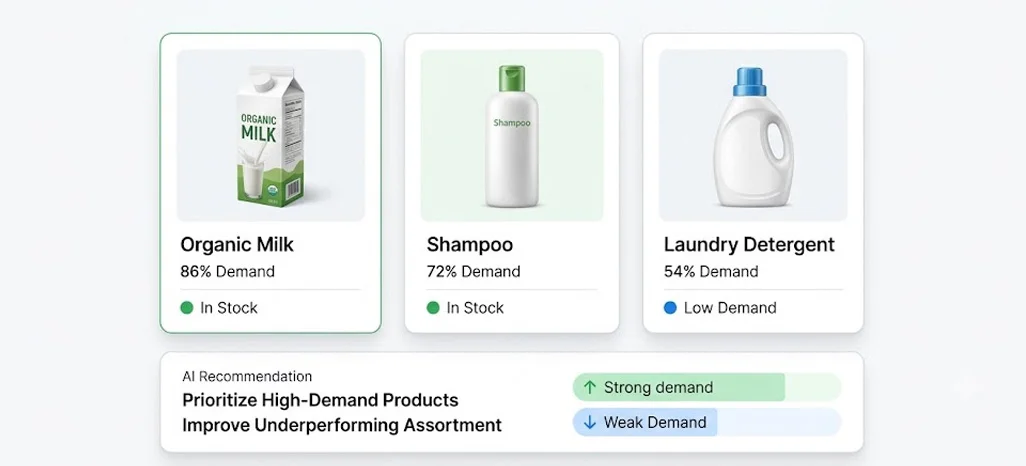
Retailers need accurate market information to understand which products attract customers and how assortment decisions affect sales performance. AI-Powered Assortment Optimization helps businesses evaluate product demand, category performance, regional preferences, and competitor offerings. By combining these insights, retailers can identify underperforming items, prioritize popular products, and adjust their catalogs according to customer expectations. This approach supports more informed assortment planning and improves the alignment between available products and market demand.
Artificial intelligence can evaluate product performance across different locations, categories, and sales channels. AI-Powered Retail Analytics helps organizations identify recurring purchasing patterns and assess how seasonal changes influence product popularity. Retailers can use these findings to recognize gaps in their offerings, compare category performance, and allocate resources more effectively. Consistent monitoring also helps businesses understand which products deserve additional investment and which require adjustments.
Market analysis becomes more valuable when retailers combine competitor observations with internal sales records. AI-Powered Retail Data Analytics for Businesses can support the evaluation of changing customer preferences, product availability, and regional demand patterns. These comparisons help retailers develop appropriate product assortments and improve planning accuracy. Businesses can also assess emerging categories and identify opportunities to expand their offerings based on measurable market signals.
Retailers can strengthen their assortment strategies by monitoring relevant performance indicators regularly. Important considerations include:
- Reviewing product sales across different categories and locations.
- Identifying seasonal purchasing patterns and emerging product preferences.
- Comparing competitor assortments to recognize potential market gaps.
- Evaluating slow-moving products before adjusting inventory commitments.
- Updating product selections according to customer demand.
| Analytical Metric | Illustrative Value | Business Application |
|---|---|---|
| Product category coverage | 70 categories | Evaluate assortment breadth |
| Product demand analysis | 12 months | Identify seasonal patterns |
| Market coverage | 20 markets | Compare regional preferences |
| Product performance review | Weekly | Adjust assortment decisions |
These figures are illustrative planning examples rather than verified industry benchmarks. Actual results depend on product categories, market conditions, data quality, and implementation practices.
Strengthening Inventory Planning Through Predictive Demand Intelligence
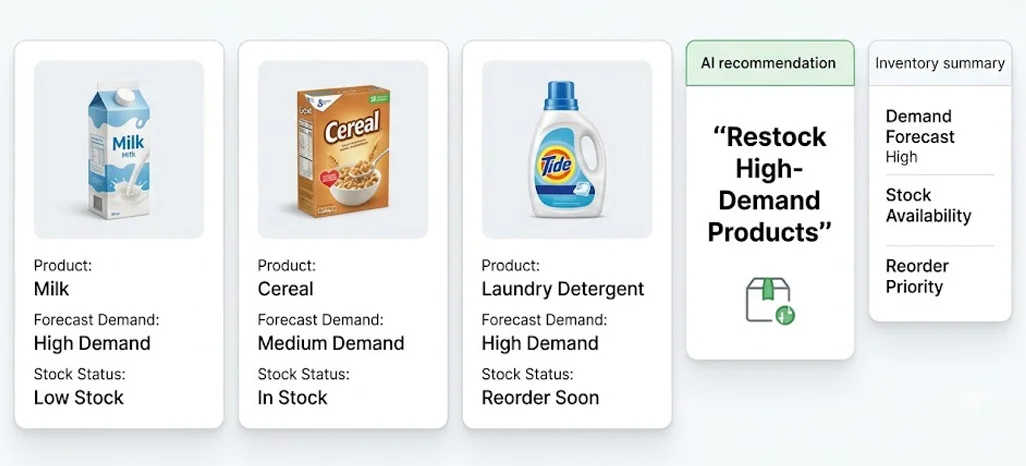
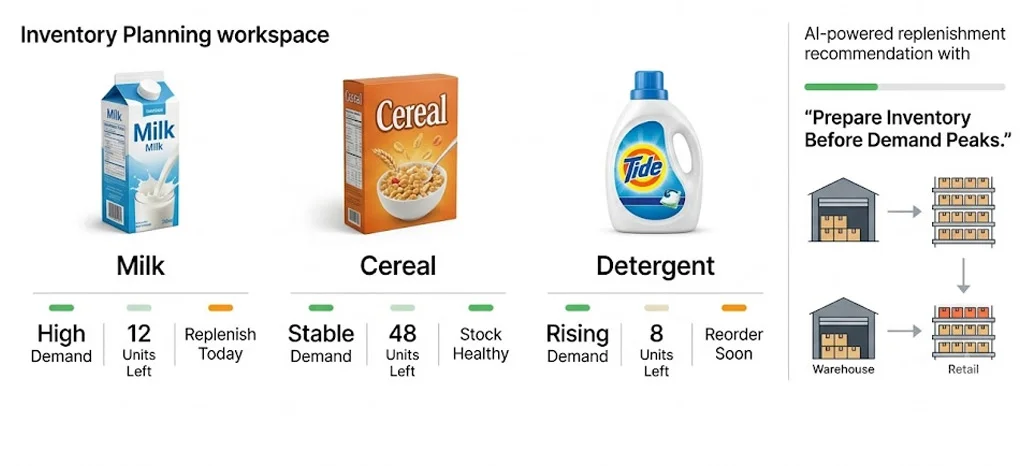
Inventory planning requires retailers to understand how customer demand changes over time. AI Demand Forecasting & Availability helps businesses estimate future product requirements by analyzing historical sales, seasonal fluctuations, promotional activity, and purchasing patterns. These forecasts support better replenishment decisions and help organizations reduce the likelihood of shortages or excess stock.
Retailers frequently collect inventory information from multiple stores, online marketplaces, and distribution channels. Retail Data Automation simplifies repetitive collection and processing tasks, allowing teams to focus on interpreting information instead of manually preparing reports. Automated workflows can organize stock records, identify missing information, and highlight changes that require attention.
Reliable inventory decisions require businesses to evaluate several indicators together rather than relying on individual sales figures. AI for Retail Decision Making supports the interpretation of demand patterns, product availability, and replenishment requirements. Retailers can use these findings to prioritize popular products, adjust safety stock levels, and allocate inventory across locations. Combining internal information with market observations also helps businesses recognize changing customer preferences before they significantly affect product availability.
Businesses can improve inventory performance by introducing consistent monitoring and review practices. Important activities include:
- Reviewing stock availability across stores and online channels.
- Identifying products with rising demand or declining sales.
- Adjusting replenishment schedules according to forecasted requirements.
- Monitoring slow-moving inventory to reduce unnecessary holding costs.
- Evaluating forecasting accuracy and refining planning assumptions regularly.
| Inventory Metric | Illustrative Value | Potential Benefit |
|---|---|---|
| Forecast review frequency | Daily | Respond to demand changes |
| Stock availability monitoring | Real-time | Identify potential shortages |
| Inventory planning horizon | 30 days | Schedule replenishment |
| Excess inventory target | 15% reduction | Improve stock efficiency |
The values above are illustrative targets, not guaranteed outcomes. Results depend on forecasting accuracy, supplier reliability, inventory policies, and operational execution.
Converting Competitive Market Information Into Strategic Business Decisions
Retailers operate in competitive markets where prices, promotions, product availability, and customer expectations frequently change. AI-Powered Insights for Retail Decision-Making helps organizations evaluate these developments and identify opportunities for differentiation. By comparing competitor offerings with internal sales performance, businesses can assess pricing gaps, monitor promotional activity, and recognize underserved product categories.
Collecting information from multiple retail platforms can create challenges when datasets use inconsistent formats or update at different intervals. A structured Retail Data API can deliver organized information from supported sources into analytics platforms, dashboards, and reporting systems. Businesses can establish consistent monitoring processes and reduce the time required to prepare information for competitive evaluations and performance reviews.
Retail intelligence becomes more useful when businesses connect collected information with measurable objectives. Retail Data Analytics Using AI can help teams evaluate pricing movements, promotional effectiveness, category changes, and competitor positioning. Organizations can also compare performance across regions and sales channels to understand how market conditions influence business outcomes.
Retailers can strengthen strategic planning by establishing a consistent framework for competitive monitoring. Recommended activities include:
- Tracking competitor prices and promotional changes at regular intervals.
- Comparing equivalent products across different retail platforms.
- Reviewing category performance to identify market opportunities.
- Evaluating campaign results against defined business objectives.
- Updating commercial strategies according to verified market observations.
| Competitive Metric | Illustrative Value | Strategic Application |
|---|---|---|
| Competitor coverage | 15 retailers | Compare market positioning |
| Price review frequency | Daily | Monitor pricing changes |
| Promotional analysis | Weekly | Evaluate campaign activity |
| Performance reporting | Monthly | Review strategic progress |
These figures illustrate a possible monitoring framework rather than verified market statistics. Businesses should customize their metrics, reporting frequency, and comparison criteria to match their operational requirements.
How Retail Scrape Can Help You?
We help businesses organize retail market information for practical analysis and commercial planning. By integrating AI Retail Data Analytics into retail intelligence workflows, organizations can examine competitor prices, product availability, promotional changes, and category performance using structured datasets.
This information supports consistent market monitoring and helps teams make decisions based on current observations rather than fragmented records. Retailers can also use Product Matching to compare equivalent products across different platforms, improving the consistency of competitor evaluations and pricing analysis.
We can support your business through the following capabilities:
- Competitor Price Monitoring: Track product prices and identify market-level pricing changes.
- Product Availability Tracking: Monitor stock status and recognize potential assortment gaps.
- Promotional Intelligence: Examine discounts, special offers, and changing campaign patterns.
- Market Trend Analysis: Identify category developments and shifting consumer preferences.
- Structured Data Delivery: Receive organized datasets suitable for reporting and analytical workflows.
- Customized Data Collection: Align extraction requirements with specific platforms, products, and business objectives.
With AI Retail Business Intelligence, businesses can interpret collected information more effectively and connect market observations with practical commercial priorities.
Conclusion
Retail growth depends on understanding customer preferences, monitoring competitors, and making informed operational decisions. AI Retail Data Analytics helps businesses transform scattered retail information into meaningful insights that support forecasting, assortment planning, inventory control, and competitive positioning.
By establishing reliable data collection processes and relevant performance metrics, retailers can improve decision-making and adapt their strategies to changing market conditions. Turn Retail Data Into Actionable Insights by connecting analytical findings with measurable business objectives and practical retail priorities. Contact Retail Scrape today to discuss your retail data requirements and build a smarter, data-driven growth strategy.