Why Is Shopify vs WooCommerce Product Data Important for Choosing an Easier Scraping Method?
Introduction
Choosing between Shopify and WooCommerce for product data extraction often depends on how clearly store structures expose product details, variants, prices, availability, and categories. Shopify vs WooCommerce Product Data provides a useful basis for evaluating which platform offers simpler collection workflows and more consistent information for research.
Shopify stores generally follow structured commerce patterns, while WooCommerce stores can vary more because hosting, themes, plugins, and configurations influence page layouts. This difference makes Shopify Product Data Extraction useful for standardized research, while WooCommerce may require flexible handling across different websites, templates, and technical setups.
A practical comparison should consider accessibility, page structure, product volume, update frequency, and the effort required to maintain scrapers. Businesses can use these factors to assess extraction efficiency before selecting an approach. The right method can reduce repetitive work and improve the quality of product datasets used for pricing, catalog, and market analysis across changing markets.
Understanding Store Structures That Influence Easier Data Extraction Methods
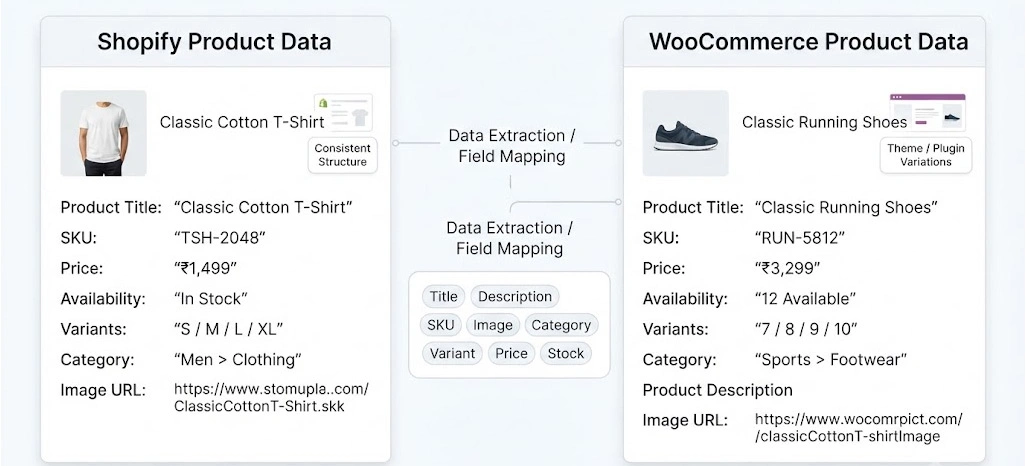
Store architecture plays an important role in determining how efficiently product information can be collected. WooCommerce can offer similar information but may use different themes, plugins, and custom templates. As a result, businesses should assess page consistency before deciding which extraction approach is suitable for their requirements. Shopify vs WooCommerce Data Extraction can help teams evaluate differences in accessibility, field organization, and maintenance requirements while planning a scalable collection process.
Product fields should also be mapped before extraction begins because different stores may present information in different locations. Titles, descriptions, SKUs, images, categories, variants, availability, and pricing are typically important fields for ecommerce analysis. With WooCommerce Product Data Extraction, teams can account for customized storefront structures while defining rules for capturing required information. A clear field-level framework can reduce missing values and make datasets easier to validate when collection expands across multiple websites.
Key areas to evaluate include:
- Product and variant structure
- Category and attribute organization
- SKU and identifier availability
- Image and description consistency
- Stock and availability presentation
- Theme-related structural variations
Businesses can also examine how storefront changes affect extraction maintenance over time. A standardized environment may require fewer adjustments, while highly customized websites can need additional validation and adaptive selectors. Evaluating structure before scaling helps teams estimate development effort, monitoring requirements, and expected data quality more accurately.
| Evaluation Area | Shopify | WooCommerce |
|---|---|---|
| Product structure | Generally standardized | More customizable |
| Theme influence | Moderate | Potentially higher |
| Variant presentation | Usually structured | Configuration dependent |
| Maintenance requirement | Often predictable | Can vary considerably |
Understanding these structural differences creates a stronger foundation for choosing an extraction workflow. Rather than focusing only on platform popularity, businesses can compare accessibility, consistency, field coverage, and maintenance requirements. This approach supports better planning and helps teams determine whether a collection process can remain reliable as product catalogs expand and storefront configurations change.
Comparing Pricing Structures And Recurring Product Collection Requirements
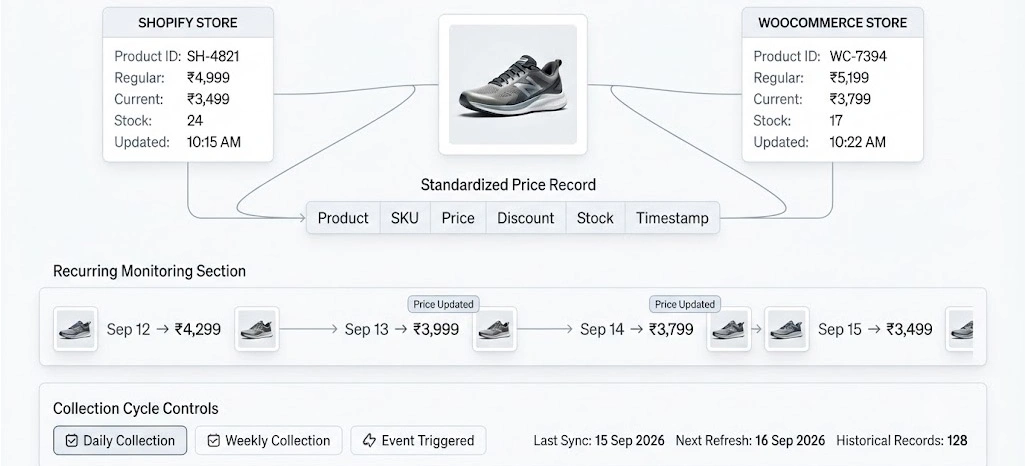
Pricing information is another important consideration when selecting an extraction method because ecommerce stores can display multiple values for the same product. A structured pricing workflow can help businesses compare product values consistently while reducing manual verification. Shopify and WooCommerce Price Data Scraping can support this process by organizing pricing information into standardized fields suitable for analysis and recurring monitoring.
Frequent price changes also make refresh schedules important. A dataset collected once may become outdated quickly when retailers introduce promotions, seasonal discounts, or inventory-based adjustments. Businesses can define daily, weekly, or event-driven collection cycles depending on their objectives. A consistent schema allows each new dataset to be compared against earlier records, making it easier to identify changes and maintain historical pricing information for research.
Important pricing considerations include:
- Regular and discounted prices
- Currency and regional variations
- Variant-level price differences
- Promotional pricing periods
- Historical price changes
- Data refresh frequency
Another consideration is how pricing information is connected with broader product attributes. Analysts may need to evaluate price alongside product names, categories, brands, ratings, availability, and specifications. This makes Shopify vs WooCommerce Data Scraping useful for evaluating whether a collection workflow can consistently capture interconnected fields rather than pricing alone. Proper normalization also helps prevent inconsistencies when similar products use different formatting or currency representations across stores.
| Pricing Consideration | Primary Purpose | Review Priority |
|---|---|---|
| Regular price | Baseline comparison | High |
| Sale price | Promotion analysis | High |
| Currency | Regional normalization | Medium |
| Variant pricing | Product-level comparison | High |
A recurring collection process should also include validation rules to identify missing, duplicated, or unexpectedly changed values. When a store modifies its theme or introduces a new promotional structure, these checks can highlight issues before inaccurate information enters the final dataset. Combining structured collection with regular validation therefore makes pricing research more dependable and supports long-term monitoring across changing ecommerce environments.
Evaluating Storefront Stability For Reliable Scraping Across Platforms
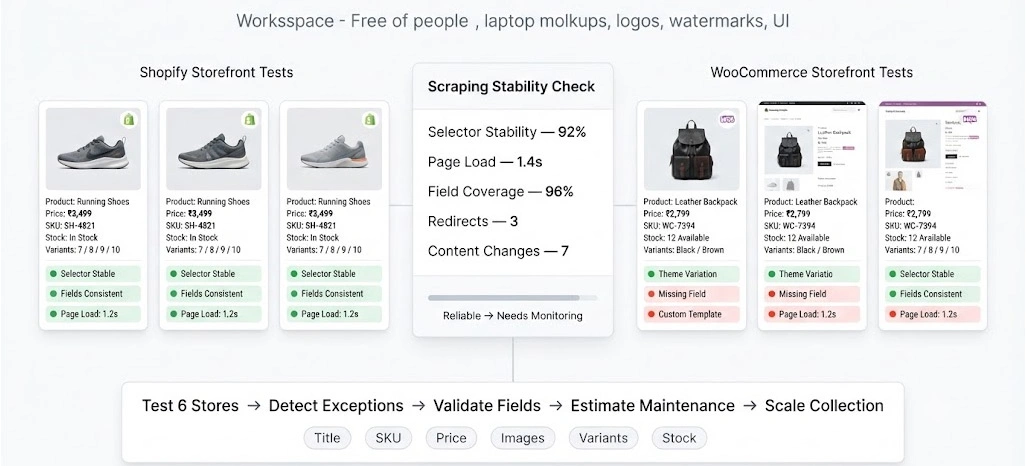
Storefront stability strongly influences the effort required to maintain an extraction workflow. Even when two platforms provide similar product information, their implementation can differ considerably from one store to another. Shopify storefronts often follow recognizable structures, while WooCommerce websites can be heavily influenced by themes, plugins, and custom development. This means teams should test several representative websites before estimating the long-term maintenance effort of their chosen method.
A useful evaluation should consider selector stability, page loading behavior, product variation, missing fields, redirects, and content changes. A Shopify Product Scraper can be designed around commonly repeated storefront patterns, helping teams organize collection rules for product catalogs. However, every workflow still benefits from monitoring because individual merchants can customize their storefronts. Testing different pages before scaling can reveal technical exceptions that may otherwise affect dataset consistency.
Teams should review factors such as:
- Selector and page structure stability
- Product page loading behavior
- Variant and option handling
- Missing or dynamically loaded fields
- Redirect and error conditions
- Changes caused by customization
Comparing multiple storefronts can provide a more realistic picture of scraping difficulty than evaluating a single website. Shopify WooCommerce Scraping Comparison can help businesses examine these differences across structure, customization, field accessibility, and expected maintenance. The comparison should focus on actual collection requirements rather than assuming that one platform will always be simpler for every type of dataset or business use case.
| Stability Factor | Shopify | WooCommerce |
|---|---|---|
| Structural consistency | Generally stronger | More variable |
| Customization impact | Moderate | Often significant |
| Validation requirements | Moderate | Potentially higher |
| Scaling approach | Pattern-based | More adaptive |
A reliable workflow should therefore combine extraction with monitoring and validation. Teams can establish sample checks, track changes in page structures, and review error rates after each collection cycle. This provides useful evidence when determining Shopify vs WooCommerce Which Is Easier to Scrape for a specific project. The result is a more practical assessment based on actual storefront behavior, required fields, and expected maintenance rather than assumptions about either platform.
How Retail Scrape Can Help You?
A well-planned workflow can make platform comparison more practical by defining fields, refresh cycles, validation rules, and output format before collection begins. When teams evaluate Shopify vs WooCommerce Product Data, we can help organize the process around business requirements rather than platform assumptions. The approach can support structured collection, quality checks, and repeatable delivery for catalogs.
Key support areas include:
- Defining product fields and extraction priorities
- Mapping categories, variants, and availability
- Scheduling recurring collection workflows
- Validating captured values and missing fields
- Organizing outputs for analysis and reporting
- Monitoring changes across store structures
For customized storefronts, we can configure flexible collection workflows that accommodate differences in themes, page structures, and product configurations. A WooCommerce Scraper can be incorporated where adaptable collection logic is required, while structured processing can keep outputs consistent across different websites.
The collected information can then be organized into practical datasets for pricing comparisons, catalog research, assortment evaluation, inventory monitoring, and competitive analysis. We can also support recurring workflows when businesses need updated information instead of one-time datasets.
Conclusion
Selecting an easier scraping method depends on store structure, field consistency, pricing patterns, catalog size, and maintenance requirements rather than platform preference alone. A focused evaluation of Shopify vs WooCommerce Product Data can help businesses identify suitable collection rules, validation steps, and refresh schedules. This supports cleaner datasets and more dependable product research while making future updates easier to manage across multiple storefronts.
The right workflow should remain adaptable as stores change themes, add plugins, introduce variants, or update product information. Shopify Store Data Extraction can fit within a broader process that standardizes fields and reduces repetitive manual collection. Contact Retail Scrape today to discuss your product data collection requirements and build a practical scraping solution.