How Is Building a Price Benchmarking Model Across Multiple Retailers Transforming Retail Price Accuracy?
Introduction
Retailers today face constant price shifts across marketplaces, direct stores, and regional sellers. A structured pricing strategy has become essential to maintain consistency, profitability, and customer trust. Building a Price Benchmarking Model Across Multiple Retailers helps businesses compare product rates across channels and adjust decisions using verified market data. It creates a measurable pricing framework where brands can evaluate competitor actions and reduce pricing gaps.
Market reports show that over 68% of online shoppers compare prices across at least three platforms before making a purchase. This behavior has pushed businesses to rely on structured pricing analytics rather than manual checks. By implementing Building a Retail Pricing Intelligence System, organizations can collect historical pricing patterns and identify hidden pricing trends.
This enables teams to act quickly when market conditions change. Retail brands also depend on data-driven comparison to understand discount cycles, stock-based price shifts, and regional pricing changes. Companies that apply Competitor Analysis in pricing strategy often report stronger margin control and better conversion outcomes, especially in highly competitive ecommerce categories.
Creating Reliable Retail Price Gap Identification Systems
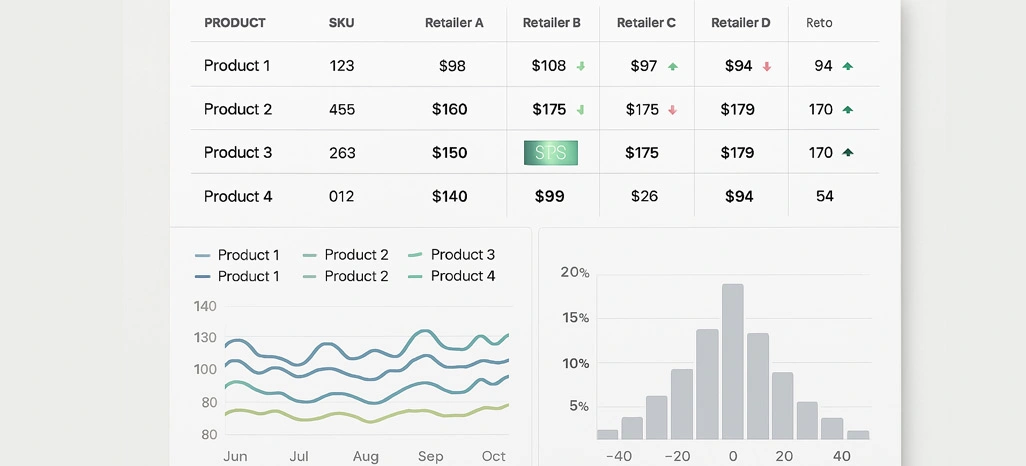
Retail businesses often face pricing inconsistencies because multiple sellers update listings independently. This creates confusion for internal teams and impacts customer confidence. A well-structured comparison strategy helps brands measure pricing gaps across channels and improve decision-making. Retail Competitor Price Analysis Using Data Scraping supports this process by collecting pricing details from ecommerce platforms and organizing them into comparable datasets.
Market research shows that 34% of retailers lose potential sales because of delayed price correction. Without a standardized model, price updates become reactive instead of planned. Businesses often rely on Dynamic Pricing vs Price Benchmarking in Retail to compare instant promotional changes with long-term pricing trends. This makes it easier to understand whether temporary discounts or consistent benchmark values should guide decisions.
To build an effective benchmark structure, teams must define comparable products, normalize SKU data, and track historical pricing. How to Build a Price Benchmarking Model requires structured workflows where product mapping, category alignment, and competitor monitoring work together. This improves data reliability and creates a reference point for pricing decisions.
| Pricing Issue | Impact on Retailers | Suggested Action |
|---|---|---|
| Inconsistent updates | Customer confusion | Standardized tracking |
| Product mismatch | Comparison errors | SKU matching |
| Regional pricing | Margin loss | Location grouping |
| Promotion overlap | Sales decline | Discount review |
When pricing systems use structured analytics, retailers gain stronger visibility into market changes. These insights reduce pricing mistakes and improve competitive planning. Accurate benchmark models also help businesses understand pricing gaps before they impact customer buying behavior.
Strengthening Competitive Visibility Through Live Pricing Insights
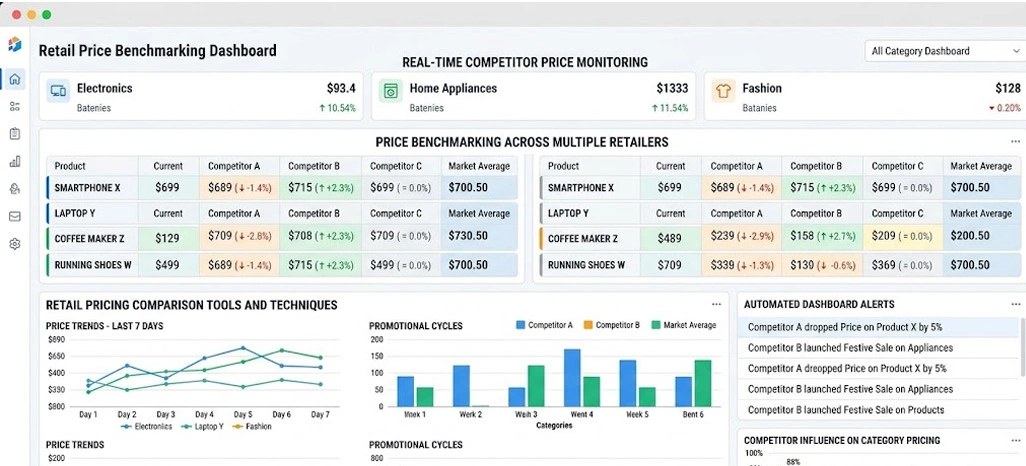
Price changes occur rapidly in modern retail, especially during campaigns and festive sales. Businesses need continuous visibility into competitor pricing to maintain relevance. Price Benchmarking Across Multiple Retailers creates a clear comparison framework where product rates are measured across different platforms.
Industry reports indicate that nearly 72% of retailers update product prices weekly during seasonal promotions. Because of this, businesses increasingly depend on Real-Time Price Monitoring Across Competitors to track market changes immediately. Automated dashboards provide instant alerts when competitors revise prices or launch discounts.
Using Retail Pricing Comparison Tools and Techniques, businesses can compare category trends, seller variations, and promotional cycles. These tools transform large pricing datasets into structured insights that guide operational planning. Teams can also identify which competitors influence category pricing most significantly.
| Monitoring Area | Tracking Frequency | Business Benefit |
|---|---|---|
| Product rates | Hourly | Quick response |
| Promotions | Daily | Campaign visibility |
| Stock changes | Real-time | Demand planning |
| Seller movement | Weekly | Trend analysis |
Many organizations also rely on Competitor Price Tracking for Retail Businesses to improve retail pricing transparency. These systems reduce manual monitoring and support faster responses to market changes. Live data helps teams understand how price adjustments influence sales performance and customer engagement across platforms..
Turning Market Data Into Strategic Pricing Actions
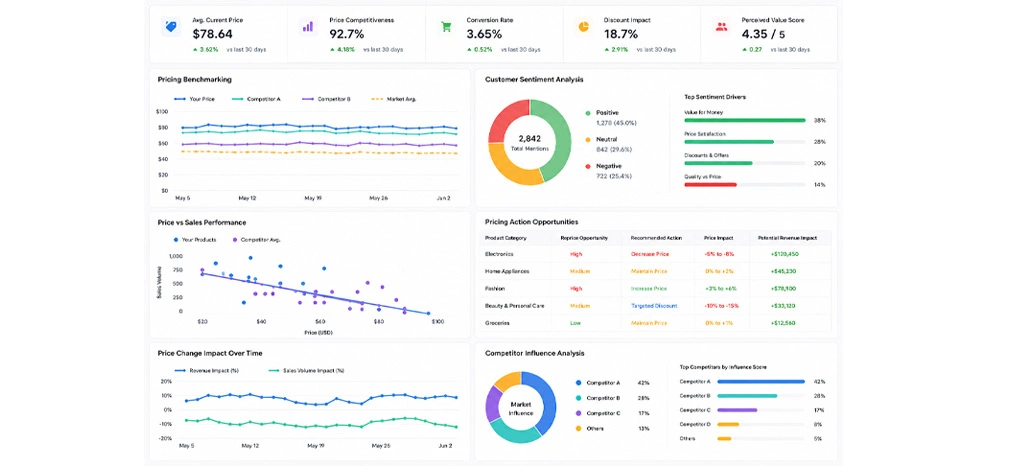
Pricing data becomes valuable only when it supports better business decisions. Retailers often collect large datasets but fail to convert them into strategic actions. Combining pricing intelligence with customer insights creates a stronger decision-making framework. Customer Sentiment Analysis helps businesses understand how pricing influences customer perception and purchasing behavior.
Studies show that 61% of customers prioritize perceived value over the lowest available price. This means businesses need context beyond raw pricing numbers. How to Optimize Pricing Using Benchmarking Data helps brands align competitor pricing with buyer expectations and product value.
Retail teams compare competitor rates with internal sales trends to identify opportunities. Customer feedback and historical pricing patterns provide additional context. Together, these datasets reveal when products should be repriced, discounted, or repositioned. Competitor Analysis supports this process by identifying which sellers influence customer decisions the most.
| Data Source | Key Use | Result |
|---|---|---|
| Competitor prices | Market alignment | Price changes |
| Reviews | Buyer feedback | Value positioning |
| Historical records | Trend tracking | Forecasting |
| Demand metrics | Sales planning | Promotion timing |
Retailers using integrated pricing systems make faster and more accurate decisions. Combining customer perception with benchmark analytics helps improve product positioning. It also supports stronger planning, especially in competitive ecommerce markets where pricing changes directly affect purchase behavior.
How Retail Scrape Can Help You?
Retail brands often struggle with collecting accurate pricing information across dozens of sellers and marketplaces. By integrating Building a Price Benchmarking Model Across Multiple Retailers, businesses can automate pricing collection and build reliable comparison systems for smarter decisions.
We support businesses through advanced Web Scraping Services that gather structured product pricing, promotional data, and competitor listings from major retail platforms.
- Collect product prices from multiple marketplaces
- Track promotional changes automatically
- Standardize data across seller listings
- Compare pricing by region and platform
- Monitor inventory-linked price changes
- Generate analytics-ready datasets
These solutions help teams reduce manual effort and maintain updated market insights. Businesses looking for How to Optimize Pricing Using Benchmarking Data can use these services to build consistent pricing workflows and improve operational accuracy.
With customized dashboards and automated collection, businesses improve visibility into market changes. Retail teams also benefit from Competitor Price Monitoring Services for Retail Brands to strengthen strategic decision-making.
Conclusion
Retail success increasingly depends on accurate pricing decisions. When businesses apply Building a Price Benchmarking Model Across Multiple Retailers, they create a structured way to compare market trends, improve visibility, and support consistent retail performance.
Better market intelligence comes from combining pricing benchmarks with Competitor Analysis. Start building a stronger pricing strategy today and connect with Retail Scrape to improve your retail growth with accurate benchmark solutions.