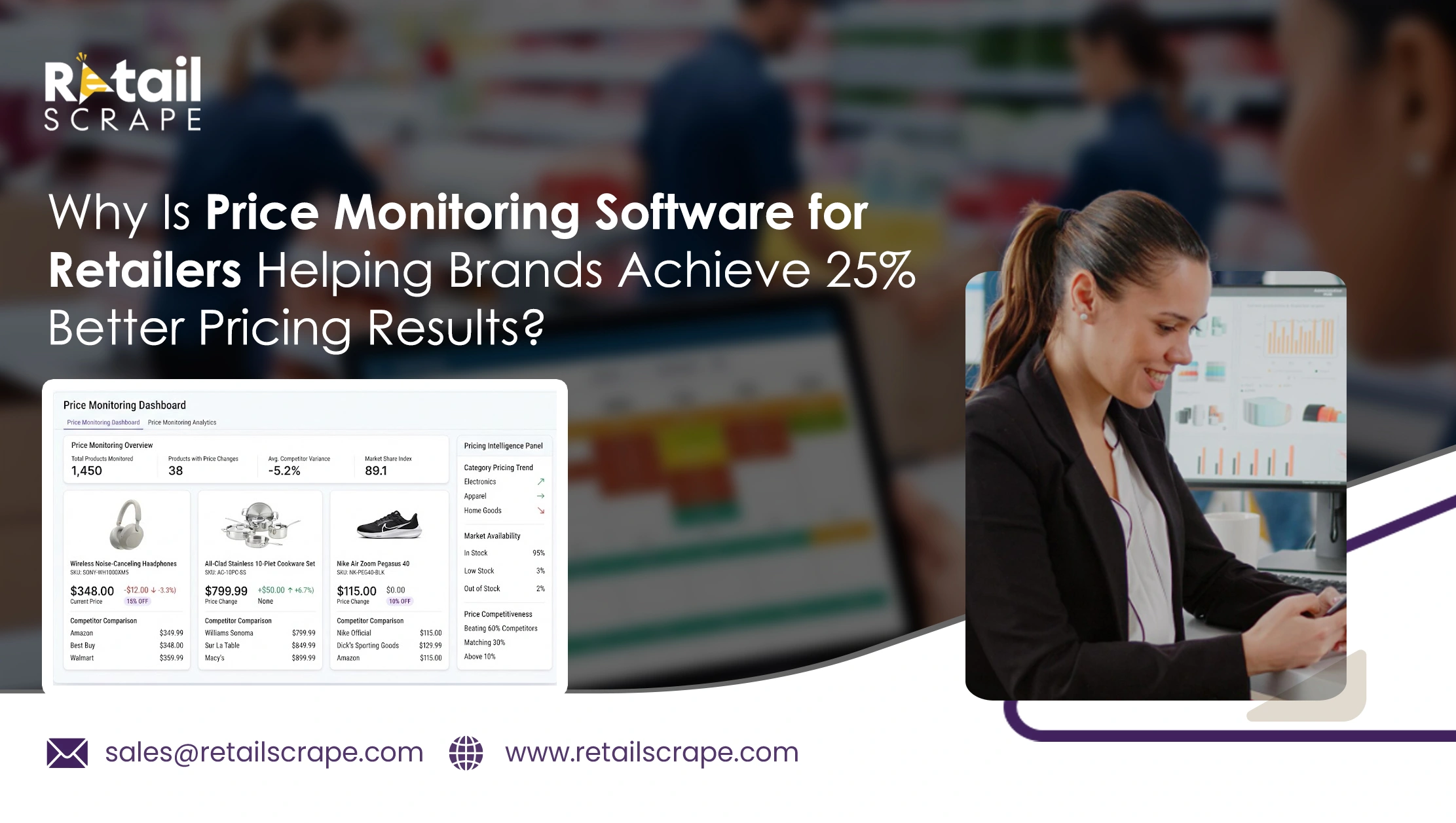
Why Is Price Monitoring Software for Retailers Helping Brands Achieve 25% Better Pricing Results?
Introduction
Retail pricing has become one of the most influential factors affecting customer purchasing decisions and long-term profitability. According to industry studies, nearly 78% of online shoppers compare prices before buying, while retailers using automated pricing intelligence report up to 25% stronger pricing performance than businesses relying on manual monitoring.
These numbers highlight why businesses are investing in Price Monitoring Software for Retailers to remain competitive in rapidly changing markets. Modern retailers face constant price fluctuations caused by promotions, seasonal demand, inventory levels, competitor campaigns, and marketplace algorithms. Monitoring these changes manually is no longer practical, especially when thousands of SKUs require continuous tracking.
Organizations of every size are also adopting solutions like Best Price Monitoring Software for Retail Businesses to centralize competitor tracking, improve decision-making, and reduce pricing errors. This approach not only protects margins but also strengthens customer satisfaction, inventory planning, and overall business performance in increasingly competitive retail environments.
Creating Reliable Competitive Visibility Across Expanding Retail Market Landscapes
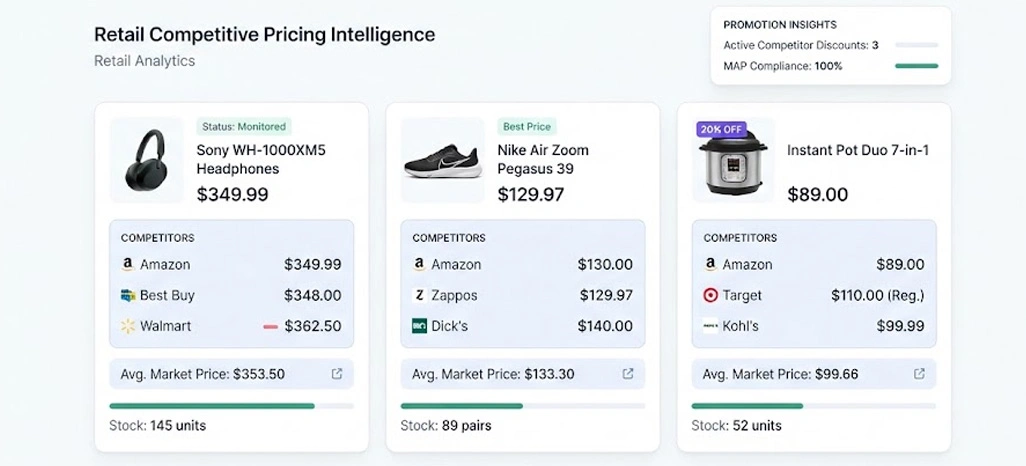
Retail businesses operate in an environment where pricing changes happen every hour across marketplaces, brand websites, and online stores. A single competitor promotion can influence customer purchasing decisions within minutes, making continuous market observation a business necessity instead of an optional activity. These findings demonstrate why structured pricing intelligence has become a core component of modern retail operations rather than a periodic business exercise.
Businesses collecting competitor pricing manually often struggle with delayed updates, inconsistent records, and missed promotional opportunities. Many organizations therefore implement Retail Price Monitoring Using Web Scraping APIs to automate competitor tracking, collect structured pricing information, and reduce the operational burden associated with manual monitoring.
Modern pricing strategies also benefit from Best Price Monitoring Software for Retail Businesses, allowing organizations to monitor competitor activities across ecommerce stores, marketplaces, and regional retail channels through centralized dashboards. Better visibility into competitor behavior also minimizes pricing inconsistencies that may otherwise affect customer confidence and overall revenue performance.
| Challenge | Business Impact | Practical Solution |
|---|---|---|
| Frequent competitor price changes | Missed pricing opportunities | Automated monitoring |
| Manual price collection | Slow decision-making | Scheduled data extraction |
| Marketplace competition | Reduced profit margins | Competitive intelligence |
| Inconsistent pricing records | Customer dissatisfaction | Centralized pricing database |
Reliable pricing intelligence strengthens long-term competitiveness by helping retailers respond proactively instead of reactively. Organizations capable of identifying pricing trends early can optimize promotional planning, maintain healthier profit margins, and improve customer retention while reducing unnecessary discounting.
Accelerating Confident Decisions Through Continuous Market Performance Insights
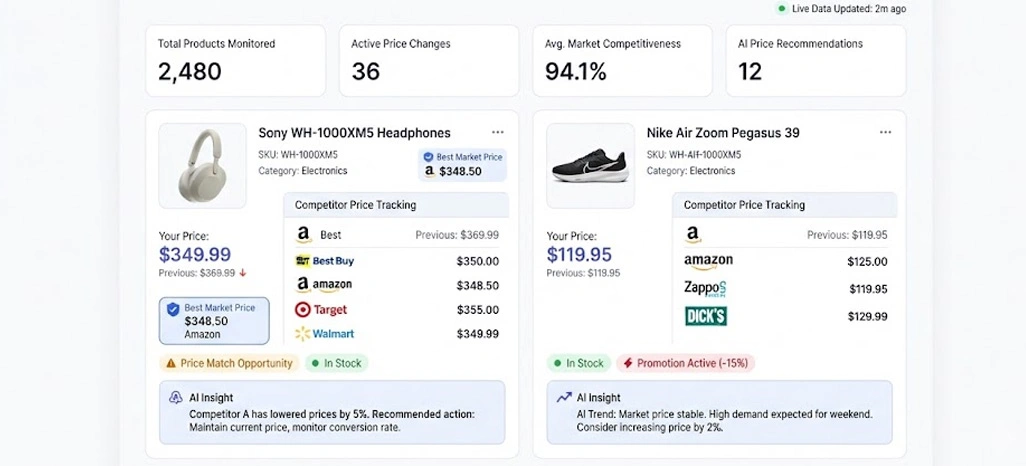
Retail markets evolve rapidly as competitors launch flash sales, promotional campaigns, seasonal discounts, and inventory clearance events throughout the day. Industry studies suggest businesses using continuous market intelligence improve pricing efficiency by more than 20%, highlighting the importance of timely competitor analysis in maintaining retail competitiveness and protecting long-term profitability.
Instead of depending on outdated reports or manually updated spreadsheets, retailers increasingly adopt Real-Time Retail Price Intelligence Using Web Scraping to capture live pricing information from ecommerce platforms and digital marketplaces. Automated collection delivers structured datasets that enable businesses to monitor changing competitor prices, evaluate promotional timing, and recognize emerging market trends before they significantly influence consumer purchasing behavior.
Organizations seeking greater operational efficiency also integrate AI-Powered Price Monitoring Software for Retailers into their pricing workflows to analyze extensive pricing datasets with improved speed and consistency. Intelligent analytics identify unusual pricing movements, recurring promotional patterns, and regional pricing differences that may otherwise remain unnoticed.
| Market Challenge | Operational Risk | Intelligent Response |
|---|---|---|
| Flash sales | Missed revenue opportunities | Live monitoring |
| Promotional campaigns | Delayed reactions | Automated alerts |
| Inventory fluctuations | Overstock or shortages | Demand-based analysis |
| Seasonal pricing | Competitive disadvantage | Continuous intelligence |
Continuous access to current market intelligence enables businesses to adapt confidently to rapidly changing retail conditions. Rather than making reactive pricing decisions after competitors gain an advantage, retailers can evaluate market signals immediately and align pricing strategies with customer expectations.
Transforming Market Intelligence Into Sustainable Revenue Growth Strategies
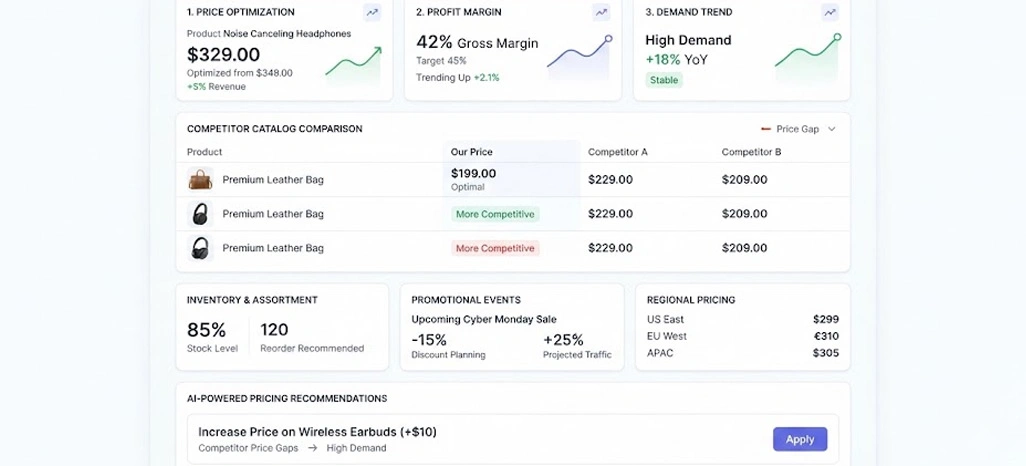
Successful retail pricing extends beyond matching competitor prices; it requires understanding customer demand, market behavior, and profitability trends simultaneously. Businesses using structured pricing analytics consistently report stronger pricing accuracy, improved promotional effectiveness, and healthier operating margins compared to organizations relying primarily on manual pricing decisions.
Advanced pricing initiatives increasingly rely on Price Optimization Software for Ecommerce and Retail Brands to evaluate competitor pricing, historical sales performance, inventory conditions, and customer demand within a unified analytical framework. Instead of reacting only after market conditions change, organizations can identify profitable pricing opportunities earlier, helping preserve margins while maintaining attractive customer pricing across multiple retail channels.
Retailers also benefit from implementing Best Price Monitoring Software for Online Retailers, providing centralized visibility into competitor catalogs, pricing history, promotional events, and assortment changes. These capabilities improve pricing consistency across regions, simplify category management, and support informed business planning through continuously updated competitive intelligence.
| Pricing Objective | Traditional Approach | Data-Driven Outcome |
|---|---|---|
| Margin protection | Manual adjustments | Optimized pricing decisions |
| Product positioning | Limited market visibility | Competitive benchmarking |
| Revenue improvement | Reactive pricing | Predictive recommendations |
| Customer retention | Static pricing | Intelligent pricing strategy |
Long-term pricing success depends on converting raw market information into actionable business strategies supported by reliable analytics. Data-driven pricing ultimately contributes to sustainable revenue growth, stronger competitive positioning, and improved profitability across dynamic retail markets.
How Retail Scrape Can Help You?
Retail success depends on accurate pricing intelligence supported by reliable market data. Businesses using Price Monitoring Software for Retailers can simplify competitor tracking while making informed pricing decisions based on continuously updated market information.
Our solutions help retailers by offering:
- Monitor competitor pricing across multiple retail platforms.
- Track promotional campaigns with automated updates.
- Collect structured product catalog information.
- Detects pricing changes with scheduled monitoring.
- Deliver clean datasets for analytics integration.
- Support scalable retail intelligence across regions.
Businesses seeking long-term pricing efficiency can combine these capabilities with Dynamic Pricing Software to automate strategic price adjustments while improving profitability, customer satisfaction, and operational performance across both online and offline retail environments.
Conclusion
Retail competition continues to intensify as consumers compare prices across numerous shopping channels before making purchasing decisions. Businesses adopting Price Monitoring Software for Retailers improve pricing visibility, react faster to competitor movements, and create sustainable pricing strategies supported by reliable market intelligence instead of manual observations.
Organizations looking to strengthen pricing performance can also benefit from Ecommerce Price Monitoring Software for Profit Optimization, helping convert competitive data into measurable business results. Connect with Retail Scrape today for customized price monitoring and competitive intelligence solutions.
Effortlessly managing intricacies with customized strategies.
Mitigating risks, navigating regulations, and cultivating trust.
Leveraging expertise from our internationally acclaimed team of developers
Reliable guidance and assistance for your business's advancement