
How Can Instacart Market Share Analysis Using Data Scraping Transform Competitive Market Research?
Introduction
The grocery delivery market has become a highly competitive digital environment where retailers, marketplaces, and quick-commerce platforms compete for customer attention, product visibility, and repeat orders. Instacart Grocery Delivery Data Scraping helps businesses collect structured information from product listings, store pages, pricing displays, promotional banners, delivery schedules, and category-level assortments.
This data supports better research into retailer participation, brand visibility, price movement, and consumer demand patterns. The United States online grocery market continues to expand as consumers increasingly use delivery and pickup services for weekly shopping. Grocery brands and retailers must therefore understand which platforms attract customers, which categories generate visibility, and where competitors are strengthening their digital presence.
By applying Instacart Market Share Analysis Using Data Scraping, businesses can measure competitor activity, compare marketplace positioning, and identify new opportunities for assortment planning, pricing intelligence, and regional expansion. Structured grocery delivery data creates a practical foundation for smarter competitive market research in 2026.
Measuring Product Visibility Across Digital Grocery Marketplaces
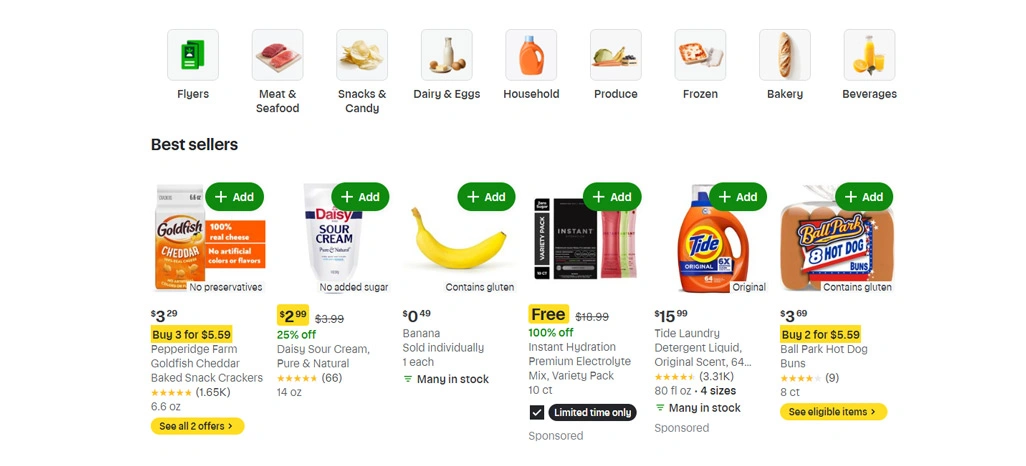
Retailers and consumer brands need consistent marketplace intelligence to understand how products, prices, promotions, and retailer listings influence digital grocery performance. Grocery platforms present thousands of items across categories, making manual tracking difficult when assortment depth, discounts, and availability change frequently.
Through Instacart Pricing and Assortment Analytics for Retailers, businesses can review product counts, package sizes, unit prices, promotional labels, and category-level availability across selected stores. These insights help pricing teams recognize whether similar products are listed at lower prices, offered in larger pack sizes, or supported by more visible discounts.
A detailed Instacart vs Competitors Market Share Analysis supports comparisons between retailer participation, product coverage, campaign frequency, and marketplace visibility. Instead of relying on isolated snapshots, analysts can measure recurring patterns across locations and categories. This creates a clearer view of where competitors are increasing their presence or changing their promotional strategy.
| Competitive Metric | Marketplace Data Collected | Business Value |
|---|---|---|
| Product availability | In-stock and unavailable status | Identifies assortment gaps |
| Pricing movement | List price, sale price, unit price | Supports price evaluation |
| Brand visibility | Search and category placement | Measures digital exposure |
| Promotion activity | Coupons, bundles, featured offers | Tracks campaign intensity |
| Retailer coverage | Store listings by region | Evaluates market presence |
Businesses can also apply Grocery Delivery Demand Analysis Using Marketplace Data to examine seasonal category movement, stock changes, delivery demand signals, and recurring product preferences. Such analysis supports better planning for promotions, inventory coordination, and category expansion.
Benchmarking Delivery Platforms Across Regional Grocery Competition
Grocery delivery competition involves marketplaces, supermarket chains, warehouse retailers, and rapid fulfillment providers that compete through pricing, store partnerships, delivery options, and promotional offers. Each platform may perform differently depending on city coverage, retailer density, consumer demand, and category assortment.
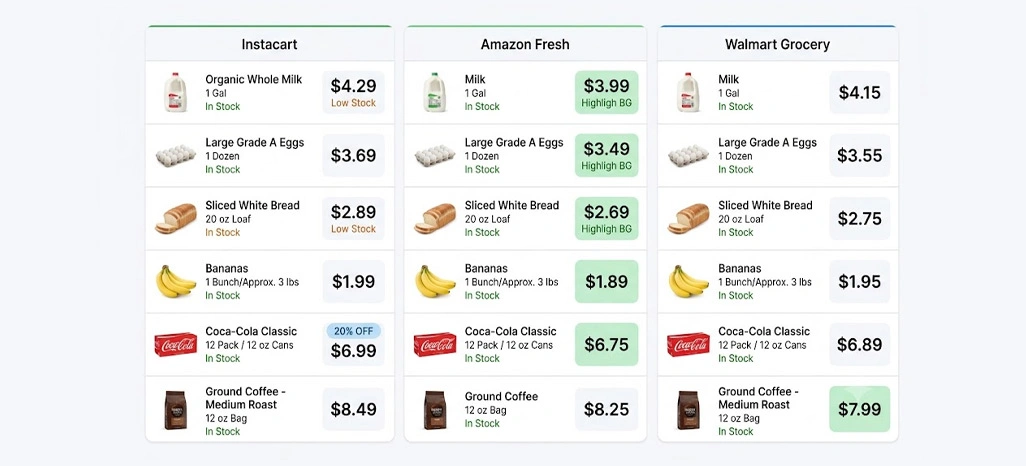
Using Instacart Competitor Benchmarking for Grocery Retailers, analysts can compare retailer networks, product availability, delivery schedules, discount activity, and category depth across multiple platforms. This approach helps teams identify whether a competitor is adding stores, improving delivery convenience, or expanding into high-demand grocery segments.
An Instacart vs Amazon Fresh vs Walmart Grocery Comparison provides a useful view of different marketplace operating models. Amazon Fresh may benefit from connected membership services, while Walmart Grocery can use store-based fulfillment capabilities.
| Comparison Area | Data Point to Monitor | Research Outcome |
|---|---|---|
| Retailer partnerships | Active stores and new listings | Measures network expansion |
| Delivery options | Available delivery windows | Evaluates convenience |
| Product assortment | Category and brand coverage | Identifies assortment differences |
| Pricing strategy | Basket-level price variation | Reviews value positioning |
| Promotions | Discounts and membership offers | Tracks campaign competition |
When Comparing Instacart With Grocery Delivery Competitors in 2026, regional data becomes especially valuable. Delivery speed, product selection, retailer availability, and basket pricing can vary significantly between cities. Tracking these factors helps businesses avoid making decisions based only on broad national trends.
Automating Competitive Intelligence Through Continuous Marketplace Data Collection
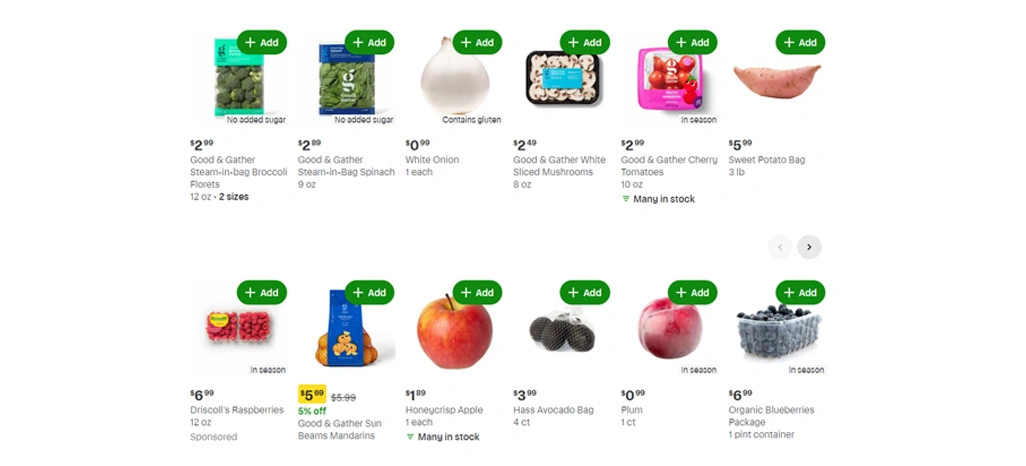
Manual grocery research often becomes difficult when businesses need to monitor large product catalogs, multiple store locations, changing prices, and short-term promotional campaigns. Automated collection helps organizations gather updated marketplace information at regular intervals, improving the speed and consistency of competitive analysis.
With Instacart Grocery API Data Scraping, businesses can collect structured information such as product names, brands, categories, pack sizes, prices, promotional offers, store availability, and delivery details. This information can be delivered through APIs, spreadsheets, cloud storage, dashboards, or databases based on reporting requirements.
Automated tracking also strengthens Quick Commerce Market Research 2026 by monitoring rapid delivery models, convenience-focused product availability, and changes in customer service expectations. These insights help businesses assess how faster fulfillment services affect category demand and local competition.
| Market Signal | Automated Monitoring Benefit | Business Response |
|---|---|---|
| New retailer listing | Detects coverage expansion | Reviews partnership options |
| Price reduction | Identifies pricing movement | Adjusts pricing plans |
| Promotion increase | Tracks discount activity | Plans response campaigns |
| Assortment change | Highlights category additions | Improves product planning |
| Faster delivery slots | Measures service expectations | Enhances fulfillment strategy |
The use of Instacart Competitor Monitoring Using AI and Web Scraping enables faster identification of unusual market changes. AI-supported workflows can flag sudden price reductions, new product listings, repeated stockouts, retailer additions, and promotional spikes.
How Retail Scrape Can Help You?
We provide customized grocery marketplace data solutions for businesses that need reliable, structured, and scalable competitive intelligence. By integrating Instacart Market Share Analysis Using Data Scraping into your research workflow, your team can monitor market movement with greater accuracy and reduce time spent on manual data collection.
Our approach includes:
- Collect product-level pricing and discount information.
- Track stock availability across multiple grocery stores.
- Monitor retailer listings and delivery coverage changes.
- Compare category assortments across locations and competitors.
- Receive scheduled data feeds in preferred file formats.
- Integrate structured marketplace data into internal dashboards.
Businesses can use an Instacart Grocery Delivery Dataset to analyze product trends, retailer activity, pricing behavior, and marketplace assortment changes. We deliver data in flexible formats that support business intelligence tools, analytics platforms, databases, and custom reporting systems.
Conclusion
Modern grocery competition requires businesses to understand how pricing, assortment, retailer coverage, and promotions influence customer decisions across delivery platforms. With Instacart Market Share Analysis Using Data Scraping, retailers and brands can measure competitive movement, identify market gaps, and build data-backed strategies for stronger digital grocery performance.
Continuous monitoring also supports Quick Commerce Market Research 2026 by revealing how faster delivery models, product availability, and convenience-focused services are reshaping grocery demand. Contact Retail Scrape today to build a customized grocery marketplace data solution for your competitive research goals.
Effortlessly managing intricacies with customized strategies.
Mitigating risks, navigating regulations, and cultivating trust.
Leveraging expertise from our internationally acclaimed team of developers
Reliable guidance and assistance for your business's advancement