


What Insights Can Homes.com Real Estate Dataset Deliver for More Accurate Property Market Analysis?

Introduction
Navigating the modern housing market requires raw data and precise real-time analytics rather than guesswork. Investors, brokerage firms, and urban planners increasingly rely on comprehensive databases to monitor valuation fluctuations and buyer demand. Having instant access to granular property information makes identifying profitable opportunities far more straightforward across dynamic regional housing sectors.
Deploying the Homes.com Real Estate Dataset delivers deep visibility into shifting property values and inventory trends. Aggregated data enables stakeholders to evaluate localized market dynamics, cross-reference historical pricing, and track seasonal demand cycles. Consequently, decision-makers can construct reliable forecasting models grounded in accurate information rather than surface-level market speculation.
Sourcing robust property details equips organizations with the exact competitive edge necessary to navigate complex market environments. Accessing listing attributes, neighborhood statistics, and pricing histories supports strategic expansion and risk mitigation. Integrating structured datasets directly into analytical workflows empowers real estate professionals to make confident, data-driven investments consistently.
Evaluating Property Price Movement and Neighborhood Valuation Changes

Tracking price fluctuations across regional markets requires consistent data aggregation from authoritative property databases. By utilizing accurate valuation records, analysts can identify micro-market growth drivers, compare historical neighborhood performance, and project future pricing trajectories effectively. Relying on structured real estate information ensures that automated valuation models remain precise and closely aligned with actual transaction trends across dynamic housing sectors.
Executing Homes.com Property Price Monitoring allows financial analysts to capture real-time shifts in asking prices, historical sales, and per-square-foot valuations without delay. Tracking these continuous adjustments provides immediate visibility into broader market health and localized economic conditions. Analysts can seamlessly pinpoint exact inflection points where buyer demand shifts across distinct residential areas.
Analyzing structured Property Price Trends Dataset records provides immediate insight into whether specific suburban sectors are appreciating or cooling off over time. Having these specific parameters structured cleanly in standard tabular formats helps quantitative teams rapidly build predictive models. The synthesized table below outlines standard regional valuation baseline metrics for fast comparison.
| Metric Parameter | Suburban Averages | Urban Core Averages | YoY Change (%) |
|---|---|---|---|
| Median Asking Price | $425,000 | $680,000 | +5.8% |
| Price per Sq. Ft. | $210 | $415 | +3.2% |
| Average Days on Market | 28 Days | 42 Days | -12.5% |
| Price Reduction Rate | 14.2% | 22.8% | +1.5% |
Evaluating these distinct data points prevents overpaying during market peaks while uncovering undervalued assets before broader market recognition occurs. Structured data feeds eliminate manual research bottlenecks, giving institutional investors a distinct analytical advantage.
- Track real-time valuation updates and historical price adjustments across target zip codes.
- Calculate exact per-square-foot baseline metrics to identify high-yield investment zones.
- Identify early cooling or heating indicators by analyzing average days on market trends.
- Compare suburban and urban performance metrics to optimize asset acquisition timing.
Optimizing Portfolio Investment Decisions Through Comprehensive Residential Data

Real estate portfolio managers need precise operational metrics to balance risk effectively while maximizing long-term returns on investment across diverse asset classes. Evaluating active inventory volume, historical sales speeds, and local property attributes reveals underlying demand patterns across different housing tiers. Having direct access to raw property details helps identify lucrative buy-and-hold markets versus short-term fix-and-flip candidates efficiently.
Using a dedicated Homes.com Scraper empowers investment firms to extract comprehensive property attributes directly into internal analytical dashboards for immediate review. This consistent flow of information allows teams to perform rapid comparative market assessments without relying on outdated aggregate summaries.
Evaluating thousands of active listings alongside historical archives like the Residential Property Dataset Us reveals hidden inventory gaps and yield potentials across competitive sectors. Comparing these records provides quantitative teams with the empirical foundation needed to stress-test financial projections under changing economic conditions. The structured table below highlights core portfolio performance metrics extracted across varied property categories.
| Property Type | Avg. List-to-Sale Ratio | Monthly Rental Yield | Occupancy Rate |
|---|---|---|---|
| Single-Family Detached | 98.4% | 6.2% | 96.5% |
| Multi-Family Units | 96.8% | 8.4% | 94.1% |
| Townhomes & Condos | 97.9% | 7.1% | 95.8% |
Access to raw property specifications enables automated screening scripts to flag deals matching strict ROI thresholds instantly across active regional feeds. Eliminating manual data entry drastically accelerates portfolio expansion while preserving capital through thorough risk screening.
- Ingest complete historical pricing logs to validate projected capital appreciation models.
- Evaluate local occupancy and rental yield rates across single and multi-family categories.
- Screen active market inventories automatically against customized return-on-investment parameters.
- Minimize portfolio acquisition risks by cross-referencing recent list-to-sale price ratios.
Enhancing Automated Valuation Models With Real Time Property Listings
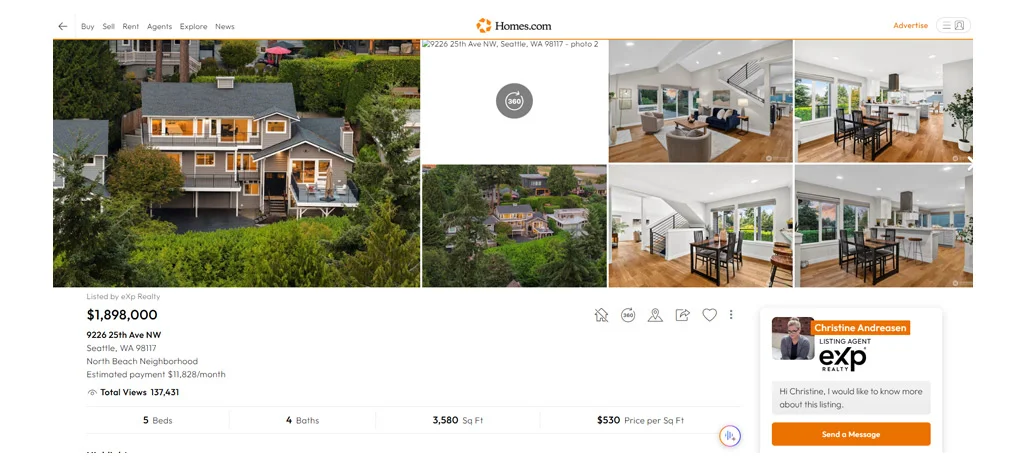
Integrating a reliable Real Estate Scraping API provides quantitative engineering teams with seamless, automated access to active market movements continuously. Direct algorithmic ingestion minimizes manual intervention while guaranteeing that predictive valuation software processes refreshed property records as soon as updates occur. This automated pipeline maintains strict valuation accuracy even during periods of intense market volatility.
Feeds rich in Homes.com Listings Data supply precise attributes such as room counts, property age, tax histories, and recent price adjustments cleanly. Accessing comprehensive property records guarantees that automated valuation systems evaluate accurate baseline metrics for every subject asset. Consequently, financial institutions can underwrite property assets with significantly higher confidence and speed.
Furthermore, quantitative development teams can utilize the Homes.com API for Property Data to directly feed clean information into custom algorithmic trading models. Integrating structured endpoints simplifies pipeline maintenance, letting data engineers focus on optimizing model features rather than fixing broken collection scripts. The table below outlines key variable weights standardly utilized within modern automated valuation architectures.
| Feature Category | High-Impact Variable | Weight in AVM Engine |
|---|---|---|
| Physical Attributes | Square Footage & Lot Size | 35% |
| Location Metrics | School Ratings & Safety Index | 25% |
| Historical Financials | Tax Assessment & Past Sales | 20% |
| Live Market Dynamics | Local Inventory & Days Active | 20% |
Relying on continuously updated property data ensures valuation models remain highly accurate, preventing costly pricing errors during underwriting. Access to precise listing records transforms raw market noise into actionable quantitative intelligence.
- Feed real-time property listing attributes directly into custom automated valuation algorithms.
- Standardize tax records, structural specifications, and price histories into unified analytical tables.
- Reduce algorithmic pricing errors by continuously updating live market inventory metrics.
- Maintain clean API data pipelines that eliminate manual dataset cleaning overhead.
How Retail Scrape Can Help You?
Modern real estate enterprises depend heavily on structured web data to build cutting-edge market analysis tools. Processing large-scale listing archives demands specialized data extraction workflows that guarantee high accuracy, continuous uptime, and compliance.
Integrating tailored Homes.com Web Scraping Services enables your team to receive cleaned, formatted data directly into your custom database or storage environment. Our engineered extraction pipelines ensure that your company accesses reliable property feeds tailored to your exact geographic specifications.
- Seamlessly stream clean listing details directly into your database.
- Access highly accurate pricing updates and historical property records.
- Scale data extraction smoothly across regional and national territories.
- Receive structured custom outputs in JSON, CSV, or database formats.
- Eliminate internal maintenance costs associated with broken data pipelines.
- Ensure maximum uptime with automated anti-bot and proxy management systems.
Incorporating the Homes.com Real Estate Dataset into your corporate strategy provides your analytics team with the precise foundation needed for deep market intelligence. Deploying automated scraping solutions ensures that your operations remain fully focused on analytical strategy rather than tedious manual collection.
Conclusion
Maximizing market returns requires turning raw web information into structured operational decisions. Deploying the Homes.com Real Estate Dataset empowers real estate professionals to track valuation movements, assess risk factors, and identify high-yielding regional assets with absolute precision. Incorporating fresh property data continuously strengthens market predictions and optimizes property underwriting.
Modern real estate firms gain a significant edge when replacing manual research with scalable data collection systems. Harnessing Homes.com Housing Market Data Analysis allows investment teams to streamline research workflows, enhance algorithmic valuation models, and make decisions confidently. Partner with Retail Scrape today to unlock customized, enterprise-grade real estate data feeds that propel your strategic growth.