

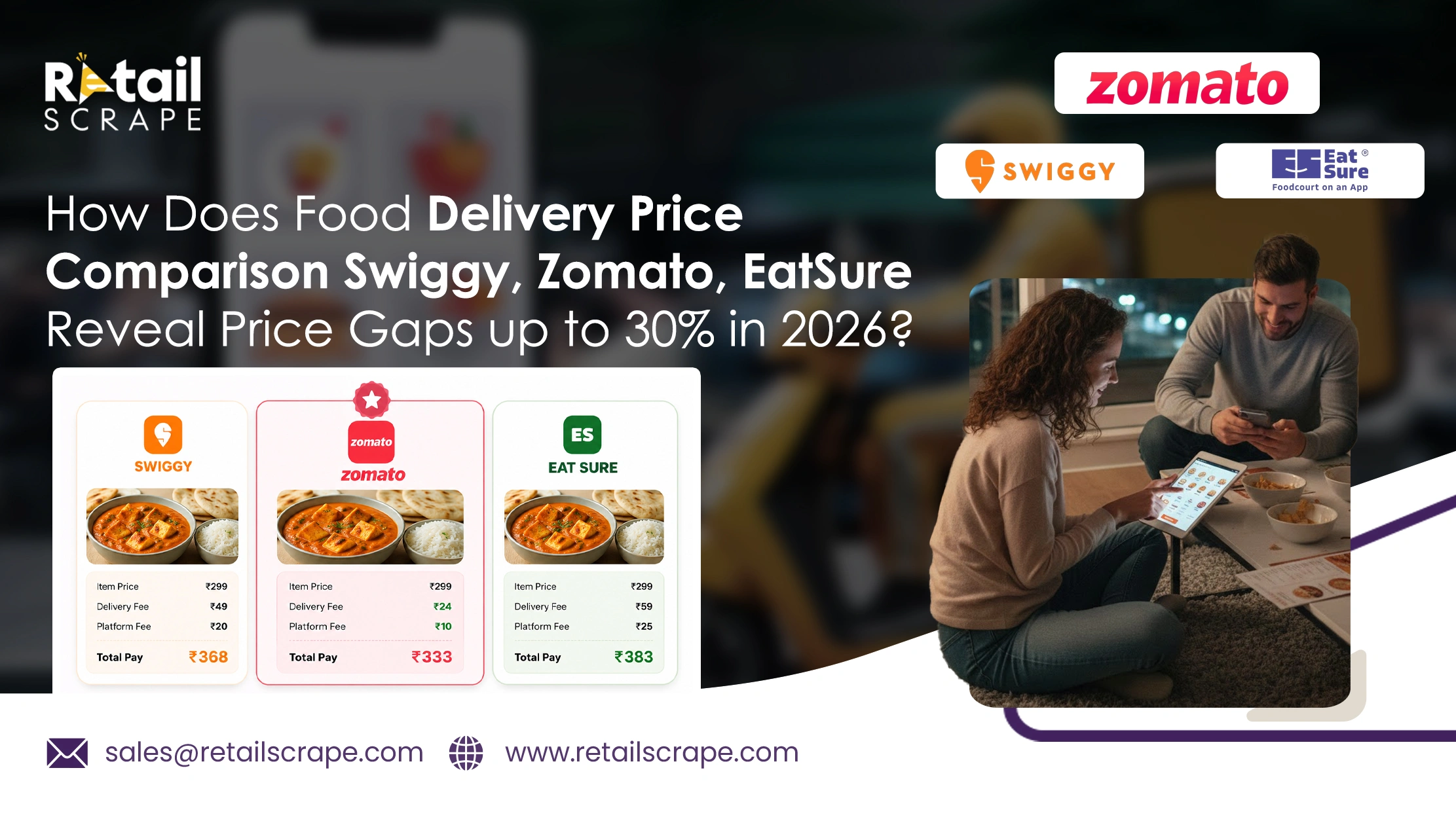
How Does Food Delivery Price Comparison Swiggy, Zomato, EatSure Reveal Price Gaps up to 30% in 2026?
Introduction
The online food delivery ecosystem in 2026 has become more competitive than ever. Restaurants are no longer competing only on food quality and customer service; they are also competing through pricing strategies across multiple delivery platforms. As consumers increasingly compare prices before placing orders, even small differences in menu pricing, delivery charges, and discounts can influence purchasing decisions. This has made cross-platform price transparency a major factor in customer acquisition and retention.
One of the biggest findings in recent market studies is that identical food items often carry different prices across delivery apps. A burger, pizza, or meal combo can vary significantly depending on the platform used. These variations are influenced by commissions, promotional campaigns, operational costs, and platform-specific pricing models. Businesses that fail to track these changes risk losing market share and profitability.
The growing relevance of Food Delivery Price Comparison Swiggy, Zomato, EatSure has encouraged restaurants, aggregators, and market analysts to monitor pricing trends more closely. With some restaurants experiencing price gaps of up to 30% across platforms, real-time monitoring has become essential for maintaining competitiveness in a rapidly evolving food delivery marketplace.
Tracking Hidden Pricing Variations Across Leading Delivery Networks
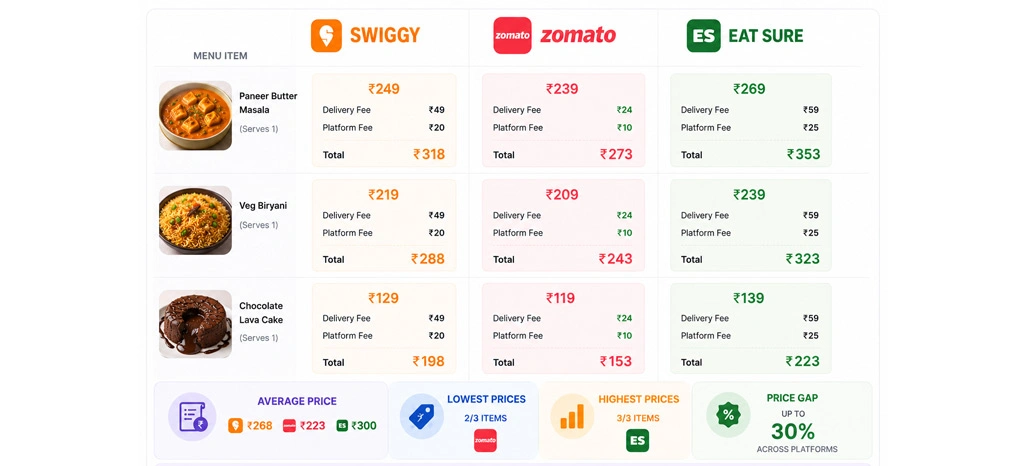
The food delivery industry in 2026 continues to experience significant pricing fluctuations across platforms, creating challenges for restaurants and opportunities for consumers. While customers often assume menu prices remain consistent, reality shows otherwise. Delivery aggregators apply different fee structures, promotional strategies, and commission models, resulting in noticeable variations in the final order value.
For businesses, understanding these fluctuations is critical for maintaining competitiveness and protecting profit margins. Recent market evaluations indicate that menu prices can vary between 10% and 30% depending on the platform selected by a customer. These differences are not limited to premium restaurants; even fast-food chains and local eateries experience substantial pricing gaps.
Such inconsistencies influence purchasing decisions and shape consumer perceptions of value. As customer awareness grows, businesses must actively monitor how products are priced across multiple channels. A growing number of restaurant operators now depend on Swiggy Zomato EatSure Menu Price Analysis to identify discrepancies and improve pricing consistency.
Platform-Based Price Variation Snapshot:
| Menu Item | Platform A | Platform B | Platform C | Difference |
|---|---|---|---|---|
| Veg Burger | ₹180 | ₹205 | ₹230 | 28% |
| Pizza Combo | ₹499 | ₹565 | ₹645 | 29% |
| Biryani Meal | ₹249 | ₹285 | ₹325 | 30% |
| Sandwich Meal | ₹189 | ₹215 | ₹245 | 29% |
Simultaneously, Food Delivery Data Scraping for Competitive Intelligence provides large-scale visibility into changing menu structures, promotional campaigns, and competitor movements. These insights help businesses make informed pricing decisions while reducing revenue leakage caused by unmanaged platform differences.
Evaluating Revenue Impact From Continuous Menu Adjustments
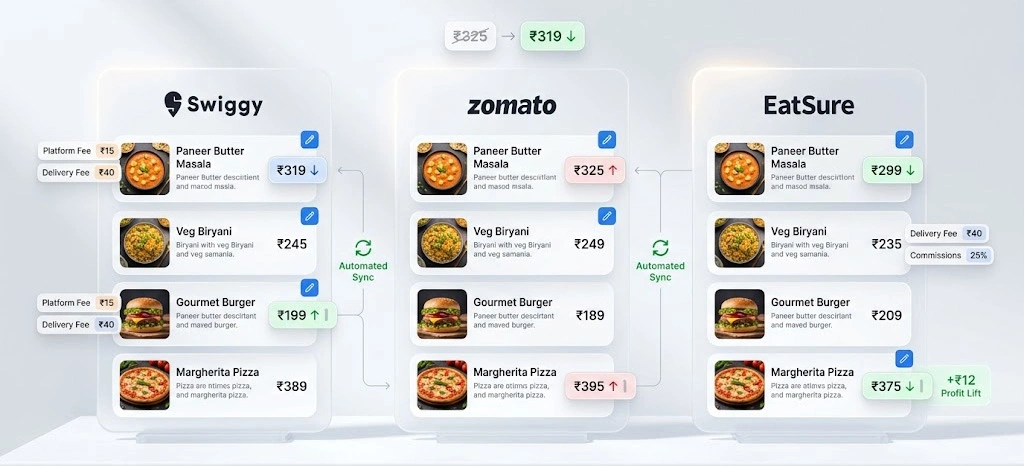
As delivery platforms expand their market share, restaurants are facing increasing pressure to manage pricing consistency across every channel. In addition, understanding Food Delivery Platform Commission Impact on Menu Prices allows businesses to evaluate how platform costs influence pricing decisions and customer perception.
One of the primary reasons for these discrepancies is the changing cost structure associated with food delivery platforms. Restaurants frequently adjust prices to compensate for service fees, commissions, advertising costs, and fulfillment expenses. Without continuous monitoring, these adjustments can become difficult to manage and may result in pricing conflicts between platforms.
Businesses that proactively track menu changes can identify irregularities before they negatively impact sales performance. To address these challenges, many organizations implement Restaurant Menu Price Monitoring Using Scraped Data to automate tracking and reporting processes. Automated monitoring improves visibility into menu modifications while reducing manual effort.
Common Drivers Behind Pricing Changes:
| Pricing Factor | Operational Effect | Customer Effect |
|---|---|---|
| Commission Fees | Margin reduction | Higher menu prices |
| Discount Campaigns | Revenue fluctuation | Better deal expectations |
| Delivery Charges | Additional costs | Increased order value |
| Service Fees | Cost recovery | Lower affordability |
The broader market is also being shaped by Food Delivery Pricing Trends in 2026, where pricing flexibility and real-time adjustments are becoming standard practices. Businesses that continuously evaluate these trends are better positioned to maintain competitiveness and improve customer retention.
Building Stronger Competitive Strategies Through Data Insights
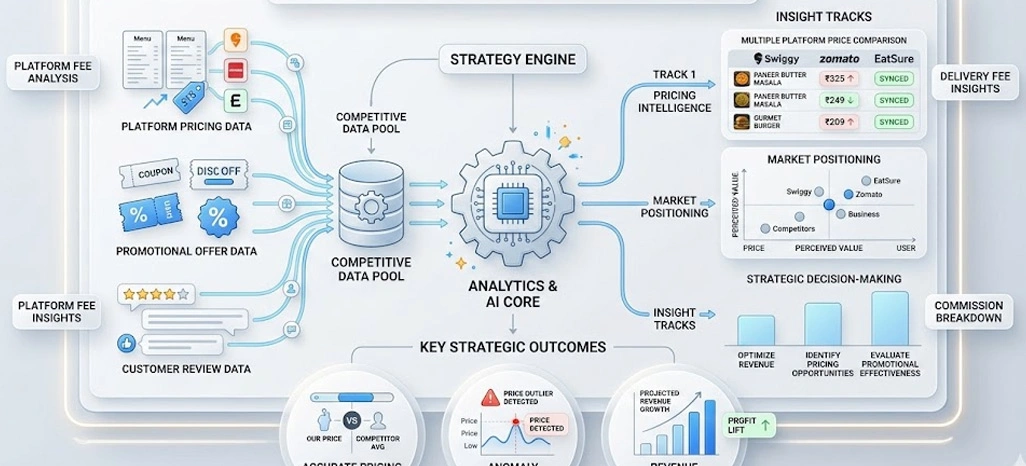
Competition within the food delivery ecosystem has intensified considerably, making accurate pricing intelligence more valuable than ever. Restaurants no longer compete solely on food quality or delivery speed; pricing transparency has become equally important. Customers actively compare offers across platforms and often choose the option that delivers the highest perceived value.
This shift has encouraged businesses to adopt more advanced monitoring and benchmarking strategies. These tools support comprehensive Food Delivery Price Comparison Across Multiple Platforms, enabling businesses to detect pricing anomalies and evaluate competitive performance. The resulting insights help improve decision-making and optimize revenue strategies.
Accurate data collection enables businesses to identify pricing opportunities, monitor promotional effectiveness, and understand market positioning more effectively. Many organizations now utilize Food Delivery Competitor Pricing Analysis Software to benchmark products across competing platforms.
Competitive Benchmarking Example:
| Category | Lowest Price | Highest Price | Gap Percentage |
|---|---|---|---|
| Burgers | ₹169 | ₹219 | 29% |
| Pizza | ₹399 | ₹519 | 30% |
| Biryani | ₹229 | ₹299 | 31% |
| Desserts | ₹99 | ₹129 | 30% |
Beyond menu prices, businesses increasingly focus on Delivery Fee and Discount Analysis for Restaurants to understand total order costs from a customer perspective. Monitoring both pricing and delivery-related charges creates a more accurate view of market competitiveness and supports sustainable business growth.
How Retail Scrape Can Help You?
Food delivery businesses require reliable data to monitor changing market conditions and optimize pricing decisions. Continuous monitoring of Food Delivery Price Comparison Swiggy, Zomato, EatSure enables businesses to maintain pricing consistency while responding quickly to competitor movements.
We help businesses by:
- Tracking menu changes in real time
- Monitoring competitor pricing activities
- Detecting promotional campaign variations
- Collecting delivery charge information
- Generating actionable market reports
- Supporting data-driven pricing decisions
Organizations seeking stronger visibility into competitive landscapes can benefit from Food Delivery Market Intelligence Using Web Scraping. Accurate and scalable data collection enables businesses to improve strategic planning, enhance profitability, and respond effectively to rapidly changing market dynamics.
Conclusion
Price transparency has become a defining factor in the food delivery industry. The growing significance of Food Delivery Price Comparison Swiggy, Zomato, EatSure highlights why businesses must adopt data-driven approaches to remain competitive in 2026.
As competition intensifies, evaluating Food Delivery Price Comparison Across Multiple Platforms can reveal hidden pricing gaps, improve decision-making, and support sustainable growth. Contact Retail Scrape today to transform food delivery pricing data into actionable business intelligence.
Effortlessly managing intricacies with customized strategies.
Mitigating risks, navigating regulations, and cultivating trust.
Leveraging expertise from our internationally acclaimed team of developers
Reliable guidance and assistance for your business's advancement