
Why Choose ERP Data Scraping for Inventory Management to Streamline Supply Chain Operations?
Introduction
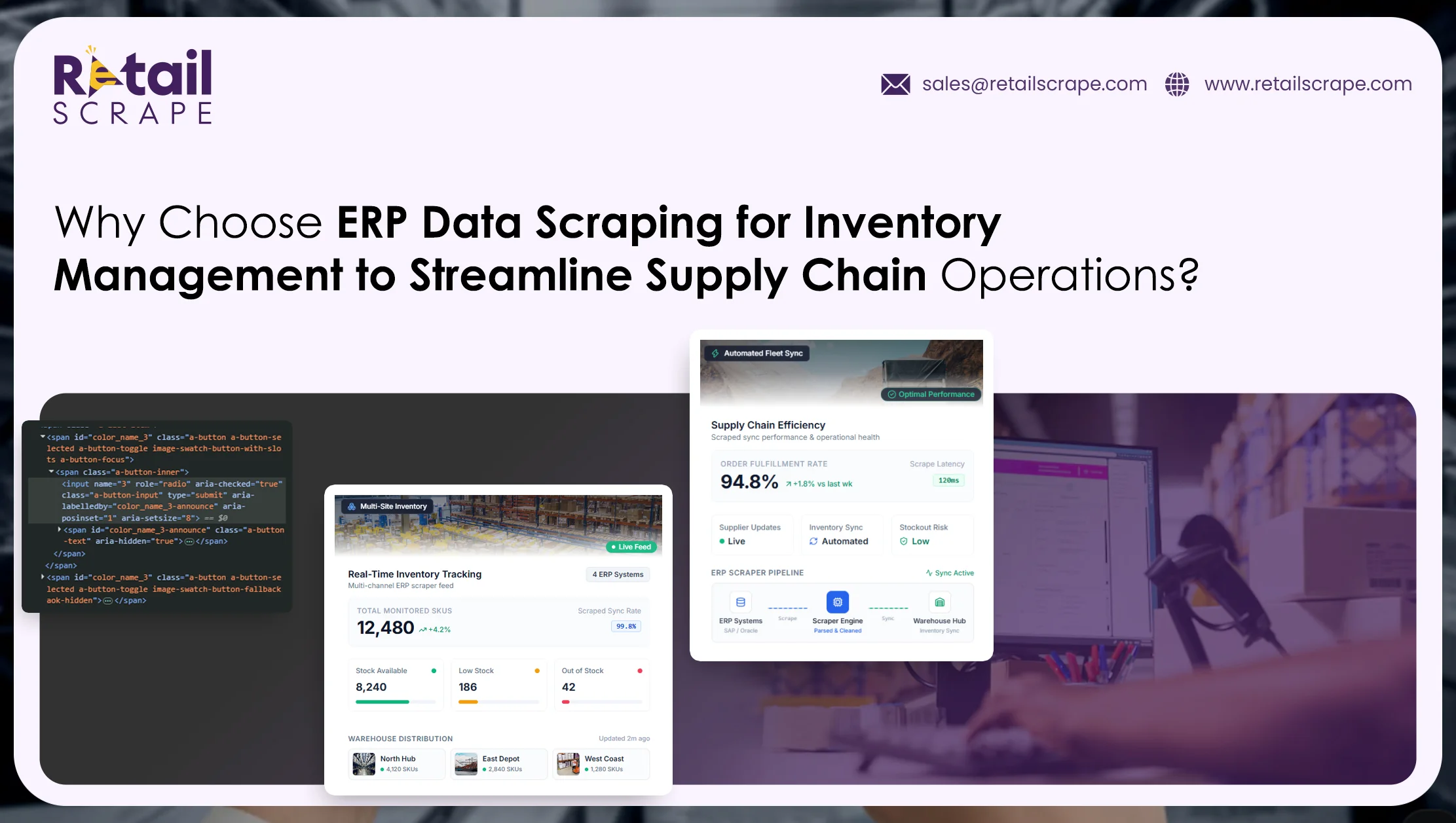
In today's fast-paced commercial landscape, maintaining seamless visibility across modern supply chains is no longer optional. Fragmented enterprise systems frequently create silos that prevent operations managers from accessing unified real-time stock figures, ultimately leading to stockouts, overstocking, and costly delays.
To resolve these operational bottlenecks, forward-thinking organizations are adopting Enterprise Web Crawling techniques to integrate complex legacy and cloud architectures. Automated data harvesting systematically extracts, unifies, and processes crucial inventory metrics from disparate ERP portals, ensuring higher tracking accuracy across every single distribution channel.
By deploying ERP Data Scraping for Inventory Management, businesses transform scattered operational figures into structured intelligence. This continuous flow of automated data empowers leaders to optimize demand forecasting, streamline warehouse workflows, and maintain a resilient supply chain ecosystem.
Direct Strategies for Eliminating Stock Silos in Enterprise Environments
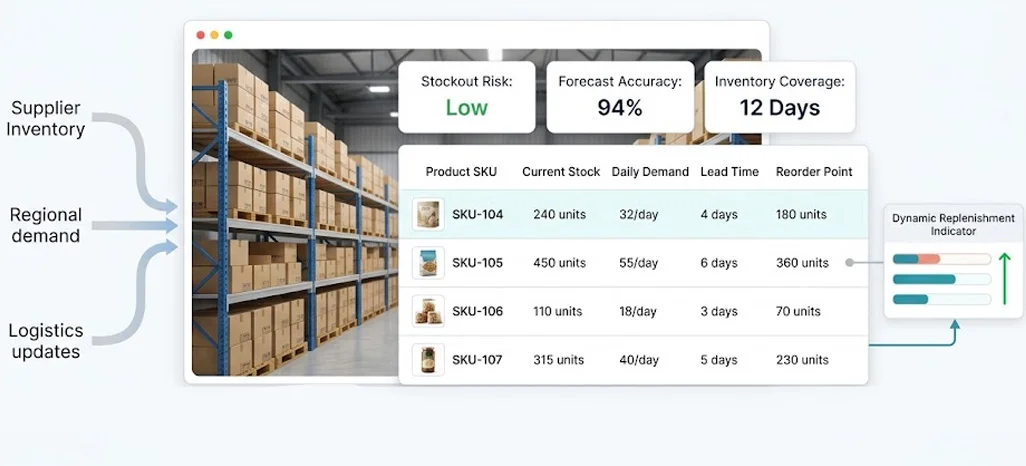
Navigating multi-regional distribution networks demands complete operational transparency across all product categories. Fragmented database architectures routinely hinder fulfillment workflows, creating artificial inventory shortages and inflated buffer stock requirements across regional warehouses.
Implementing Enterprise Web Scraping Solutions within enterprise infrastructure systematically bridges isolated software portals and vendor dashboards. Modern extraction pipelines continuously harvest operational figures, replacing prone-to-error manual data entry while providing unified visibility into actual physical quantities across every active distribution node.
Organizations that transition to automated extraction methodologies systematically mitigate fulfillment bottlenecks and improve order turnaround times. Deploying a reliable Web Data Scraper for ERP Inventory Reports allows procurement leaders to consolidate scattered metrics, generate accurate stock ledgers, and establish dependable supply chain workflows across all selling channels.
Key Advantages of Stock Synchronization:
- Eliminates human data entry errors across vendor and internal databases.
- Provides near real-time updates across disparate regional fulfillment centers.
- Reduces administrative overhead expenses related to manual ledger reconciliation.
- Improves overall order fulfillment accuracy and customer satisfaction metrics.
| Operational Dimension | Legacy Manual Tracking | Automated Data Extraction |
|---|---|---|
| Error Rate | 8% to 12% human entry error | Under 0.5% automated precision |
| Update Frequency | Weekly or monthly batch sync | Near real-time continuous feeds |
| Operational Overhead | High labor & reconciliation costs | Up to 40% reduction in tracking costs |
Operational teams frequently encounter discrepancies between physical shelf counts and system ledgers due to delayed database updates. Establishing automated extraction routines ensures continuous reconciliation across platforms, preventing premature stockouts and maintaining healthy inventory velocity throughout peak demand cycles.
Advanced Methodologies for Dynamic Demand Forecasting and Inventory Alignment
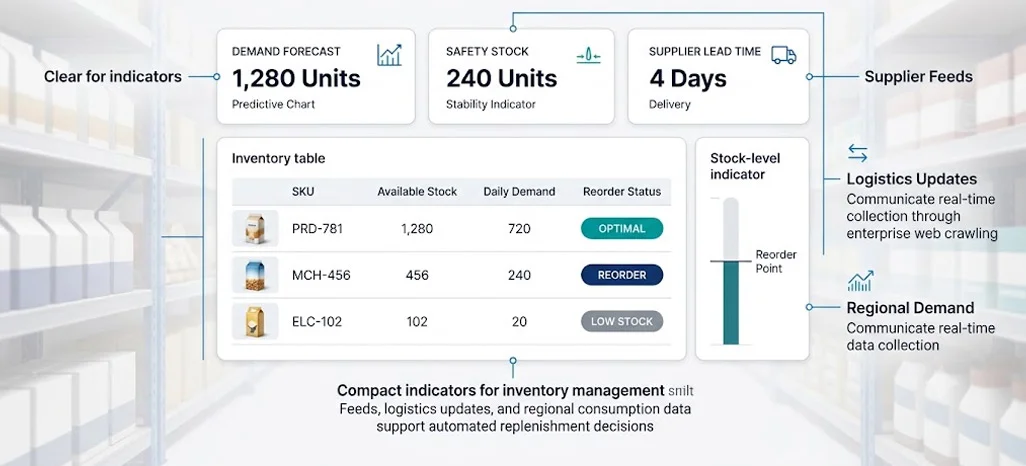
Unpredictable market conditions require flexible supply chain management capabilities that static inventory reporting tools simply cannot provide. Maintaining adequate safety stock while minimizing holding expenses requires accurate insights into inventory movement speed, vendor lead times, and regional consumption spikes.
Deploying resilient Enterprise Web Crawling architectures enables supply chain teams to collect granular operational metrics across supplier networks and logistics interfaces. Accessing fresh operational intelligence allows purchasing departments to anticipate supply bottlenecks, adjust reorder points dynamically, and prevent critical stockouts during unexpected surges in consumer demand.
Industry research demonstrates that enterprises adopting continuous data collection models achieve significant reductions in holding expenses while drastically improving order fulfillment accuracy. Integrating automated extraction tools gives operational leadership a distinct competitive advantage through precise, data-backed demand planning and proactive stock replenishment.
Core Benefits of Dynamic Alignment:
- Prevents revenue loss caused by unexpected out-of-stock product instances.
- Minimizes holding costs associated with excess carrying stock in warehouses.
- Enhances long-term demand planning accuracy using real-time operational feeds.
- Enables proactive reorder adjustments based on actual supplier lead times.
| Supply Chain KPI | Impact of Real-Time Operational Data |
|---|---|
| Stockout Reduction | Decreases out-of-stock instances by up to 30% |
| Holding Cost Savings | Reduces excess inventory carrying costs by 15-22% |
| Forecast Accuracy | Boosts demand forecasting precision by over 25% |
Modern supply chain ecosystems must adapt swiftly to shifting vendor timelines and transport delays. By feeding clean extracted data directly into predictive analytics platforms, enterprise planners can model supply disruptions accurately, optimize buffer stock levels, and protect profit margins across volatile market cycles.
Modern Solutions for Automating Multi System Supplier Data Aggregation
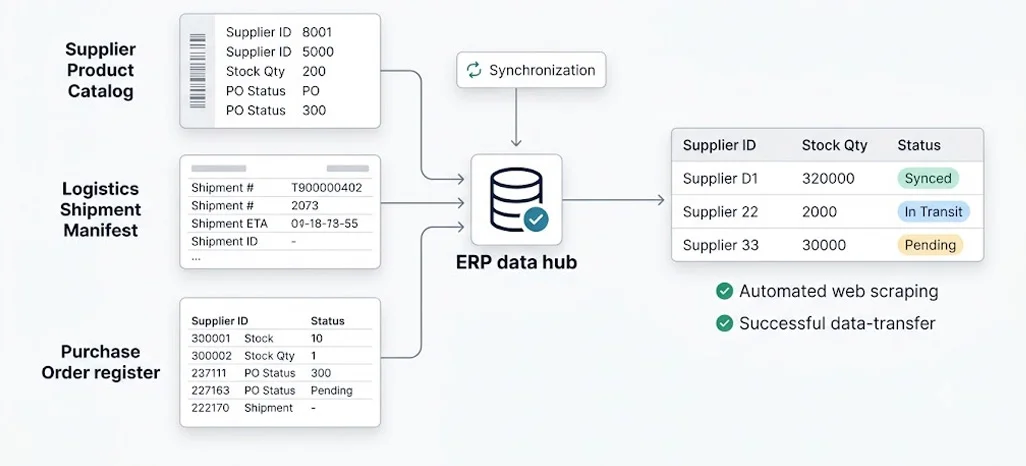
Managing global enterprise vendor networks requires continuous, error-free data exchange between external suppliers, third-party logistics providers, and internal databases. Relying on manual spreadsheet uploads slows critical decisions and exposes enterprise operations to severe tracking errors.
Adopting specialized Web Scraping Services allows organizations to bridge legacy system gaps without investing in costly custom middleware infrastructure. Automated scrapers smoothly pull critical inventory figures, pending purchase orders, and shipment tracking updates into a single dashboard, keeping executive teams fully informed at all times.
Empirical studies confirm that replacing manual reporting routines with automated aggregation reduces overall report generation timelines significantly. Deploying a structured ERP Data Extraction API enables enterprises to construct scalable reporting pipelines that strengthen supplier collaboration and maintain seamless operational flow across all distribution networks.
Essential Features of Automated Aggregation:
- Bridges software gaps between incompatible external supplier management portals.
- Automates recurring report compilation to save valuable administrative hours.
- Delivers continuous oversight across global logistics and shipping channels.
- Scales effortlessly to accommodate growing transaction volumes and datasets.
| System Capability | Traditional Manual Management | Automated Scraping Workflows |
|---|---|---|
| Data Synchronization | Delayed by hours or days | Instant automated synchronization |
| System Compatibility | Requires manual export/import | Works across incompatible legacy interfaces |
| Reporting Scalability | Fails as transaction volume grows | Handles massive datasets effortlessly |
Cross-border supply chain operations often involve legacy portals that lack direct software integration capabilities. Automated extraction tools bypass these technical barriers by interacting directly with user interfaces, ensuring continuous data flow into central analytics hubs without manual intervention.
How Retail Scrape Can Help You?
Navigating complex enterprise architectures requires customized extraction workflows tailored specifically to your operational ecosystem. Utilizing ERP Data Scraping for Inventory Management enables your business to bridge software gaps, automate stock auditing, and maintain pristine operational visibility without interrupting daily workflows.
- Extract granular stock metrics directly from cloud platforms and custom interfaces.
- Convert raw interface outputs into structured formats compatible with major databases.
- Receive prompt automated alerts when inventory drops below safety stock levels.
- Schedule recurring extraction routines to keep supply chain dashboards updated continuously.
- Bypass manual data collection bottlenecks to lower administrative costs significantly.
- Bridge disconnected supplier portals into one central analytics framework.
Our specialized E-Commerce Scraping Services deliver the precision and infrastructure required to transform enterprise data into a strong strategic advantage.
Conclusion
Managing complex distribution networks requires rapid access to clean operational data across all platforms. Integrating ERP Data Scraping for Inventory Management into your operational framework eliminates software compatibility barriers, reduces expensive stock tracking mistakes, and enhances overall supply chain transparency.
Adopting an advanced ERP Data Scraper for Supply Chain Reporting empowers your enterprise to make confident, data-driven decisions and stay ahead of market demands. Partner with the Retail Scrape team today to build custom extraction solutions that elevate your supply chain performance.