How Can E-Commerce Price Monitoring Transform Retail Price Intelligence and Competitor Analysis?
Introduction
Retail pricing changes rapidly as brands respond to competitor movements, customer demand, promotions, inventory levels, and seasonal conditions. E-Commerce Price Monitoring helps businesses organize these changes into actionable pricing insights. By continuously comparing product prices across online marketplaces and retail websites, companies can identify patterns that support faster and more informed commercial decisions.
Modern retailers increasingly depend on structured pricing information to understand where their products stand within competitive categories. Online Retail Price Intelligence supports evaluations of price gaps, promotional movements, and product-level positioning across multiple channels. Instead of relying on occasional manual checks, businesses can create consistent monitoring processes that reveal meaningful changes and support timely pricing adjustments.
Price monitoring also strengthens competitor analysis by connecting product, pricing, and market movement data. Businesses can evaluate discount strategies, identify frequently changing products, and measure price differences across competing sellers. This creates a clearer foundation for planning promotions, optimizing product positioning, and improving pricing strategies while responding more effectively to changing e-commerce conditions.
Strengthening Market Visibility Through Strategic Retail Price Analysis
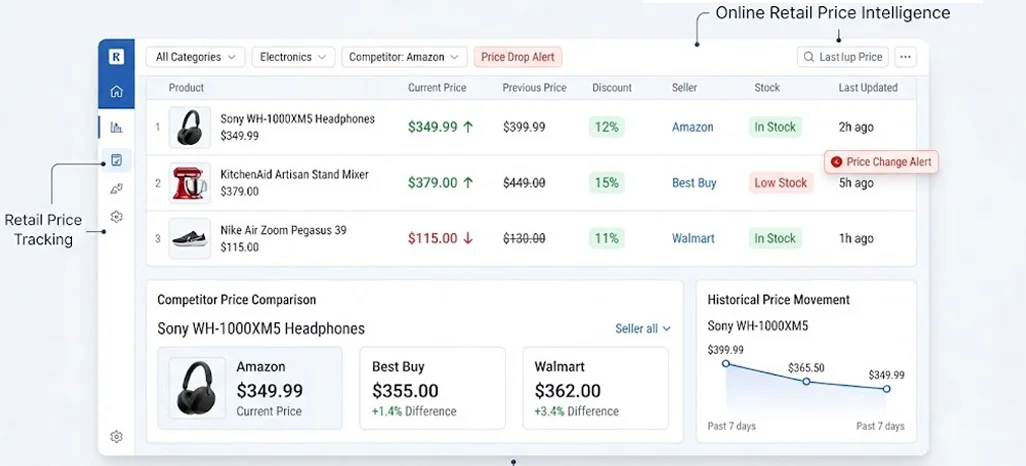
Retailers need reliable visibility into changing prices across marketplaces, brand websites, and competing sellers. Continuous analysis helps businesses understand how products are positioned within specific categories and where meaningful price differences appear. Rather than relying on occasional manual checks, businesses can maintain structured datasets that show pricing movements over time. This approach creates a clearer foundation for evaluating market conditions, promotional activity, and competitor positioning.
A structured Online Retail Price Intelligence workflow can bring product prices, discounts, seller information, and availability into a consistent analytical framework. Retail teams can compare similar products across multiple sources while identifying unusual price movements that may require attention. This information also supports category-level research by showing how pricing varies between brands, product variants, and sales channels.
Using reliable Retail Price Tracking Tools can further simplify recurring monitoring activities and reduce repetitive manual research. These solutions can collect pricing information at scheduled intervals, helping teams build historical records for comparison. Meanwhile, Ecommerce Price Intelligence can connect current pricing information with product and market attributes, allowing businesses to interpret price changes within a broader commercial context.
Key benefits of structured price analysis include:
- Monitoring multiple retail sources consistently
- Comparing product prices across sellers
- Recording historical pricing movements
- Reviewing promotional changes efficiently
- Supporting category-level market research
- Identifying unusual price variations
| Analysis Area | Business Application |
|---|---|
| Product Pricing | Market comparison |
| Discounts | Promotion evaluation |
| Seller Activity | Competitive assessment |
| Price History | Trend analysis |
Together, these capabilities provide retailers with a more organized approach to market evaluation. Instead of viewing individual prices separately, teams can assess broader patterns and understand how pricing decisions may affect product positioning, promotions, and customer-facing competitiveness across digital retail channels.
Improving Competitor Comparisons Through Continuous Pricing Insights
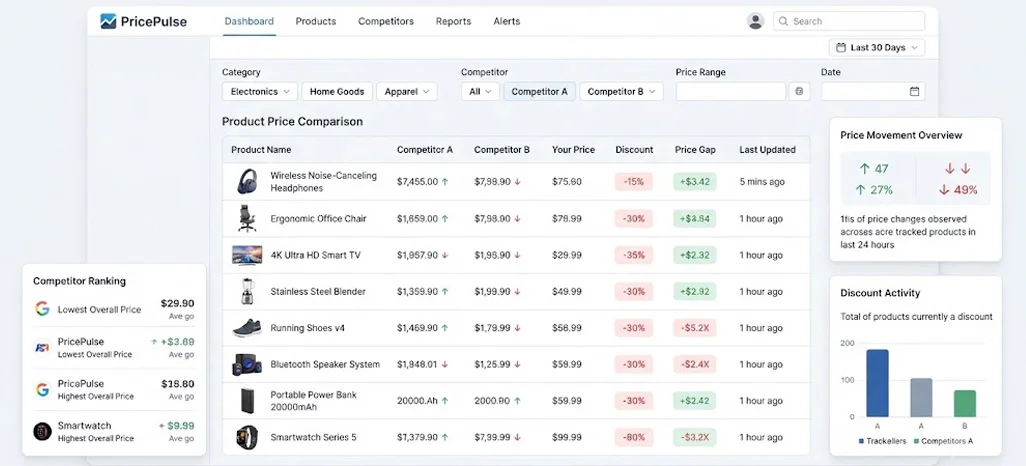
Competitive retail analysis becomes more effective when businesses can consistently observe how rival sellers adjust their product prices. Pricing changes may occur because of promotions, inventory conditions, seasonal demand, or strategic repositioning. Continuous collection allows retailers to compare these movements over defined periods and identify changes that could influence their own pricing decisions.
Through Competitor Price Monitoring for Ecommerce, businesses can organize competitor listings and evaluate differences between comparable products. This process can reveal recurring discount patterns, significant price gaps, and changes among leading sellers. Such information gives pricing teams a practical reference point when reviewing product positioning and deciding whether existing prices remain appropriate within competitive categories.
Another important area involves Ecommerce Competitor Price Tracking, which enables businesses to maintain structured records of competitor movements instead of relying on isolated observations. Regular comparisons can help teams recognize products that experience frequent price changes and categories where competitive pressure remains high. Ecommerce Price Tracking can also support scheduled data collection across selected websites, creating a consistent stream of information for recurring analysis.
Retailers can use competitive pricing information for several practical activities:
- Comparing equivalent products across sellers
- Reviewing competitor discount movements
- Identifying frequently changing products
- Monitoring category-level price differences
- Supporting promotional planning
- Maintaining historical competitor records
| Competitive Area | Analytical Purpose |
|---|---|
| Seller Pricing | Position comparison |
| Promotions | Discount evaluation |
| Product Matching | Comparable analysis |
| Market Movement | Trend identification |
By bringing these activities into one organized workflow, pricing teams can spend less time gathering scattered information and more time interpreting market behavior. Continuous comparison also supports stronger reporting, helping decision-makers understand competitive movements before adjusting product pricing, promotional strategies, or category priorities.
Converting Pricing Signals Into Actionable Retail Strategies
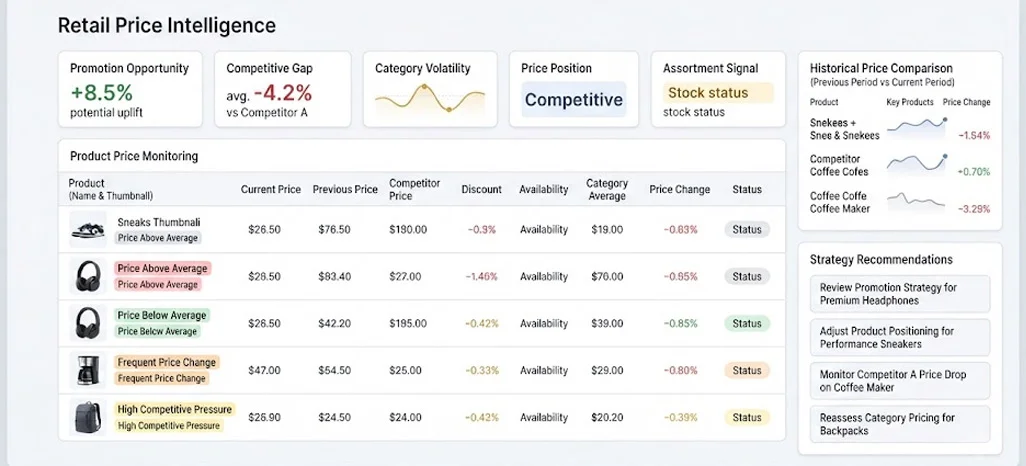
Pricing information becomes more valuable when businesses can connect individual changes with broader market behavior. Historical records allow retailers to examine recurring patterns, compare current conditions with previous periods, and identify categories experiencing stronger competitive pressure. This makes pricing analysis more useful for strategic planning rather than limiting it to basic price comparisons.
With Product Price Monitoring for Retailers, teams can evaluate individual product movements alongside discounts, seller changes, and availability information. This broader view helps distinguish temporary promotional changes from longer-term pricing patterns. Businesses can also identify products that frequently move above or below category averages, creating useful signals for reviewing assortment and promotional decisions.
A structured Retail Price Intelligence process can connect historical observations with current market conditions and product-level performance. Meanwhile, businesses can use pricing records to evaluate how frequently competitors adjust prices and whether specific categories experience stronger volatility. These insights can contribute to better planning around promotions, product positioning, category management, and competitive benchmarking.
Important applications of pricing analysis include:
- Evaluating historical product movements
- Identifying recurring pricing patterns
- Comparing category-level performance
- Reviewing competitor adjustment frequency
- Supporting promotional planning
- Improving competitive benchmarking
| Strategic Factor | Business Use |
|---|---|
| Historical Data | Pattern evaluation |
| Price Variation | Market assessment |
| Category Activity | Strategic planning |
| Competitor Movements | Benchmarking |
Combining these signals gives retailers a more complete view of digital market conditions. Instead of reacting to individual price changes without context, teams can assess historical and current information together. This supports more consistent decisions while helping businesses refine pricing strategies, evaluate competitive positioning, and prioritize categories requiring closer attention.
How Retail Scrape Can Help You?
We can support structured pricing workflows by collecting relevant product information from multiple online sources. With E-Commerce Price Monitoring integrated into a broader data process, retailers can compare pricing movements, review competitor activity, and organize information for recurring analysis.
Automated collection can reduce repetitive manual checks while providing consistent datasets for pricing teams and analysts.
Key capabilities can include:
- Automated collection of product pricing information
- Scheduled monitoring across selected retail websites
- Structured product and competitor data organization
- Historical datasets for trend comparison
- Identification of discounts and promotional changes
- Scalable workflows for large product catalogs
We can also connect collected information with broader Ecommerce Data Intelligence workflows, enabling businesses to evaluate pricing alongside product attributes, availability, seller information, and category trends. This structured approach helps teams transform scattered online information into datasets that can support reporting, competitor benchmarking, pricing strategy, and market research.
Conclusion
Effective pricing strategies depend on timely information, consistent comparisons, and a clear understanding of competitor behavior. E-Commerce Price Monitoring enables retailers to evaluate market movements, identify pricing gaps, and respond to changing commercial conditions with greater confidence. It also creates a structured foundation for recurring pricing analysis across competitive online channels.
When supported by Retail Price Intelligence for Ecommerce, pricing teams can connect competitor movements with broader market patterns and product-level decisions. Ready to strengthen your retail pricing strategy? Connect with Retail Scrape to build a structured e-commerce price monitoring solution tailored to your business needs.