


What Makes Blinkit Data Scraping Bangalore Useful for Packed Grocery Pricing and Inventory Analysis?
Introduction
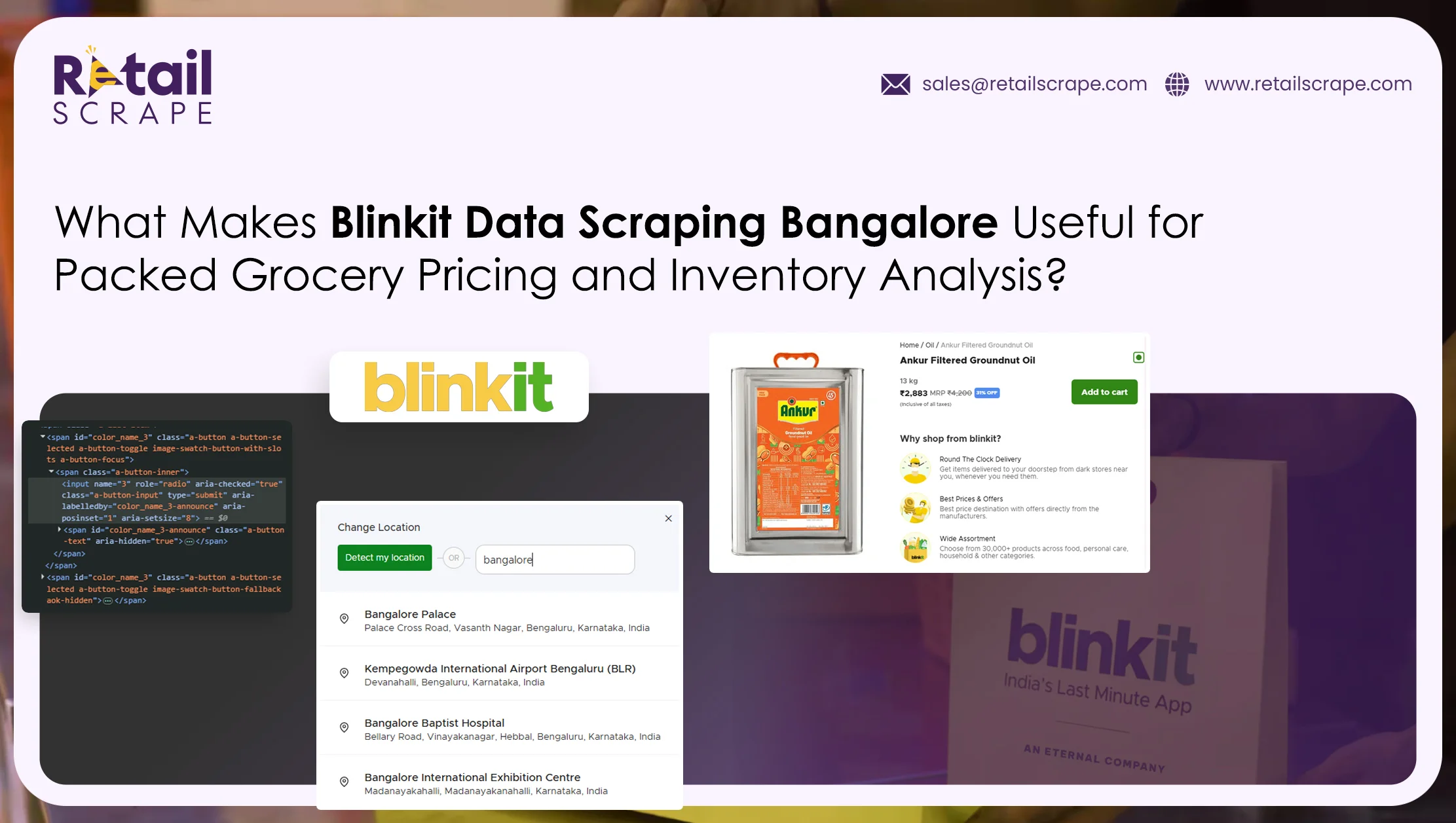
Bangalore’s quick-commerce ecosystem operates at breakneck speed, where packed grocery prices and stock levels fluctuate multiple times a single day. For FMCG brands and retail aggregators, relying on manual tracking creates massive blind spots. Implementing Blinkit Data Scraping Bangalore solves this challenge by capturing real-time digital shelf movements across diverse urban neighborhoods.
Understanding micro-market dynamics requires granular visibility into every dark store operating within the city. By deploying Blinkit Product Data Scraping, businesses can systematically monitor competitor discounting, SKU assortments, and localized demand spikes. This structured intelligence transforms raw storefront listings into actionable strategies for commercial teams.
Instead of reacting late to stockouts or aggressive markdowns, decision-makers can anticipate market shifts immediately. Integrating Blinkit SKU Data Scraping into daily analytics workflows ensures brands maintain optimal pricing parity, protect profit margins, and capture maximum market share in India’s competitive tech capital.
Evaluating Hyperlocal Discount Patterns Across Neighborhood Dark Stores
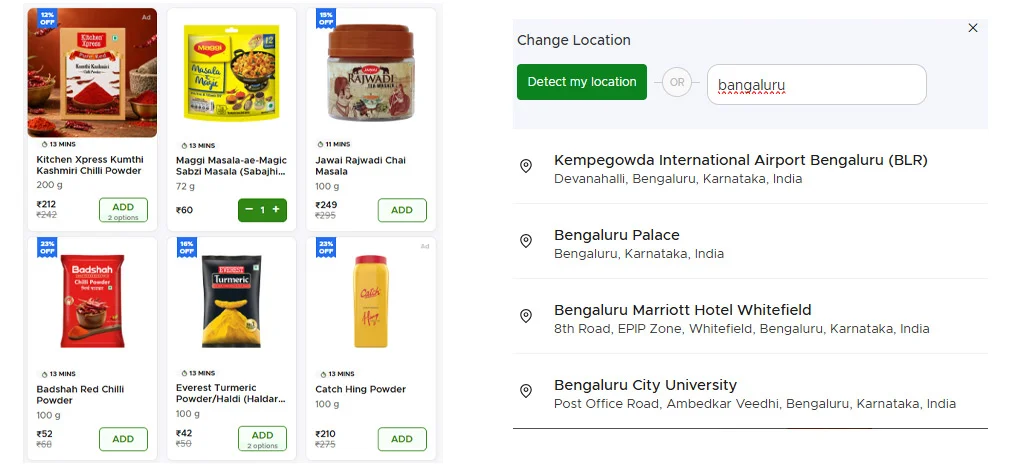
Quick-commerce platforms dynamically adjust product pricing based on neighborhood demographics, local competition, and real-time order velocity across every residential zone. A single packet of biscuits or cooking oil frequently carries three distinct selling prices across Indiranagar, Koramangala, and Whitefield simultaneously. Conducting Bangalore Quick Commerce Product Price Tracking reveals these subtle micro-market pricing tiers, enabling commercial brands to evaluate whether regional promotions genuinely drive incremental volume or simply erode baseline profit margins.
Recent industry benchmarks indicate that packed grocery discounts on instant delivery platforms in Tier-1 Indian cities fluctuate by 8% to 18% during weekend peak hours. Without automated visibility into Bangalore Pincode Wise Grocery Price Tracking, category managers remain completely unaware of unauthorized distributor discounting or sudden competitor price drops that divert consumer clicks away from flagship products.
Analyzing these localized pricing matrices allows revenue growth teams to calibrate promotional budgets with mathematical precision across diverse consumer segments. Implementing Blinkit SKU Data Scraping alongside regional sales logs ensures brands deploy targeted offers in high-elasticity zones while preserving full-price realizations in high-loyalty residential clusters.
- Monitor hourly discount fluctuations across high-volume residential and IT corridor neighborhoods.
- Identify unauthorized price undercutting by competing regional distributors in real time.
- Measure promotional price elasticity to optimize trade spend and protect baseline margins.
| Bangalore Micro-Market (Pincode) | Avg. Packed Grocery Discount (%) | Daily Price Change Frequency | Top Volatile Categories |
|---|---|---|---|
| Koramangala (560034) | 14.2% | 3.4 times/day | Ready-to-Eat, Gourmet Snacks |
| Indiranagar (560038) | 12.8% | 2.9 times/day | Beverages, Dairy & Breakfast |
| Whitefield (560066) | 16.5% | 4.1 times/day | Staples, Cooking Oils, Pulses |
| Electronic City (560100) | 15.1% | 3.2 times/day | Instant Noodles, Biscuits |
| Jayanagar (560041) | 10.4% | 1.8 times/day | Traditional Spices, Condiments |
Sustaining long-term profitability requires continuous surveillance of competitor pricing algorithms rather than periodic manual audits. By aligning trade promotions with verified hyperlocal storefront data, consumer brands eliminate wasted marketing expenditure and strengthen retail partnerships across the city.
Monitoring Real-Time Shelf Availability and Preventing Stockouts
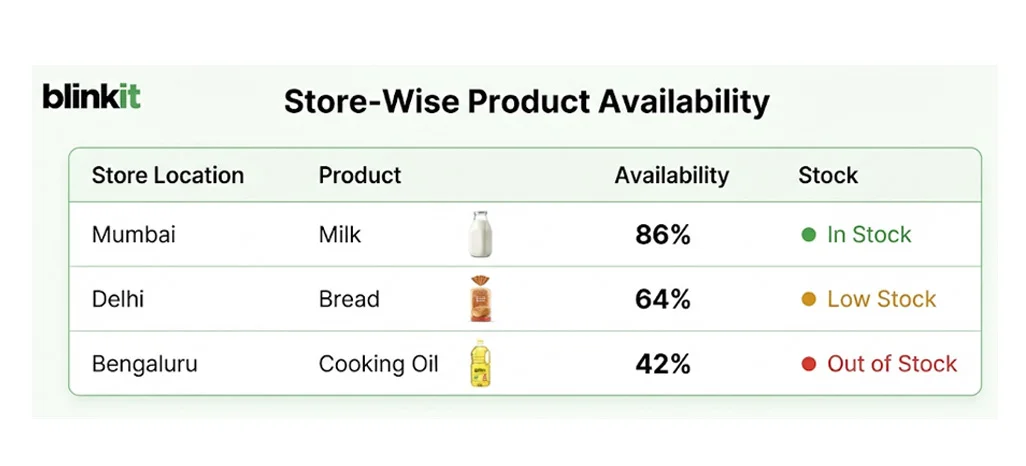
Stockouts in quick commerce represent immediate, irreversible lost sales because shoppers rarely wait for restocks when alternative brands arrive within ten minutes. Deploying Blinkit Store-Wise Product Data extraction allows supply chain planners to track SKU availability at the exact dark store level across every commercial hub. Monitoring these granular stock signals helps manufacturers identify fulfillment bottlenecks before entire city zones go dark on high-demand consumer staples.
Data from urban quick-commerce audits shows that top-selling packed grocery items face an average out-of-stock rate of 11.5% during evening rush hours between 6:00 PM and 9:00 PM. When a primary item becomes unavailable, 68% of instant delivery shoppers immediately switch to a competing brand rather than abandoning their digital cart. Utilizing Blinkit Grocery SKU Price Monitoring Services alongside availability tracking provides an early warning system, alerting account managers whenever dark store inventory drops below critical thresholds.
By correlating dark store stockouts with regional weather patterns, festival surges, and monthly payday cycles, brands can optimize warehouse replenishment schedules effectively. Leveraging Blinkit Product Data Scraping ensures supply chain teams maintain uninterrupted digital shelf visibility when consumer purchase intent reaches its absolute peak.
- Detect dark store stockouts immediately during evening rush hours and weekend demand surges.
- Prevent revenue leakage caused by high brand-switching rates among convenience-focused urban shoppers.
- Align warehouse dispatch schedules with localized restock turnaround cycles across key pincodes.
| Packed Grocery Sub-Category | Peak Hour Stockout Rate (%) | Avg. Restock Turnaround (Hours) | Brand Switching Probability (%) |
|---|---|---|---|
| Packaged Dairy & Paneer | 15.4% | 6.5 hrs | 74% |
| Chips, Namkeen & Snacks | 12.1% | 8.0 hrs | 71% |
| Cold Beverages & Juices | 13.8% | 7.2 hrs | 69% |
| Biscuits & Cookies | 8.4% | 11.5 hrs | 62% |
| Packaged Atta & Rice | 6.9% | 14.0 hrs | 58% |
Proactive inventory intelligence bridges the communication gap between regional distributors and centralized manufacturing plants. When brands eliminate recurring stockouts at the neighborhood level, they naturally boost organic search rankings and build lasting consumer trust on rapid delivery apps.
Optimizing Product Assortments and Benchmarking New Launches
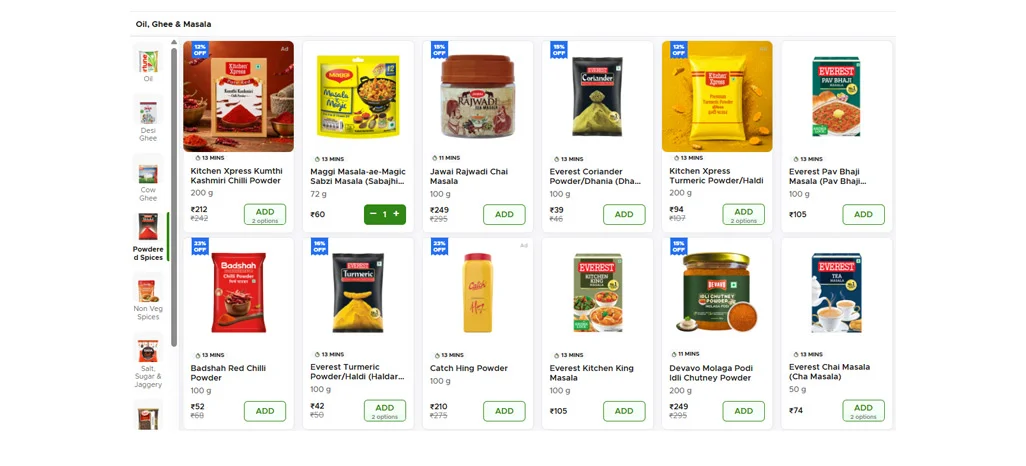
Launching a new packed grocery variant requires continuous monitoring of shelf placement, pack-size preferences, and initial consumer traction across varied demographics. When brands Scrape Blinkit Packed Grocery Product Data, they gain immediate visibility into which pack sizes—such as single-serve pouches versus family multipacks—dominate search rankings across different Bangalore localities.
Market intelligence studies reveal that quick-commerce baskets in tech-heavy corridors favor smaller, convenience-sized packs, whereas suburban residential areas exhibit a 42% higher conversion rate for bulk value packs. Integrating a Blinkit Product Data API for Grocery Analytics directly into internal BI dashboards enables category teams to benchmark their share of digital shelf against emerging D2C challengers and legacy FMCG giants alike.
Tracking competitor product launches, rating velocity, and promotional banner placements allows marketing teams to refine keyword targeting and ad spend efficiently. Utilizing an Automated Blinkit Grocery Data Collection API enables brands to spot emerging flavor trends early and accelerate distribution into high-performing dark stores.
- Compare pack-size performance between bachelor-dominated IT hubs and family-oriented residential neighborhoods.
- Track competitor new product launches, customer rating velocity, and digital banner placements.
- Identify underserved dietary niches such as high-protein, gluten-free, or sugar-free packaged snacks.
| Pack Size Format | Preferred Bangalore Zones | Avg. Search Rank Position | Repeat Order Index (Out of 100) |
|---|---|---|---|
| Single-Serve / Trial Packs | HSR Layout, Bellandur | Top 5 | 84 |
| Standard Mid-Size Packs | Marathahalli, Malleshwaram | Top 8 | 89 |
| Family / Value Multipacks | Yelahanka, Sarjapur Road | Top 6 | 92 |
| Combo & Bundled Offers | Hebbal, Banashankari | Top 4 | 87 |
Data-driven assortment planning ensures every square inch of digital shelf space generates maximum return on investment. By tailoring SKU catalogs to match local neighborhood preferences, FMCG companies outperform static competitors and capture loyal repeat buyers effortlessly.
How Retail Scrape Can Help You?
Navigating the fast-moving quick-commerce landscape requires robust data infrastructure capable of handling frequent storefront updates and complex anti-bot mechanisms. Our specialized Blinkit Data Scraping Bangalore solutions empower FMCG brands, retail analysts, and pricing teams with clean, structured, and real-time market intelligence.
Our enterprise-grade Blinkit Grocery Scraper handles multi-pincode extraction seamlessly, ensuring you never miss critical digital shelf shifts across India’s leading tech hub:
- Capture real-time selling prices, MRP variations, and active promotional discounts across hundreds of urban pincodes simultaneously.
- Monitor exact dark store stock statuses and out-of-stock frequencies to prevent sudden revenue leakage during peak shopping hours.
- Track digital shelf positioning, sponsored ad placements, and organic search rankings for your entire product catalog.
- Benchmark competitor SKU assortments, pack-size distributions, and new product launches across specific residential and commercial clusters.
- Receive normalized, ready-to-analyze datasets delivered directly in JSON, CSV, or Parquet formats without engineering overhead.
- Scale extraction volumes effortlessly during festive sales, weekend surges, and major promotional events with guaranteed uptime.
By integrating our Automated Blinkit Grocery Data Collection API directly into your existing BI tools, your team gains continuous visibility to make faster, smarter pricing and supply chain decisions.
Conclusion
Winning in Bangalore’s hyper-competitive quick-commerce sector demands precision, speed, and continuous visibility into localized storefront dynamics. By adopting Blinkit Data Scraping Bangalore, commercial teams transform fragmented digital shelf signals into a cohesive, real-time intelligence engine that protects margins and drives sustainable category growth.
Equipping your analytics pipeline with structured market feeds ensures every pricing adjustment and inventory allocation is backed by empirical evidence. When you Scrape Blinkit Packed Grocery Product Data consistently, you empower your brand to anticipate consumer demand, optimize dark store replenishment, and outperform competitors across every neighborhood. Connect with the Retail Scrape team today to schedule a custom data demo and elevate your quick-commerce intelligence strategy.