
How does Competitor Assortment Intelligence for Retail Brands Help Optimize Assortment Planning?

Introduction
Retail success depends on offering the right products at the right time while responding quickly to changing customer preferences and competitor strategies. Traditional assortment planning often relies on historical sales data, which may not accurately reflect real-time market shifts. Modern retailers require continuous visibility into product availability, pricing trends, category expansion, and emerging consumer demand across competing brands.
One of the most effective approaches is Retail Assortment Optimization With Web Scraping, which provides structured market intelligence from multiple online retail platforms. By collecting competitor product information, brands can compare assortments, identify missing categories, evaluate pricing consistency, and recognize fast-moving products before market opportunities are lost.
Competitor Assortment Intelligence for Retail Brands helps retailers transform large volumes of competitive data into actionable business insights. As retail markets become increasingly data-driven, organizations that continuously monitor assortment performance are better positioned to improve customer experiences, increase revenue, and maintain long-term competitiveness in rapidly changing retail environments.
Building Smarter Product Strategies Through Competitive Market Evaluation
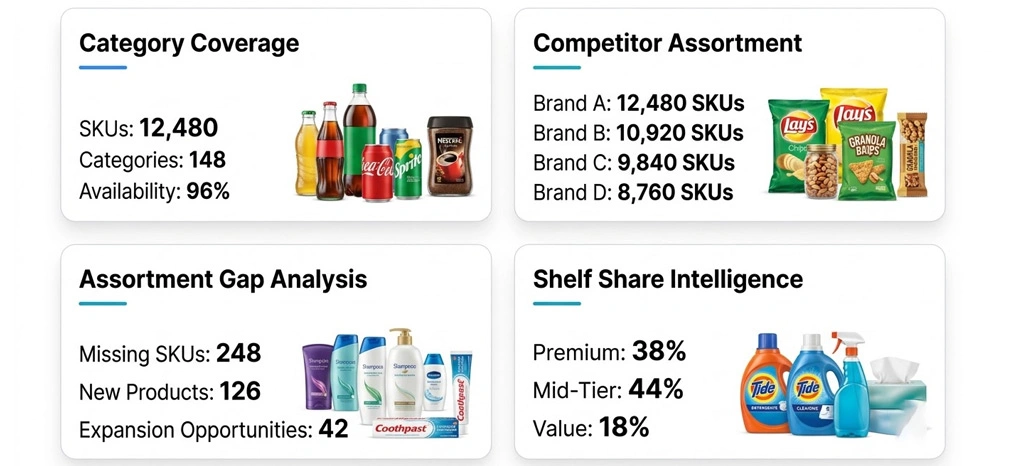
Retailers face growing challenges in maintaining an assortment that matches changing customer expectations while remaining competitive across multiple channels. Depending solely on internal sales reports often leaves businesses unaware of competitor assortment changes until market share is affected. Alongside Real-Time Competitor Price Monitoring, businesses can evaluate both pricing behavior and assortment changes to support more responsive merchandising strategies.
Industry studies indicate that nearly 65% of consumers compare products across several retailers before making a purchase, while organizations using competitive assortment analytics improve inventory efficiency by more than 20%. These insights help merchandising teams identify assortment gaps, improve category planning, and reduce lost sales opportunities.
Using Competitor Assortment Intelligence, retailers receive structured insights into competitor product portfolios, making it easier to evaluate assortment depth, identify missing SKUs, and compare category coverage. Likewise, Competitor Assortment Datasets provide continuously updated product information that supports forecasting, merchandising improvements, and inventory optimization without relying on manual monitoring.
| Challenge | Business Impact | Data-Driven Solution |
|---|---|---|
| Missing products | Reduced customer retention | Identify assortment gaps quickly |
| Category limitations | Lower competitiveness | Compare competitor categories |
| Manual product tracking | Slow decision-making | Automated competitive monitoring |
| Inventory imbalance | Overstock and shortages | Improve planning accuracy |
| Product introductions | Delayed market response | Monitor assortment expansion |
Continuous competitive visibility enables retailers to make informed assortment decisions, improve inventory alignment, respond faster to changing consumer preferences, and strengthen long-term merchandising performance through reliable competitive intelligence.
Enhancing Merchandising Decisions With Continuous Competitive Analysis
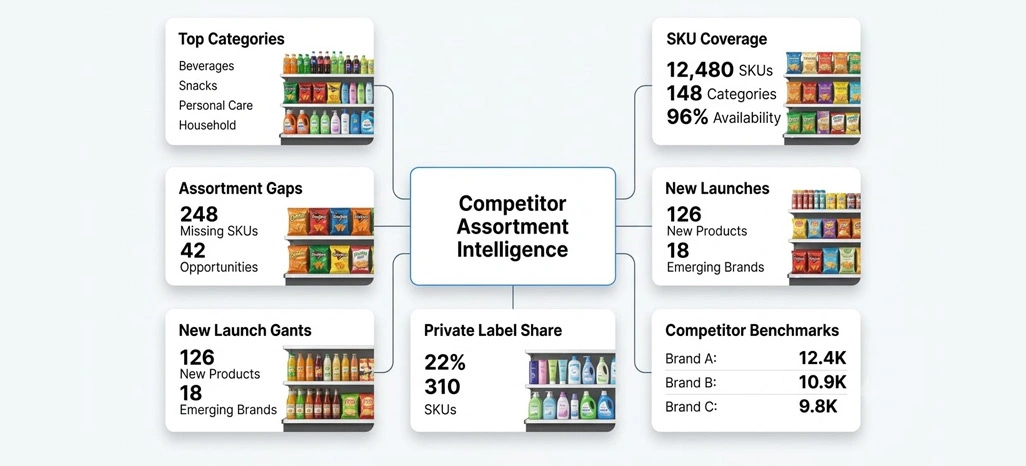
Successful assortment planning depends on understanding how competing retailers continuously modify product portfolios, introduce seasonal collections, and adjust category strategies. Through Competitor Pricing and Assortment Intelligence, retailers evaluate pricing movements together with assortment changes, enabling balanced merchandising decisions that support both profitability and customer satisfaction.
Additionally, Assortment Intelligence for Retailers helps organizations compare product depth, monitor assortment consistency, and evaluate category performance across competing retailers. Research suggests that retailers using advanced competitive assortment analytics improve category profitability by nearly 18% while significantly reducing inventory inefficiencies through more accurate demand forecasting.
Businesses also benefit from Scrape Competitor Product Assortment Analysis, which automates competitor product collection across numerous retail platforms. This process provides structured competitive information for benchmarking assortments, identifying assortment gaps, and monitoring category expansion without extensive manual effort.
| Planning Objective | Competitive Insight | Business Outcome |
|---|---|---|
| Category expansion | New product additions | Better assortment diversity |
| Seasonal planning | Product launch timing | Improved forecasting |
| SKU optimization | Low-performing products | Inventory efficiency |
| Promotional strategy | Competitor campaigns | Smarter merchandising |
| Lifecycle monitoring | Product portfolio changes | Faster strategic planning |
Consistent competitive analysis enables retailers to respond proactively to evolving market trends, improve category planning, and strengthen merchandising strategies through reliable, data-driven decision-making.
Transforming Competitive Product Data Into Better Decisions
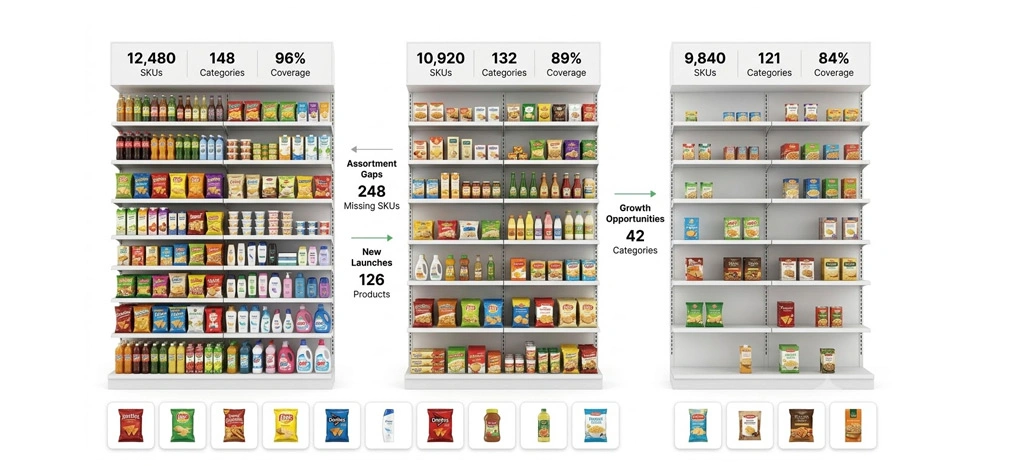
Retail assortment planning becomes more effective when businesses automate the collection and analysis of competitor product information instead of relying on periodic manual reviews. Continuous market monitoring provides merchandising teams with updated insights into assortment changes, category performance, and product availability across multiple retail channels.
Industry estimates show that automated competitive intelligence reduces assortment evaluation time by more than 70%, allowing retailers to dedicate greater resources to strategic planning and customer-focused merchandising initiatives. Automated monitoring also improves consistency by eliminating delays associated with manual competitor research.
Using Web Scraping API Retail Assortment, retailers automate product collection across multiple websites while maintaining standardized datasets that simplify analysis and benchmarking. Furthermore, Competitor Catalog Analysis enables organizations to compare product depth, SKU diversity, category coverage, brand representation, and assortment consistency across competing retailers to identify strategic opportunities for improvement.
| Strategic Activity | Competitive Data Used | Result |
|---|---|---|
| SKU benchmarking | Product catalog comparison | Balanced assortments |
| Brand evaluation | Brand distribution | Better supplier planning |
| Category analysis | Product diversity | Stronger category management |
| Regional comparison | Local assortments | Improved localization |
| Product monitoring | Continuous assortment updates | Faster competitive response |
Automated competitive intelligence also supports Retail Market Intelligence Solutions, providing retailers with comprehensive market visibility that strengthens assortment planning, improves inventory management, reduces manual effort, and enables more confident merchandising decisions based on continuously updated competitive data.
How Retail Scrape Can Help You?
Successful retail growth depends on reliable competitive intelligence supported by accurate market data. Businesses using Competitor Assortment Intelligence for Retail Brands can continuously evaluate product availability, assortment gaps, pricing consistency, and merchandising opportunities across multiple retail channels while improving strategic planning.
Our solutions help organizations:
- Automate product assortment collection across retailers.
- Monitor category expansion and discontinued products.
- Improve merchandising and inventory planning.
- Benchmark product portfolios efficiently.
- Support faster strategic decision-making.
- Generate structured competitive datasets for analysis.
Our experts also provide Competitor Assortment Price Intelligence alongside Retail Market Intelligence Solutions to help retailers transform competitive market data into meaningful business insights that improve assortment optimization and long-term growth.
Conclusion
Retailers operating in competitive markets require continuous visibility into changing product assortments to make informed merchandising decisions. By adopting Competitor Assortment Intelligence for Retail Brands, businesses improve forecasting accuracy, reduce inventory risks, and strengthen long-term assortment planning while responding more effectively to evolving customer demand.
Data-driven assortment planning becomes significantly more valuable when supported by Competitor Catalog Analysis, enabling retailers to benchmark competitors with greater precision and improve strategic decisions across every product category. Contact Retail Scrape today to build smarter assortment strategies powered by reliable competitive intelligence.
Effortlessly managing intricacies with customized strategies.
Mitigating risks, navigating regulations, and cultivating trust.
Leveraging expertise from our internationally acclaimed team of developers
Reliable guidance and assistance for your business's advancement