

What Benefits Can Building Scalable Data Pipelines for Mobile App Data Extraction Deliver to Enterprises?
Introduction
Enterprises today rely on application-based ecosystems to understand customer engagement, digital transactions, and platform-level trends. Mobile apps generate large volumes of data every second, from user behavior and pricing changes to review patterns and competitor activities. Extracting this information manually creates delays, limits scalability, and introduces gaps in strategic decision-making.
As businesses expand across markets, demand for automated collection frameworks has increased. Structured pipelines make it possible to collect, transform, and analyze millions of records from multiple applications in near real-time. In sectors like eCommerce, finance, and entertainment, app data is often the first source for identifying market changes and user expectations. The rise of Mobile Data Scraping Solutions supports this need by enabling high-volume collection across diverse mobile platforms.
According to industry estimates, over 80% of enterprises now prioritize app intelligence for digital transformation initiatives. Integrating Building Scalable Data Pipelines for Mobile App Data Extraction allows companies to convert scattered app records into usable datasets that support market expansion, pricing intelligence, and user trend mapping across global digital ecosystems.
Streamlining Enterprise App Intelligence Through Structured Collection Systems
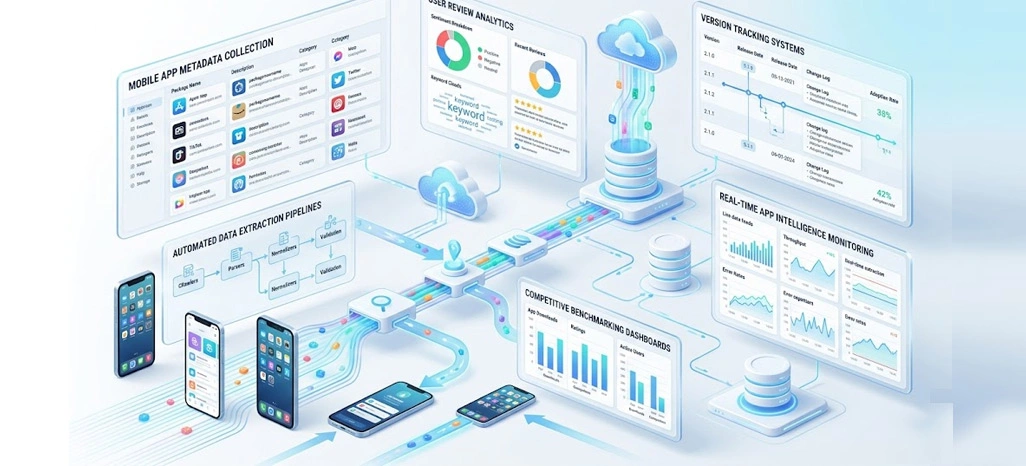
Enterprises increasingly depend on mobile applications as primary channels for customer interaction, digital transactions, and service delivery. However, extracting large-scale app information manually often creates fragmented datasets, delayed reports, and operational inefficiencies. Structured extraction frameworks help standardize millions of app records into organized datasets that support business forecasting and competitive benchmarking. Integrating Mobile App Data Extraction into centralized workflows ensures better access to application-level insights across departments.
According to recent market studies, over 78% of enterprises use app analytics to guide digital product decisions. This growing dependence requires infrastructure that can process large data streams from app stores, user reviews, and product updates. By using Web Scraping Pipelines, organizations can connect mobile applications with web datasets for broader competitive intelligence. When supported by App Data Scraping, enterprises reduce manual effort while improving reporting consistency.
The adoption of Data Extraction Pipelines supports the collection of app metadata, version changes, and user feedback without interruption. Enterprises can connect extracted information to internal reporting systems and automate decision-making processes. Advanced systems powered by Automated Data Pipelines further reduce delays in operational reporting. Such structured workflows allow business teams to respond faster to shifts in customer demand and app ecosystem trends.
| Business Challenge | Structured Solution |
|---|---|
| Fragmented app data | Centralized workflows |
| Manual collection | Automated systems |
| Delayed analysis | Faster reporting |
| Disconnected datasets | Unified storage |
Enterprises that implement these systems often achieve over 60% improvement in analytics turnaround. This ensures better strategic planning and stronger visibility into mobile ecosystem changes across multiple markets.
Enabling Continuous Monitoring for Faster Business Decisions
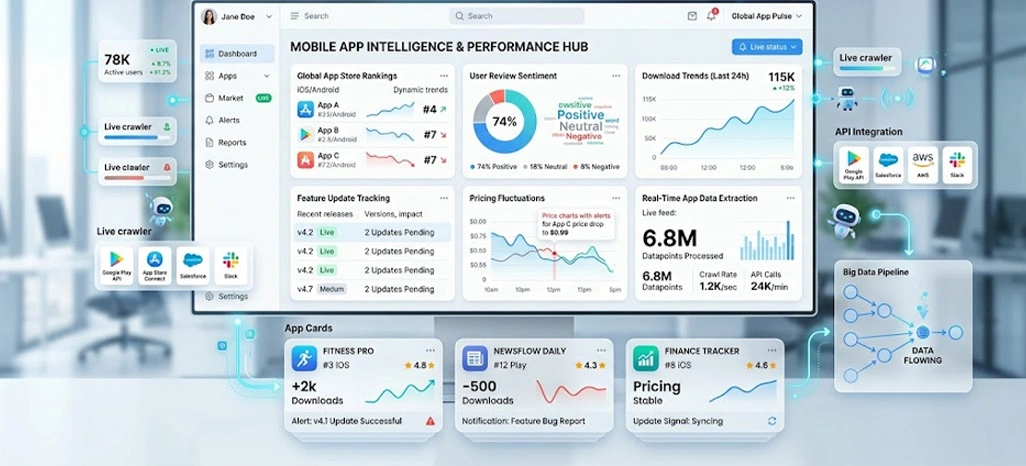
Mobile app ecosystems evolve rapidly with daily feature releases, user reviews, and ranking fluctuations. Businesses relying on delayed app reports often miss critical market changes that affect pricing, promotions, and customer engagement. Continuous monitoring frameworks allow organizations to capture live app intelligence as events occur. Real-time systems help convert application activity into business-ready insights.
Studies indicate enterprises using live monitoring systems improve strategic response times by nearly 42%. Through Mobile App Scraping API, businesses can capture application metadata, feature changes, and review updates instantly. This ensures decision-makers receive current intelligence without depending on manual processes. When integrated with Live Crawler, enterprises can collect app store information continuously across regions.
The implementation of Real-Time Mobile Data Extraction System enhances visibility into user reviews, pricing adjustments, and download trends. Organizations also use Data Pipeline for App Scraping Automation to synchronize data ingestion with dashboards. This reduces latency between extraction and analysis. Large enterprises further combine these methods with Big Data Pipeline for Mobile App Scraping to process massive app datasets for enterprise intelligence.
| Monitoring Requirement | Business Result |
|---|---|
| Real-time updates | Faster actions |
| Review tracking | Sentiment insights |
| App ranking changes | Competitor benchmarking |
| Instant reports | Improved planning |
Continuous systems ensure enterprises remain informed about digital market changes, enabling faster responses to consumer behavior, competitor launches, and application performance shifts.
Strengthening Global Expansion with Flexible Data Infrastructure
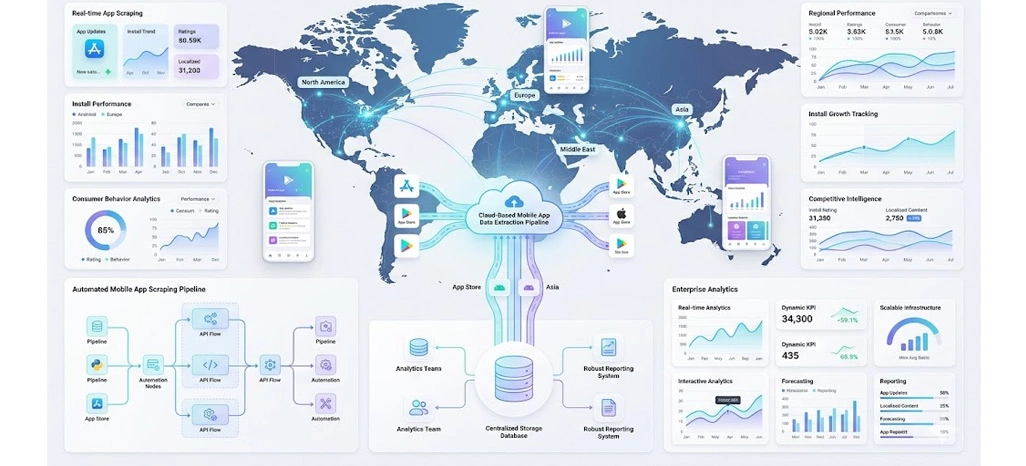
As businesses expand across regions, app ecosystems become increasingly complex. Enterprises must monitor regional apps, localized content, and customer preferences while managing large data volumes. Flexible extraction infrastructure supports this expansion by allowing organizations to process app data from multiple markets within unified systems.
Industry reports suggest organizations implementing scalable extraction systems improve operational efficiency by more than 55%. With Android App Scraping, enterprises can collect device-specific information such as app updates, install behavior, and feature adoption. This provides deeper insights into platform-specific performance. The use of Cloud-Based Mobile App Data Extraction Pipeline enables centralized storage, reducing infrastructure bottlenecks while improving access for analytics teams.
Modern enterprises also adopt Automated Mobile App Scraping Pipeline to streamline ingestion from diverse app stores and application ecosystems. Combined with centralized storage and processing, businesses create stronger reporting models that improve forecasting. Flexible infrastructure supports regional benchmarking, consumer trend analysis, and competitive intelligence without requiring repeated system changes.
| Expansion Goal | Infrastructure Support |
|---|---|
| Regional coverage | Unified pipelines |
| Multi-market analysis | Central reporting |
| Platform monitoring | Scalable systems |
| Forecasting | Historical insights |
Scalable frameworks ensure app intelligence remains accessible even as businesses enter new markets. This supports stronger strategic decisions, operational resilience, and continuous growth across digital ecosystems.
How Retail Scrape Can Help You?
Enterprises require strong technical partners to manage high-volume app data workflows across multiple regions. This makes Building Scalable Data Pipelines for Mobile App Data Extraction more practical for organizations seeking structured analytics and business intelligence.
We support enterprise operations through specialized solutions:
- App store intelligence collection
- Metadata transformation workflows
- Review and rating aggregation
- Competitive benchmarking systems
- Scalable cloud deployment
- Continuous monitoring support
Organizations can integrate extracted records into dashboards, reporting tools, and forecasting systems. With advanced support for Customer Sentiment Analysis, enterprises can understand review trends and user perceptions to enhance products and customer experiences.
Conclusion
Modern enterprises depend on automated systems to convert app interactions into actionable insights. As mobile ecosystems grow, Building Scalable Data Pipelines for Mobile App Data Extraction ensures companies maintain consistency, speed, and reliable market visibility across business operations.
Scalable systems improve analysis while reducing manual workloads. By combining structured frameworks with Mobile App Scraping API, organizations strengthen forecasting and digital strategy. Connect with Retail Scrape today to build scalable app intelligence systems tailored to your enterprise goals.