

How Does Beauty Product Price Intelligence Across Top Retailers Transform D2C Pricing Decisions?
Introduction
Beauty brands increasingly compete across marketplaces, retailer websites, and D2C storefronts where product prices can change frequently. For growing brands, comparing prices manually makes it difficult to identify competitive gaps, promotional patterns, and category movements. Beauty Care Product Data Scraping provides structured market information that supports faster and more informed pricing decisions.
A data-driven pricing approach helps D2C businesses compare products across skincare, cosmetics, haircare, fragrances, and personal care categories. Beauty Product Price Intelligence Across Top Retailers brings competitor pricing, discounts, product positioning, and availability into a centralized view, helping teams understand where their prices stand within the market.
Using Beauty Product Data Scraper solutions, brands can collect relevant product information at scale and organize it for analysis. This enables teams to evaluate price differences, identify recurring promotional trends, and refine pricing strategies according to market conditions instead of relying entirely on occasional manual checks.
Retail Pricing Signals That Strengthen D2C Decision Making
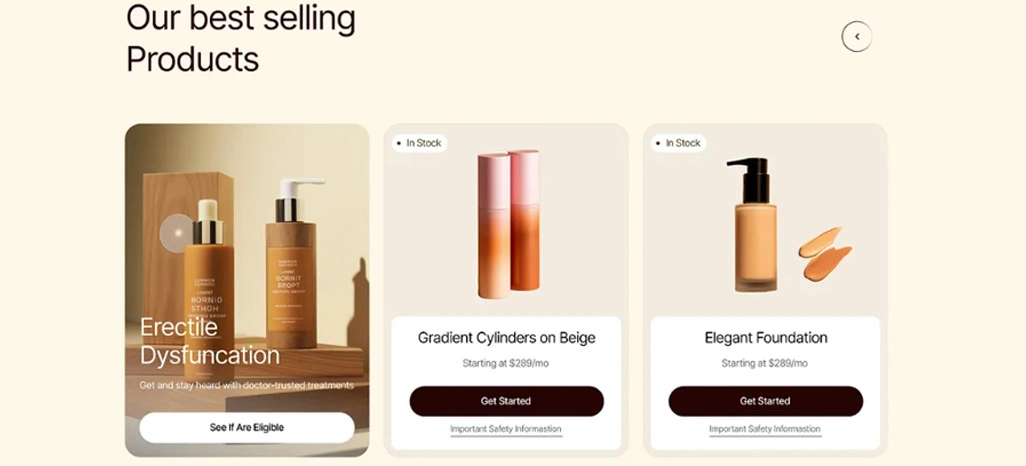
Beauty retailers frequently adjust prices according to promotions, demand, inventory, seasonal campaigns, and competitive activity. Real-Time Beauty Product Price Tracking helps D2C teams identify these changes quickly and compare their own positioning against market movements. Structured monitoring also helps businesses distinguish temporary promotional changes from recurring pricing patterns.
When teams Scrape Beauty Product Data, they can organize information such as selling prices, discounts, brands, pack sizes, ratings, and product categories for consistent comparison. This makes competitive research more systematic and helps pricing teams evaluate whether their products are positioned appropriately across different retailers and customer segments.
Several practical signals can strengthen pricing decisions:
- Current selling prices across comparable products
- Promotional discounts and changing offers
- Brand and category-level price differences
- Pack-size variations between competing products
| Pricing signal | D2C decision supported |
|---|---|
| Competitor pricing | Positioning analysis |
| Discount levels | Promotion planning |
| Product ratings | Value assessment |
| Category movement | Assortment planning |
The resulting Beauty Care Product Datasets can support historical comparisons and recurring analysis. Instead of relying on isolated observations, teams can evaluate market movements over time and identify pricing opportunities with greater consistency across selected beauty categories.
Connecting Product Availability With Competitive Pricing Insights
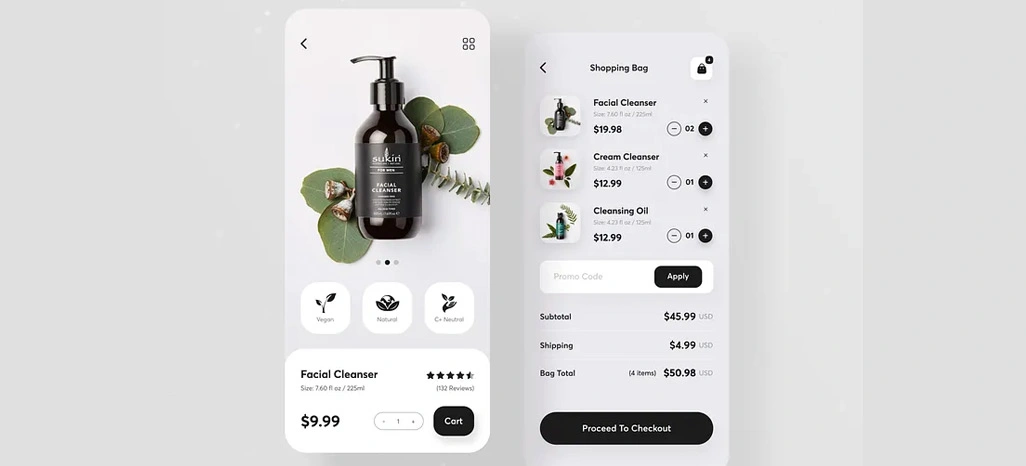
Price information becomes more meaningful when businesses also understand whether competing products are actually available. Real-Time Product Availability provides additional context for interpreting market differences because a lower competitor price may have limited commercial impact when that product is temporarily unavailable. This distinction supports more accurate competitive assessments.
Through Scraping Beauty Care Product Data, businesses can collect product-level information alongside availability indicators, pricing details, discounts, and other relevant attributes. Combining these signals helps teams understand whether pricing pressure is persistent, promotion-driven, or connected to inventory conditions across different online retail environments.
Important information can include:
- Product availability status across selected retailers
- Current and previous selling prices
- Listed discounts and promotional changes
- Product size and packaging information
| Data element | Business application |
|---|---|
| Stock status | Opportunity identification |
| Selling price | Market benchmarking |
| Listed MRP | Discount evaluation |
| Pack size | Product comparison |
This combined perspective can also improve promotional planning. Ecommerce Beauty Price Monitoring becomes more useful when availability and pricing are assessed together. Teams can identify competitors with aggressive pricing, understand whether their products remain purchasable, and determine where pricing changes may create opportunities for their own assortment.
When a competing SKU becomes unavailable, brands may reassess promotional intensity, inventory allocation, or price positioning. Such insights help D2C businesses respond to market conditions with greater precision rather than treating every price difference as an immediate competitive threat.
Converting Cross-Retailer Observations Into Strategic Pricing Actions
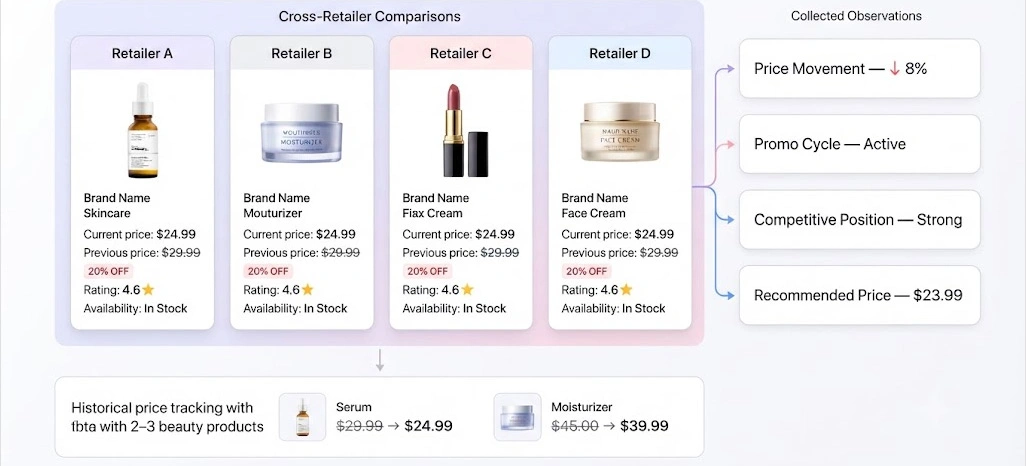
Beauty Price Tracking Using Web Scraping can turn scattered retailer observations into a structured workflow for D2C pricing teams. Instead of manually checking individual product pages, businesses can organize prices, discounts, brands, categories, ratings, and availability indicators for systematic analysis. This creates a stronger foundation for recurring market evaluation.
With Scrape Beauty Product Price Intelligence, teams can compare current observations against previous pricing records and identify recurring movements. Historical comparisons may reveal promotional cycles, frequent price adjustments, changing competitive positions, or category-level shifts that are difficult to recognize through occasional manual research.
Useful applications include:
- Comparing prices across selected retailer websites
- Identifying recurring promotional patterns
- Evaluating pricing gaps between similar products
- Supporting category-level price band analysis
| Intelligence area | Strategic application |
|---|---|
| Price differences | SKU repositioning |
| Promotion patterns | Campaign planning |
| Brand comparisons | Competitive evaluation |
| Category movements | Pricing refinement |
Competitor Price Monitoring for Beauty Brands can help commercial teams evaluate where their products sit within a broader market landscape. By combining comparable products with structured pricing observations, teams can prioritize SKUs that require attention and avoid making broad pricing changes without supporting evidence.
A repeatable data workflow also supports better collaboration between pricing, merchandising, marketing, and strategy teams. How to Track Beauty Product Prices becomes a more organized process when relevant observations are collected consistently, standardized, and prepared for analysis. This allows teams to turn retailer-level information into practical pricing actions.
How Retail Scrape Can Help You?
For D2C beauty companies, Beauty Product Price Intelligence Across Top Retailers can become a practical foundation for evaluating competitive positioning. We can support structured collection of product-level information from relevant online retail sources and organize it into datasets that pricing, marketing, merchandising, and strategy teams can use.
Key capabilities can include:
- Collecting product information across selected retailer sources
- Monitoring price changes across comparable beauty products
- Organizing category, brand, and SKU-level information
- Capturing promotional and discount-related information
- Supporting historical comparisons for pricing analysis
- Preparing structured outputs for dashboards and internal analytics
These capabilities help businesses create repeatable workflows instead of depending on fragmented manual checks. Ecommerce Beauty Price Monitoring can then be incorporated into regular commercial analysis, allowing teams to evaluate competitive movements and identify pricing opportunities with greater consistency.
For broader market intelligence, we also provide Beauty Care Product Datasets tailored to specific categories, retailers, regions, and product attributes. This supports Real-Time Beauty Price Monitoring while helping teams assess competitor pricing, promotions, assortment changes, and market trends.
Conclusion
Effective pricing requires more than knowing what a product costs today. D2C brands need context around competitor positioning, discounts, assortment, availability, and category movement. Beauty Product Price Intelligence Across Top Retailers brings these signals together so businesses can make pricing decisions using structured and comparable market information.
With Competitor Price Monitoring for Beauty Brands, teams can continuously evaluate market movements and identify where pricing strategies may need adjustment. A structured workflow also makes How to Track Beauty Product Prices more systematic across large product catalogs and multiple retail sources. Connect with Retail Scrape to build a customized beauty pricing intelligence solution for your D2C brand.