
How to Predict Demand Using AI Product Demand Prediction With Web Scraping USA With 90% Accuracy?
Introduction
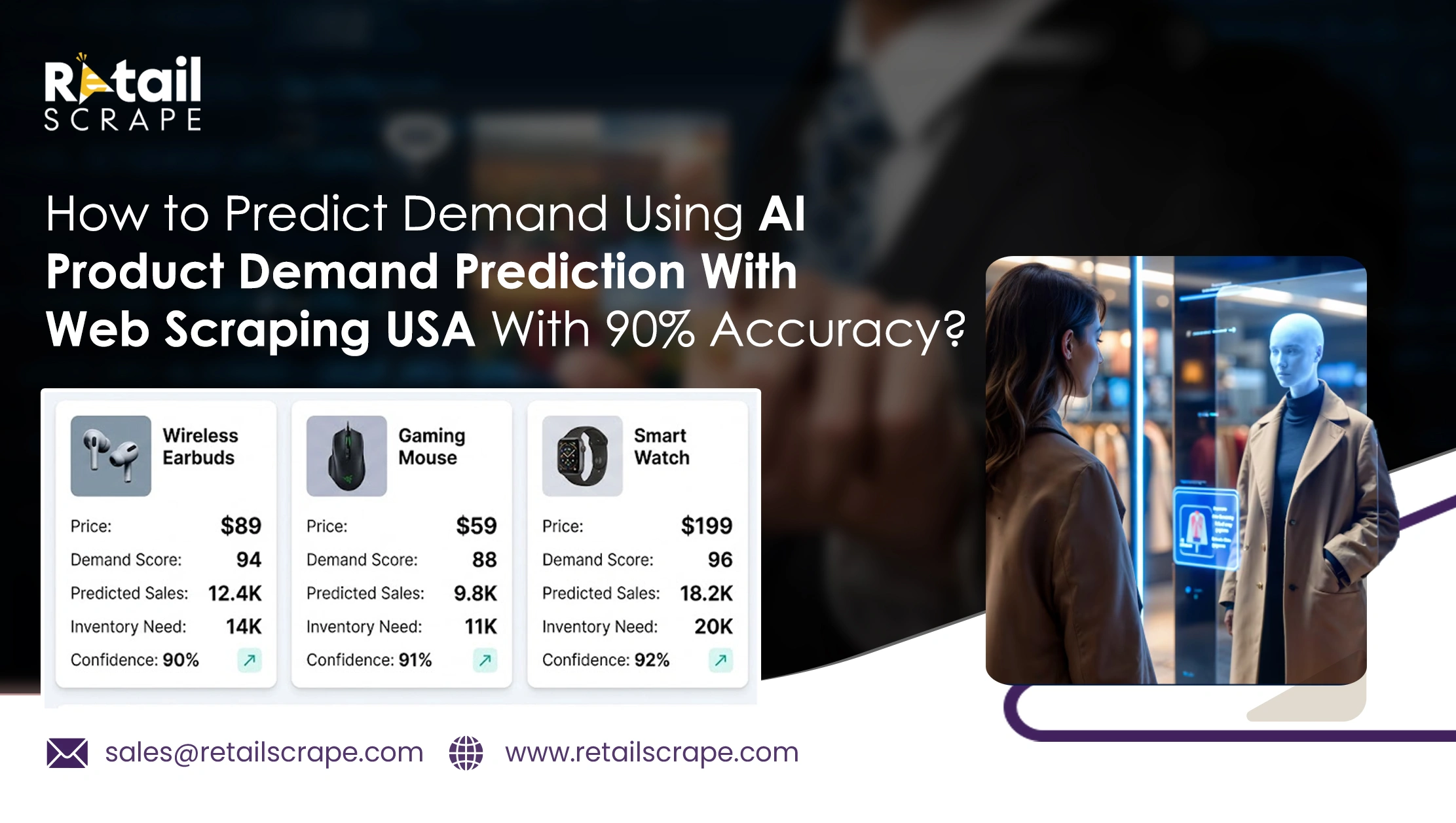
Accurate demand prediction has become one of the biggest competitive advantages for modern retailers, manufacturers, and ecommerce businesses. Consumer preferences, seasonal fluctuations, competitor pricing, and changing market trends make forecasting increasingly complex when businesses rely on traditional historical reports alone. Artificial intelligence combined with automated data collection enables organizations to analyze thousands of market signals in real time, helping them make faster and more confident inventory decisions.
Modern Web Scraping for Demand Prediction collects valuable information from ecommerce platforms, product listings, pricing updates, customer reviews, availability, and promotional campaigns. Combined with machine learning, these datasets reveal buying patterns that manual analysis often misses. Organizations using AI Product Demand Prediction USA can better anticipate customer behavior, improve purchasing decisions, and maintain optimal inventory levels throughout the year.
According to industry research, AI-powered forecasting can improve demand prediction accuracy by nearly 90%, reduce inventory costs by up to 30%, and minimize stock shortages by over 60%. As competition continues to increase, adopting AI Product Demand Prediction With Web Scraping USA provides companies with the insights needed to respond quickly to market changes while improving customer satisfaction and long-term business growth.
Building Smarter Strategies Through Early Market Demand Signals
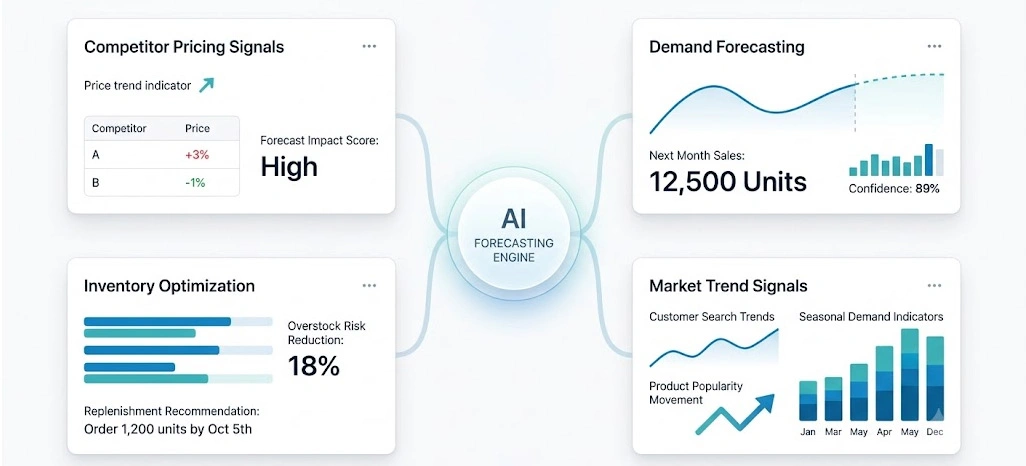
Businesses that rely solely on historical sales data often struggle to anticipate sudden market changes. Modern forecasting depends on collecting live ecommerce information that reflects customer interests, pricing trends, product availability, and seasonal buying behavior. Integrating Competitor Pricing Data Scraping into forecasting models allows businesses to identify competitor pricing adjustments before they influence customer purchasing decisions.
This proactive approach helps retailers optimize inventory planning while minimizing excess stock and preventing lost sales opportunities. At the same time, leveraging Retail Demand Forecasting Datasets enables AI models to analyze millions of structured records, including historical sales, customer searches, and marketplace performance, creating highly accurate forecasting outcomes.
According to industry research, organizations using AI-driven forecasting improve inventory accuracy by nearly 35%, reduce overstock by approximately 30%, and lower stockout incidents by more than 40%. These improvements support stronger operational efficiency while maintaining better customer satisfaction throughout the buying cycle.
| Market Indicator | Business Impact |
|---|---|
| Competitor price changes | Faster purchasing decisions |
| Inventory movement | Better stock planning |
| Seasonal buying patterns | Improved forecasting |
| Customer demand signals | Higher inventory accuracy |
| Historical sales trends | Smarter replenishment planning |
As ecommerce competition becomes increasingly data-driven, organizations that invest in advanced demand forecasting technologies build greater resilience against market uncertainty while improving profitability through informed inventory management and smarter purchasing strategies.
Improving Operational Efficiency Through Continuous Market Intelligence
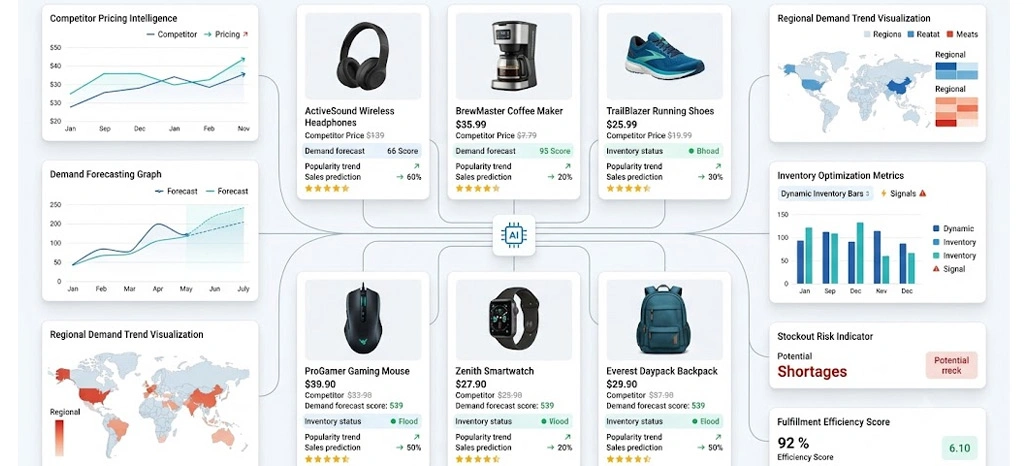
Inventory management becomes significantly more effective when businesses combine artificial intelligence with continuously updated marketplace information. Incorporating Competitor Pricing Intelligence enables businesses to understand how pricing strategies influence consumer purchasing decisions while responding rapidly to competitive market conditions.
In addition, Retail Demand Forecasting USA provides localized forecasting capabilities that account for regional purchasing behavior, seasonal demand variations, and changing consumer preferences across diverse retail categories. Studies indicate that businesses using predictive AI reduce inventory carrying costs by nearly 20%, improve fulfillment efficiency by over 35%, and increase forecast precision through continuous market monitoring.
These improvements strengthen inventory optimization while reducing operational risks associated with overstocking or stock shortages. AI models also learn from ongoing marketplace behavior, enabling forecasting systems to become increasingly accurate over time without requiring constant manual adjustments.
| AI Insight | Operational Benefit |
|---|---|
| Regional demand analysis | Improved purchasing accuracy |
| Pricing intelligence | Faster competitive response |
| Inventory optimization | Lower warehouse expenses |
| Promotion tracking | Better campaign planning |
| Consumer behavior monitoring | Higher fulfillment efficiency |
This data-driven approach improves purchasing accuracy, warehouse utilization, supplier coordination, and inventory allocation while supporting sustainable business growth. Continuous intelligence ultimately transforms forecasting from a reactive process into a proactive decision-making framework that improves efficiency across every stage of retail operations.
Strengthening Forecast Reliability With Ongoing Market Evaluation
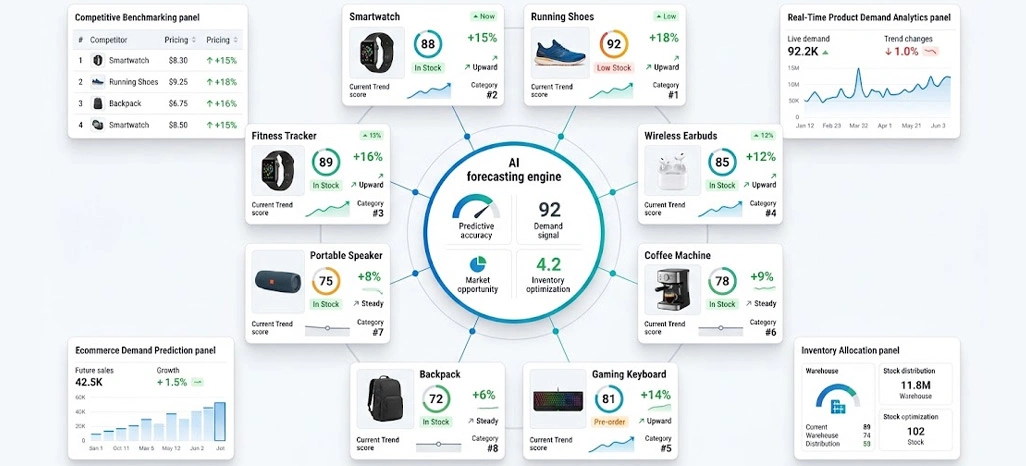
Artificial intelligence processes vast amounts of marketplace information, helping organizations identify emerging opportunities before competitors recognize shifting demand patterns. Implementing Competitive Benchmarking allows retailers to compare product assortment, pricing strategies, promotional performance, and customer engagement across multiple marketplaces.
Simultaneously, Real Time Product Demand Analytics USA continuously monitors evolving customer activity, enabling forecasting models to adapt quickly as purchasing behavior changes. Businesses also improve strategic planning through Ecommerce Demand Prediction, which combines structured ecommerce information with machine learning algorithms to estimate future sales volumes more accurately.
Industry reports suggest organizations using continuous predictive analytics improve forecasting accuracy by up to 90%, reduce inventory waste by nearly 25%, and enhance customer satisfaction through improved product availability. These insights help businesses optimize procurement schedules, allocate inventory efficiently across locations, and identify fast-growing product categories before demand peaks.
| Forecast Variable | Business Value |
|---|---|
| Customer purchasing behavior | Improved forecasting precision |
| Product popularity trends | Better inventory allocation |
| Market comparison analysis | Stronger strategic planning |
| Promotional performance | Optimized campaign timing |
| Demand fluctuations | Reduced operational risk |
As ecommerce markets continue evolving, businesses equipped with AI-powered forecasting systems can confidently make strategic decisions based on real-time market intelligence, resulting in stronger profitability, improved operational performance, and enhanced customer experiences across highly competitive retail environments.
How Retail Scrape Can Help You?
Modern businesses require reliable data pipelines to make informed forecasting decisions in competitive ecommerce markets. By implementing AI Product Demand Prediction With Web Scraping USA, we deliver scalable data collection and AI-powered insights that improve forecasting accuracy, inventory optimization, and pricing strategies.
Our services help businesses through:
- Automated marketplace monitoring
- Accurate inventory trend tracking
- Continuous product availability updates
- Reliable pricing comparison
- AI-ready structured datasets
- Scalable data delivery solutions
In addition to these capabilities, we provide advanced E-Commerce Data Intelligence that helps organizations convert complex datasets into meaningful business insights.
Businesses also benefit from Ecommerce Demand Forecasting With AI, enabling smarter planning, faster decision-making, and long-term operational efficiency across rapidly changing ecommerce environments.
Conclusion
Modern forecasting requires more than historical sales reports. Businesses implementing AI Product Demand Prediction With Web Scraping USA combine artificial intelligence with live ecommerce intelligence to improve inventory planning, anticipate customer demand, reduce operational risks, and make confident business decisions in highly competitive markets.
Organizations adopting Ecommerce Demand Forecasting With AI position themselves for stronger operational efficiency, improved customer satisfaction, and sustainable growth through accurate predictive analytics. Partner with Retail Scrape today to transform market data into intelligent forecasting solutions that help your business make smarter decisions every day.
Effortlessly managing intricacies with customized strategies.
Mitigating risks, navigating regulations, and cultivating trust.
Leveraging expertise from our internationally acclaimed team of developers
Reliable guidance and assistance for your business's advancement